The only time I had visited Nuremberg (Nürnberg) was 2003. But it’s now the 30th of July in 2025, as I arrive from Vienna by train. I check into my hotel, and hurry over to the German National Museum (Germanisches Nationalmuseum) to take advantage of their extended Wednesday hours. Founded in 1852, this is the German-speaking world’s largest museum on Teutonic culture. I’m here to see 2 specific objects in their collection.
Long thought to be the world’s oldest pocket watch by Peter Henlein from the 16th-century, additional research with non-invasive non-destructive scanning technology has shown the central parts likely to be late-19th century, although many parts date to the 16th century. But it sure is pretty and interesting to see in person. Mechanism: worked iron and brass; Case: gold-plated brass.
Terrestrial globe, Nürnberg, 1492-1494 CE: about 50-cm in diameter; designed by Martin Behaim, and painted by Georg Glockendon the Elder. As one of the oldest surviving globes in the world, the Behaim terrestrial globe has since 2023 been inscribed into UNESCO’s Memory of the World program.
For late 15th-century, India and Southeast Asia appear to take shape, with a lot of coastline yet to be mapped.
North and South America are missing, but east Asia seems to hold some promise, especially with Japan (the large island of Cipangu on its own at right). The South Pacific is also missing representations of Australia and New Zealand. I’m reminded by terrestrial globes I’ve seen in Vienna’s Austrian National Library (Prunksaal, Globenmuseum).
Sketch of the Behaim globe (Wiki). Europe and Africa are at far-right, and Cipangu is where Japan is supposed to be.
I made all images above with an iPhone15 on 30 July 2025. This post composed within Jetpack for iOS appears on Fotoeins Fotografie at fotoeins DOT com.
Travel day 54. The beginning of day 48 in Berlin ends with day 1 in Vienna.
I completed 7 weeks in Berlin after having been away for almost 4 years. But this is now my 4th consecutive summer in Vienna, another month in the Austrian capital. I guess the Vienna “Grantigkeit” is something I can recognize and appreciate. I’ll miss the general reach, frequency, and efficiency of Berlin’s U- & S-Bahn, but I’m also a fan of Vienna’s “end of the Alps” foothills and the unmistakable presence of the Danube river.
From one airport’s train station at BER, to the next airport’s train station at VIE.
I arrived at Berlin’s airport on an FEX (Flughafen Express) train from Gesundbrunnen station.
Multiple tracks and platforms at Berlin Brandenburg Airport BER train station.
The airport is named after former German chancellor Willy Brandt. “If I were asked to say what, apart from peace, was most important to me, then my answer would be ‘freedom’.”
BER gates A16 and A17 at left and right, respectively. My flight to Vienna with Austrian Airlines from gate A17 is getting the prep.
Into VIE: Terminal 1 arrivals’ baggage carousel.
How could you, VIE, possibly know I was thinking about going back to Meissl & Schadn? Perhaps this is why.
I’m about to board an ÖBB RailJet train to Vienna’s central station (Hauptbahnhof).
I made all images above with an iPhone15 on 30 June 2025. This post composed within Jetpack for iOS appears on Fotoeins Fotografie at fotoeins DOT com.
So goes this day, number 47 of my stay in Berlin. Most of my day is in Kreuzberg district, but I haven’t returned to the little hill that’s given the district name.
Did I accomplish everything in my to-do list for Berlin? No, the list was an impossible task, but that’s how “life-long projects” should continue. I’m starting to consider whether I should return to Berlin next summer. But those Alps beckon me, too …
According to iOS’ Health app, I walked today almost 21-thousand steps for a distance of just under 15.5 km. My sore feet and joints tell me I need to take more breaks and sit down; I’ll chew on that at the next destination. But that’s tomorrow, and as for today, here’s some of what I saw, what compelled me to make these images.
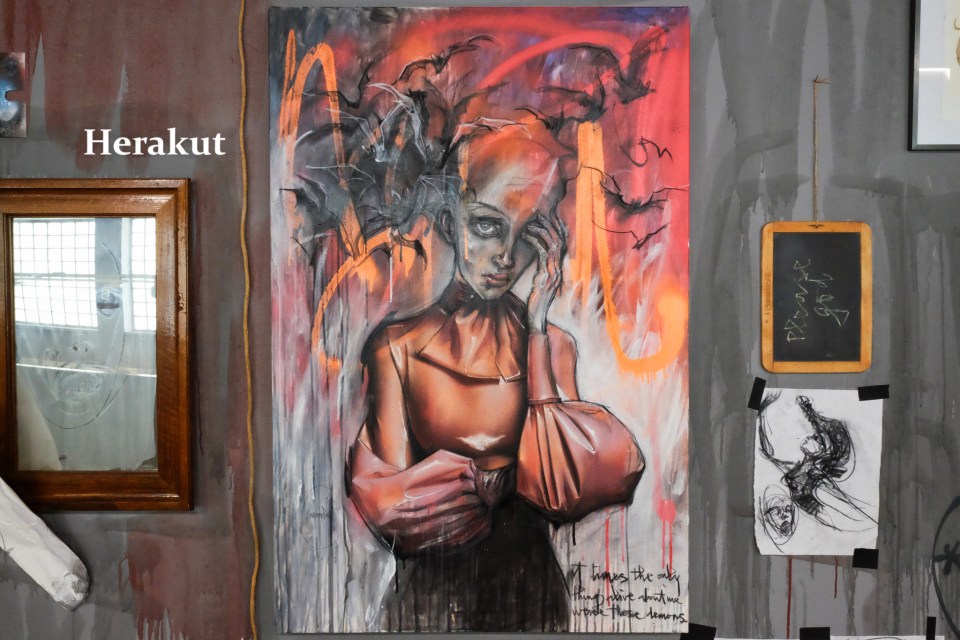
“Less castles, more jungle.” Hera (of Herakut) + Juli Jah + friends for the Green Forest Fund, 2023.
“Neues Deutschland” (new Germany).
“My home might be no palace, but we can share it if you like.” Herakut 2018.
Outside Hallesches Tor, a U-Bahn junction station for lines U1, U3, and U6.
Willy-Brandt-Haus, SPD party headquarters.
Inside Willy-Brandt-Haus.
The sky over Pankow, the city district where I’ve stayed over the last 7 weeks. It’s outside of the (S-Bahn) Ring, but not by much. I got to know the Nord-Süd Bahn, as well as the “East Berlin” segment of the U2 line.
I made all images above with an iPhone15 on 29 June 2025. This post composed within Jetpack for iOS appears on Fotoeins Fotografie at fotoeins DOT com.
On the train southwest from central Berlin to Potsdam, there are many reasons to stop in Wannsee on a bright summer day, including the many nice big (richly decorated) villas in the city district, a memorial to Heinrich Kleist, a small cemetery where Hermann Helmholtz and Emil Fischer are buried, as well as boating clubs and the Strandbad beach next to Wannsee lake.
But I’m here for the lakeside villa purchased by German Impressionist painter Max Liebermann and his wife Martha, and another villa just down the street whose importance lies in total infamy.
Liebermann-Villa
Max Liebermann was an important late 19th-century artist, contributing to the German Impressionism movement of the time. Liebermann had by 1910 a villa constructed by Wannsee lake for their family summer getaway from Berlin. By the 1930s, he like many suffered discrimination and persecution by the National Socialists because of his Jewish heritage. He died in 1935, and in 1940, the National Socialists forced the rest of the family to sell the villa. Since 2006, the refurbished villa reopened as a museum, thanks to the Max Liebermann Society.
Mounted on the fence is a Berlin memorial plaque dedicated to Max Liebermann. The 1909-1910 building was by architect Paul O.A. Baumgarten.
Front of the villa at centre-background, garden shed at left is now the museum’s entrance portal, and the “front garden” is in the foreground.
Renovated upstairs with barrelled ceiling; this used to be Max Liebermann’s work space and now it’s exhibition space.
Facing west to the back, which is now patio seating for the museum’s café. Wannsee lake is behind me.
2025 eastward view of the back garden, towards Wannsee lake. The villa is behind me.
1921 painting by Max Liebermann: “View of the garden at Wannsee, looking east”, oil on canvas.
Haus der Wannsee-Konferenz
On 20 January 1942, 15 high-ranked SS-officers in various aspects of Nazi governance met in another lakeside villa just down the road from the Liebermann summer house. In a lunch meeting lasting about 90 minutes, the 15 decided the fate of millions, organizing pre-existing extrajudicial-killing groups into the logistics and industrialization of mass murder of European Jewish men, women, and children. Since 1992, the renovated building is both memorial and education site, with an active archive and library on the upper floor.
Sign in front of entrance to “Memorial site: House of the Wannsee Conference”.
The villa at Am Großen Wannsee 56-58. Architect Paul O.A. Baumgarten had this villa built in 1915 for businessman Ernst Marlier.
This is the former dining room where the 1942 meeting took place. Today, the memorial site has displays of the meeting, its participants, and a complete display of “The Protocol”, or minutes of the meeting.
Page 1 of “The Protocol” (minutes of the meeting): German at left, English translation at right. Numbers in dark blue correspond to participants. The Moiré pattern is caused by direct imaging of an illuminated display.
Page 2 of “The Protocol” (minutes of the meeting): German at left, English translation at right. Numbers in dark blue correspond to participants. The arrow points to wording with the word/phrase “Endlösung” or “final solution”; the euphemisms fly fast and thick. The Moiré pattern is caused by direct imaging of an illuminated display.
The idyllic view out back onto Wannsee lake.
I made all images above with an iPhone15 on 28 June 2025. This post composed within Jetpack for iOS appears on Fotoeins Fotografie at fotoeins DOT com.
Potsdam’s Sanssouci (“care free”) palace and park are very popular places for visitors in summer. However, a couple of days with severe thunderstorms and high winds in the past week forced the closure of the entire grounds, as announced earlier today on their website and as seen with signs on their locked gates. Downed branches and tree segments needed clearing. By mid-afternoon, some of the grounds opened to foot traffic, bicycles, and motor vehicles. It’s no surprise there were far fewer number of visitors observed on the grounds today.
In 1990, selected gardens and palaces in Potsdam including Sanssouci were inscribed by UNESCO as a single item onto their list of World Heritage Sites.
Locked gate on the grounds’ southern perimeter in morning hours.
Orangerieschloss: 1851 to 1860/1864, by Stüler and Persius.
Neue Kammern: 1748 by Knobelsdorff; first an orangery, then guest palace.
Hauptallee, facing west to Neues Palais.
From Hauptallee up to Sanssouci palace.
Weinbergterrasse (vineyard terrace), facing north to Sanssouci palace.
Weinbergterrasse (vineyard terrace), facing south to the Great Fountain.
On the terrace steps, up to the palace.
The final spots for Friedrich the Great (below) and his beloved dogs (above center).
Grave for Friedrich the Great (1712-1786) who ruled as Prussia’s monarch from 1740 until his death. Yes, those are spuds on the plaque; legend has him responsible as the first to getting potatoes into German hands and bellies.
The visual jewel that is the centre portion of Sanssouci Palace.
I made all images above with an iPhone15 on 27 June 2025. This post composed within Jetpack for iOS appears on Fotoeins Fotografie at fotoeins DOT com.