Fotoeins Fotografie

location bifurcation, place vs. home

Posts tagged ‘Deutschland’

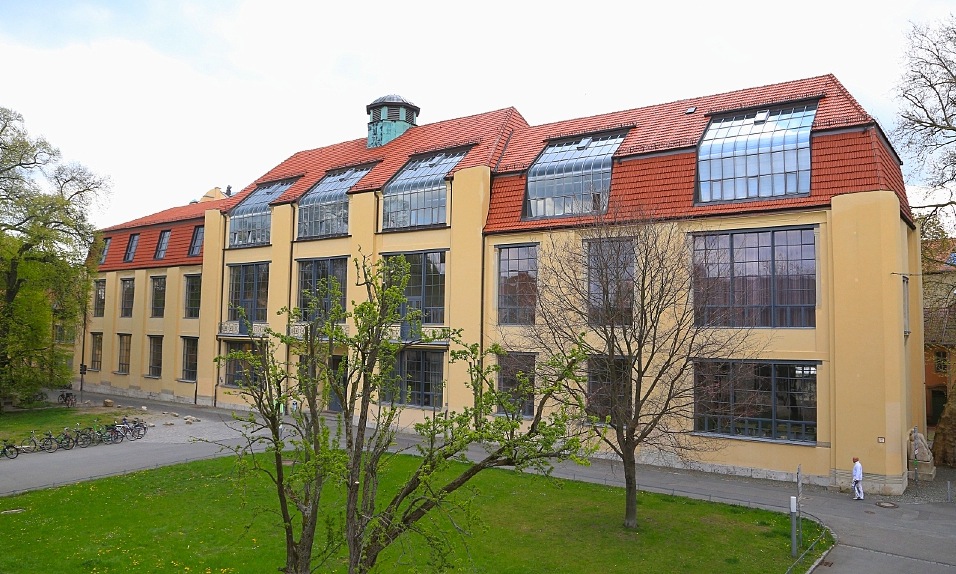
Uni-Hauptgebäude, Bauhaus Universität, Weimar, Thüringen, Germany, UNESCO World Heritage, Weltkulturerbe, fotoeins.com

Weimar Bauhaus Old & New, UNESCO WHS

There’s a clear transition in time where architecture and design took a step from behind closed doors for the sole purview of the rich and royal and out into the open for public and general consumption. It’s no surprise the years from the end of the 19th-century into the 20th-century marked big changes, with Art Nouveau at the time as part of the Secession movement. Throughout Europe, rebellion and revolution were in the air, economically, politically, and culturally.

The Bauhaus movement also helped initiate a conversation, creating and fostering a relationship between industry’s machinery and artistic or cultural creativity. Bauhaus opened in Weimar in 1919, before moving to Dessau and Berlin. The rise of the National Socialists deemed Bauhaus “degenerate” and did all they could to eliminate a movement and her people deemed counter to National Socialist policy. With Bauhaus’ forced closure in 1933 by the Nazis, a number of practitioners escaped Germany to other parts of the world, including the United States and Argentina.

For their deep and wide-ranging influence on 20th-century art, architecture, and design, an incomplete list of names includes Martin Gropius, Lyonel Feininger, Gerhard Marcks, Paul Klee, Wassily Kandinsky, Oskar Schlemmer, Herbert Bayer, Irene Bayer (née Hecht), Karla Grosch, Hannes Meyer, Ludwig Mies van der Rohe, etc. In particular, László Moholy-Nagy would move to Chicago in the United States and established in 1937 the New Bauhaus which became the Institute of Design in 1944.

Tucked away on a university campus a few minutes south of the Weimar city centre, two important building lie across from each other: the Saxony Academy of Art1 building and the Grand Ducal Saxony School of Arts and Crafts (College of Applied Arts)2. The former is now the main building for the present-day Bauhaus University, and the latter now houses Bauhaus University’s Faculty of Design. In 1996, these two buildings formed a part of the UNESCO World Heritage Site (WHS) listing and designation for Bauhaus sites in Weimar and Dessau.

( Click here for images and more )

Haus Meissen, Meissener Porzellan, Staatliche Porzellan-Manufaktur Meissen, Meissen, Sachsen, Saxony, Germany, fotoeins.com

Meissen: centuries of porcelain-making tradition

In a present-age of speed, screens, and instant gratification, there are reasons to hold onto something tangible in your hands, something as simple as a cup, a plate, a bowl; all high-quality products made in the slow time-honoured way developed over centuries as an important local and, now national, cultural tradition.

First time porcelain production began in China going back at least 1000 years BCE with the subsequent centuries yielding hard durable highly-valued products in white, blue-and-white, and green. With European naval powers reaching Asia in the 16th and 17th-centuries, porcelain found new customers and high demand as “white gold” on par with gold and silver. Admiration and envy got many in Europe to thinking: all we need are some chalky deposits, some water, and some big hot ovens, and we’ll be rich … apart from chemistry, the correct firing or curing temperatures, experimentation, and skill. Until the early 18th-century all porcelain came from China, which is how the present-day phrase “(fine) china” arises.

The European debut to porcelain-making began in 1710 in Albrechtsburg castle in Meissen. When the big guy (who pays your wages or is holding you prisoner) says: “go ye therefore and make me some ‘gold'”, one tends to heed those orders. Frequently in need of funds, Augustus the Strong imprisoned and ordered the alchemist Johann Friedrich Böttger to produce “gold”, but with mathematician and physicist Ehrenfried Walther von Tschirnhaus’ guidance, the two gentlemen did the next best thing and produced Europe’s first “white gold.” Porcelain manufacturing moved from the castle to the present location outside of Meissen’s old town in 1863.

We enter the Meissen Couture and its porcelain museum for a look behind the scenes. Why worry about modern techniques like 3-d printing when you’ve got motivated people willing to put in the hours; their hearts, minds, and souls into their craft? The basic creative instinct and personal touch live on in the town of Meissen in Germany’s Saxony.


( Click here for images and more )

My Berlin: Schöneberg

Above/featured: Entrance to U-Bahnhof Rathaus Schöneberg.

It seems as universal as the common opinion about how cool and interesting Berlin is.

Both residents and visitors mention the same names in conversations throughout the city: Prenzlauer Berg, Mitte, Friedrichshain, Kreuzberg, Neukölln, and the hybrid “KreuzKölln”, even as Wedding and Lichtenberg begin weaving their way into the dialogue.

Of the neighbourhoods within the city’s Ring, what about Charlottenburg or Schöneberg? The answers often arrive as expected. Why would anyone visit there or live there? It’s boring! It’s too quiet! It’s dead! Lots of sniffy snobby dismissive exclamation points! That few choose the area is precisely why I’m in Schöneberg for three months at the tail end of my year-long around-the-world.

For many in Berlin, they’re living, working, and playing in areas where they’re close to the action and housing costs may on average be slightly cheaper. There’s something to be said about proximity and small “stumbling distances” after a night of drinking. For some, Schöneberg is too far, too expensive, too quiet, or all of the above. I don’t mind the 20-, 30-, or 45-minute travel times to places where friends eat, drink, or hang out.

It’s always a matter of choice for me to be in Schöneberg. There’s a comfortable stillness here that always sets me at ease, where I can tune out or turn down the noise, and find my calm. For a very special time, this area in Berlin, “der schöne Schöneberg,” is home.

( Click here for images and more )