Fotoeins Fotografie

location bifurcation, place vs. home

Posts tagged ‘deutsche Hauptstadt’

My Berlin: Bornholmer Strasse, first through the Wall

By today’s appearance, it’s easy to overlook the bridge at Bornholmer Strasse (also known as Bösebrücke) as an historic landmark. On the night of 9 November 1989, the Berlin Wall opened here first, at the Bornholmer Strasse bridge border-crossing between East Berlin and West Berlin.


( Click here for images and more )

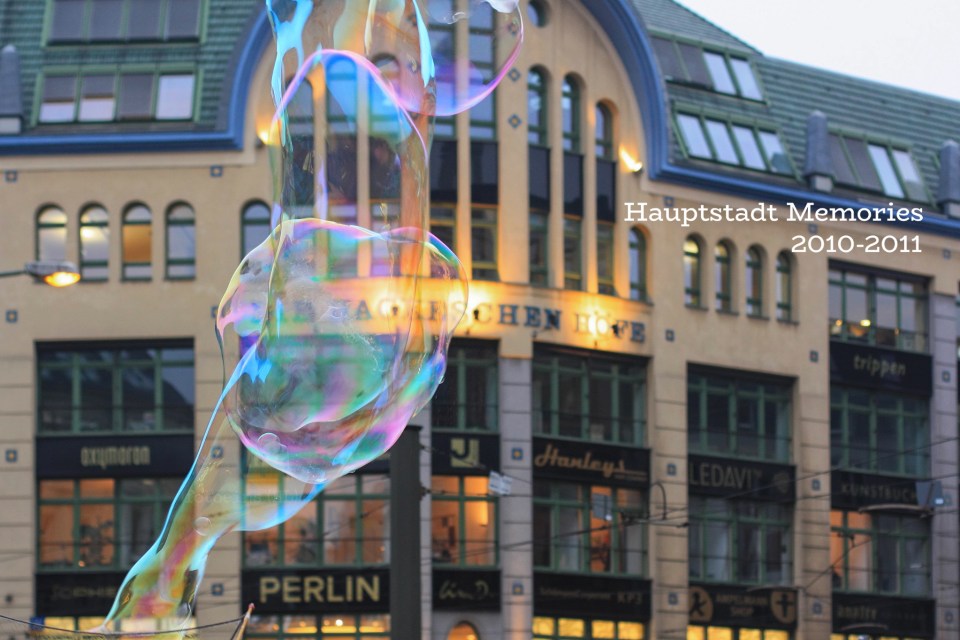
Perlin, Hackesche Höfe, Hackescher Markt, Berlin, Germany, fotoeins.com

My Berlin: Hauptstadt Memories, 2010-2011

Featured: “Pe(a)rlin’ in Berlin”, Hackescher Markt – 16 March 2011 (HL).

Berlin is one of my favourite cities in the world. From the moment I stepped foot inside the German capital city for the first time in 2002, it’s been an ongoing love story. I’m convinced the “Hauptstadt” will always be worth photographing; it’s my “long game.” Naturally, there are a massive number of sights throughout Berlin, and I’ve always combined public transport with plenty of walking. In fact, traveling 10 to 20 kilometres per day throughout the city is pretty much the norm. These photographs are personal observations and measurements of location, geometry, and motion.

The pictures and memories may be from years past, but all of the them retain their contemporary nature: images which include quiet snowy Christmas, an important memorial, and pieces of architectural design.

( Click here for images and more )

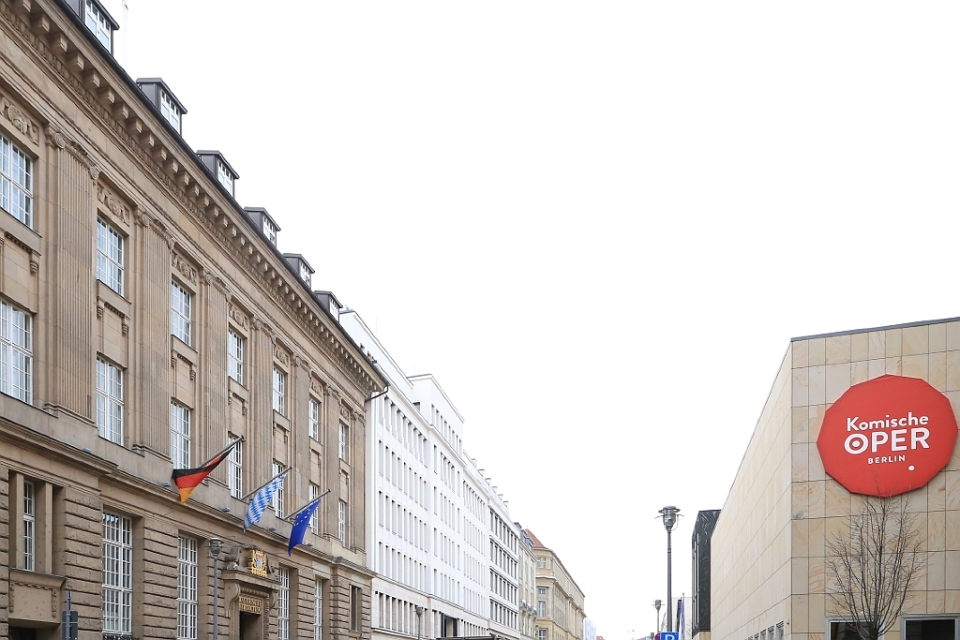
Bayerische Vertretung, Behrenstrasse 21, Euler-Haus, Berlin Mitte, Germany, fotoeins.com

Berlin Mitte ‘Math’: where Euler lived for 23 years

In Berlin Mitte at address Behrenstrasse 21 is the Bayerische Vertretung, whose functions are described as “… die Aussenstelle der Staatskanzlei in der Bundeshauptstadt,” or “branch office of the Bavarian State Chancellery in the German capital.”

Swiss scientist Leonhard Euler spent some 20 years (1743-1766) in Berlin, living in this very building and working at the Académie Royale des Sciences et Belles-Lettres de Prusse (now, Berlin-Brandenburg Academy of Sciences). Euler’s name is very familiar to anyone who’s encountered and studied mathematics and physics. He is well known for his study and work in the fields of physics, astronomy, and engineering. But for his contributions to notation, functional analysis, number theory, and graph theory, Euler is considered one of the greatest mathematicians in history. Euler departed Berlin in 1766, accepting an invitation from Russia’s Catherine the Great to return to St. Petersburg where he remained for the rest of his life.

( Click here for more )

Berlin & 125 successive weekends

The first weekend begins Friday, August 9, 2013, in the German capital city of Berlin.

To the unmistakable sounds of low rumble hustle of traffic and the happy chirps and tweets of birds. That’s strange, because I’m asleep; aren’t I? It’s much better if I’m not, a warm and gentle possibility in the spotlight of my mind.

My eyes struggle to open, brilliant morning light streaming through the open balcony windows and past the billowing room-high drapes. I pad slowly to the source of the light, and part the drapes to see what’s outside. I’m on the 5th-floor apartment of an “Alt Bau” in the city’s Westend. The apartment’s windows face north which means plenty of summer morning light.

I open the bedroom door. She smiles at me, her gaze warm and alive as a summer breeze. “Good morning.”

From that August weekend, I’ve kept a single promise to let her know I’m thinking about her. I’ve sent a text-message every single weekend without fail. Except for one weekend about a year ago when I missed my schedule, and she promptly sent an e-mail asking – no, demanding to know – if things were all right, if I was all right. There’s busy and there’s her kind of busy, and I understand all of it. Her urgent message strikes something solid, commencing the melt for the first time in a very long time.

On December 9, 2015, she asks me to stop.

( Click here to read more )

Berlin Grunewald: no train will ever leave track 17 again

Present in the vicinity of a train station are very distinct and familiar sounds: the racket of heavy locomotives chugging down the rail and the screech of high-friction braking. A breeze sweeps through two columns of trees, creating a low keening sound which escapes into the open space beyond. To stop and listen, the sounds could easily be human: faint shouts and cries. Are they tricks of the mind, or are the dead speaking? The spectre of cruelty, despair, and suffering clings to the abandoned track; seven decades in the past don’t seem very far.

On a cool grey late-autumn afternoon, I’m on an S-Bahn train heading towards Potsdam. Beyond the limits of the “Stadtbahn” and one stop beyond the “Ring” at Westkreuz, the train pulls into the former goods and freight station at Grunewald. Dropping into the underground passage, signage points to the memorial at track 17. I leave the station by the southeast exit, and turn left to ascend the ramp along the side street.

In the Berlin borough of Charlottenburg-Wilmersdorf, Grunewald station lies on the S7 S-Bahn line serving central Berlin city, the city of Potsdam to the southwest, and Ahrensfelde to the northeast in the Berlin borough of Marzahn-Hellersdorf. Grunewald station began operation in 1879 under its original name Hundekehle named after a nature reserve nearby. The station changed its name to “Grunewald” in 1884 when the old Grunewald station began its new life as “Halensee” station. Grunewald station and its tracks were incorporated into Berlin’s S-Bahn train network in 1928.

Many companies including the Deutsche Reichsbahn (German Imperial Rail) were actively complicit in the machinery of mass murder during Nazi rule. After reunification of East and West Germany in 1990, the two separate railways also merged to form Deutsche Bahn in 1994, and calls arose for the new company to acknowledge its dark past. To mark the Reichbahn’s collaboration in deporting people to camps and their deaths, present-day Deutsche Bahn AG established a memorial at track 17. Inaugurated in 1998 the memorial was designed and built by architects Hirsch, Lorch, and Wandel who were very mindful of the 1991 Karol Broniatowski memorial near the station’s entrance.

Along track 17, metal plates have been inserted, one for every transport train which took Berlin’s Jews to their deaths. Each plate includes the transport date, the number of people deported, and the transport’s destination. The first train of record departed Grunewald on 1941 October 18 when 1251 Jews were deported to Łódź. Another plate marks the last train of record (so far) leaving Grunewald on 1945 March 27 when 18 Jews were deported to Theresienstadt; blank plates leave room for additional commemorations with new uncovered information. More than 50-thousand Jews from Berlin were deported from this station alone. The first set of trains went to concentration-camps in eastern Europe, but by the end of 1942, trains were directed to Auschwitz and Theriesenstadt.

The vegetation that’s been left to grow around the track over the years is a visible symbol and an unspoken promise to all: that no train will leave track 17 ever again.

( Click here for images and more )