Fotoeins Fotografie

location bifurcation, place vs. home

Posts tagged ‘deutsche Hauptstadt’

Tempelhofer Feld, Flughafen Tempelhof, THF, Tempelhof, Berlin, Hauptstadt, Germany, Deutschland, fotoeins.com

Previously, in Berlin

Above/featured: Tempelhofer Feld: runway 09R/27L at former THF airport – 16 Oct 2017 (6D1).

I made the cross-country rail journey to Berlin for the first time in 2002 when I lived and worked in Heidelberg. In the years since, I’ve answered the siren’s frequent call by returning to Berlin multiple times. I’ve lost track of the precise count that’s north of 10, but less than 20.

Berlin is Germany’s capital city, but in many respects, the city isn’t very German at all. Berlin is an “internationally German place.” The enigmatic moody metropolis isn’t the prettiest and can be one of isolation, especially in autumn and winter. During a cold gloomy stretch in late-2012, I survived by accessing the diverse array of arts and culture events and venues. What is very familiar is how Berlin’s residents show up outside when sunshine returns.

The following 16 images in chronological sequence show a slow forward progression to a quiet contemplative observation of the city and her residents.

( Click here for images and more )

Siegessäule, Grosse Stern, Tiergarten, Berlin, Germany, fotoeins.com

My Berlin: 30 tracks for the German capital

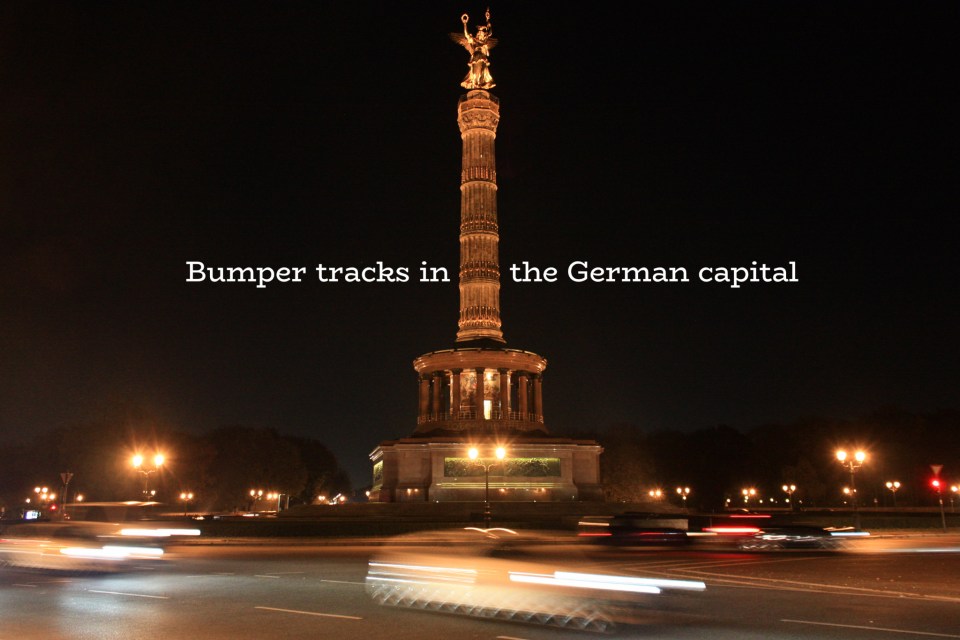
Above/featured: Siegessäule & Grosse Stern, at night – 13 Nov 2012 (HL).

I compiled a list of songs accompanying my travel, a soundtrack that’s full of meaning and memories. This is another set, a listing of tracks I associate with Germany’s capital city. Music is always about personal selection, and every track fires a specific memory of time and place within Berlin. For example, watching “Lola rennt” (Run Lola Run) in a movie theatre in Toronto in the fall of 1998 planted the seeds for a move to Germany three years later. My first visit to Berlin soon after marked the beginning of a deep love affair with the “grand lady of BAER’leen.”


( Click here for more )

My Berlin: that tower again

I like shiny pointy objects, and if it’s by deliberate effort or accidental circumstance, the Fernsehturm (TV Tower) slides into many of my photos from Berlin. And if people throughout Berlin can see the tower, how do those who live in or commute through different parts of the capital city view the landmark? After multiple visits between 2005 and 2021, I’ve accumulated over 45 lines-of-sight to the TV Tower around Berlin.


( Click here for images and more )

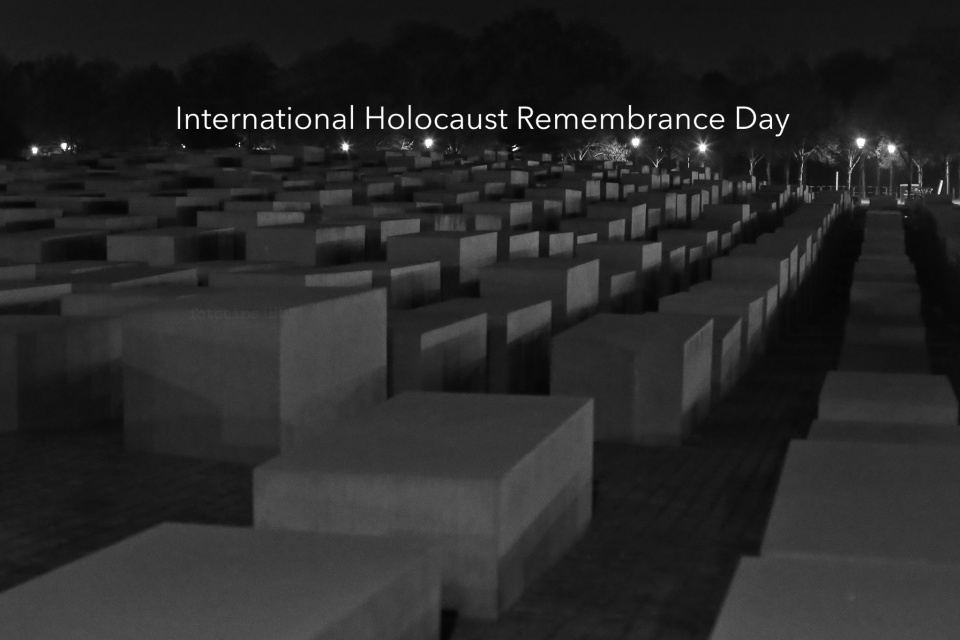
IHolocaustdenkmal, Berlin, Germany, fotoeins.com

International Holocaust Remembrance Day: observations from Germany

Primo Levi, Italian-Jewish author, chemist, and Auschwitz survivor, delivered a set of essays about life and survival in Nazi extermination camps in his 1986 book “The Drowned and the Saved”. Levi wrote:

… For us to speak with the young becomes even more difficult. We see it as a duty and, at the same time, as a risk: the risk of appearing anachronistic, of not being listened to. We must be listened to: above and beyond our personal experiences, we have collectively witnessed a fundamental, unexpected event, fundamental precisely because unexpected, not foreseen by anyone. It took place in the teeth of all forecasts; it happened in Europe; incredibly, it happened that an entire civilized people, just issued from the fervid cultural flowering of Weimar, followed a buffoon whose figure today inspires laughter, and yet Adolf Hitler was obeyed and his praises were sung right up to the catastrophe. It happened, therefore it can happen again: this is the core of what we have to say.

On 27 January 1945, Soviet Red Army troops liberated the Nazi concentration and extermination camp at Auschwitz-Birkenau in south-central Poland. Over 1 million men, women, and children were murdered.

The United Nations declared January 27 as International Holocaust Remembrance Day; the designation came during the 42nd plenary session of the United Stations when resolution 60/7 was passed on 1 November 2005.

Accepting and openly stating responsibility are critical first steps, but spending time, money, and effort to ensure the simple motto of “never again” is also an ongoing reality that isn’t solely up to the citizens of Germany. It’s a collective responsibility that we all should have to remain vigilant; that we all have to recognize and bolster actions which encourage and strengthen the universality of human rights, and reject the erosion and withdrawal of those rights.

I believe responsible tourism also includes paying appropriate respect at a memorial, especially the Holocaust Memorial in Berlin. It’s my view this important memorial is not (supposed to be) a playground.

And yet, there’s something to be said about what it means to have freedom in the early 21st-century, allowing people to laugh and frolic in the public space, an undulating sculpture of featureless massive grey cement blocks, a testimonial to the systematic murder of millions of people.

Naturally, you have the freedom to play here, take selfies, and have a grand time. But it doesn’t mean I’m gonna laugh with you; for example: Yolocaust art project (DW 2017).


( Click here for more )

Mengenlehreuhr, set theory clock, Berliner Uhr, Berlin Clock, Sixt, Europa-Center, Budapester Strasse, Charlottenburg, Berlin, Hauptstadt, Germany, fotoeins.com

My Berlin: An Unusual (Set Theory) Clock

I had read about this unusual clock years ago; the unusual mathematics connection was an additional “plus”.

I leave the crowds at Gedächtniskirche and Breitscheidplatz and head on over to the SixT car rental outlet on Budapester Strasse. What’s standing in front is most certainly a curiosity, even as passers-by look at me curiously.

The Berlin Clock is known in German as “Berliner Uhr”. The alternate name is “set theory clock” or “Mengenlehreuhr”, a German compound word consisting of “Menge” for quantities (sets), “Lehre” for theory, and “Uhr” for clock. The Guinness Book of Records claimed “the Berlin Clock was the first clock in the world operating according to the principles of set theory1“.

Created by inventor Dieter Binninger, the clock first stood at the corner of Kurfürstendamm and Uhlandstrasse in West Berlin from 1975 to 1995. Local business arrangements were made with Binninger’s widow for a long-term loan including maintenance costs, and the clock was moved in 1996 to its present location at the Europa-Center.

Here is how one reads the Berlin Clock:

  • Top circle: light flashes every 2 seconds; ‘on’ 1-second, ‘off’ 1-second
  • 1st row: hour of day in 5-hour increments, up to 20
  • 2nd row: hour of day in 1-hour increments, up to 4
  • 3rd row: minutes in 5-minute increments, up to 55
  • 4th row: minutes in 1-minute increments, up to 4

Time shown in the above featured image is 1310 hours or 110pm, which breaks down as (2 x 5) + (3 x 1) hours and (2 x 5) + (0 x 1) minutes.

( Click here for more )