Fotoeins Fotografie

location bifurcation, place vs. home

Posts tagged ‘Bavaria’

Fotoeins Friday: Bayreuth Opera House, 🇩🇪 UNESCO WHS

Bayreuth, Germany: inside the main hall of the Margravial Opera House (Markgräfliches Opernhaus) during guided tour. The building was inscribed as UNESCO World Heritage Site in 2012.

I made the image above on 9 Jun 2024 with a Fujifilm X70 fixed-lens prime and the following settings: 1/30-sec, f/2.8, ISO6400, and 18.5mm focal length (28mm full-frame equivalent). This post appears on Fotoeins Fotografie at fotoeins DOT com as https://wp.me/p1BIdT-wBK.

Nuremberg: The Landmark Trials in Room 600, 80 years on

Above: In front of the Justizpalast (Palace of Justice) at the corner of Benjamin-Ferencz-Platz and Fürther Strasse in Nuremberg, Germany.

On 20 November 1945, an extraordinary trial got under way in the German city of Nuremberg, only six months after the Nazis surrendered to the Allied nations in World War 2. For the first time in modern history, an assembled tribunal of international judges presided over trials against top leaders of a nation for crimes against peace, war crimes, crimes against humanity, and conspiracy to carry out these crimes.

What is called the “Nuremberg Trials” refers primarily to the “Major War Criminals Trial” where over 20 leaders in German Nazi high command were put on trial before the International Military Tribunal (IMT) from November 1945 to October 1946. The IMT consisted of judges from each of the four Allied nations: Great Britain, France, United States, and the U.S.S.R. Subsequently from late-1946 to 1949, 12 additional trials were held before American military tribunals to uncover and highlight the extent and depth to which additional leaders in German society supported the Nazi dictatorship.

“… The privilege of opening the first trial in history for crimes against the peace of the world imposes a grave responsibility. The wrongs which we seek to condemn and punish have been so calculated, so malignant and so devastating, that civilization cannot tolerate their being ignored because it cannot survive their being repeated. That four great nations, flushed with victory and stung with injury stay the hand of vengeance and voluntarily submit their captive enemies to the judgment of the law is one of the most significant tributes that power has ever paid to reason.”

– Opening statement by Robert H. Jackson, U.S. chief prosecutor, on the second day of the Nuremberg Trials (Major War Criminals Trial), 21 November 1945; see Sources below.


( Click here for images and more )

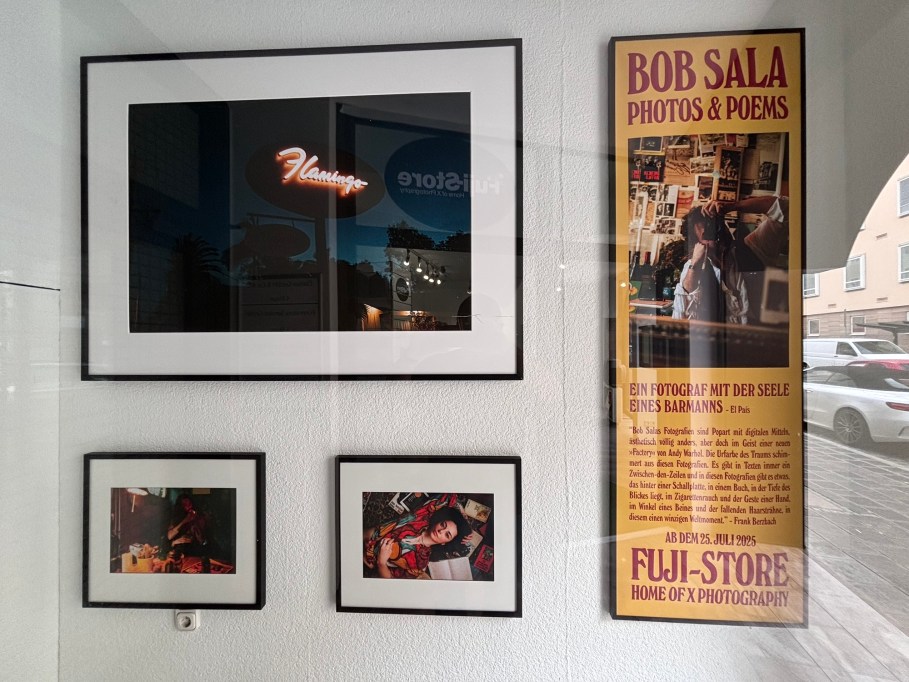
Nuremberg: Fuji(film)-Store

“Home of X Photography”

It’s a busy active crowded Saturday in Nuremberg’s city centre. There’s a big music festival with acts ranging in size from solo artists to 3-piece bands. But as I walk across town, I see a big Fujifilm sign, and as I approach, I can see this is no ordinary camera shop.

I learn there’s been a Fuji shop in the city for a number of years, and only this past February did they move to this new location. Judging by layout and the upstairs gallery, the Fuji shop has a feel similar to aLeica shop. That’s because the owner of Nuremberg’s Fuji-Store created the shop based on their experience operating the city’s Leica shop nearby. I chat with Peter, the gentleman in the shop about what’s out now and what else might be expected. We agree to a common wish: to have Fuji fill a current niche with a compact portable point-and-shoot at the right price point. How about an X80 product variant?

I’ve done my fair share of drooling (but no buying) at Leica shops in Frankfurt and Vienna, and I enjoyed doing the same to available X-models on display at Nuremberg’s Fuji-Store. Did I buy? No. Am I thinking about life after the X70? Yes.

I can also see Fuji X Weekly having some fun here in the shop.
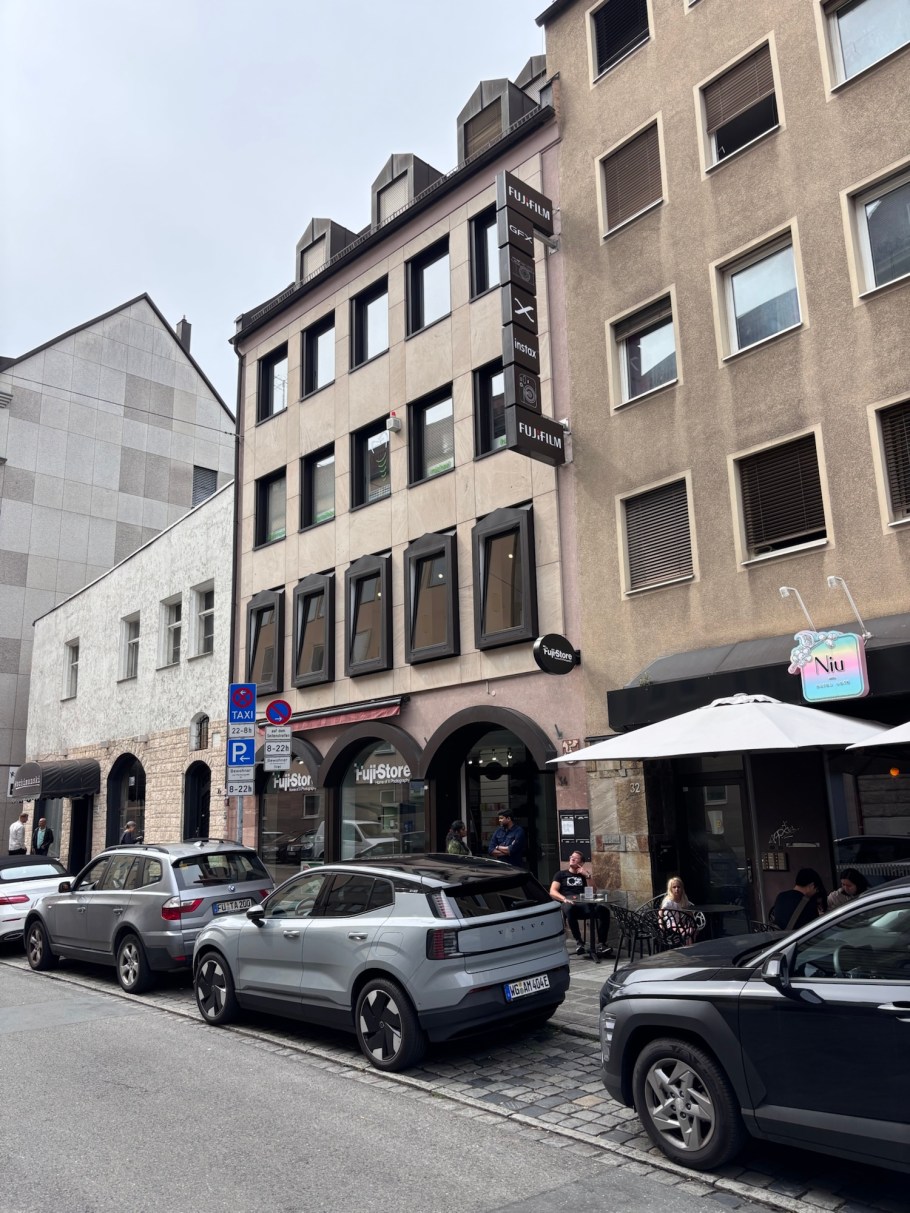


I received neither support nor compensation for this piece. I made all images above with an iPhone15 on 2 August 2025. This post composed within Jetpack for iOS appears on Fotoeins Fotografie at fotoeins DOT com.

25T87 Nuremberg: Kaiserburg (Imperial Castle)

E86, N04.

At the north end of Nuremberg’s Old Town is the Imperial Castle on top of a sandstone mount. An initial structure goes back to the 12th-century CE, but much of the castle appeared in the 15th-century. As an independent Imperial city, Nuremberg had been a safe place to store the jewels of the Holy Roman Empire jewels; these are now in the Hofburg Schatzkammer (Treasury Vault) in Vienna. In ruins after the Second World War, the post-war era saw a rebuild of town and castle, and the 21st-century version of the Kaiserburg is a snapshot of not only about grandeur, but also the importance Nuremberg held in the Empire.


A tunnel into the Old Town.
Tiergärtnertor (zoo gate).
Albrecht Dürer House, a half-timbered building where the famous artist lived and worked from 1509 until his death in 1528.
“The Hare: An Homage to Dürer”, 1984 artwork by artist Jürgen Goertz; a modern interpretation of Albrecht Dürer’s 1502 painting “Die Hase” (The Hare).
The path up called Burg.
Passage to Heidenturm (Heathen’s Tower).
Left: Tiefer Brunnen; right: Sinwellturm.
A view of the city from Freiung.
The tower called Sinwellturm.
Kaiserstallung constructed as the city’s Imperial Granary by Hans Beheim in 1495; also subsequently used as imperial stables.
One last look from below at Am Ölberg.

I made all images above with an iPhone15 on 2 August 2025. This post composed within Jetpack for iOS appears on Fotoeins Fotografie at fotoeins DOT com.

25T85 The Nuremberg Trials: Courtroom 600

E84, N02.

There’s a courtroom I’ve wanted to visit for a very long time. On return to Nuremberg after 22 years, I’m taking full advantage of the opportunity.

After the conclusion of World War 2, the four Allied powers agreed to put key Nazi perpetrators on trial which began in November 1945 and ended in October 1946. The Nuremberg Trials became the first international war crimes tribunal in history.

The famous venue, Schwurgerichtssaal 600 (Courtroom 600), remained an active courtroom at Nuremberg’s Palace of Justice until 2020. The courtroom is now a part of the museum Memorium Nuremberg Trials housed in the same building.

On 21 November 1945, Robert H. Jackson, the chief United States prosecutor at the Nuremberg Trials, gave his opening statement, which remains as one of the most influential speeches about the emergent principles and applications of international criminal law in the post-war era. His statement began with:

The privilege of opening the first trial in history for crimes against the peace of the world imposes a grave responsibility. The wrongs, which we seek to condemn and punish, have been so calculated, so malignant, and so devastating, that civilization cannot tolerate their being ignored, because it cannot survive their being repeated. That four great nations, flushed with victory and stung with injury stay the hand of vengeance and voluntarily submit their captive enemies to the judgment of the law is one of the most significant tributes that power has ever paid to reason.

• US National WW Museum: 2020 article.

• Robert H Jackson Center: YouTube.


I received neither support nor compensation for the present piece. I made all images above with an iPhone15 on 31 July 2025. This post composed within Jetpack for iOS appears on Fotoeins Fotografie at fotoeins DOT com.