Fotoeins Fotografie

location bifurcation, place vs. home

Posts tagged ‘Bauhaus’

Before Bauhaus: Alfeld Fagus Factory, UNESCO WHS

Before Bauhaus found its first footing in Weimar, there was in the town of Alfeld in central Germany the Fagus-Werk factory building.

The Fagus factory building is looked upon as the first building in the world for the modern architectural age, and is the predecessor to the elegant 1926 Bauhaus headquarters building in Dessau. Fagus company founder Karl Benscheidt commissioned architect and future Bauhaus founder, Walter Gropius, to create and build a shoe-making factory as an artistic project. Gropius and his collaborator Adolf Meyer stuck with working floor-plans by architect Eduard Werner, and set their sights on new exterior and interior designs. Completed in 1911, the factory’s office building set a new standard for 20th-century industrial architecture with steel and glass construction and tall unsupported windows at the corners of the building.

“Fagus” is Latin for “beech tree”, and shoemaking began with shoe lasts or moulds constructed from beech wood, which were sold and distributed around the world to other companies for the productions of shoes. In the 1920s, Benscheidt developed the turning precision-lathe speeding up production, prompting growth and expansion and elevating the company to world’s top producer of shoe lasts. Today, the building is still a working factory: Fagus creates plastic lasts milled by automated machinery to precise specifications for specific designs by shoe companies. Also on-site is GreCon which produces systems for fire-detection and fire-extinguishing in industrial settings. The Fagus factory building was recognized as “unique living monument” and inscribed by UNESCO as World Heritage Site (Welterbe) in 2011.

With a population of over 20-thousand people, Alfeld is located in the German federal state of Lower Saxony. The town’s reach by train is 30-minutes from Hannover or 40-minutes from Göttingen, after which is a short 5- to 10-minute walk from Alfeld(Leine)1 train station to the entrance of the Fagus/GreCon complex. Visitors can walk around the working factory site, stop at the World Heritage Site Visitor Centre, sit in the neighbouring café for coffee or tea, and visit the museum dedicated to the building’s origins, the building’s century-long history of shoe-making, and a general history of footwear.

Walter Gropius and others would move to Weimar to establish a centre of art, design, thought, and attitude for Bauhaus in 1919, eight years after inauguration of the Fagus-Werk.

Die Baukunst soll ein Spiegel des Lebens und der Zeit sein.
(Architecture should be a mirror to life and its time.)

– Walter Gropius.

( Click here for images and more )

Dessau: The Bauhaus Building, UNESCO WHS

21st-century Modernity, from 1919 on

The chair or couch on which you sit.
The table on which you’re resting your mobile or pad.
The desk on which your laptop or desktop resides.
The light fixture on your desk or above your head.
The windows in your room, your house, or in the café where you’re reading this.

The “universal” idea of living in a house or apartment with the furnishings we all take for granted from bathroom to bedroom and kitchen to living room is a relatively young idea by historical standards. It’s easy to imagine a time where only the rich upper-class could afford and were allowed to have and live in heated furnished residences, and the poor lower-class lived in unheated homes under damp dirty squalid conditions. Past designs with its heavy stone, porcelain, and ornate decorative components gave way to steel, glass, lightness of space, to favouring function over form. Simpler designs were meant to provide universal access: to the home, and to the essentials which furnished the home.

( Click here for images and more )

Wittenberger Marktplatz, Rathaus, Lutherdenkmal, Stadtkirche Sankt Marien, Marktplatz, Lutherstadt Wittenberg, Sachsen-Anhalt, Wittenberg, Saxony-Anhalt, Germany, Deutschland, UNESCO, World Heritage Site, Welterbe, Weltkulturerbe, fotoeins.com

The Saxony-Anhalt 5: Luther & Bauhaus

(October 2016.)

As motivation to trace Martin Luther’s footsteps for the 500th anniversary of the Reformation in 2017 and to learn more about the impact of the Bauhaus art and design movement for the centenary in 2019, I embarked on a press-trip in the autumn 2016 to the German federal state of Saxony-Anhalt.

(( The description of this trip would be a continuation of a consecutive annual streak going back to 2001. I’ve set foot inside Germany at least once every year since 2001. I’d already claimed another consecutive year with a short stint at “home” in the HD earlier in the spring, but autumn in-country* solidly confirmed a 16th consecutive year in the country. ))


( Click here for more )

Uni-Hauptgebäude, Bauhaus Universität, Weimar, Thüringen, Germany, UNESCO World Heritage, Weltkulturerbe, fotoeins.com

Weimar Bauhaus Old & New, UNESCO WHS

There’s a clear transition in time where architecture and design took a step from behind closed doors for the sole purview of the rich and royal and out into the open for public and general consumption. It’s no surprise the years from the end of the 19th-century into the 20th-century marked big changes, with Art Nouveau at the time as part of the Secession movement. Throughout Europe, rebellion and revolution were in the air, economically, politically, and culturally.

The Bauhaus movement also helped initiate a conversation, creating and fostering a relationship between industry’s machinery and artistic or cultural creativity. Bauhaus opened in Weimar in 1919, before moving to Dessau and Berlin. The rise of the National Socialists deemed Bauhaus “degenerate” and did all they could to eliminate a movement and her people deemed counter to National Socialist policy. With Bauhaus’ forced closure in 1933 by the Nazis, a number of practitioners escaped Germany to other parts of the world, including the United States and Argentina.

For their deep and wide-ranging influence on 20th-century art, architecture, and design, an incomplete list of names includes Martin Gropius, Lyonel Feininger, Gerhard Marcks, Paul Klee, Wassily Kandinsky, Oskar Schlemmer, Herbert Bayer, Irene Bayer (née Hecht), Karla Grosch, Hannes Meyer, Ludwig Mies van der Rohe, etc. In particular, László Moholy-Nagy would move to Chicago in the United States and established in 1937 the New Bauhaus which became the Institute of Design in 1944.

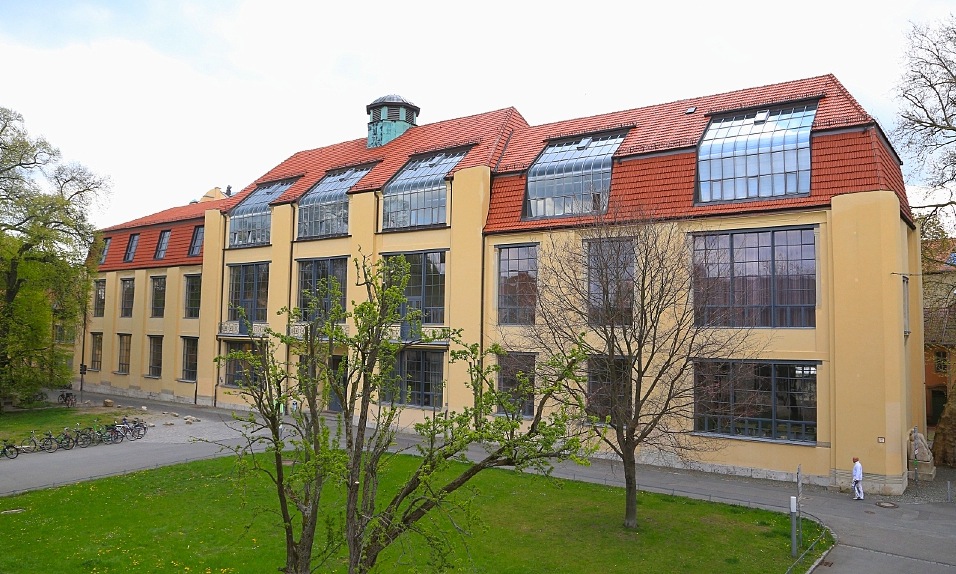
Tucked away on a university campus a few minutes south of the Weimar city centre, two important building lie across from each other: the Saxony Academy of Art1 building and the Grand Ducal Saxony School of Arts and Crafts (College of Applied Arts)2. The former is now the main building for the present-day Bauhaus University, and the latter now houses Bauhaus University’s Faculty of Design. In 1996, these two buildings formed a part of the UNESCO World Heritage Site (WHS) listing and designation for Bauhaus sites in Weimar and Dessau.


( Click here for images and more )