Fotoeins Fotografie

location bifurcation, place vs. home

Posts tagged ‘Alps’

Hafelekar, Nordkette, Nordkette cable car, Nordkettenbahn, Hungerburg funicular, Hungerburgbahn, Innsbruck, Tirol, Tyrol, Oesterreich, Austria, fotoeins.com

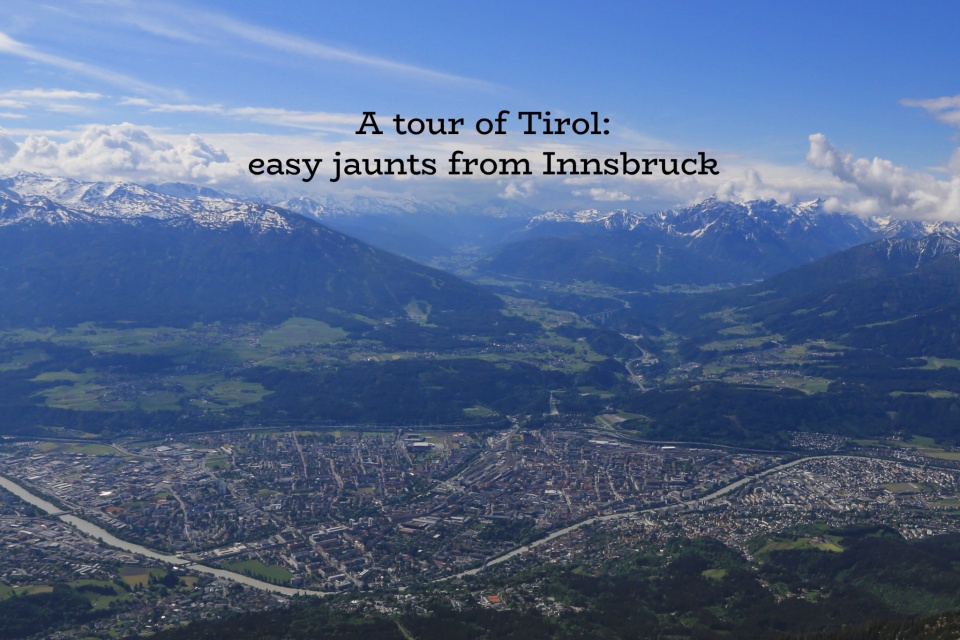
My Tirol: day trips from Innsbruck

As one of nine states within the federal republic of Austria, Tirol is well known not only for all-season access to the Alps, but also for a variety of other attractions.

With transport authorities IVB Innsbruck, VVT Tirol, and ÖBB Austria, Tirol state capital Innsbruck was the base from which I travelled to Alpbach (half-day), Brenner (half-day), Hall in Tirol (half-day), Nordkette (half-day), Scharnitz (half-day), Stubaital (half-day), and Wilder Kaiser (full day).


( Click here for more )

Zugspitze: spotting the Alps across 5 nations

“If I’m at the highest point in Germany, can I see Italy?”

Over the years, I’ve seen at various times the claim made about seeing Italy from the tallest mountain in Germany.

I’m startled by the winter morning sun, streaming through the window into my hotel room in Garmisch-Partenkirchen. I rise slowly from the bed, barely able to keep my eyes open. I shuffle across the room, and pull the small linen drapes aside. It’s blue everywhere, and there isn’t a cloud in the sky. My eyes are now wide open, heart pumping with excitement, because I know skies are gonna be clear up top. Later I learn forecast conditions for the Zugspitze summit are excellent: mostly sunny, visibility out to 160 kilometres (100 miles) with a high temperature of -8C/+18F. Cold, but very doable. It’s also why I have with me 70-300 glass for the long zooms.

Below I show photographs with sightlines and their corresponding average azimuths*: east-southeast (107 degrees), southeast (138 degrees), south (175 degrees), southwest (210 degrees), west-southwest (250 degrees). I label specific mountain peaks of interest in addition to the flag of the country where the mountain is located. In a few cases, mountains lie along the border between two nations in which case I provide two country flags. For the labeled peaks, I’ve also provided further information about mountain heights and sightline distances in the map below.

Spoiler alert: not only am I able to spot mountains in Italy, but also other peaks in Austria, Switzerland, and Liechtenstein.

* Azimuths are measured with north at 0 degrees, east at 90, south at 180, and west at 270 degrees.


( Click here for images and more )

Oberstdorf, Oberbayern, Upper Bavaria, Bavaria, Allgaeu Alps, Alps, Germany, fotoeins.com

Oberstdorf: Sunday Allgäu night auf Deutsch

Why multiple languages rock my world

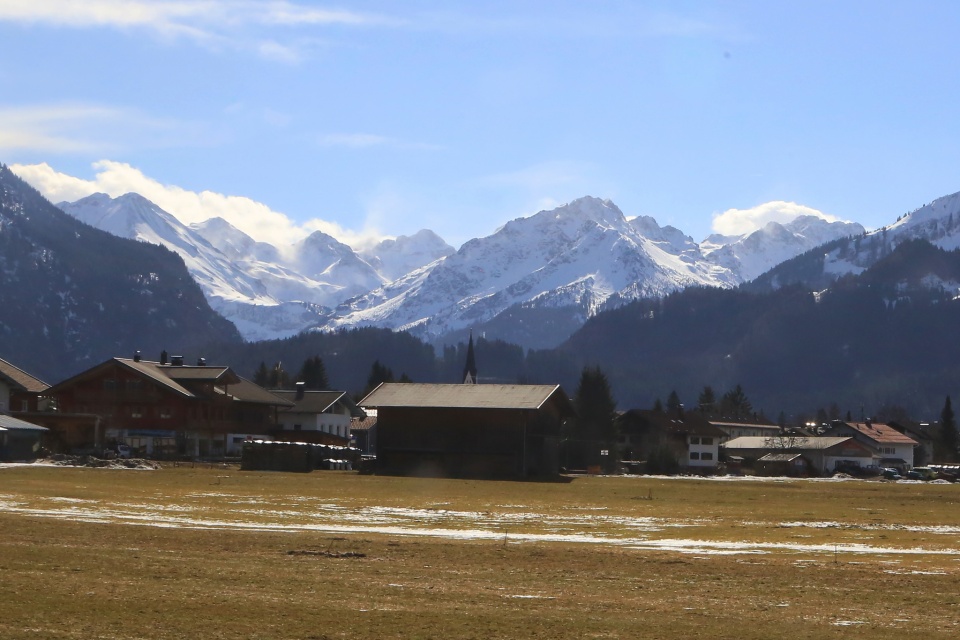
With fewer than ten-thousand inhabitants, Oberstdorf in southern Bavaria is as its German name suggests: an “upper village” tucked in the Allgäu Alps near the German-Austrian border. Yet, the town feels busy and full with skiers, snowboarders, and winter hikers.

It’s Sunday night and I’m on the hunt for “schnitzel and spätzle.” With my eye already on a place, I arrive at 630pm to a full house. I don’t have a reservation (which is dumb in a small town), but a table of four is available (which is fortunate). The server offers me the table, with the condition I’ll be sharing the table if two people want places. “Alles klar,” I reply.

I order a standard half-litre Weizen beer, along with the required schnitzel-and-spätzle platter. An elderly couple is offered two places at my table; they take one glance in my direction, and they’re gone. The server wears a puzzled look, and I can only shrug. A second couple arrives ten minutes later, and as they approach my table with curiosity, I tell them “die Plätze sind noch frei” (the places are available). They express their thanks, and take their seats across from me. Those last five German words set a positive tone for the rest of the evening.

( Click here for more )

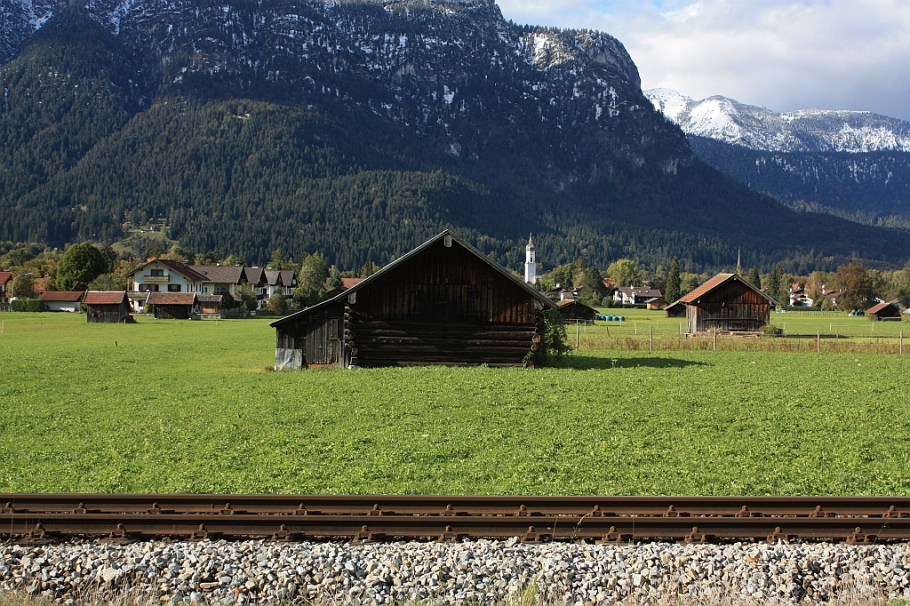
Loisach valley, east to Garmisch-Partenkirchen, Bayerische Zugspitzbahn, fotoeins.com

Oberbayern Hausberg: bovines and alpine meadows (2011)

It’s a bright autumn afternoon in Oberbayern (Upper Bavaria), and the cogwheel railway is on the descent from Zugspitze, returning to the valley base in Garmisch-Partenkirchen. The train slows on approach to station “Garmisch-Partenkirchen Hausberg”, only two-kilometres southwest from the twin towns.
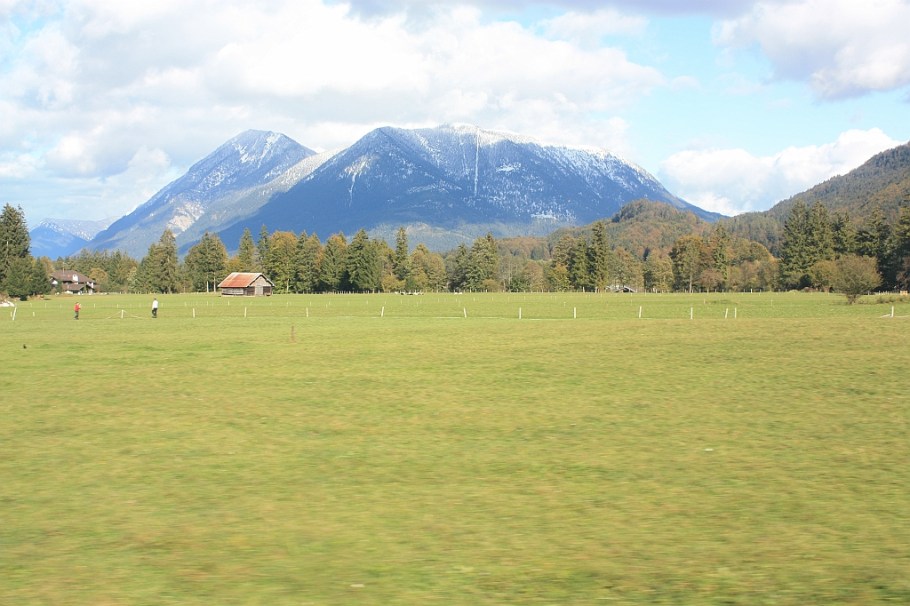
Loisach valley, east to Garmisch-Partenkirchen, Bayerische Zugspitzbahn, fotoeins.com

Loisach valley, east to Garmisch-Partenkirchen

Train station, Garmisch-Partenkirchen Hausberg, fotoeins.com

Train stop “Hausberg”

Stepping out at Hausberg

Doors to the stuffy train compartment open out to the breeze riding down the Loisach river valley. Deep breaths expand and fill my lungs with the slightest hints of hay, fresh cut grass, cow dung, and woodsmoke. Brightly illuminated pastures beckon me forward, one foot in front of the other. Blank looks from the “bayerische Kühe” sprawled out on the grass suggest a possible course of action. Except for the part about the blank faces …

I’ve already seen a number of people in the valley as the train weaved its way down from the summit. Couples are out on their walks. Their slow gait is not representative of age or condition; their easy stroll reflects many years of familiarity with the area.

With a smile, I’ll greet passersby with “Grüss Gott”. I’m in small conversation, proceeding typically in one-way flow: “where are you from?”, “how did you learn German?”, “how long are you here?”, and “do you like the area?” My final answer often surprises them most: “ich würde hier lange bleiben, wenn ich könnte.” (I’d stay here longer, if I could.)

Within an illuminated river valley surrounded by “little” Alps, idyll has another name: Hausberg belongs right here in the now.

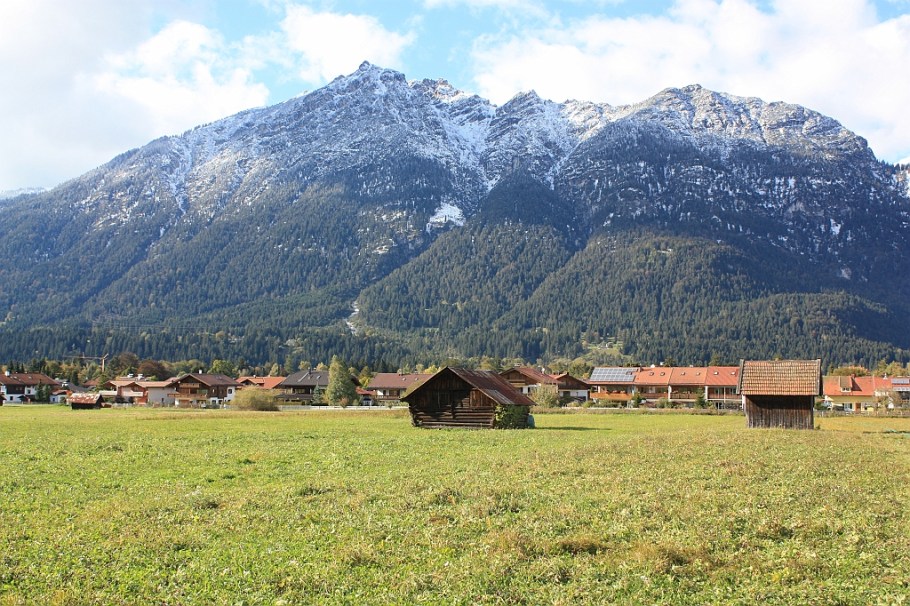
Loisach valley, near Garmisch-Partenkirchen Hausberg, fotoeins.com
Loisach valley at Hausberg, fotoeins.com

Loisach valley, at Hausberg, near Garmisch-Partenkirchen

Ausserfernbahn DB train, to Reutte in Tirol, fotoeins.com

Deutsche Bahn “Ausserfernbahn” train, to Austria’s Reutte in Tirol
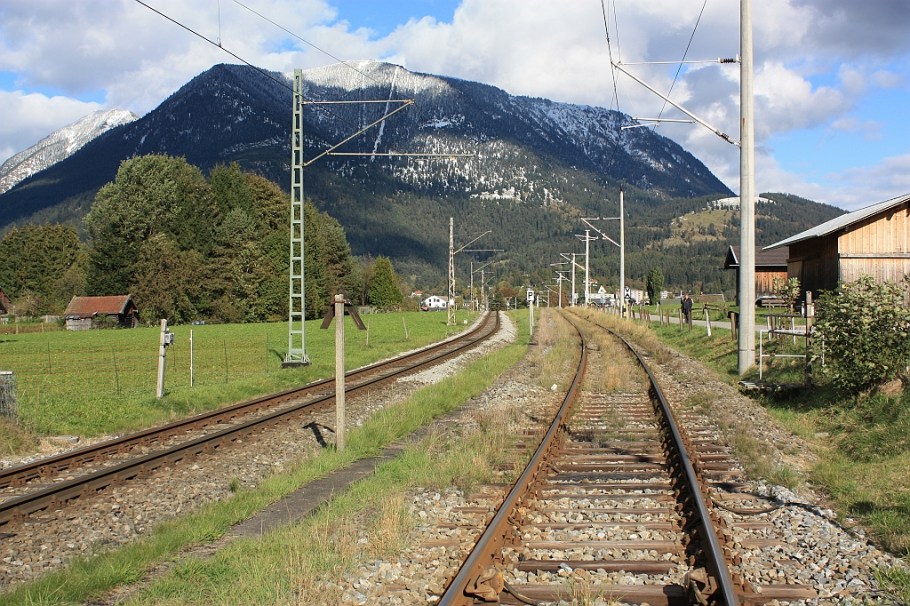
Tracks shared by Bayerische Zugspitzbahn and Ausserfernbahn, Hausberg, fotoeins.com

Tracks shared by Bayerische Zugspitzbahn and Deutsche Bahn

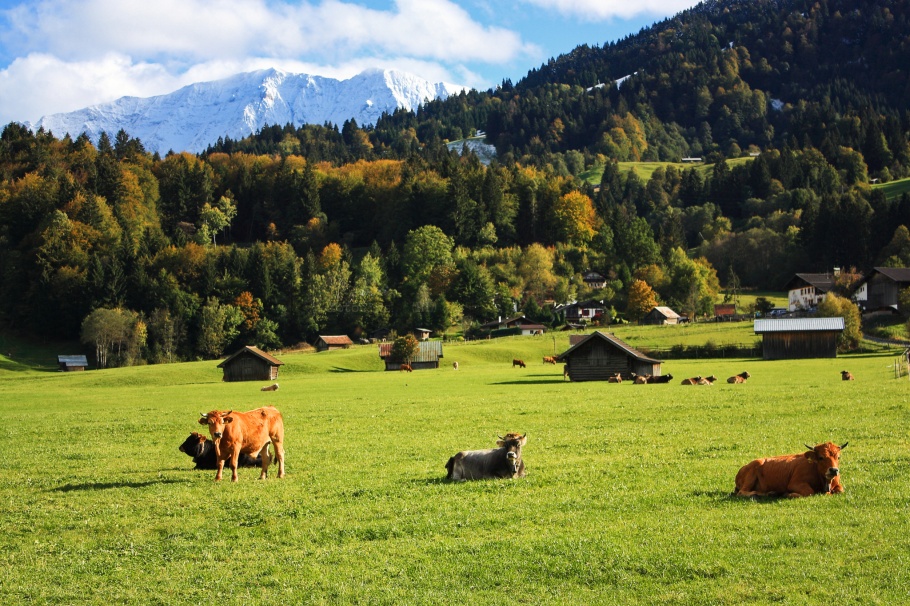
Bovine residents at Hausberg, fotoeins.com

Bovines, meadows, Alps, Hausberg, Garmisch-Partenkirchen, Oberbayern, Upper Bavaria, Bavaria, Bayern, Germany, Deutschland,  fotoeins.com

Simple things in Upper Bavaria: bovines, meadows, Alps.

Reaching Hausberg

Visitors staying in Garmisch-Partenkirchen can easily walk the short distance from either of the twin towns. The flat stretch of Loisach river valley is easily walkable on the paved pedestrian path from Garmisch-Partenkirchen on the way to Grainau, Eibsee lake, and beyond. Alternatively, hop on the regional “Ausserfernbahn” train from Garmisch-Partenkirchen to Reutte (in Tirol) and request to disembark at Hausberg. Another alternative is to hop on the Bayerische Zugspitzbahn cog railway on its ascent or on the way down from the Zugspitze summit.

I made all of the photos above on 9 October 2011. This post appears on Fotoeins Fotopress at fotoeins.com as http://wp.me/p1BIdT-5A1.

Garmisch-Partenkirchen, Oberbayern, Bavaria, Germany, fotoeins.com

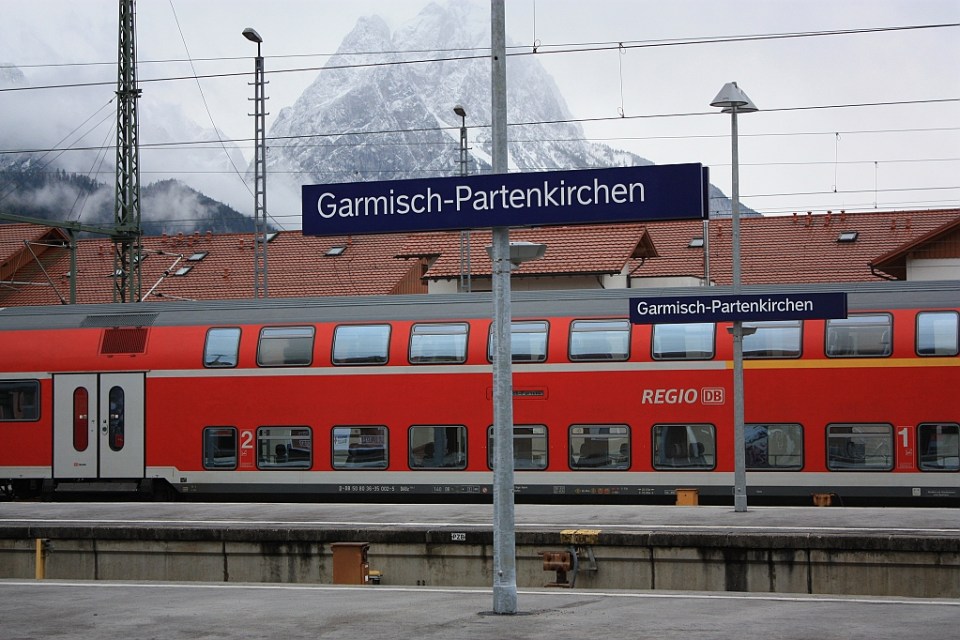
The twin towns of Garmisch-Partenkirchen (fall 2011)

(Mostly overcast conditions in autumn, October 2011.)

They are six syllables, almost a mouthful, but the two words also represent hiking, climbing, trekking, skiing, Olympic history, and Alpine grandeur.

Garmisch-Partenkirchen is located about 90 kilometres (55 miles) southwest from München, and can be reached in about 90 minutes with Deutsche Bahn regional-trains. With the town’s close proximity to the Austrian border, additional trains direct passengers onwards to the Austrian towns of Reutte and Innsbruck.

In preparation for the 1936 Winter Olympics, the neighbouring towns of Garmisch and Partenkirchen were merged in 1935 to form a single entity. According to “Placenames of the World: Origins and Meanings of the Names for 6,600 Countries, Cities, Territories, Natural Features, and Historic Sites” by Adrian Room (2005):

Garmisch-Partenkirchen. Town, southern Germany. The present town was formed in 1935 on the amalgamation of the two communities Garmisch and Partenkirchen. The former name means “Germar’s district,” the latter “(settlement of the) Parthians by the church.”

Many arrive in Garmisch-Partenkirchen for day hikes into one of two gorges in the area: Partnachklamm and Höllentalklamm. Longer daytrips include a visit to Mittenwald or an ascent to Zugspitze, the highest peak in Germany.

In town, there are small narrow cobblestone streets, few cars, and many colourful buildings built in a distinctive Bavarian architectural style. Garmisch feels more modern, whereas Partenkirchen has retained its old Bavarian charm. The combined town is contained neatly at the junction of the Loisach and Partnach rivers, in a broad valley surrounded by a crown of mountains. There must be something in the crisp air and the snowmelt; some consider Garmisch-Partenkirchen as a base for daytrips, but the town itself is worthy of discovery.

( Click here for images and more )