Fotoeins Fotografie

location bifurcation, place vs. home

Posts from the ‘MyRTW’ category

My around the world journey: Dec 2011-Jan 2013

Grazing Antarctica over the Indian Ocean, QF63 SYD-JNB, fotoeins.com

The Antarctic flyby, QF63 SYD-JNB

On a plane again: it’s either a prayer or a curse.

I summon the sleep gods on this 14-hour flight, and going over this very large body of water seems like an eternity.

Over the last few years, I’ve become accustomed to 10-hour “shuttles” between Chile and the United States, and I’ve trained mind and body to divide 10-hour flights into three easy-to-digest chunks between take-off and landing: (1) dinner; (2) an attempt at sleep, movies, or reading; and the final third that is (3) breakfast.

But it’s always been the case that the extra flying hours beyond the 10 mark can be a big mental block.

Sometimes, the goal is the motivation. On this 14-hour flight, Cape Town is the destination.

Qantas flight 63 is a non-stop flight from Sydney, Australia to Johannesburg, South Africa, and it’s at the latter where I’ll transfer onto another plane to Cape Town.

This ‘marathon’ flight takes place mostly over the Indian Ocean, the third largest on the planet.

On a flat surface, the shortest route between two points is a line, but on a curved surface, the shortest route is a curved path (i.e., great circle). QF63’s flight path takes us over the South Indian Ocean, and the plane skirts past the edge of Antarctica, on the side opposite to South America.

About halfway into the flight, I’m standing in the rear galley of this jumbo jet plane, and I’m looking out the window. The optics through the window are weird, giving a weird warped view of the world outside. I’m leaving nose prints on the interior plexiglass screen.

Sure enough, there it is.

Peeking under cloud cover is a hint of land below.

Under the rippling deck lies the great southern continent of Antarctica.

That’s what the plane’s in-flight displays say, too.

Our plane’s path glances over the continent of Antarctica; the display helpfully supplies geographic information, locating Argentina, Brazil, and Chile as well.

How do I feel?

Nostalgic.

There’s loss, too. I’m not going to see Antarctica on this trip, and I have no plans to do so in the near future.

After 5 years in Chile, what I miss most are the people with whom I worked, my friends and colleagues. Perhaps this “near miss” is a reminder, that I should return to South America sometime soon in the future.

Approaching South Africa, I’ve just departed Australia, after ten weeks among friends in some of the most beautiful spots around. I feel loss and separation from friends and country.

As sure as I’m moving forward on this around-the-world journey, I’m confident I’m coming back someday soon.

On board Qantas flight QF63 SYD-JNB, I made the photos above on 10 October 2012 with a 4th-generation iPod Touch. This post appears on Fotoeins Fotopress at fotoeins.com as http://wp.me/p1BIdT-5q0.

https://www.instagram.com/p/QozxHvJIot/

Tian Tan Buddha, Ngong Ping, Ngong Ping 360, Lantau Island, Hong Kong, fotoeins.com

My Hong Kong: above on the Ngong Ping 360

If you’re in Hong Kong and you’re thinking about visiting the “Big Buddha” on Lantau Island, you should consider the 6-kilometre Ngong Ping 360 cable-car high above the island.

From the Tung Chung lower station to the Ngong Ping upper station, the 25-minute cable car ride offers a 360-degree view of the Tung Chung development, Tung Chung Bay, the HKG international airport at Chep Lap Kok, and the forested parklands of Lantau North Country Park. At Ngong Ping village, most will head out on foot to visit the nearby Po Lin Monastery and the Tian Tan Buddha (known also as the “Big Buddha”), hike across North Lantau back towards Tung Chung, or hop on a bus to any number of villages along the island’s coastline.

From central Hong Kong, hop onto the MTR Tung Chung transport-line to the western terminus station in the town of Tung Chung. Located across from the MTR station is the lower station for the “Ngong Ping 360“, labeled ‘T’ (for Tung Chung) in the map below. ‘N’ marks the upper station at Ngong Ping. As of June 2014, adult fares for the standard cabin are $105 HKD one-way (about $14 USD) and $150 HKD return (about $19 USD); private cabins or “crystal” cabins with glass floors cost extra. The 360 operates weekdays 10am to 6pm, and weekends/holidays 9am to 630pm.

( Click here for more )

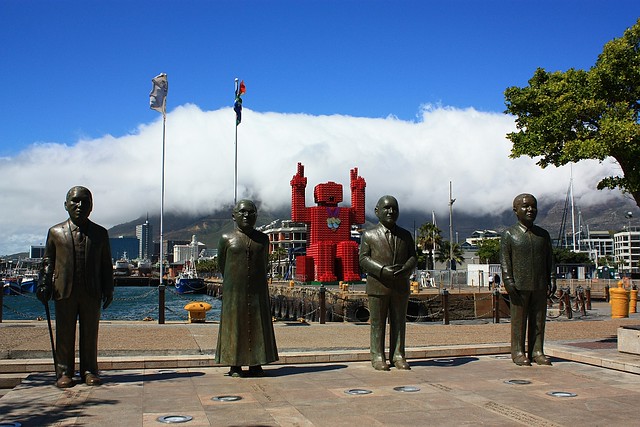
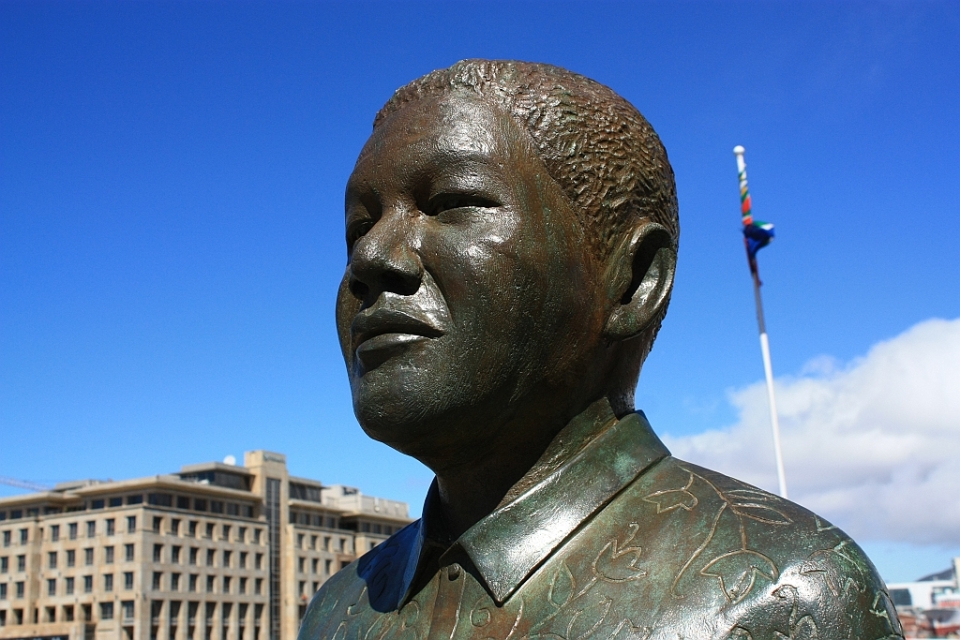
Nelson Mandela statue, Nobel Plaza, Victoria & Alfred Waterfront, Cape Town

Cape Town: remembering Nelson Mandela and 10 May 1994

On 27 April 1994, South Africa held its first post-apartheid elections with universal suffrage, where all people independent of gender and race could vote. The elections ushered the once-banned African National Congress (ANC) party into government. April 27 is Freedom Day, an annual national holiday in South Africa.

The ANC election victory brought another historic development. On 10 May 1994, Nelson Mandela was officially inaugurated as the first black person to be democratically elected President of South Africa.

2014 marked the 20th anniversary of the first freely run post-apartheid elections and of Nelson Mandela as elected President. National elections were held on 7 May 2014; these elections were the fifth held in the post-apartheid era, and the first held since Mandela’s passing in early-December 2013. With 18 years the minimum age for people to vote in South Africa, the 2014 elections included the first voting “born-free generation” who have never known a nation under apartheid.

Nelson Mandela and F. W. de Klerk both won the 1993 Nobel Peace Prize.

South Africa Nobel Peace Prize laureates, Nobel Square, Cape Town, South Africa

4 Nobel Peace Prize laureates from South Africa

I made the two photos above at Cape Town’s Nobel Square in October 2012. This post appears on Fotoeins Fotografie at fotoeins DOT com as http://wp.me/p1BIdT-45A.

Canberra: Remembering ANZACs at Australian War Memorial

ANZAC Day is held annually on the 25th of April to commemorate Australian and New Zealand Army Corps (ANZAC) from the First World War and ANZAC military personnel in subsequent service around the world.

The day also marks the 1915 anniversary when ANZAC troops landed on the Gallipoli peninsula in Turkey. The attempted move did not end well for the ANZACs, as the Ottomans successfully repelled the invasion force. The land invasion stalled after eight months with subsequent withdrawal from Turkey to Egypt.

ANZAC Day in Australia and New Zealand has surpassed the commemoration of Remembrance Day held annually on the 11th of November in Commonwealth nations, including Canada and the United Kingdom.

In the Australian capital city of Canberra, the Australian War Memorial is a grand structure, housing an impressive collection of historical artifacts, collections, and documents, outlining and describing Australian action at home and overseas. One day or an afternoon makes for a great introduction, but multiple visits are required to plumb the depths of their extensive archives. At the end of every day, the War Memorial closes its doors with a farewell to visitors in the “Last Post” ceremony, beginning at 455pm local time.

( Click here for images and more )

Hong Kong: almost China at the Lo Wu gateway

I’m at the turnstiles, off to the side from the steady stream of people going through to the other side.

I’m standing on the one side in Hong Kong (香港).

The other side is the city of Shenzhen in the People’s Republic of China’s province of Guangdong (Kwangtung | 廣東 | 广东).

MTR trains come in from Hong Kong and stop here at the end of the line. People pour out of the trains, and head for Shenzhen. There are occasional lulls in between frequent arrivals and departures of the trains, reminding me I’m in the middle of the countryside and at the frontier section separating between what most people know as Hong Kong and China.

Over on the “other” side, Shenzhen is a strong economic force, helped along by its special designation as a Special Economic Zone (SEZ), but there’s still a special allure for many to working inside Hong Kong’s Special Administrative Region. MTR rail passengers depart Hong Kong and enter Shenzhen at either the Lo Wu or Lok Ma Chau (Spur Line) crossings. The average cross-border passenger traffic numbers are 220,000 and 80,000 people per day, at Lo Wu and Lok Ma Chau, respectively (Source 1, Source 2).

From an economic, urban planning, and logistics point of view, it’s no surprise there’s a push to amalgamate Shenzhen with Hong Kong to create a super-metropolis here at the mouth of the Pearl River. Hong Kong has over 7 million people, whereas the population of neighbouring Shenzhen exceeds 13 million. Many would like to see easier and faster movement of goods and people between the two cities, but many in Hong Kong fear an exacerbation of existing problems with overcrowding and overburdened resources.

But what of the people going back and forth? How many from China and/or Shenzhen enter Hong Kong for work or school, and reverse course at the end of every day? How many from Hong Kong go to work in Shenzhen?

I wonder what the daily routine is for someone going back and forth between Shenzhen and Hong Kong. I watch patiently, and I wonder what it’s like on the other side. I have no doubt there’s someone on the other side in Shenzhen who’s wondering the same thing.

( Click here for images and more )