Fotoeins Fotografie

location bifurcation, place vs. home

Posts from the ‘MyRTW’ category

My around the world journey: Dec 2011-Jan 2013

Wellington waterfront, Museum of New Zealand Te Papa Tongarewa, Te Papa, Wellington, New Zealand, Te Whanganui-a-Tara, Aotearoa, fotoeins.com

10 Capital Cities

Above/featured: Waterfront and Te Papa: Wellington, New Zealand – 12 Oct 2010 (450D).

Two definitions for the noun “capital (city)” are:

1. the city or town functioning as the seat of government and administrative centre for country or region.
2. with modifier, a place associated more than any other with a specified activity or product; e.g., fashion capital of the world.

I’ll go with the first definition. With almost 70% of this planet’s land mass in the northern hemisphere, you’d be forgiven in subscribing to a selection bias for capital cities primarily north of the equator. I was born in the north, but I also spent a good chunk of the last two decades in the south; so, I’ve chosen here 5 capital cities in each of the northern and southern hemispheres.

( Click here for images and more )

Bodensee, Lake Constance, Konstanz, Germany, fotoeins.com

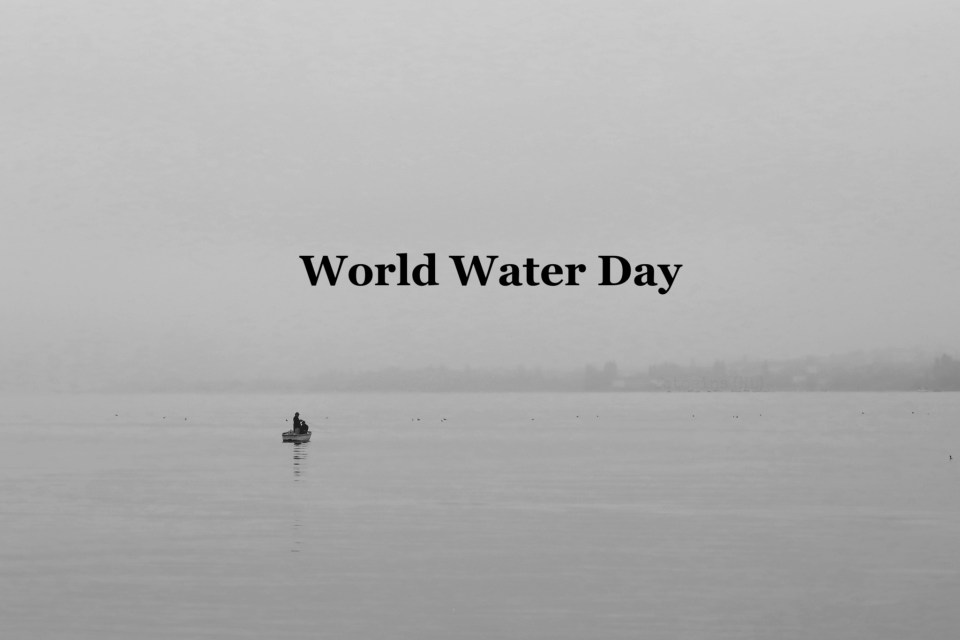
World Water Day: an RTW selection

Above: Early start by fishermen on the Bodensee on a misty autumn morning (HL).

22 March is World Water Day:

An international day to celebrate freshwater was recommended at the 1992 United Nations Conference on Environment and Development (UNCED) in Rio de Janeiro. The United Nations (UN) General Assembly responded by designating 22 March 1993 as the first World Water Day.

Cape Town’s dwindling fresh water supply has once again raised attention and a call to examine usage, recycling, and waste of available drinking water.

I list the following examples of fresh water bodies to question our interaction with and impact on water sources, and to ask whether water is truly free and whether some people are more “free” to receive water than others.

  1. Aachener Weiher: Cologne, Germany
  2. Akaka Falls: Hawaii, USA
  3. Aussenalster: Hamburg, Germany
  4. Bodensee: Unteruhldingen, Germany
  5. Capilano Lake: Vancouver, Canada
  6. Eibsee: Grainau, Germany
  7. Embalse Puclaro: Región de Coquimbo, Chile
  8. Foz do Iguaçu: Brazil
  9. Lake Burley Griffin: Canberra, Australia
  10. Lake Matheson: New Zealand’s South Island
  11. Lake Ontario: Toronto, Canada
  12. Lake Washington: Seattle, USA

( Click here for more )

Kea, alpine parrot, Homer Tunnel, Milford Road, South Island, Te Waipounamu, Aotearoa, New Zealand, fotoeins.com

Waitangi Day (6 Feb): 15 images from Aotearoa

Above/featured: The kea is the world’s only alpine parrot and on the endangered list; on Milford Road near Homer Tunnel.

On the 6th of February, I’ll be humming “E Ihowa Atua” and “Pokarekare Ana”.

Waitangi Day is a national holiday in New Zealand to commemorate the signing of the Treaty of Waitangi on 6 February 1840. As the founding document of the country, the Treaty of Waitangi (Te Tiriti o Waitangi) is an accord agreed upon by representatives of the Crown (British Empire) and of indigenous Māori iwi (tribes) and hapū (sub-tribes). The agreement is named after the name of the location in the Bay of Islands where the Treaty was first signed. Despite continuing disagreements between the two parties about contemporary extent and redress, I think the conversation and interactions between the communities are at a more advanced stage of integration within the nation’s fabric by comparison with Australia and Canada.

For Aotearoa, the New Zealand government approved in October 2013 formal names of the two main islands in Māori and English:

•   Te Ika a Māui (“the fish of Māui”) for the North Island, and
•   Te Wai Pounamu (“the waters of greenstone”) for the South Island.

I highlight Aotearoa with 15 images of the following locations:

  1. Akaroa
  2. Auckland
  3. Dunedin
  4. Franz Josef Glacier *
  5. Greymouth
  6. Hapuku (Seaward Kaikouras)
  7. Homer Tunnel *
  8. Lake Matheson *
  9. Milford Sound *
  10. Queen Charlotte Sound
  11. Queenstown
  12. Southern Alps *
  13. Waimakariri River
  14. Wellington City
  15. Wellington Harbour

Asterisks identify locations within the Te Wāhipounamu area in South West New Zealand which was inscribed in 1990 as UNESCO World Heritage Site that includes four national parks: Aoraki/Mount Cook, Fiordland, Mount Aspiring, and Westland Tai Poutini.

( Click here for images and more )

IHolocaustdenkmal, Berlin, Germany, fotoeins.com

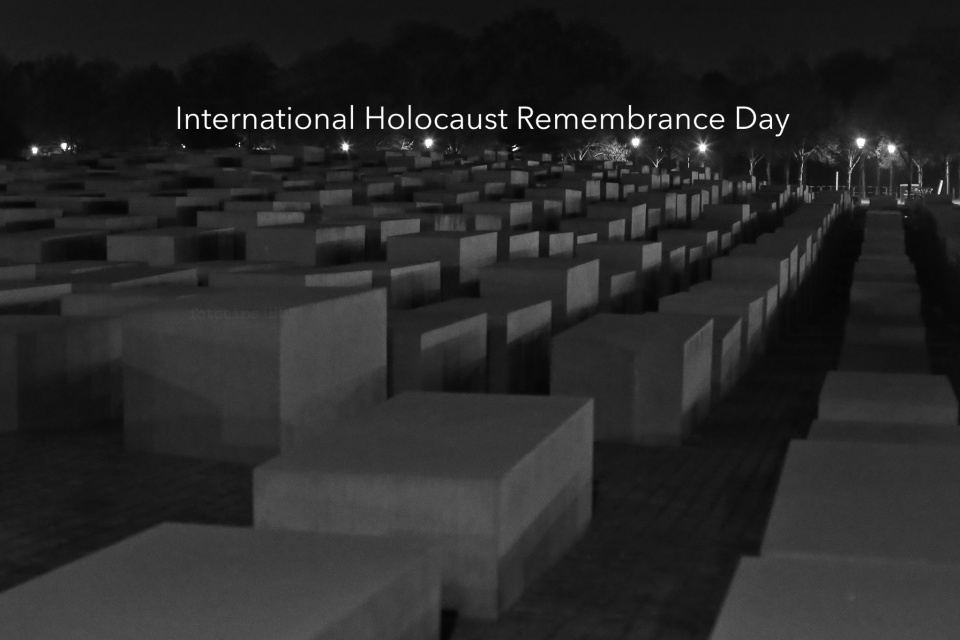
International Holocaust Remembrance Day: observations from Germany

Primo Levi, Italian-Jewish author, chemist, and Auschwitz survivor, delivered a set of essays about life and survival in Nazi extermination camps in his 1986 book “The Drowned and the Saved”. Levi wrote:

… For us to speak with the young becomes even more difficult. We see it as a duty and, at the same time, as a risk: the risk of appearing anachronistic, of not being listened to. We must be listened to: above and beyond our personal experiences, we have collectively witnessed a fundamental, unexpected event, fundamental precisely because unexpected, not foreseen by anyone. It took place in the teeth of all forecasts; it happened in Europe; incredibly, it happened that an entire civilized people, just issued from the fervid cultural flowering of Weimar, followed a buffoon whose figure today inspires laughter, and yet Adolf Hitler was obeyed and his praises were sung right up to the catastrophe. It happened, therefore it can happen again: this is the core of what we have to say.

On 27 January 1945, Soviet Red Army troops liberated the Nazi concentration and extermination camp at Auschwitz-Birkenau in south-central Poland. Over 1 million men, women, and children were murdered.

The United Nations declared January 27 as International Holocaust Remembrance Day; the designation came during the 42nd plenary session of the United Stations when resolution 60/7 was passed on 1 November 2005.

Accepting and openly stating responsibility are critical first steps, but spending time, money, and effort to ensure the simple motto of “never again” is also an ongoing reality that isn’t solely up to the citizens of Germany. It’s a collective responsibility that we all should have to remain vigilant; that we all have to recognize and bolster actions which encourage and strengthen the universality of human rights, and reject the erosion and withdrawal of those rights.

I believe responsible tourism also includes paying appropriate respect at a memorial, especially the Holocaust Memorial in Berlin. It’s my view this important memorial is not (supposed to be) a playground.

And yet, there’s something to be said about what it means to have freedom in the early 21st-century, allowing people to laugh and frolic in the public space, an undulating sculpture of featureless massive grey cement blocks, a testimonial to the systematic murder of millions of people.

Naturally, you have the freedom to play here, take selfies, and have a grand time. But it doesn’t mean I’m gonna laugh with you; for example: Yolocaust art project (DW 2017).


( Click here for more )

Laupahoehoe Point, Laupahoehoe, Hamakua Coast, Big Island, Hawaii, USA, myRTW, fotoeins.com

Hawaii Big Island: A Tranquil Tip at Laupāhoehoe

I’m standing in the warm ocean breeze, with rustling palm trees and crashing ocean surf for company. My friend appears from around the corner, and she tosses me a look before breaking out to a smile; I must be sporting a ridiculous gobsmacked expression.

New land laid with volcanic lava takes days, weeks, even years; but breaking the land down takes millions of years. Even with abundant foliage as partial deterrents, the absolute power of moving water and the unstoppable process of erosion must produce the inevitable; the hardest of rock gets pounded into submission, broken and ground down to fine particles of sand. But all that fun geology is forgotten in this rural idyll next to the open ocean, and it’s a big reason why about 600 people make this place their home.

On the Big Island of Hawaii, the drive on the number 19 Mamalahoa Highway north from the state capital city of Hilo turns northwest along the Hāmākua Coast. The scenery becomes a mix of grassy meadows along the descending flank of the Mauna Kea volcano, accompanied by deep gulches and steep cliffs dropping into the Pacific Ocean.

The word Laupāhoehoe means “a flat or tip of smooth lava” for the tip of land that sticks out into the water. At its peak in the late 19th- and early 20th-century, more than two thousand people lived in the town, self-contained with a school, stores, and a hospital. Taro root farms, cane plantations, and the Laupāhoehoe Sugar Factory (1880) provided employment and the local economy. Factory operations ceased in the mid-1990s, bringing a century of sugar-making along the island’s east coast to an end.

On 1 April 1946, a strong earthquake occurred inn the Aleutian islands on the Alaska coast. The resulting tsunami swept across the Pacific Ocean, and arrived at Hawaii at about 7am local time1. Waves up to 15 metres (50 feet) high hit the Big Island, creating widespread damage and killing over 150 people in total. At Laupāhoehoe, multiple waves struck, wiping out the only rail link to Hilo, and causing property damage; over 20 died, drowned, or went missing. After the tsunami, the school and houses moved back and further up the slope. The loss and subsequent abandonment of the rail line connection to Hilo meant a loss of transport, shipping, and tourism; the town population never recovered to the numbers in its heyday. The 1946 tsunami’s reach, power, and resulting destruction raised calls for an early warning system, and by 1949, the Pacific Tsunami Warning Centre was in operation in Hawaii.

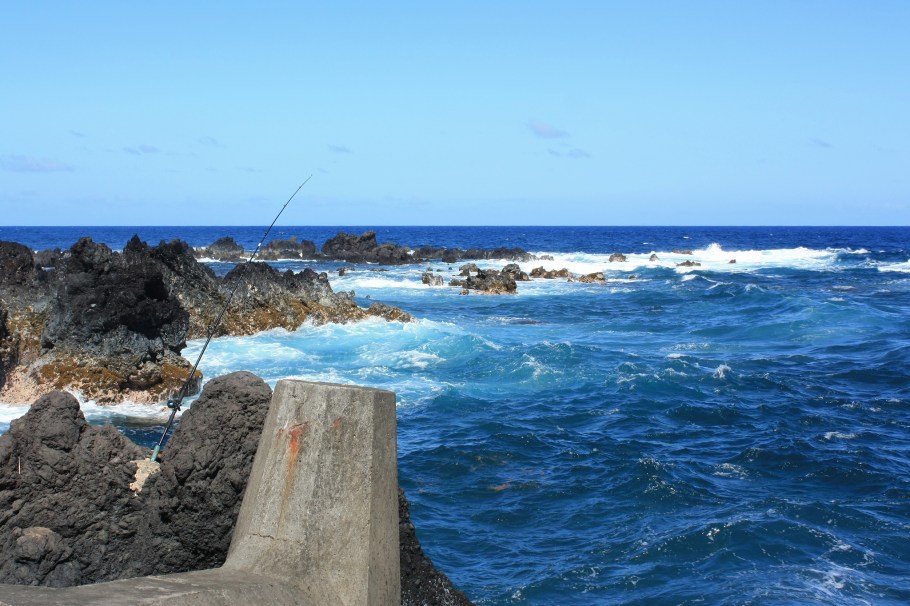
Near the shoreline is a memorial to those who perished in 1946. Not far from the memorial, someone has jammed a fishing pole between rocks next to the breakwater. Life continues here, slowly and surely. The warm breeze still comes onshore, fallen palm fronds lay scattered on the beach, and ocean meets beach in a wet foamy crash.

Memorial to the perished at the 1946 tsunami (picture by Wmpearl for Wikipedia, CC1 license).
Laupahoehoe Point, Laupahoehoe, Hamakua Coast, Big Island, Hawaii, USA, myRTW, fotoeins.com

From Laupāhoehoe Point: east-southeast towards Welokā (centre) and Pāpa’Aloa. (centre-right)

Laupahoehoe Point, Laupahoehoe, Hamakua Coast, Big Island, Hawaii, USA, myRTW, fotoeins.com

Built in 1983 by the US Army Corps of Engineers, this breakwater consists of concrete tetrapod wave-breakers.
Laupahoehoe Point, Laupahoehoe, Hamakua Coast, Big Island, Hawaii, USA, myRTW, fotoeins.com

Life in the harbor.

Laupahoehoe Point, Laupahoehoe, Hamakua Coast, Big Island, Hawaii, USA, myRTW, fotoeins.com

1With Google Maps, the distance from Scotch Cap at the southwest tip of Unimak Island in the Alaskan Aleutian Islands to the northern tip of the Hawaiian island of Oahu is about 3700 kilometres (2300 miles). After the 1946 earthquake in Alaska, tsunami waves arrived at Hawaii about 5 hours after the earthquake, making the “surface speed” 740 kilometres per hour (460 miles per hour) which is consistent with general speed estimates. The Pacific Tsunami Warning Center created a model animation for the 1946 earthquake, and the video animation is on YouTube.

With one exception, I made the other photos on 21 January 2012 at the beginning of my year-long RTW. Thanks to MK for guiding me to new and unseen (for me) parts of the Big Island. This post appears on Fotoeins Fotografie at fotoeins.com as http://wp.me/p1BIdT-9jx.