Above:WN_31 at the corner of Ballgasse and Rauhensteingasse, 9 July 2024 (P15).
Don’t worry: it’s not 1529, nor is it 1683, and there are no bands of marauders on horseback arriving for a large and lengthy siege. This also does not include anything from outside the Solar System. Instead, this is about a human artist and their little creations sprinkled throughout the Austrian capital city. In fact, I’d claim their “invasion” has already succeeded.
When a wae lad was I, the video game Space Invaders was a kind of dawn, an opening to a brand new world. The lasting effects snuck into many aspects of life, including the time I dedicated to the learning, pursuit, and practice of science. In time, a video game about a battle to ward off waves of little aliens required the purchase of a large bulky black console, accompanied by a large bulky black joystick with a big red button. In the decades since, the technological leap into the first-quarter of the 21st-century means that Space Invaders is available as an online web-application, easily called upon anytime on demand.
In Vienna, the sight of little aliens prompted immediate personal curiosity, and I spent parts of three consecutive summers wandering the streets to find as many possible little “visitors”.
Above: Danube river at dusk, facing southeast from Brigittenauer Sporn. Photo, 11 Jun 2022 (X70).
Vienna is a historical city of music with the likes of Beethoven, Haydn, Mozart, Schubert, and more. In the mid- to late-19th century, the Strauss family of composers created a dominant scene in Viennese waltz (Wiener Waltz). Johann Strauss II’s “An der schönen blauen Donau” (The Blue Danube) is one of the best-known compositions of classical music. The song was used famously in Stanley Kubrick’s film adaptation of Arthur C. Clarke’s novel “2001: A Space Odyssey“.
And as in the movie, the soaring feelings of hopeful anticipation during the spacecraft’s journey and docking with the spinning space station have become as routine as my arrival onto Viennese shores from the other side of the big eastern pond. I rely on Vienna to provide the gravity to maintain balance and spirit; this much has stayed true over multiple consecutive summers.
I’ve spent over 100 total days in Vienna, explored many of her streets and districts, and walked hundreds of kilometres. Efforts to immerse myself in various types of the city’s art and architecture have been accompanied by the sounds of brass horns and sweeping strings in a back-and-forth “dance” that spans the entire city. There’s new opportunity to learn about the song’s composer who was born, raised, studied, worked, and died in the Austrian capital city.
With the 200th anniversary of Johann Strauss II’s birth in 2025, the city of Vienna celebrates the occasion with a multitude of arts and culture events over the entire 2025 year.
2024 has been an interesting year of personal challenge and discovery. A conclusion for the family house provided fresh impetus to inhabit (in the short term) new spaces and places to improve overall health and happiness. In Vienna, I spent a full month for the third consecutive summer. Yes, it was continent hot, but time in the Austrian capital was both glorious and productive as expected. In Calgary is a city I hadn’t visited in many decades, and I witnessed a very happy aunt surrounded by many family members on her centenary year. In California’s Bay Area is a place where I hadn’t set foot in over ten years, but whose daily temperatures and chances of consistent sun offer a higher level of content.
The last time I saw my aunt J in person was in Vancouver for Dad’s funeral ten years ago. The last time I set foot inside aunt J’s home in Calgary was in 1976, which by now is a mere hop for a 50-year anniversary.
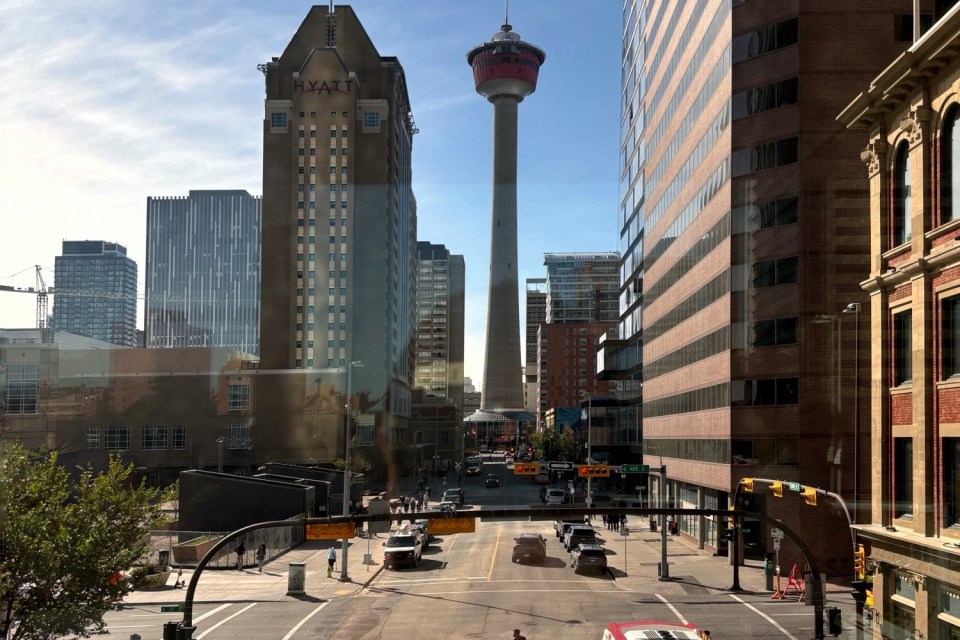
My mum’s big sister is celebrating her 100th birthday this month, and many members of the extended family from across North America are gathering in Alberta’s most populous city for a momentous celebration.
My photographic traces of a late-summer morning and afternoon wandering the city centre is on display, “outlined” by various pieces of art and architecture.
I’m in Stuttgart for a few days, and I rediscover photographer Gerda Taro was born in the city. I’d already read some history of photography, including the Spanish Civil War and Gerda Taro as the first woman to photograph and publish images about open conflict. I’ve gone looking for some traces in the city of her birth, as a quick and spontaneous mini-project in the midst of 90 consecutive days in Europe.
Memorial, near Olgaeck
Near the bus and tram stop Olgaeck is Gerda Taro Plaza, in memory of the young woman photographer who was born “Gerta Pohorylle” in Stuttgart and who once lived with her family in the area. At the plaza is a 2014 memorial dedicated to Taro; the text on all nine panels is entirely in German.
Named for photographer Gerda Taro (1910-1937), the plaza was unveiled by the city in 2008, and redesigned in 2014 with the installation of the memorial.
“O”. Gerda Taro, a pioneer in war photography.
“R”. The 1920s: Jazz, Theater, and the Stuttgart Kickers.
“A”. Leipzig: distributing leaflets against Hitler.
“T”. Exile in Paris: meeting André Friedmann, and the creation of Gerda Taro and Robert Capa. There is no Capa without Taro.
“A”. The Spanish Civil War, 1936-1939.
“D”. Barricades, armed women, equitable distribution of land.
“R”. The camera as witness: misery and terror from bombs.
“E”. Getting up close, for the world at large.
“G”. The first woman war-photographer killed on location. Documenting Spain’s civil war with her camera, Gerda Taro was accidentally run over by a tank and died from her injuries in a hospital near Madrid on 26 July 1937. She was buried in a marked grave in Paris’ Cimetière du Père-Lachaise.
Republican militia women training on the beach outside Barcelona, Spain: photo by Gerda Taro, August 1936. Provided by Ur Cameras on Flickr via Creative Commons.
Family home
Not far from Gerda-Taro-Plaza, I found the Pohorylle family’s former home, based on this poignant essay. I didn’t see any Gedenktafel (memorial plaque) or any Stolpersteine (stumbling stones) in the pavement, at or in front of either building 170 or 170A. In 1929, when Gerta was 19 years old, the Pohorylle family moved from Stuttgart to Leipzig.
Obstructed view of the former Pohorylle family house (in light orange), as seen from passage off Cottastrasse.
Gate to path access for building address Alexanderstrasse 170A.
Former Pohorylle family house, at Alexanderstrasse 170A.
Taro, short bio
Born Gerta Pohorylle, 1910 in Stuttgart, Germany; died 1937 in El Escorial, Spain.
“… Studied in Leipzig starting in 1929. Emigrated to Paris in 1933. In 1935 began working with the photographer André Friedmann, later known as Robert Capa. In 1935-1936 worked for the Alliance Photo Agency. Shortly after the outbreak of the Spanish Civil War in the summer of 1936, she and Capa went to Spain; other photography assignments in Spain followed in early 1937. She was fatally wounded at the Brunete front in July 1937 and was the first female war correspondent killed in action.”
Source: “Women War Photographers: from Lee Miller to Anja Niedringhaus” (Munich: Prestel, 2019), p. 218.
I made all photos above with an iPhone15 on 22 Jul 2024. I received no support from an external organization. This post composed with Jetpack for iOS appears on Fotoeins Fotografie at fotoeins DOT com.



 Fotoeins Fotografie