Fotoeins Fotografie

location bifurcation, place vs. home

Posts from the ‘Summer’ category

My Berlin: Wrapped Reichstag after 30 years

Above: “Wrapped Reichstag 1995–2025” light show.

In 1995, the artist duo Christo & Jeanne-Claude carried out a bold but contentious project by covering Berlin’s landmark Reichstag parliament building. Plans for the project had taken over 20 years, even though the artwork had always meant to be temporary and all expenses had been covered without corporate sponsors. Over 5 million visited in a period of 12 days in the summer of 1995 to look at the undulating “silver dream” in the German capital city. The timing was ideal. After reunification of the two Germanys in 1990, the new home of the federal parliament would be Berlin’s Reichstag. Renovations to the building began in the autumn of 1995 with the federal parliament opening in the spring of 1999.

From 9 to 22 June 2025, the Reichstag building was illuminated nightly with a light show in a 30-year anniversary tribute to the famous 1995 artwork. In a 20- to 30-minute cycle, the light-show appeared to first envelop the building in silver fabric. The fabric cover flapped in artificial breeze, before the cover lost its shape and fell onto the ground at the base of the building. The free-of-charge light show began shortly after sunset at about 930pm and continued until 1am. Whatever Christo and Jeanne-Claude chose to cover and transform, their art works posed questions of perception, origins, shape, functionality, and permanence.

•   DW: Germany Arts
•   Visit Berlin


( Click here for images )

Nuremberg: The Landmark Trials in Room 600, 80 years on

Above: In front of the Justizpalast (Palace of Justice) at the corner of Benjamin-Ferencz-Platz and Fürther Strasse in Nuremberg, Germany.

On 20 November 1945, an extraordinary trial got under way in the German city of Nuremberg, only six months after the Nazis surrendered to the Allied nations in World War 2. For the first time in modern history, an assembled tribunal of international judges presided over trials against top leaders of a nation for crimes against peace, war crimes, crimes against humanity, and conspiracy to carry out these crimes.

What is called the “Nuremberg Trials” refers primarily to the “Major War Criminals Trial” where over 20 leaders in German Nazi high command were put on trial before the International Military Tribunal (IMT) from November 1945 to October 1946. The IMT consisted of judges from each of the four Allied nations: Great Britain, France, United States, and the U.S.S.R. Subsequently from late-1946 to 1949, 12 additional trials were held before American military tribunals to uncover and highlight the extent and depth to which additional leaders in German society supported the Nazi dictatorship.

“… The privilege of opening the first trial in history for crimes against the peace of the world imposes a grave responsibility. The wrongs which we seek to condemn and punish have been so calculated, so malignant and so devastating, that civilization cannot tolerate their being ignored because it cannot survive their being repeated. That four great nations, flushed with victory and stung with injury stay the hand of vengeance and voluntarily submit their captive enemies to the judgment of the law is one of the most significant tributes that power has ever paid to reason.”

– Opening statement by Robert H. Jackson, U.S. chief prosecutor, on the second day of the Nuremberg Trials (Major War Criminals Trial), 21 November 1945; see Sources below.


( Click here for images and more )

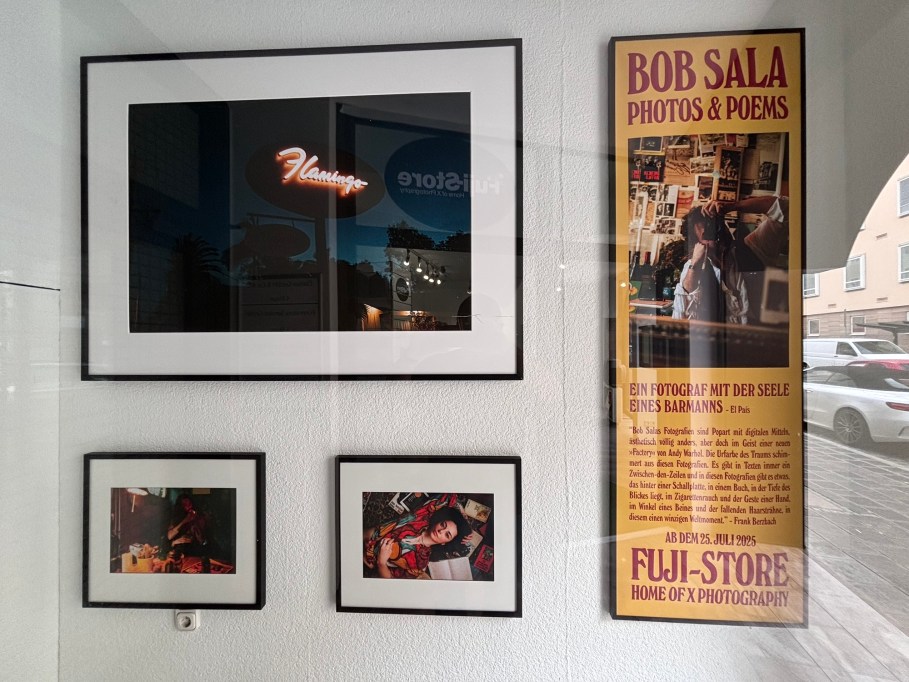
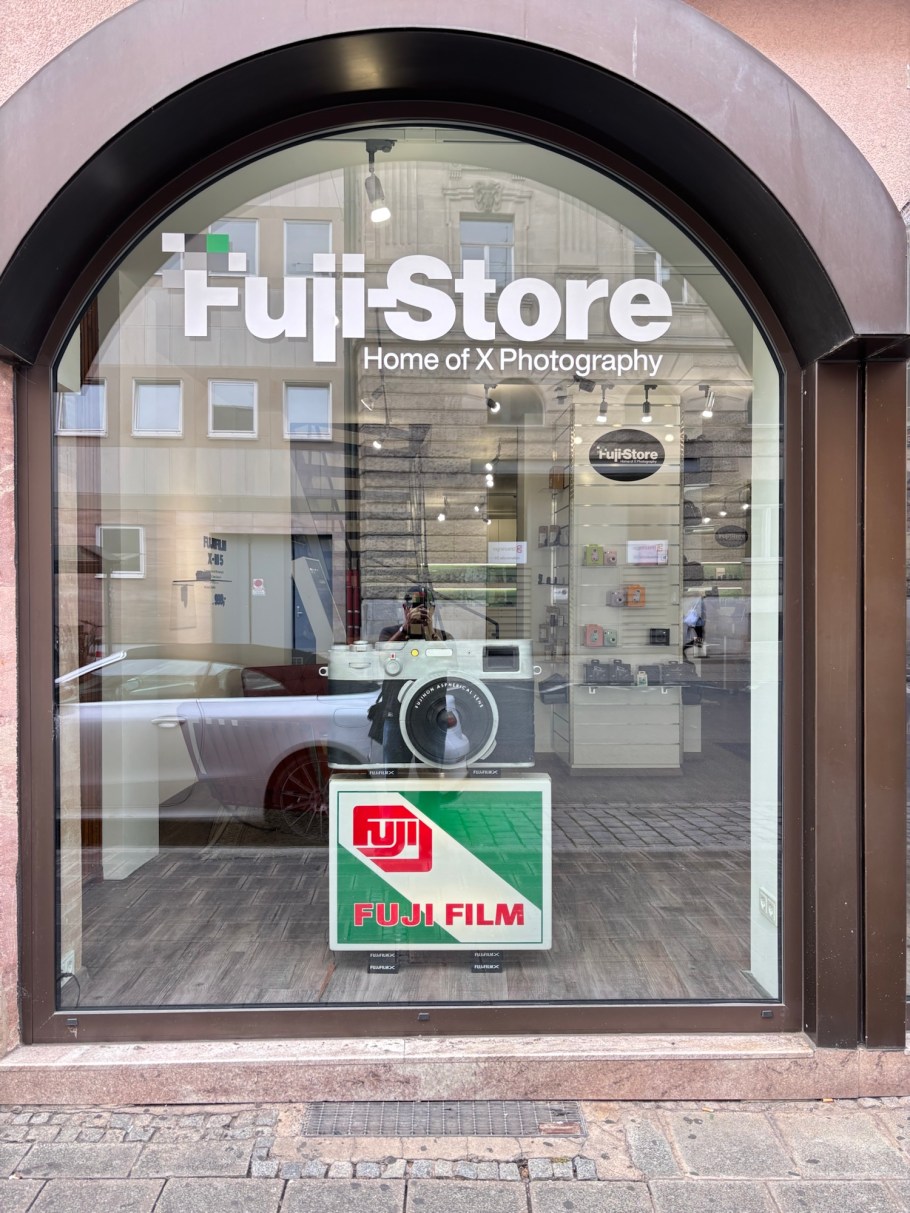
Nuremberg: Fuji(film)-Store

“Home of X Photography”

It’s a busy active crowded Saturday in Nuremberg’s city centre. There’s a big music festival with acts ranging in size from solo artists to 3-piece bands. But as I walk across town, I see a big Fujifilm sign, and as I approach, I can see this is no ordinary camera shop.

I learn there’s been a Fuji shop in the city for a number of years, and only this past February did they move to this new location. Judging by layout and the upstairs gallery, the Fuji shop has a feel similar to aLeica shop. That’s because the owner of Nuremberg’s Fuji-Store created the shop based on their experience operating the city’s Leica shop nearby. I chat with Peter, the gentleman in the shop about what’s out now and what else might be expected. We agree to a common wish: to have Fuji fill a current niche with a compact portable point-and-shoot at the right price point. How about an X80 product variant?

I’ve done my fair share of drooling (but no buying) at Leica shops in Frankfurt and Vienna, and I enjoyed doing the same to available X-models on display at Nuremberg’s Fuji-Store. Did I buy? No. Am I thinking about life after the X70? Yes.

I can also see Fuji X Weekly having some fun here in the shop.
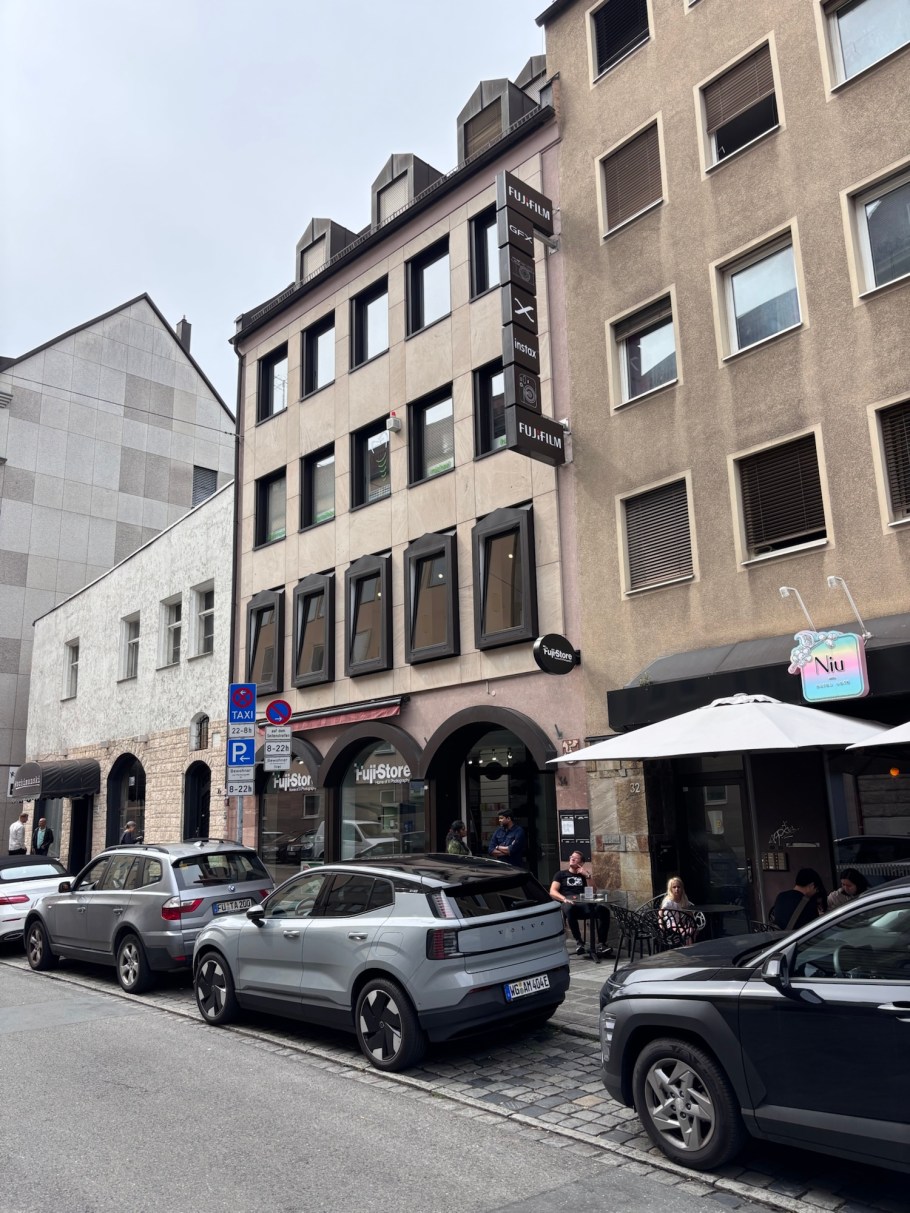


I received neither support nor compensation for this piece. I made all images above with an iPhone15 on 2 August 2025. This post composed within Jetpack for iOS appears on Fotoeins Fotografie at fotoeins DOT com.

Vienna: space invaders in the capital

Above: WN_31 at the corner of Ballgasse and Rauhensteingasse, 9 July 2024 (P15).

Don’t worry: it’s not 1529, nor is it 1683, and there are no bands of marauders on horseback arriving for a large and lengthy siege. This also does not include anything from outside the Solar System. Instead, this is about a human artist and their little creations sprinkled throughout the Austrian capital city. In fact, I’d claim their “invasion” has already succeeded.

When a wae lad was I, the video game Space Invaders was a kind of dawn, an opening to a brand new world. The lasting effects snuck into many aspects of life, including the time I dedicated to the learning, pursuit, and practice of science. In time, a video game about a battle to ward off waves of little aliens required the purchase of a large bulky black console, accompanied by a large bulky black joystick with a big red button. In the decades since, the technological leap into the first-quarter of the 21st-century means that Space Invaders is available as an online web-application, easily called upon anytime on demand.

In Vienna, the sight of little aliens prompted immediate personal curiosity, and I spent parts of three consecutive summers wandering the streets to find as many possible little “visitors”.

( Click here for more )

Vienna: Johann Strauss II, traces & places

Above: Danube river at dusk, facing southeast from Brigittenauer Sporn. Photo, 11 Jun 2022 (X70).

Vienna is a historical city of music with the likes of Beethoven, Haydn, Mozart, Schubert, and more. In the mid- to late-19th century, the Strauss family of composers created a dominant scene in Viennese waltz (Wiener Waltz). Johann Strauss II’s “An der schönen blauen Donau” (The Blue Danube) is one of the best-known compositions of classical music. The song was used famously in Stanley Kubrick’s film adaptation of Arthur C. Clarke’s novel “2001: A Space Odyssey“.

And as in the movie, the soaring feelings of hopeful anticipation during the spacecraft’s journey and docking with the spinning space station have become as routine as my arrival onto Viennese shores from the other side of the big eastern pond. I rely on Vienna to provide the gravity to maintain balance and spirit; this much has stayed true over multiple consecutive summers.

I’ve spent over 100 total days in Vienna, explored many of her streets and districts, and walked hundreds of kilometres. Efforts to immerse myself in various types of the city’s art and architecture have been accompanied by the sounds of brass horns and sweeping strings in a back-and-forth “dance” that spans the entire city. There’s new opportunity to learn about the song’s composer who was born, raised, studied, worked, and died in the Austrian capital city.

With the 200th anniversary of Johann Strauss II’s birth in 2025, the city of Vienna celebrates the occasion with a multitude of arts and culture events over the entire 2025 year.


( Click here for images and more )