Fotoeins Fotografie

location bifurcation, place vs. home

Posts from the ‘Summer’ category

Vienna: free city views from modest heights

At the eastern limit of the Alps, the city of Vienna is built at the “low end” where the hills meet the Danube river, at a minimum altitude of about 150 metres (500 feet) above sea-level. Visitors to the Austrian capital city who don’t have much time but want a broad overview of the city will make their way to one or all of the Donauturm (Danube Tower), Riesenrad (Ferris Wheel), and Stephansdom (St. Stephen’s Cathedral). Each of these landmarks requires the price of admission to get up high in the sky.

For other views at more modest heights, you’ll see there are options, especially because I’ve set foot in all 23 of the city’s districts. Below I highlight seven locations; all are free (zero charge) to access. All but one are well outside the inner city for the opportunity to explore other city districts and to gain a better sense of the physical size of the city. All images below are cropped square.


( Click here for more )

Eisfuchs, Eis, ice cream, Neubau, Wien, Vienna, Austria, Österreich, fotoeins.com

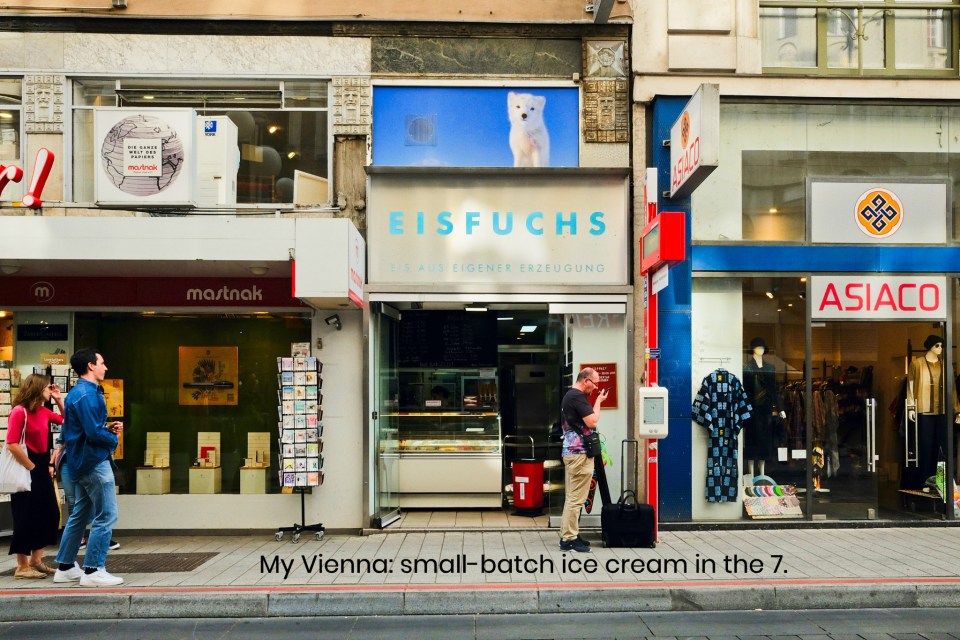
My Vienna: Eisfuchs ice-cream in the 7th district

Above/featured: Eisfuchs, at Neubaugasse 31 – 1 Jun 2022 (X70).

I’m on a 4-week stint in Vienna in late-spring/early-summer. Days are getting warmer, and I’m search of “Eis”. There are no shortage of ice cream shops in Vienna; trick is finding a really good one.

Out of their many recommendations, my host has pointed out Eis-Fuchs (“ice fox”), a small ice cream shop in the 7th district, known to residents local and across the city, but little recognized outside of Vienna.

That’s my kinda place.

All of their ice cream is made “in house,” and while they’ve got a list of favourites, they have a selection of “seasonal” varieties, which are made in small batches which last from a few days to a week or two. My favourite flavours are “Cheesecake Marille” (apricot cheesecake) and “Tarte au Citron” (lemon tart). The dessert is rich and creamy, and the fruit provides a refreshing tart edge.

With the 2nd visit, I promise the woman behind the counter I’ll visit more regularly. At the next visit, she nods at me in recognition and we chat a little about the ice cream: the variety of flavours and their production. With my final visit, I announce with some regret that my time in Vienna is ending, and I must return to Canada; I leave the shop with a double scoop of deliciousness.

( Click here for images and more )

My Fuji X70: Kodacolor (XTrans2 recipe)

Above/featured: After Girard: Vancouver-Strathcona, 14 Oct 2021.

The Fujifilm X70 mirrorless fixed-lens prime camera has been a real boon to my approach to photography for personal projects both domestically and internationally. To satisfy my curiosity, I’ve provided examples of X70 images made with two Fujifilm analog-film simulation (film-sim) recipes:

•   Ektachrome 100SW (saturated warm), simulating images with the Kodak colour transparency or slide films produced between 1996 to 2002;
•   Kodachrome 64, simulating images with the Kodak colour film produced between the mid-1970s and 2009.

In this post, I examine the Kodacolor film-simulation, a reproduction of which Fuji X Weekly’s Ritchie Roesch describes as “producing a classic Kodak analog aesthetic.” According to Roesch, the digital film-simulation is closest to Kodacolor VR analog color film from the early-1980s, whose ISO200 version is still available for purchase as “ColorPlus 200” (Kodacolor 200).

The following film-simulation recipe creates images similar to the look of “Kodacolor VR 200 (film) that’s been overexposed.” My X70 settings are:

  • ‘Classic Chrome’ built-in film-sim
  • Dynamic Range: DR400
  • Highlight: +1 (Medium-High)
  • Shadow: +1 (Medium-High)
  • Color: -2 (Low)
  • Sharpness: 0 (Medium)
  • Noise Reduction: -2 (Low)
  • White Balance: 6300K; -3 Red, -2 Blue
  • ISO: Auto, up to 6400 for “grainy” appearance (or fixed to 1000)

The recipe above is for the X-Trans II sensor; the corresponding recipe for an updated or more recent sensor is found here. All other recipes sorted by specific sensor are found here.

The following images were made at locations throughout metropolitan Vancouver. Minor adjustments to brightness level, rotation, and geometric distortion have been applied from straight-out-of-the-camera (SOOC) to posting.


( Click here for images )

My Fuji X70: Ektachrome 100SW (XTrans2 recipe)

Above/featured:False Creek east, from Cambie Bridge – 12 Jul 2021.

A variety of film simulations in the form of recipes with different settings are applicable to Fujifilm cameras to create uniquely historical and/or vintage look to images. Fortunately, a number of recipes are available to apply onto Fuji cameras with X-Trans II sensors.

That’s where my Fuji X70 has entered the fun fray. Previously, I showed examples of images made with the Kodachrome 64 recipe, simulating images made with the Kodak analog colour film produced from the mid-1970s to its final run in 2009.

I wanted to try another film-simulation recipe: the Ektachrome 100SW (SW for ‘saturated warm’) described by Ritchie Roesch in Fuji X Weekly. Historically, the Kodak company produced the ‘Ektachrome’ line of colour transparency or slide films. From its introduction in 1996 to its termination in 2002, the ‘Ektachrome 100SW’ film with increased ISO sensitivity produced images with deeper colours and warmer colour balance.

At locations throughout metropolitan Vancouver over a period of four weeks in July and August 2021, here are images below straight-out-of-the-camera (SOOC) with the following settings:

  • ‘Velvia’ built-in film-sim
  • Dynamic Range: DR200
  • Highlight: +2 (High)
  • Shadow: +1 (Medium-High)
  • Color: -1 (Medium-Low)
  • Sharpness: 0 (Medium)
  • Noise Reduction: -2 (Low)
  • White Balance: Auto; +1 Red, -2 Blue
  • ISO: Auto up to 3200 (or fixed to 1000)

All recipes sorted by specific sensor are found here.


( Click here for images )