Fotoeins Fotografie

location bifurcation, place vs. home

Posts from the ‘Seasons’ category

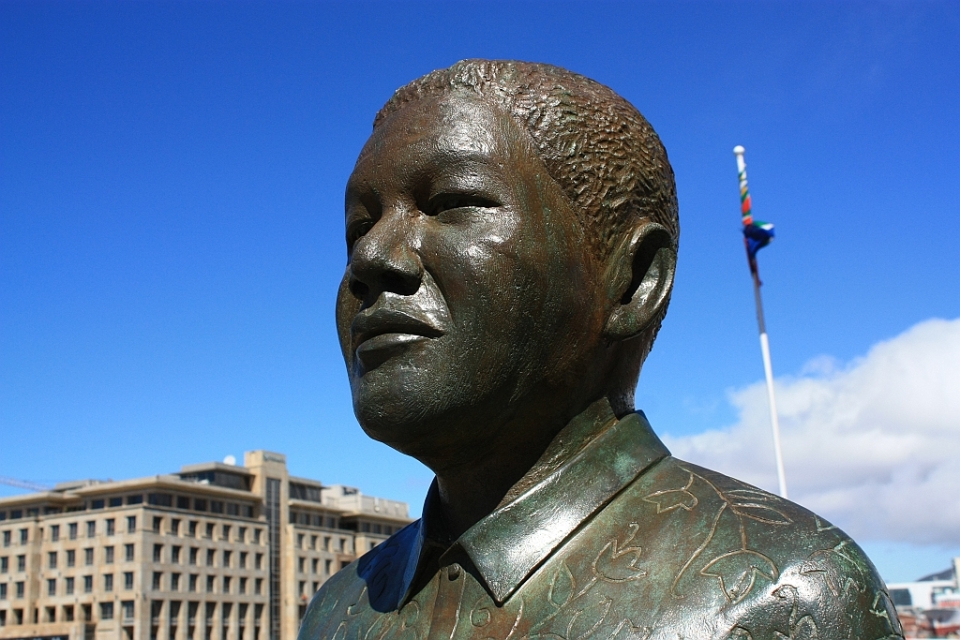
Nelson Mandela statue, Nobel Plaza, Victoria & Alfred Waterfront, Cape Town

Cape Town: remembering Nelson Mandela and 10 May 1994

On 27 April 1994, South Africa held its first post-apartheid elections with universal suffrage, where all people independent of gender and race could vote. The elections ushered the once-banned African National Congress (ANC) party into government. April 27 is Freedom Day, an annual national holiday in South Africa.

The ANC election victory brought another historic development. On 10 May 1994, Nelson Mandela was officially inaugurated as the first black person to be democratically elected President of South Africa.

2014 marked the 20th anniversary of the first freely run post-apartheid elections and of Nelson Mandela as elected President. National elections were held on 7 May 2014; these elections were the fifth held in the post-apartheid era, and the first held since Mandela’s passing in early-December 2013. With 18 years the minimum age for people to vote in South Africa, the 2014 elections included the first voting “born-free generation” who have never known a nation under apartheid.

Nelson Mandela and F. W. de Klerk both won the 1993 Nobel Peace Prize.
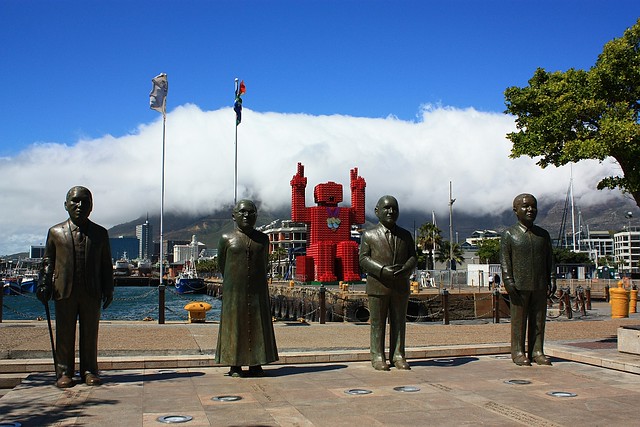
South Africa Nobel Peace Prize laureates, Nobel Square, Cape Town, South Africa

4 Nobel Peace Prize laureates from South Africa

I made the two photos above at Cape Town’s Nobel Square in October 2012. This post appears on Fotoeins Fotografie at fotoeins DOT com as http://wp.me/p1BIdT-45A.

Hong Kong: almost China at the Lo Wu gateway

I’m at the turnstiles, off to the side from the steady stream of people going through to the other side.

I’m standing on the one side in Hong Kong (香港).

The other side is the city of Shenzhen in the People’s Republic of China’s province of Guangdong (Kwangtung | 廣東 | 广东).

MTR trains come in from Hong Kong and stop here at the end of the line. People pour out of the trains, and head for Shenzhen. There are occasional lulls in between frequent arrivals and departures of the trains, reminding me I’m in the middle of the countryside and at the frontier section separating between what most people know as Hong Kong and China.

Over on the “other” side, Shenzhen is a strong economic force, helped along by its special designation as a Special Economic Zone (SEZ), but there’s still a special allure for many to working inside Hong Kong’s Special Administrative Region. MTR rail passengers depart Hong Kong and enter Shenzhen at either the Lo Wu or Lok Ma Chau (Spur Line) crossings. The average cross-border passenger traffic numbers are 220,000 and 80,000 people per day, at Lo Wu and Lok Ma Chau, respectively (Source 1, Source 2).

From an economic, urban planning, and logistics point of view, it’s no surprise there’s a push to amalgamate Shenzhen with Hong Kong to create a super-metropolis here at the mouth of the Pearl River. Hong Kong has over 7 million people, whereas the population of neighbouring Shenzhen exceeds 13 million. Many would like to see easier and faster movement of goods and people between the two cities, but many in Hong Kong fear an exacerbation of existing problems with overcrowding and overburdened resources.

But what of the people going back and forth? How many from China and/or Shenzhen enter Hong Kong for work or school, and reverse course at the end of every day? How many from Hong Kong go to work in Shenzhen?

I wonder what the daily routine is for someone going back and forth between Shenzhen and Hong Kong. I watch patiently, and I wonder what it’s like on the other side. I have no doubt there’s someone on the other side in Shenzhen who’s wondering the same thing.

( Click here for images and more )

Berlin Gleisdreieck: winter vs. summer

Gleisdreieck (“railway triangle”, “triangular junction”) is a U-Bahn train- and junction-station at the western end of the Kreuzberg district in the German capital city of Berlin.

The station has both upper-level and lower-level platforms serving lines U1 and U2, respectively, although both sets of track are raised above ground. At Gleisdreieck, the U1 line runs west-east, whereas the U2 line runs perpendicularly and temporarily “north-south”.
( Click here for more )

Nassau, The Bahamas, Caribbean Sea, North Atlantic Ocean, North America, fotoeins.com

Nassau, Bahamas: sea-to-sky blues at Junkanoo

The sand is snow white and soft to the touch. The skies are deep blue, and soothing on the eyes. The water is welcoming: its colours shimmer between aquamarine and turquoise, the waves lapping gently against the smooth shoreline.

That’s just my imagination – it’s all in my mind, right?

It should be so easy on the senses, but it seems too much to believe in the convergence at the same time. It seems unreal, best left to dreams from within the confines of a landlocked town.

But I slowly wake, and I open my eyes.

Disorientation gives way slowly to observation.

I feel the warm breeze against my skin, the soft sand between my toes. I breathe deeply to smell the salt in the sea air. I hear small ocean waves roll and dissipate on the beach. I can’t get enough of blues and greens.

I’m committing this to memory.

It’s time. Please hand over that rum for a sip, time for another snooze in this hammock. Perhaps there’ll be time for a short dip in the sea, before I go looking for some conch salad …

( Click here for images and more )

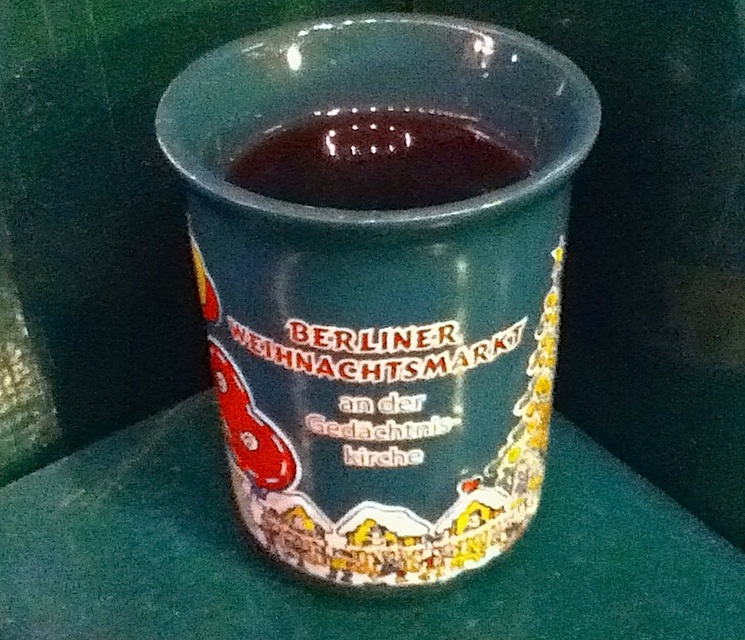
Berliner Weihnachtsmarkt an der Gedächtniskirche, Berlin, Germany

Christmas markets: Glühwein smarts

Above/featured: Christmas market at Berlin’s memorial church – 6 Dec 2012 (450D).

It’s easy to underestimate how much “punch” is delivered in a single Glühwein drink at a Christmas market. If I’m not careful and drink Glühwein too quickly and without food to soften the blow, I’ll encounter the very repeatable experience of “mind-body separation”.

What is this magically mysterious Christmas concoction called “Glühwein”?


( Click here for more )