Fotoeins Fotografie

location bifurcation, place vs. home

Posts from the ‘Urban Photography’ category

The place where I died

With these pictures, I explored the perspective of witnessing a parent’s unstoppable decline to the end. I didn’t include pictures of my father in this set, but I gave voice to growing distress at his final journey in orbit around a downward spiral. My gaze drifted externally to the space and form of the hospital and to the surroundings outside.

On 19 July 2014, Dad was taken to Vancouver’s St. Paul’s Hospital after he had a minor fall down the stairs at home. No bones were broken, which was remarkable considering his worsening health in the final stages of cancer. He would never return to the house in which he and Mum had bought and lived since 1976.

By the 2nd week, he had been moved from to the Palliative Care Unit (PCU) on the 10th floor. The wonderful hospital staff took great care of him and other patients in the unit. Dad charmed the PCU staff by chatting with them in broken English; it was his way of exerting some measure of control. I also witnessed the inevitable “shuffle”. One day, a patient slept quietly in one of the other beds, surrounded by members of his family. The following day, the bed was cleared, cleaned, and prepared for a new patient.

Into week 3, his mind and spirit departed, and he became completely unresponsive to external prompts. Over the following days, his body remained, accompanied by sounds of breathing, often shallow and laboured. He was at peace, and thanks to the meds, in diminished pain. I’d been with Dad a part of every day for 21 consecutive days. Friday came and went, and so did the passing of the sun. As I’d done every evening, I leaned down and whispered: “good night, I’ll see you tomorrow.” The following morning, I awoke to a phone call. The nurse’s voice was calm and gentle. Somewhere in the universe, I heard faint echoes of the death rattle. I said to the nurse: “thank you for your phone call. We’ll be at the hospital in a few hours.”

I ended the call and looked down at my watch: 613am. The date was August 9. He had celebrated his 82nd birthday only a few weeks earlier.

Northern summers, especially July and August, mean something entirely different.


( Click here for images and more )

Halle an der Saale, Halle, Saale river, Saale, Sachsen-Anhalt, Saxony-Anhalt, Cultural Heart of Germany, Germany, fotoeins.com

My Halle (Saale): 12 highlights in the Händelstadt

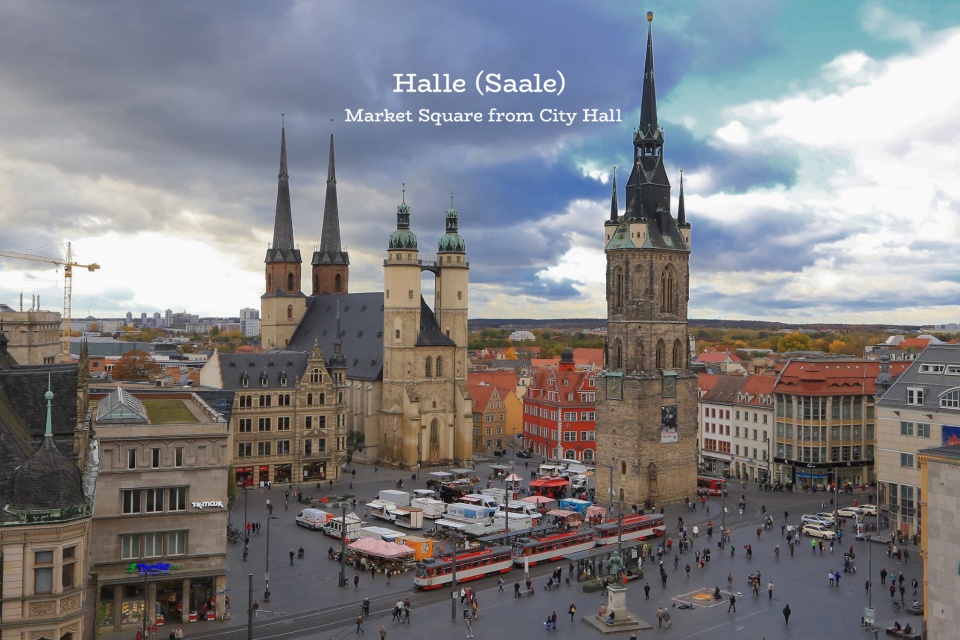
Featured: “5 towers” with 4 (spires) from St. Mary’s Church (left-centre) and 1 from the Red Tower (right-centre). Händel monument is at lower centre.

You’re visiting Halle to learn and discover:

  • why salt also known as “white gold” was critical to the city’s development;
  • how Martin Luther and the Reformation left their mark in the city;
  • composer Händel’s birth house, his upbringing, and how he learned the organ;
  • the oldest German chocolate factory continues producing “Halloren Kugeln”; and
  • how the Museum of Prehistory houses the world’s oldest depiction of the night sky.

Located in the present German federal state of Saxony-Anhalt, the city of Halle along the Saale river is one of the larger cities in east-central Germany. Making salt was of great historic and economic importance that the name of the city “Halle” is derived from the old Celtic/Brythonic word hal, meaning “salt”. The name of the river “Saale” is derived from the old German word for “salt”1. With salt bringing wealth to the city through trade, Halle became a trade city or “Handelsstadt.” With the birth and upbringing of composer Händel in the city, Halle also became a cultural city or “Händelstadt.”

Halle’s present-day population at 240-thousand people is neck and neck with the 241-thousand people in the the state capital city of Magdeburg, 75 kilometres to the north. But proximity means Halle is also connected with Leipzig, only 31 kilometres to the southeast in the state of Saxony. Halle and Leipzig are connected with the S-Bahn Mitteldeutschland train service, and the two cities share an airport located about halfway in-between.

1 The Welsh word for salt is “halen”, and the German word for salt is “Salz”. See also “Celtic culture: a historical encyclopedia,” Volume IV (M—S), pg. 1555. Editor J. T. Koch (ABC-CLIO, 2006).

( Click here for images and more )

Sonic Bloom, Dan Corson, Pacific Science Center, Seattle Center, Space Needle, Seattle, WA, USA, fotoeins.com

Seattle: “Sonic Bloom”, by Dan Corson

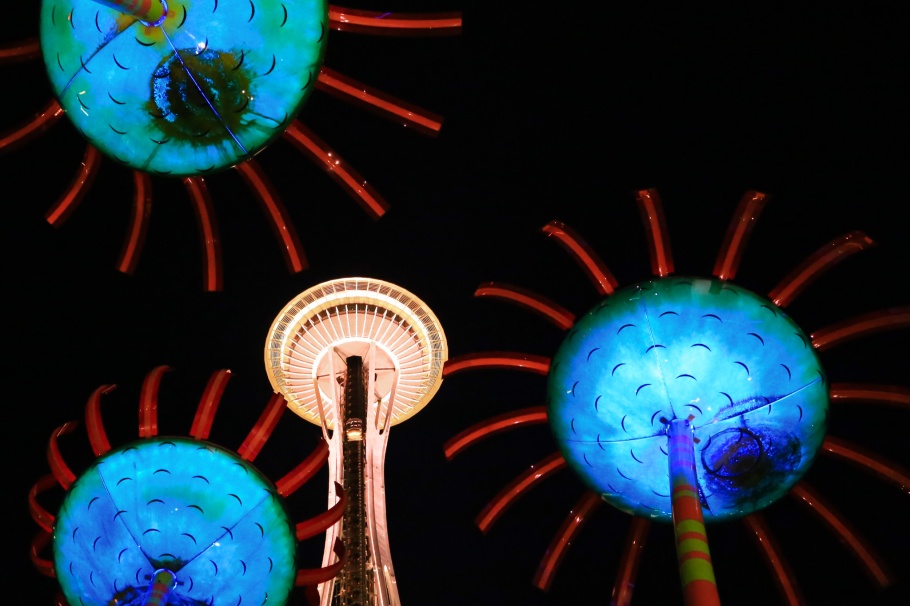
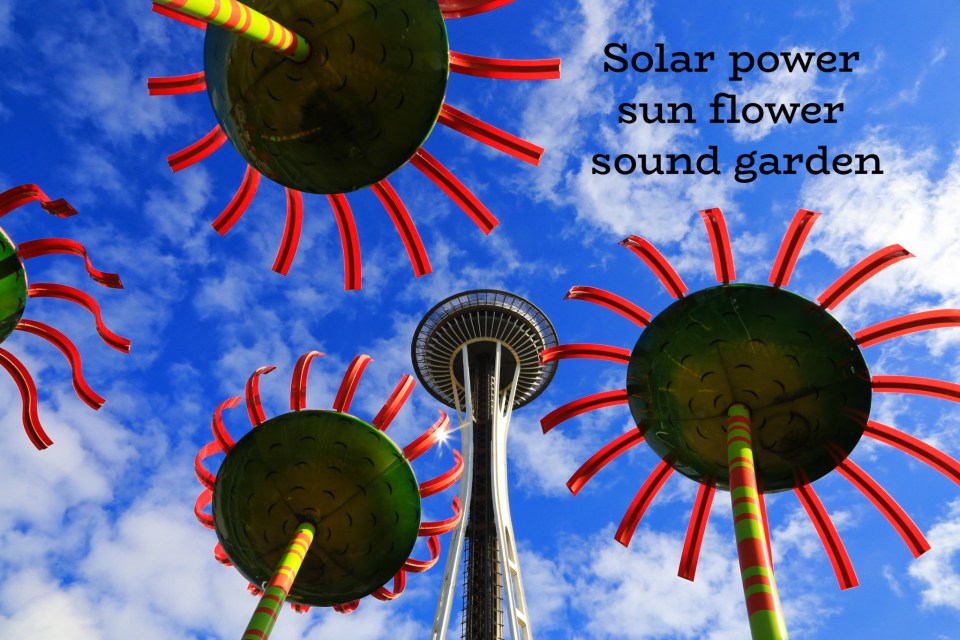
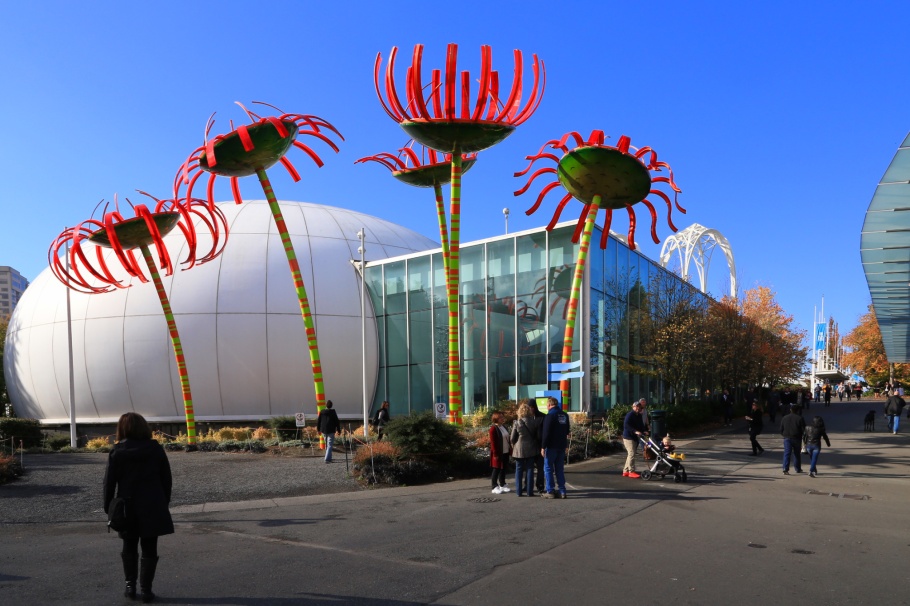
A set of very tall “flowers” greets visitors to the Seattle Center. The sculpture by Dan Corson is called “Sonic Bloom” for the Pacific Science Center. Five flowers constructed with steel, acrylic, and fibreglass stand up to 13 metres (40 feet) above the ground. The stripes along the stalks are large mysterious barcodes left as puzzles for people to decode. Night-time illumination by the sculpture is powered completely from solar energy stored on panels “capping” the flowers and panels at the neighboring Science Center. The sculpture is a playful mix of both sight and sound as detection sensors emit choral tones in the presence of movement.

Sonic Bloom, Dan Corson, Pacific Science Center, Seattle Center, Space Needle, Seattle, WA, USA, fotoeins.com

“Sonic Bloom” (Dan Corson) with the Pacific Science Center behind.

Sonic Bloom, Dan Corson, Pacific Science Center, Seattle Center, Space Needle, Seattle, WA, USA, fotoeins.com

Together with the Space Needle, all lit up!


I acknowledge my time on the traditional and ancestral land of the first people of Seattle, the Duwamish (Dxʷdəwʔabš) People past and present, and honour with gratitude the land itself and the Duwamish Tribe. I made the media above by day on 10 October 2016 and at night on 14 April 2017, all entirely with a Canon EOS6D mark1. This post appears on Fotoeins Fotografie at fotoeins DOT com as http://wp.me/p1BIdT-9zW.

Dessau: The Bauhaus Building, UNESCO WHS

21st-century Modernity, from 1919 on

The chair or couch on which you sit.
The table on which you’re resting your mobile or pad.
The desk on which your laptop or desktop resides.
The light fixture on your desk or above your head.
The windows in your room, your house, or in the café where you’re reading this.

The “universal” idea of living in a house or apartment with the furnishings we all take for granted from bathroom to bedroom and kitchen to living room is a relatively young idea by historical standards. It’s easy to imagine a time where only the rich upper-class could afford and were allowed to have and live in heated furnished residences, and the poor lower-class lived in unheated homes under damp dirty squalid conditions. Past designs with its heavy stone, porcelain, and ornate decorative components gave way to steel, glass, lightness of space, to favouring function over form. Simpler designs were meant to provide universal access: to the home, and to the essentials which furnished the home.

( Click here for images and more )