Fotoeins Fotografie

location bifurcation, place vs. home

Posts from the ‘Street Photography’ category

Mi CDMX: unos momentos en las calles

Mexico City: people and streets of interest

The following is a cross-section through the massive metropolis that is Mexico City. The city proper has population around 9 million, but the greater urban area has in excess of 20 million. An afternoon walk provides a tiny visual slice of all that makes up the city in her streets: her people and where they live, work, eat, play/pray, and love.

( Click here for images and more )

My Berlin: Schöneberg

Above/featured: Entrance to U-Bahnhof Rathaus Schöneberg.

It seems as universal as the common opinion about how cool and interesting Berlin is.

Both residents and visitors mention the same names in conversations throughout the city: Prenzlauer Berg, Mitte, Friedrichshain, Kreuzberg, Neukölln, and the hybrid “KreuzKölln”, even as Wedding and Lichtenberg begin weaving their way into the dialogue.

Of the neighbourhoods within the city’s Ring, what about Charlottenburg or Schöneberg? The answers often arrive as expected. Why would anyone visit there or live there? It’s boring! It’s too quiet! It’s dead! Lots of sniffy snobby dismissive exclamation points! That few choose the area is precisely why I’m in Schöneberg for three months at the tail end of my year-long around-the-world.

For many in Berlin, they’re living, working, and playing in areas where they’re close to the action and housing costs may on average be slightly cheaper. There’s something to be said about proximity and small “stumbling distances” after a night of drinking. For some, Schöneberg is too far, too expensive, too quiet, or all of the above. I don’t mind the 20-, 30-, or 45-minute travel times to places where friends eat, drink, or hang out.

It’s always a matter of choice for me to be in Schöneberg. There’s a comfortable stillness here that always sets me at ease, where I can tune out or turn down the noise, and find my calm. For a very special time, this area in Berlin, “der schöne Schöneberg,” is home.

( Click here for images and more )

My Prague: the night watch

With visits to the city numbering well into the double digits, Prague started me on a different path, and eventually, to a change in my life.

According to legend, the city’s name, Praha, is derived from the Czech word, “práh” for “threshold” or “steps”. With the city’s geographic location within the European continent, it’s hard to recount the chronicles of Central Europe without mentioning Praha. History and significance permeates the city in the cobbled stonework, centuries of architecture, and stories of struggle and change.

I believe the city is one step of many on my journey and transition from my past as research scientist to a future that remains under continuous construction. Prague has been and continues to be an important part of this process. I’ve fallen in love with Praha – she means a lot to me.

As day passes to night, many parts of the city become quiet and empty, with only the yellow glow of the street lamps for company. Many are taught not to go into areas unknown, poorly lit, or vacant.

But I know Praha enough to see her differently.

I’ve done the legwork by day, scouting out and noting various locations around the city, and imagining their appearance in the dark. With a newly crafted road map in my head, I stand in the hotel lobby. I close my eyes in a mental walkthrough of my map, breathing deeply, slowly. I open my eyes again and step out into the night, guided by the lights of Staré MÄ›sto, and across the Vltava over to Mal´ Strana.

I’m on the “night watch” with Rembrandt’s painting high in mind. The city and its streets don’t care who we are or from where we come. They lie still, in wait around the next corner.

In this place I’m always on the verge of something new; it’s a set of new ideas, much of them extraordinary, romantic, and meaningful. The meanings signify truth on a personal level for those willing to listen and heed the signs.

Prague never lets go of you … this little mother has claws.
— Franz Kafka (1883-1924).

( Click here for images and more )

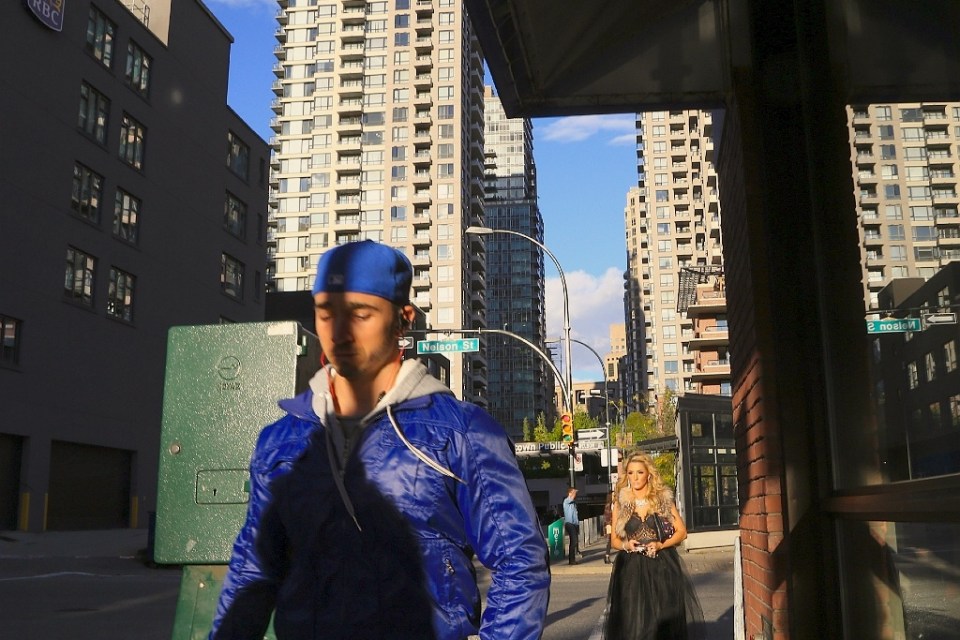
Yaletown, Vancouver, BC, Canada, 26 Oct 2014, fotoeins.com

What about now? How about now?

I think I’ve struck a nugget of gold.

I also believe the chances of finding it again might well be slim to none …

Jean François Paul de Gondi, Cardinal de Retz, wrote in the 17th-century:

Il n’y a rien dans ce monde qui n’ait un moment decisif. (There is nothing in this world that does not have a decisive moment.)

Photographer Henri Cartier-Bresson used this quote for the preface of his 1952 book “Images à la sauvette” (The Decisive Moment). That phrase has been described in great detail and (mis)interpreted over the years, undoubtedly adding only to the legend and his place in the history of photography. With his landmark photograph “Derrière la gare Saint-Lazare” (Paris 1932), Cartier-Bresson described moments like these as:

To me, photography is the simultaneous recognition, in a fraction of a second, of the significance of an event as well as of a precise organization of forms which give that event its proper expression. (Photographier: c’est dans un même instant et en une fraction de seconde reconnaître un fait et l’organisation rigoureuse de formes perçues visuellement qui expriment et signifient ce fait.)

What does any of this have to do with the photo above? Everything.
( Click here for more )

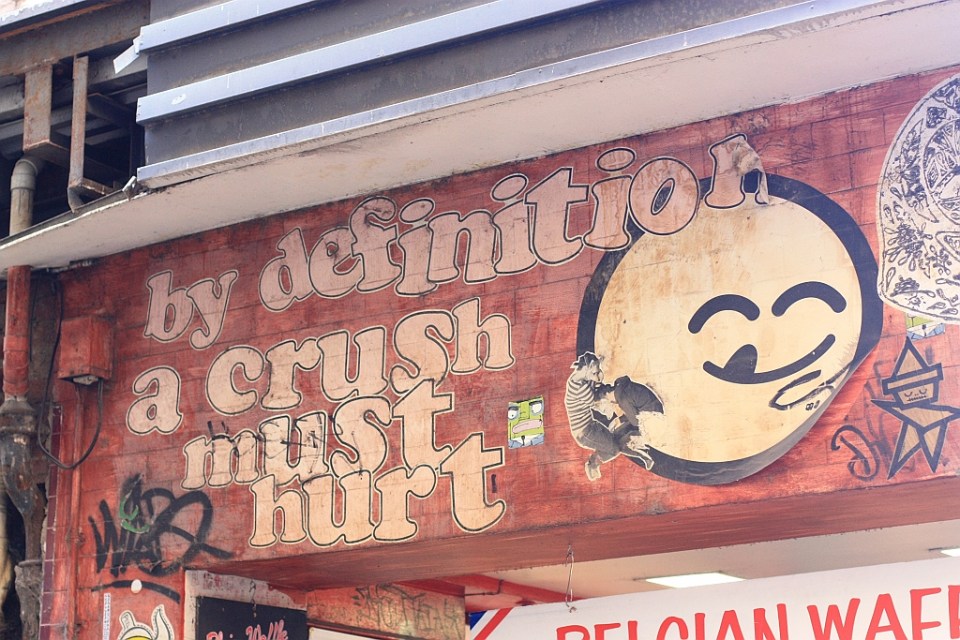
Melbourne, Australia, myRTW, fotoeins.com

Navigating Melbourne’s lanes for street art

In an earlier post, I’ve shown some work on display as street art in Adelaide in South Australia.

Over a period of four days in Melbourne, I wandered through lanes and streets to look for some representative street art in the Victorian state capital, some works which spoke of the people who live there. Would it be the same kind of art and/or messages I’d seen earlier in Adelaide? As always, the set of artists and their respective work hold unique value in each of the cities.


( Click here for images and more )