Fotoeins Fotografie

location bifurcation, place vs. home

Posts from the ‘Photography’ category

Links to photography blogs, information, sites

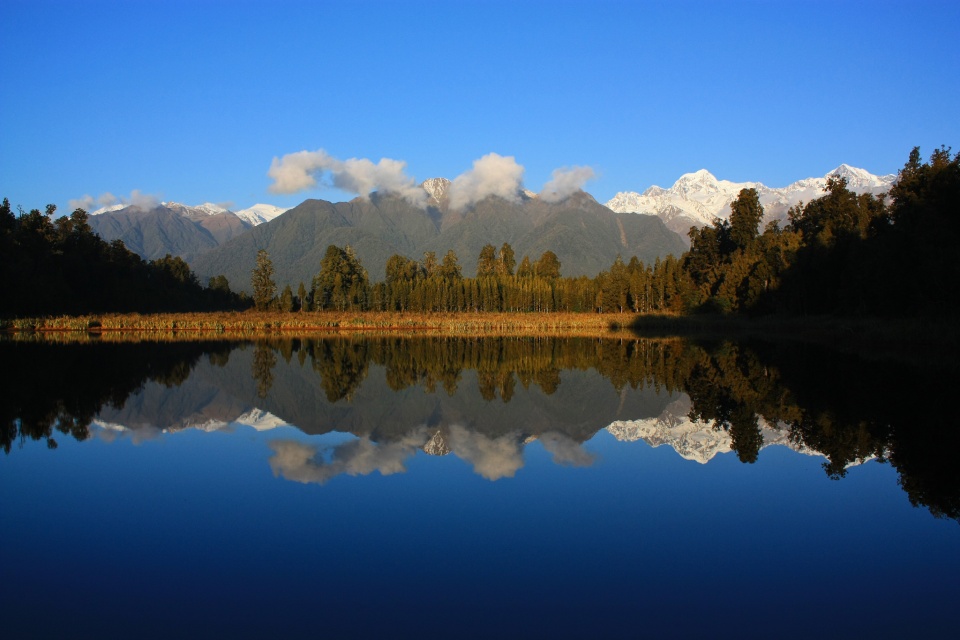
Lake Matheson, Westland National Park, West Coast, South Island, New Zealand, fotoeins.com

New Zealand: Lake Matheson & the southern Alps at sunset

Rewards go to the patient, especially those on daytime walks through the temperate rainforest to the Franz Josef Glacier and the Fox Glacier.

After all, this area is a UNESCO World Heritage Site.

After my visit to Fox Glacier earlier in the day, I arranged for a short 10-minute shuttle from Fox Glacier town to Lake Matheson (Te Ara Kairaumati) before sunset. Even in winter’s low-season, I was surprised by how few people were around to enjoy the view.

The sequence of photos below span a period of just over one hour in time. Appearing in most of the photos are the two grand snow-frosted peaks: Mount Tasman (Horokoau) on the left and Aoraki (Mount Cook) on the right.

( Click here for more )

New Zealand: forest walk to Fox Glacier

With coach services, I’ve been making my way down the west coast of New Zealand’s South Island. I spend a couple of days around Franz Josef town, and I describe the walk from town to the Franz Josef Glacier.

Will a visit to the Fox Glacier be as memorable? To find out, I head south on Highway 6 (Haast Highway) to Fox Glacier town, some 20 kilometres from Franz Josef town. Fox Glacier town was once known as Weheka which is also the original Māori name for Cook river nearby.

( Click here for images and more )

New Zealand: slow bound to Franz Josef Glacier

To a person, from the InterCity coach driver to the proprietors of motels along the South Island’s west coast, everyone spoke about how the Franz Josef and Fox Glaciers are two of the most accessible glaciers in the world. All things being equal, reaching the glaciers is definitely easier with a vehicle.

But I’m on New Zealand’s South Island, in the middle of a rainforest, and within the Westland National Park which is part of a UNESCO Heritage Site. I’m in no rush; so I think I’ll spare the trees from the expelled products of a combustible engine.

( Click here for images and more )

Canberra: Poppies at the Australian War Memorial

The word “poppy” in Germany is associated with the delicious poppy seed filling (“Mohn”) commonly used in cakes and pastries. Elsewhere, poppies are unfortunately associated with the production and consumption of hard drugs.

It’s easy to forget another representation associated with the flower: a commemoration symbol for the war dead.

Wild poppies grow in Belgium, and in particular, in the Ypres salient, one of many places where bodies, blood, and mud were the norm in close-contact trench warfare in World War One. Canadian physician and Lieutenant Colonel John McCrae was serving in the 1st Field Artillery Brigade, and after burying his friend, Lieutenant Alexis Helmer who died of injuries sustained during the Second Battle of Ypres, McCrae wrote the poem “In Flanders Fields” as he took the scene before him. Moved by McCrae’s poem, American Moira Michael began in 1918 the practice of wearing poppies on Remembrance Day.

It’s why you may see people sporting poppies on their lapels in the days leading up to November 11; the tradition is encouraged and upheld mostly in Commonwealth countries. In Australia and New Zealand, the big day of commemoration is ANZAC Day on April 25.

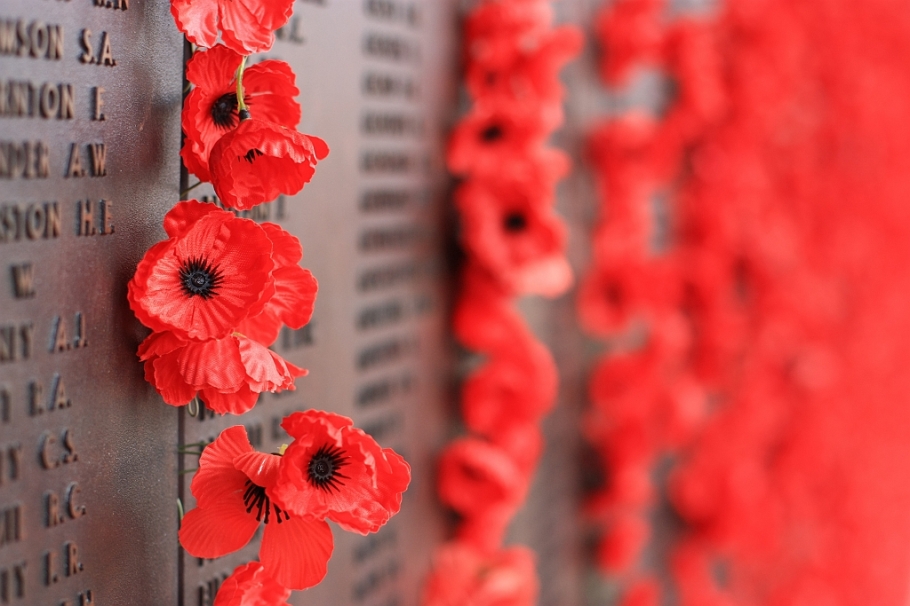
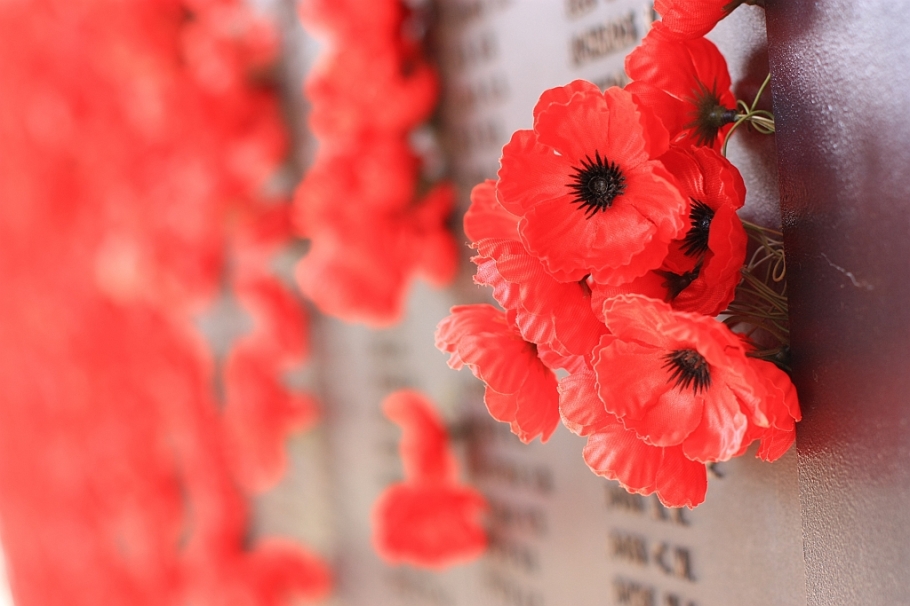
At the Australian War Memorial in Canberra, over one hundred thousand names are inscribed on the walls at the Roll of Honour; these are the names of people killed in action since 1885. A paper poppy is placed next to each name for relatives or direct descendants.

Roll of honour, west, Australian War Memorial, Canberra, ACT, Australia
Roll of honour, east, Australian War Memorial, Canberra, ACT, Australia

Roll of honour: west (top), east (bottom) : Australian War Memorial, Canberra, ACT

I made the two photos above at the War Memorial’s Roll of Honour on 6 September 2012; this post appears on Fotoeins Fotopress at fotoeins.com.

The Crier, Tiergarten, Berlin, Germany, fotoeins.com

The Crier: from Berlin to Perth

In this post, I wrote about how I discovered the statue called “Der Rufer” (The Crier) in Berlin’s Tiergarten:

The statue in the foreground is called “Der Rufer” (The Caller or The Crier). Created by Gerhard Marcks in 1966, a cast of the bronze statue was purchased and erected here in place in the former West Berlin in May 1989. The statue was placed deliberately so that the “caller” faced East Berlin. At the sculpture’s base is a quote by Italian poet Francesco Petrarch (1304-1374): “Ich gehe durch die Welt, und rufe ‘Friede Friede Friede'” | “I wander through the world, and cry ‘Peace, Peace, Peace.'”

On 12 September 2012, some 18 months after making the above photo, I discovered the same statue by accident at the Cultural Centre in Northbridge, Perth, Australia.

The Crier, Art Gallery of Western Australia, Perth, WA, Australia, fotoeins.com

The Crier (Perth)

Sculptor Gerhard Marcks (1889-1981) did not intend to convey a specific message or meaning to his piece of work. However, the version of the sculpture in Berlin was dedicated to a call for peace, whereas the casting in Perth was dedicated to the victims of torture.

I made the photos shown above with a Canon EOS450D: the first (Berlin shot) with EF-S 18-55mm f/3.5-5.6 IS kit-lens, and the second (Perth shot) with the 50mm f/1.4 prime-lens. This post appears on Fotoeins Fotopress at fotoeins.com as http://wp.me/p1BIdT-2og.