Fotoeins Fotografie

location bifurcation, place vs. home

Posts from the ‘Photography’ category

Links to photography blogs, information, sites

Metro Monorail, Sydney, Australia

Sydney Monorail: the final stop after 25 years

(24 June 2013.)

For 25 years, the Metro Monorail (wiki) has allowed both residents and visitors to go between the downtown Central Business District (CBD) and Darling Harbour. After spending some time in Sydney, it’ll be different to view the CBD without seeing the overhead guideway or the monorail sliding in between the buildings.

On the other hand, some argue it’s about time the unsightly eyesore of the monorail disappeared.

What’s certain is that the Sydney Monorail service will cease operations on 30 June 2013.

After many years of abandonment and neglect, Darling Harbour was redeveloped in the late-1980s as a pedestrian vehicle-free tourist area. The redevelopment project included construction of the Sydney Monorail which began operations in 1988. The monorail was built as a single 3.6-kilometre loop with eight stations, connecting the CBD, Darling Harbour, the Sydney Convention and Exhibition Centre, and Chinatown/Haymarket in a complete circuit within 20 minutes.

With little prospect for an upgrade to an aging transport system or for continuing operating funds, the transport authority for the state of New South Wales purchased the company operating the Monorail, and announced in June 2012 monorail operations would stop in one year’s time.

After its final stop on 30 June, the monorail trains will be decommissioned. The track, guideway, and station infrastructure will be dismantled, demolished, and removed. This process will give way for an expanded entertainment, convention, and exhibition centre (International Convention Centre, ICC Sydney) for scheduled completion by the end of 2016, although some disagree with plans to demolish the present convention centre.

“Goodbye, and thanks for the memories …”

Removal of the monorail began August 2013 and was completed by April 2014.

I made the photos above on 2 April, 12 April, and 12 May 2013. This post appears on Fotoeins Fotografie at fotoeins.com as http://wp.me/p1BIdT-3d3.

( Click here for more )

Berlin: the city’s oldest Jewish Cemetery

Der Jüdische Friedhof (Old Jewish Cemetery), Grosse Hamburger Strasse

In the past, I’ve often felt guilty for taking photographs at a cemetery, as if the act of opening and closing the camera’s shutter somehow “exposes and steals” the essence of people who are laid to rest. Only in the last few years have I overcome these feelings, as I now see cemeteries as beautiful places to visit and to witness frozen snapshots to individual lives over time. On this late-autumn afternoon, I stood in the middle of the garden, transported to a different place and a different time, surrounded by tranquility and living memories.

Große Hamburger Straße (or Greater Hamburg Street) was the key central road in what was once the Spandauer Vorstadt, which was the suburb or town at the foot of the former Berlin city gates. The road allowed for trade and movement from Berlin in the direction towards the nearby town of Spandau.

According to berlin.de, the area developed around the Hackesche Market and Courtyards:

Historically, development of the Höfe went hand in hand with the growth of Berlin as a thriving urban centre. The expansion started around 1700 from an outer suburb known as Spandauer Vorstadt, located outside the Spandau City gate which already had its own church, the Sophienkirche as early as 1712. Friedrich Wilhelm I built a new city wall here and the former suburb became a new urban district belonging to Berlin. Today’s Hackescher Markt takes its name from the market built here by a Spandau city officer, Count von Hacke.

The influx of Jewish migrants and the exiled French Huguenots gave the district the cosmopolitan diversity which it never lost. The first synagogue was built in this area and the first Jewish cemetery established on the Grosse Hamburger Strasse. Another name for the area, the Scheunenviertel (barn district) is associated today with up and coming art galleries and the more bohemian side of Berlin. The largest synagogue in Germany was built in nearby Oranienburger Strasse in 1866.

In use from 1672 to 1827, this is Berlin’s oldest cemetery for the Jewish community. Buried here is Moses Mendelssohn (1729-1786), philosopher, a founding father of the Jewish Enlightenment, and grandfather to the great composer Felix Mendelssohn. During the last stages of fighting in the Second World War, 2425 dead were buried here in 16 mass graves. With no clear boundaries separating those buried in the past from those buried during the war, the new memorial garden was constructed and restored in 2007-08 with all of the buried left undisturbed as they were.

The present location was also the site of the first nursing home in 1844 for the Jewish community in Berlin. The Gestapo transformed the home in 1942 to a collection and staging point for prisoners, and ordered the destruction of the entire site in 1943. 55000 Berlin Jews from infants to the elderly were deported and murdered in the concentration camps at Auschwitz and Theresienstadt.

( Click here for images and more )

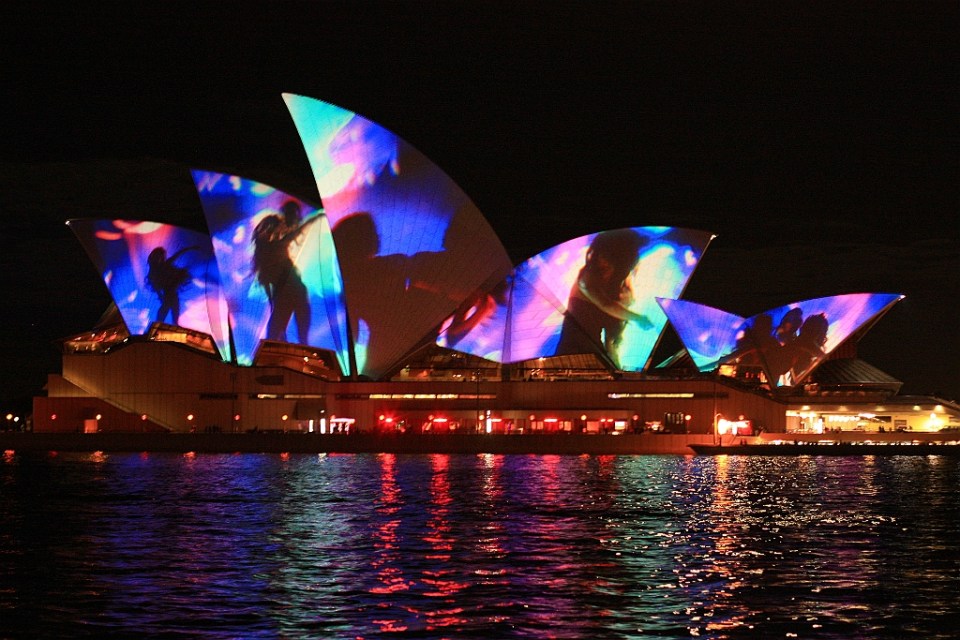
Opera House, VIVID Sydney, Australia

My 70000th, part 2: Sydney Opera House

Yes, you read that correctly … part 2.

I made a mistake.

I wrote previously about “flipping” or resetting the image-number counter on my camera for the 7th time as I visited the Museum of Contemporary Art in Sydney.

I was wrong and I’d been too hasty when I began writing. I’d read the image numbers incorrectly, and I’d overlooked the image numbers (67000!).

But it wasn’t long until zeroes were back on the camera display and the actual 70000th exposure was made on the Canon 450D/XSi.

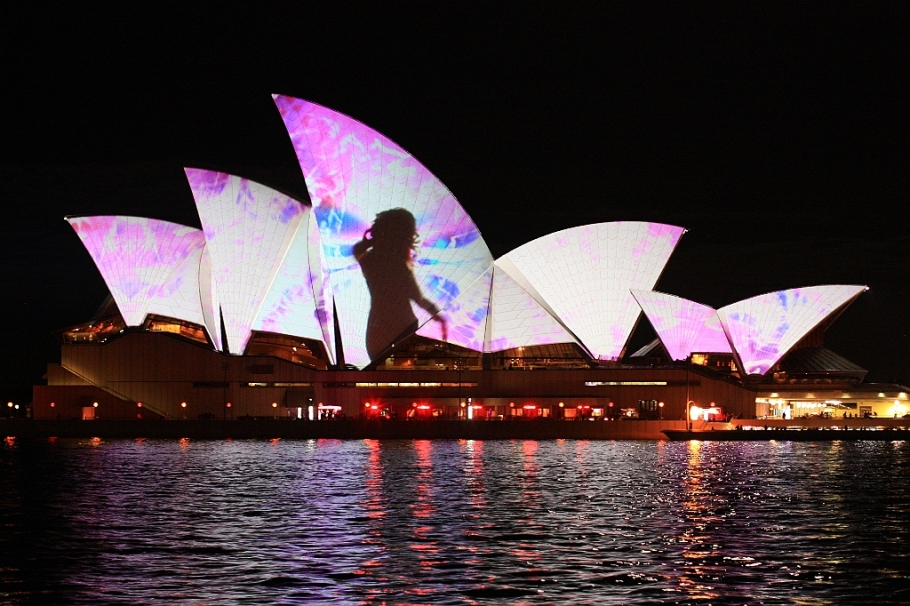
For a few evenings after opening night, I’d visited and photographed various displays at the VIVID Sydney festival of lights around Sydney Cove, Walsh Bay, and Darling Harbour. Midweek is a good time with fewer people around for plenty of space at the best spots to photograph the sights. I chose a Wednesday evening to focus on the Opera House. The photos below form a part of the sequence called “PLAY” by the Spinifex Group who have additional projections at the festival.

MIRROR by The Spinifex Group, Opera House, VIVID Sydney, Australia


I made the photos above on 29 May 2013. This post appears on Fotoeins Fotopress at fotoeins.com.