Posts from the ‘Photography’ category
Links to photography blogs, information, sites
Above/featured: Waterfront and Te Papa: Wellington, New Zealand – 12 Oct 2010 (450D).
Two definitions for the noun “capital (city)” are:
1. the city or town functioning as the seat of government and administrative centre for country or region.
2. with modifier, a place associated more than any other with a specified activity or product; e.g., fashion capital of the world.
I’ll go with the first definition. With almost 70% of this planet’s land mass in the northern hemisphere, you’d be forgiven in subscribing to a selection bias for capital cities primarily north of the equator. I was born in the north, but I also spent a good chunk of the last two decades in the south; so, I’ve chosen here 5 capital cities in each of the northern and southern hemispheres.
( Click here for images and more )
Where: Judenplatz, in Vienna’s Altstadt.
What: Holocaust Memorial, by Rachel Whiteread (2000).
How do you commemorate or memorialize the absent or missing? How should the void be acknowledged, recognized, and remembered? Does the act of constructing a physical monument “draw a line”, creating a physical manifestation of marking an end that gathers and wipes away all subsequent future responsibility for remembering?
In Vienna’s Old Town, what was unjustly and violently removed from the city’s long historical memory and cultural identity comes into shape at Judenplatz. Under the public square are ruins of the medieval synagogue destroyed in the pogrom of 1421 with hundreds of Jews driven out, hundreds killed by burning, and the community erased. Directly above these ruins is the Holocaust Memorial which attempts to generate experiences and memories to address the void left behind after the systematic murder of 65-thousand people.
( Click here for images and more )
48.211677
16.369494
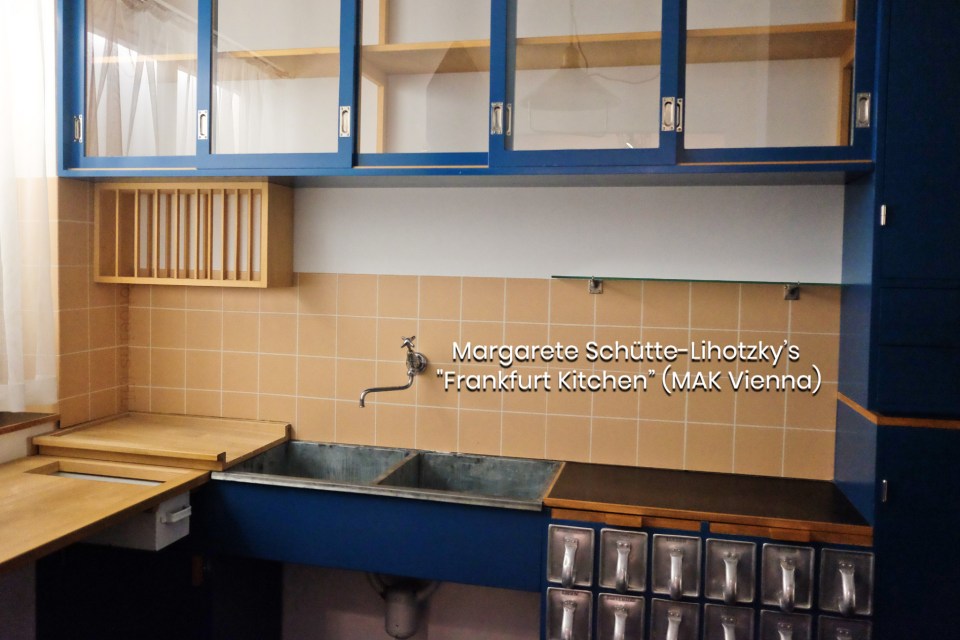
Who: Margarete Schütte-Lihotzky.
Key: 1st woman architect in Austria, designer of something we take entirely for granted.
Quote: “I developed the kitchen as an architect, not as a housewife.”
I always liked how cooking had well-defined endpoints: a desirable start, and a satisfying conclusion. I enjoy the process: the contemplation of “what to make,” the gathering of ingredients, the preparation, and naturally, the consumption. There might also be something to say about the duality of creation and annihilation …
That got me to thinking about kitchens as a critical unit of a home. Before the 20th-century, the wealthy could afford to have staffed kitchens; everybody else had access to no kitchen or an unsafe unhygienic kitchen in a building separate to their living quarters. The assumed universality of a kitchen within a home is a 20th-century concept and implementation that sought to overcome social and economic class. The design of a modern kitchen invites repeated patterns of movement and action around where cookware, utensils, condiments, glassware, etc. are stored and where the central focus of cooking activity takes place.
For everyone who spends any time in a kitchen, we have Margarete Schütte-Lihotzky (MSL) to thank.
( Click here for more )
48.208174
16.373819
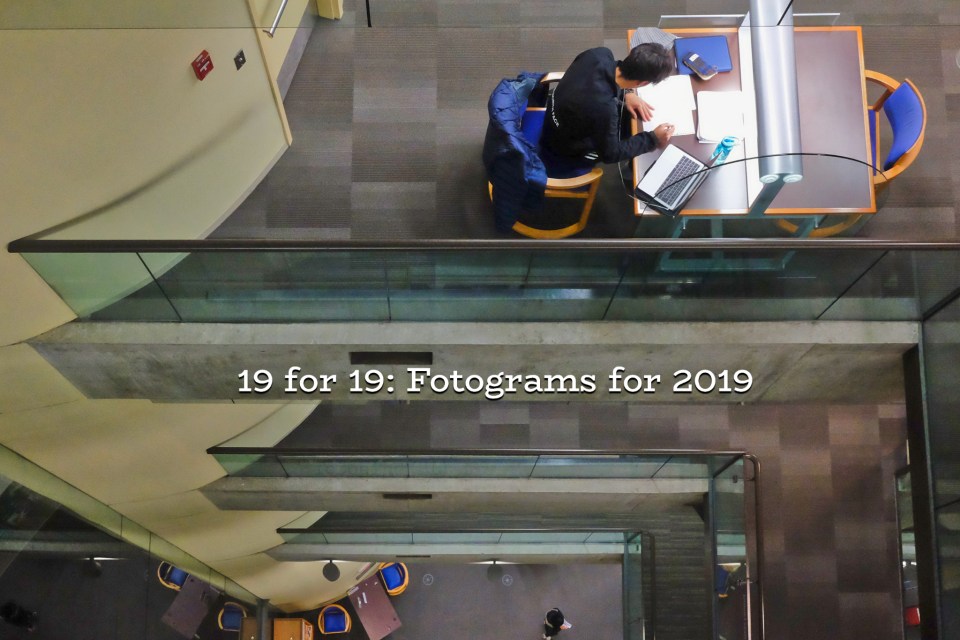
Above/Featured: Vancouver Central (VPL) – 11 November.
I look back at 2019 through 19 images posted on social media, continuing a consecutive string of year-end reviews. With the following images made entirely in the metropolitan Vancouver area, a number of questions about places past and present were raised; what remained elusive were clear answers about home and belonging.
( Click here for more )
49.282729
-123.120738
Above/feature: In the background at right-centre is the sacred Pueblo Peak (Taos Mountain) with a light dusting of autumn snow.
The following takes place entirely on travel day 8 in our visit of the American Southwest.
In a daylong trip from Santa Fe, we’re in Taos for the first time where we meet with nature photographer Jim O’Donnell, whose writings also appear locally in The Taos News. We also marvel in the hamlet of Embudo the collection of paraphernalia associated with American automobile culture at the Classic Gas Museum.
Our drive is on the Low Road, there and back. It’s no real surprise we’re in the Taos area longer than anticipated, but we leave the area a little earlier to catch a couple of sights back in Santa Fe as we must depart the following day for Arizona. It’s curse and benefit, wanting (or needing) to stay in one place for an extended duration with the anticipation of a return, because there’s much more to see and learn.
( Click here for images and more )
36.407249
-105.573066