Fotoeins Fotografie

location bifurcation, place vs. home

Posts from the ‘Flora and Fauna’ category

Tulips alight, Skagit Valley Tulip Festival (2017)

I was skeptical of a visit to tulip gardens.

“They’re just flowers after all.”

When I lived in Heidelberg, Germany, my friends wanted to travel to the Netherlands before pregnancy kicked into full swing. They wanted to visit Keukenhof and Amsterdam. I was excited about Amsterdam; I was unsure about Keukenhof.

But one step inside the tulip gardens in Keukenhof was enough to turn my head and my opinion about tulip fields spun completely around.

That was 2002, and this is 2017. I’m highway-bound along I-5 into western Washington State to see tulips.

During the annual tulip festival in April, the Skagit river valley is populated by fields of daffodils and tulips, in eye-popping yellow, red, orange, purple, and white. The overcast skies with diffuse grey light provides ideal light conditions with no strong shadows. The explosion of colour should surely melt hearts and convince minds, if the change to my once obstinate stance is any indication.

( Click here for images and more )

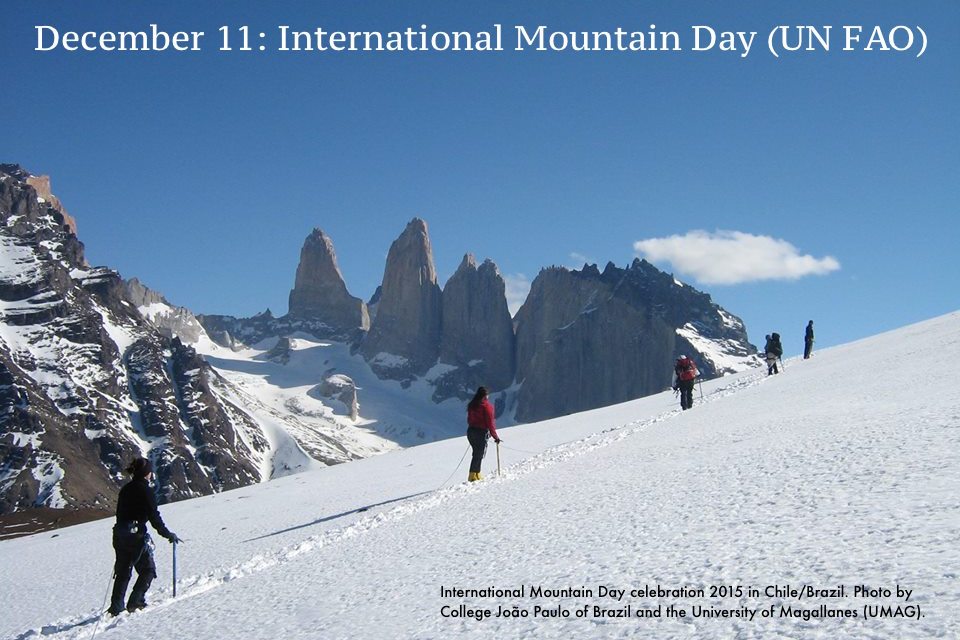
UN FAO International Mountain Day. International Mountain Day celebration 2015 in Chile/Brazil: photo by College João Paulo of Brazil and the University of Magallanes (UMAG).

11 December: International Mountain Day

Since 2003, December 11 is International Mountain Day as designated by the United Nations General Assembly. Annually, the Food and Agriculture Organization of the United Nations (FAO) observes the day:

… to create awareness about the importance of mountains to life, to highlight the opportunities and constraints in mountain development and to build alliances that will bring positive change to mountain peoples and environments around the world.

•   Mountains cover almost one-quarter (22 percent) of the Earth’s surface.
•   Mountains host about 50 percent of the world’s biodiversity hotspots.
•   Up to 80 percent of the world’s freshwater supply comes from mountains.
•   One in eight people (13 percent) around the world lives in the mountains.
•   Mountain tourism accounts for almost 20 percent of the worldwide tourism industry.

The following provides a glimpse to the mountain environments around the world and to the challenging conditions our ancestors would have faced and endured.


( Click here for images and more )

Buenos Aires: abandoned cats in the garden

Since 1996, the Botanical Gardens of Buenos Aires in the affluent neighbourhood of Palermo is one of Argentina’s national cultural monuments. The gardens’ full name is Jardín Botánico Carlos Thays after the French landscape architect Carlos Thays who arrived in Argentina in 1889 and became the Buenos Aires’ Director of Parks and Walkways in 1891. The gardens contain thousands of plant varieties over a seven-hectare spread.

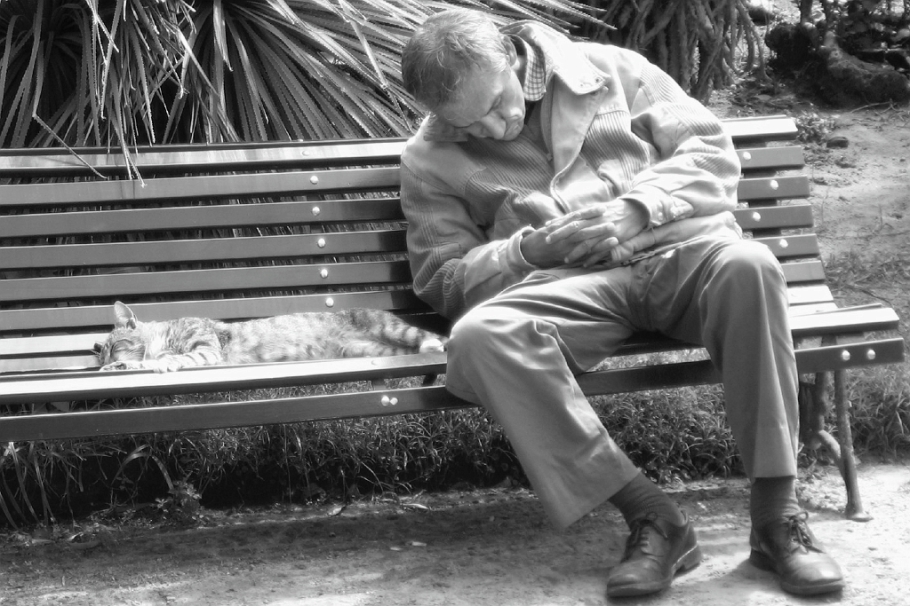
The Gardens also have the unfortunate reputation as the home to unwanted domesticated cats. Early calls to remove or destroy the feline population were met with fierce opposition. Interested volunteers have formed the committee, Asociación Civil Gatos Botánico (on Facebook and Twitter). With several hundred cats in the gardens, people have a tough job keeping up, taking their own time and money to neuter, care, feed, and vaccinate the cats, as well as organizing suitable candidates for adoption into new homes.

•   “Everything You Need to Know About the Cats of the Jardín Botanico”, by Mark Pampanin, The Bubble, 20140604.
•   “La tarea de los voluntarios del Jardín Botánico es enorme – nos ocupamos del bienestar 250 gatos en estado de abandono.” Por Silvina Rufrancos, La Prensa, 20140820.


Abandoned domesticated cats, Jardin Botanico Carlos Thay, Palermo, Buenos Aires, Argentina, fotoeins.com

Abandoned domesticated cats, Jardin Botanico Carlos Thay, Palermo, Buenos Aires, Argentina, fotoeins.com

Abandoned domesticated cats, Jardin Botanico Carlos Thay, Palermo, Buenos Aires, Argentina, fotoeins.com

Abandoned domesticated cats, Jardin Botanico Carlos Thay, Palermo, Buenos Aires, Argentina, fotoeins.com

Abandoned domesticated cats, Jardin Botanico Carlos Thay, Palermo, Buenos Aires, Argentina, fotoeins.com

Abandoned domesticated cats, Jardin Botanico Carlos Thay, Palermo, Buenos Aires, Argentina, fotoeins.com

Abandoned domesticated cats, Jardin Botanico Carlos Thay, Palermo, Buenos Aires, Argentina, fotoeins.com

I made these photographs with a Canon PowerShot A510 on 23 March 2008 in Buenos Aires, Argentina. This post appears on Fotoeins Fotopress at fotoeins.com as http://wp.me/p1BIdT-884.

New Zealand: inside Fiordland’s Milford Sound

A trip to New Zealand’s South Island is incomplete without a visit to the Fiordland National Park. A stop at one or both of Milford Sound or Doubtful Sound is also highly recommended, as they are some of the most popular destinations in New Zealand and on the South Island. From Queenstown, I sided with Real Journeys for a daytrip out to Milford Sound: morning coach on the only road access, Milford Sound Highway (State Highway 94), from Queenstown to Milford Sound; a boat into the fiord; and the return to Queenstown by plane. The Maori Ngai Tahu name for the body of water is Piopiotahi (“one piopio bird”). The piopio resembles a thrush but is considered extinct with the last sighting in 1905.

Much of the scenery reminds me of my home province: coastal British Columbia. Carved by glacial activity, Fjords (also spelled “fiords”) are long narrow inlets with steep sides or cliffs. My time in southwest New Zealand reminds me of home along the southwest coast of British Columbia.

( Click here for images and more )

Kangaroo Island (SA): seals, koalas, & roos

Devastating bushfires in the 2020 Australian summer (December 2019-March 2020) wiped out a significant fraction of flora and fauna on Kangaroo Island. For many plant and animal species, recovery will require years to decades.

Kangaroo Island in South Australia was named for the large number of kangaroos, which were a source of fresh meat for the crew of the British ship HMS Investigator in 1802. The ship was captained by Matthew Flinders, who was tasked to chart the southern Australian coastline. Desperate without fresh supplies for months, Flinders named the island in gratitude for the abundance of roo meat.

Then again, the indigenous name for the island is “Karta” or “Island of the Dead.” That’s a little sinister, as something must have happened; either the aborigine population left the island or they died out.

But life bounces back, and there’s plenty of it on this island.

There are plenty of sheep where on grassy meadows, seals at Kingscote Jetty, young and adult seals relaxing and sleeping in the sun at Admirals Arch, free-climbing koala bears and free-roaming kangaroos at the Hanson Bay Wildlife Sanctuary, Ligurian honey bees at Clifford’s Honey Farm, and a lone echidna by the side of a dirt road in the middle of the island.

In making these photos, I used my long-zoom lens; no animals were harmed, poked, prodded, or ridiculed in the process.

( Click here for images and more )