Fotoeins Fotografie

location bifurcation, place vs. home

Posts from the ‘Canada’ category

The place where I died

With these pictures, I explored the perspective of witnessing a parent’s unstoppable decline to the end. I didn’t include pictures of my father in this set, but I gave voice to growing distress at his final journey in orbit around a downward spiral. My gaze drifted externally to the space and form of the hospital and to the surroundings outside.

On 19 July 2014, Dad was taken to Vancouver’s St. Paul’s Hospital after he had a minor fall down the stairs at home. No bones were broken, which was remarkable considering his worsening health in the final stages of cancer. He would never return to the house in which he and Mum had bought and lived since 1976.

By the 2nd week, he had been moved from to the Palliative Care Unit (PCU) on the 10th floor. The wonderful hospital staff took great care of him and other patients in the unit. Dad charmed the PCU staff by chatting with them in broken English; it was his way of exerting some measure of control. I also witnessed the inevitable “shuffle”. One day, a patient slept quietly in one of the other beds, surrounded by members of his family. The following day, the bed was cleared, cleaned, and prepared for a new patient.

Into week 3, his mind and spirit departed, and he became completely unresponsive to external prompts. Over the following days, his body remained, accompanied by sounds of breathing, often shallow and laboured. He was at peace, and thanks to the meds, in diminished pain. I’d been with Dad a part of every day for 21 consecutive days. Friday came and went, and so did the passing of the sun. As I’d done every evening, I leaned down and whispered: “good night, I’ll see you tomorrow.” The following morning, I awoke to a phone call. The nurse’s voice was calm and gentle. Somewhere in the universe, I heard faint echoes of the death rattle. I said to the nurse: “thank you for your phone call. We’ll be at the hospital in a few hours.”

I ended the call and looked down at my watch: 613am. The date was August 9. He had celebrated his 82nd birthday only a few weeks earlier.

Northern summers, especially July and August, mean something entirely different.


( Click here for images and more )

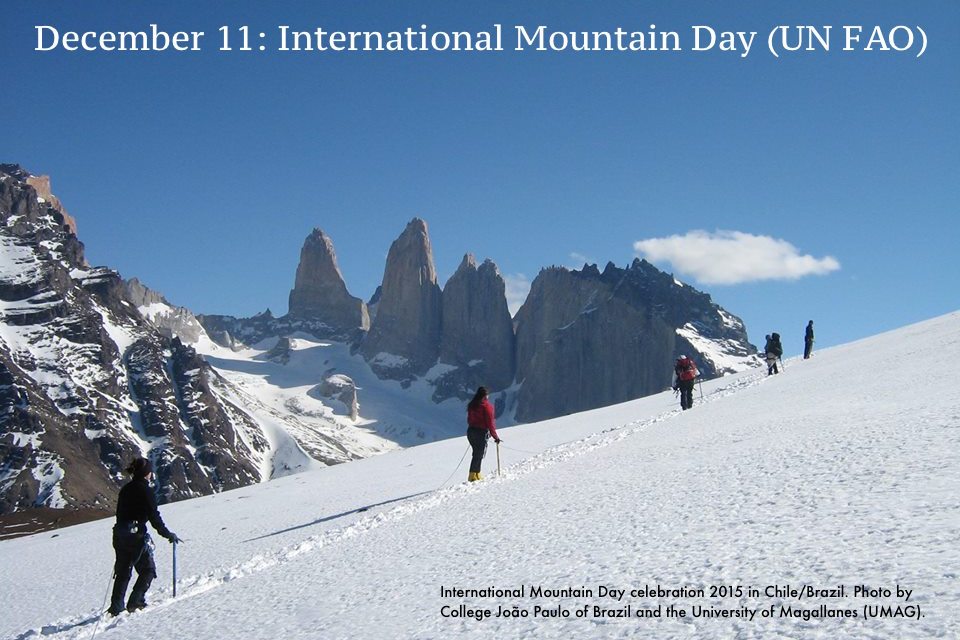
UN FAO International Mountain Day. International Mountain Day celebration 2015 in Chile/Brazil: photo by College João Paulo of Brazil and the University of Magallanes (UMAG).

11 December: International Mountain Day

Since 2003, December 11 is International Mountain Day as designated by the United Nations General Assembly. Annually, the Food and Agriculture Organization of the United Nations (FAO) observes the day:

… to create awareness about the importance of mountains to life, to highlight the opportunities and constraints in mountain development and to build alliances that will bring positive change to mountain peoples and environments around the world.

•   Mountains cover almost one-quarter (22 percent) of the Earth’s surface.
•   Mountains host about 50 percent of the world’s biodiversity hotspots.
•   Up to 80 percent of the world’s freshwater supply comes from mountains.
•   One in eight people (13 percent) around the world lives in the mountains.
•   Mountain tourism accounts for almost 20 percent of the worldwide tourism industry.

The following provides a glimpse to the mountain environments around the world and to the challenging conditions our ancestors would have faced and endured.


( Click here for images and more )

Fraser River, Port Mann Bridge, Coquitlam, Port Coquitlam, BC, Canada, fotoeins.com

World Rivers Day: 50+ rivers from around the world

Above: Fraser River, east from Port Mann Bridge, between Coquitlam and Surrey, BC (HL).

The fourth Sunday in September is World Rivers Day. The University of Oxford’s Dictionaries defines ‘river‘ as:

“a large natural stream of water flowing in a channel to the sea, a lake, or another river.”

A river has always been water supply and demand: daily use and consumption; farming and agriculture; and where the waste goes, often back into the same supply. A river has always been about transport: trade and delivery of goods; shuttling people between places; and with people travelling, the exchange of language and culture. Throughout history, the establishment of towns and cities and the subsequent development of rivers have been about a mix of urban and rural elements, and about the relationship and interactions between people and their waterways.


( Click here for images and more )