Fotoeins Fotografie

location bifurcation, place vs. home

Posts from the ‘Canada’ category

New West actor Raymond Burr

Fraser Cemetery

As a boy whose early memories include the family’s small black-and-white television from the 1970s, I remember the tv show “Ironside.” Canadian-born Raymond Burr played the titular character of Robert Ironside, special consultant for the San Francisco police department. Years later in the mid- to late-1980s, Burr returned as Perry Mason, the lead from the 1960s weekly tv-drama revived as a popular series of made-for-tv movies. He died in 1993, buried with members of his family in Fraser Cemetery, at home in New Westminster, B.C.

Burr family grave at lower-centre – 9 Apr 2024 (iP15).
Raymond Burr (lower-right), with sister Geraldine, father William, and mother Minerva – 9 Apr 2024 (iP15).

In 1858, the British established New Westminster as first- and capital-city of the new colony of British Columbia. Fraser Cemetery accepted its first burials in 1869.


I made all images above with an iPhone15 on 9 April 2024. Composed entirely within Jetpack for iOS, this post appears on Fotoeins Fotografie at fotoeins DOT com as https://wp.me/p1BIdT-sjD.

A mobile test

This Heading is H4

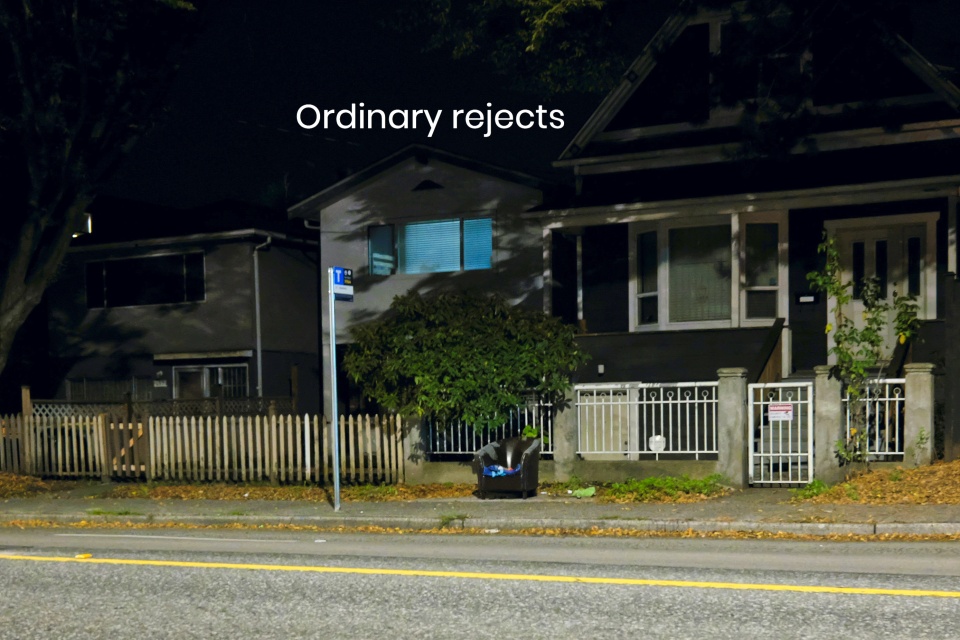
I’ve always wondered what it’d be like to create a post on mobile, independently of laptop or desktop. The present example is a text block that goes before an image.

“The Sappers were here” (www); photo on 13 Apr 2024 (iP15). Example of inserted image block.

This is an example of a text block after an image; in this case, it’s at night across Brunette Avenue from Sapperton SkyTrain station in New Westminster, BC.

While I might add a few thoughts about image and context of its time and place, further lack of customization (e.g., access to shortlink, modified edit-defaults via desktop, etc.) emphasizes the simplicity to the swift overall process of content creation and snobbery by sidestepping users’ own creative process to content creation.


I made the image above with an iPhone15 on 13 April 2024. Composed entirely within Jetpack for iOS, this post appears on Fotoeins Fotografie at fotoeins DOT com as https://wp.me/p1BIdT-siu.

My Fuji X70: Fujichrome Slide, Kodak Platinum 200 (XTrans2 recipes)

Above/featured: 1st Narrows, from John Lawson Pier.

My Fujifilm X70 mirrorless fixed-lens prime camera has been a big plus for photography at domestic and international locations. The built-into-camera film-simulations (e.g., Provia, Velvia) work beautifully in standard settings, but as I’ve never had a film camera, the advent of “camera recipes” to produce additional film-like settings stimulated interest in different colour or pictorial representations.

So far, I’ve tested these Fujifilm film-simulation (“film-sim”) recipes:

•   Ektachrome 100SW (saturated warm), simulating images with the Kodak colour transparency or slide films produced 1996–2002;
•   Kodachrome 64, simulating images with the Kodak colour film produced between the mid-1970s and 2009;
•   Kodacolor, “producing classic Kodak analog aesthetic closest to early-1980s Kodacolor VR200 colour film that’s been overexposed.”


( Click here for images )

My Fuji X70: Kodacolor (XTrans2 recipe)

Above/featured: After Girard: Vancouver-Strathcona, 14 Oct 2021.

The Fujifilm X70 mirrorless fixed-lens prime camera has been a real boon to my approach to photography for personal projects both domestically and internationally. To satisfy my curiosity, I’ve provided examples of X70 images made with two Fujifilm analog-film simulation (film-sim) recipes:

•   Ektachrome 100SW (saturated warm), simulating images with the Kodak colour transparency or slide films produced between 1996 to 2002;
•   Kodachrome 64, simulating images with the Kodak colour film produced between the mid-1970s and 2009.

In this post, I examine the Kodacolor film-simulation, a reproduction of which Fuji X Weekly’s Ritchie Roesch describes as “producing a classic Kodak analog aesthetic.” According to Roesch, the digital film-simulation is closest to Kodacolor VR analog color film from the early-1980s, whose ISO200 version is still available for purchase as “ColorPlus 200” (Kodacolor 200).

The following film-simulation recipe creates images similar to the look of “Kodacolor VR 200 (film) that’s been overexposed.” My X70 settings are:

  • ‘Classic Chrome’ built-in film-sim
  • Dynamic Range: DR400
  • Highlight: +1 (Medium-High)
  • Shadow: +1 (Medium-High)
  • Color: -2 (Low)
  • Sharpness: 0 (Medium)
  • Noise Reduction: -2 (Low)
  • White Balance: 6300K; -3 Red, -2 Blue
  • ISO: Auto, up to 6400 for “grainy” appearance (or fixed to 1000)

The recipe above is for the X-Trans II sensor; the corresponding recipe for an updated or more recent sensor is found here. All other recipes sorted by specific sensor are found here.

The following images were made at locations throughout metropolitan Vancouver. Minor adjustments to brightness level, rotation, and geometric distortion have been applied from straight-out-of-the-camera (SOOC) to posting.


( Click here for images )