Fotoeins Fotografie

location bifurcation, place vs. home

Posts from the ‘Europe’ category

Wittenberg: 13 historical highlights in the Lutherstadt

Above: Facing west from Kirchplatz, the Stadtkirche (City Church) and Schlosskirche (Castle Church) at upper-left and lower-right, respectively, are Wittenberg’s major landmarks.

If you’re thinking about or you’re already present in Wittenberg, two words have already provided the marquee reasons why you’re here at this blogsite and there in the town: Martin Luther.

The biggest reason why people will step foot in Wittenberg is to see and learn about how the Protestant and Reformation movement began and took hold, who the major players were, and what their roles were in the movement. For most, they’ll want to visit the four sites which form the basis for the town’s status as UNESCO World Heritage Site (WHS; see below). In addition to these four, there are other highlights for the curious and interested visitor, and all of them are easy to reach in the compact Old Town.


( Click here for images and more )

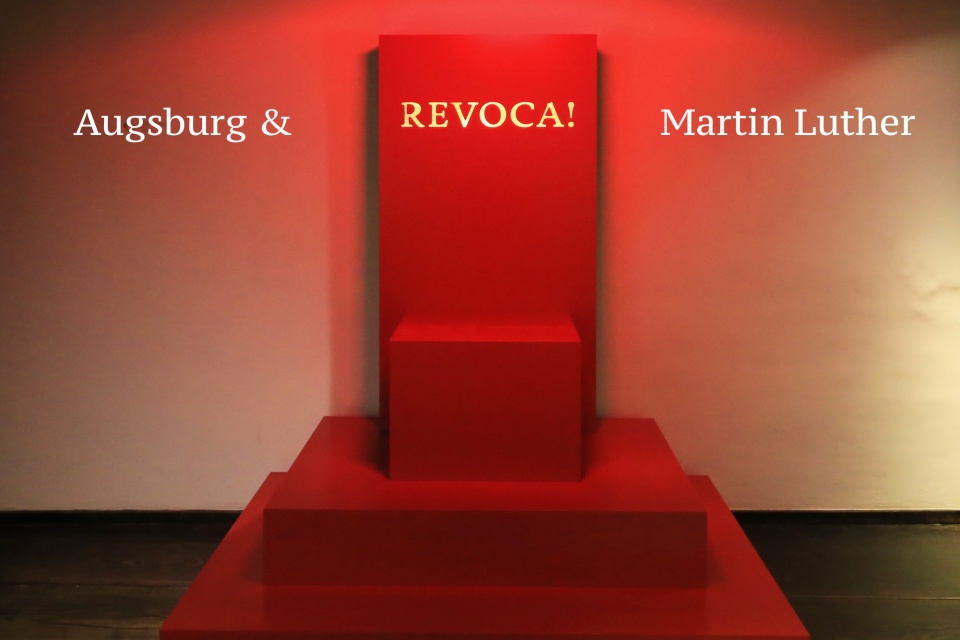
Martin Luther, Museum Lutherstiege, St.-Anna-Kirche, Augsburg, Bayern, Bavaria, Germany, fotoeins.com

Augsburg: Luther vs. Cajetan (1518), Confessions (1530)

Above/featured: REVOCA! (Cajetan to Luther, 1518), Museum Lutherstiege.

With its founding date as “Augusta Vindelicorum” by the Roman Empire in 15 BC/BCE, Augsburg is one of the oldest cities in Germany, and has ties with Martin Luther and the Reformation which marks its 500th anniversary in 2017.

Months after making his 95 Theses known to church authorities and the public, Martin Luther was called to the free imperial city of Augsburg in 1518 by Cardinal and papal legate and representative Cajetan to answer charges of heresy, for challenging the morality of indulgences, and for questioning the supreme authority of the Pope. Cajetan urged Luther to recant or revoke his statements (“revoca!”), but Luther held firm and refused to obey Cajetan.

( Click here for images and more )

street art, mural, Herakut, Metropolink, Heidelberg, Germany, fotoeins.com

My Heidelberg: Herakut street art for Metropolink

It’s amazing what gets discovered after going the wrong way.

I head straight for a full city-block before realizing my error, that I should’ve turned right about 5 minutes ago. I bow my head, and release a deep breath in frustration. I raise my head to the sky, when I catch sight of something out of the corner of my eye.

What’s that across the street?

I have to reach my destination which I know isn’t far.

But I am coming back here to get the shot.


( Click here for images and more )

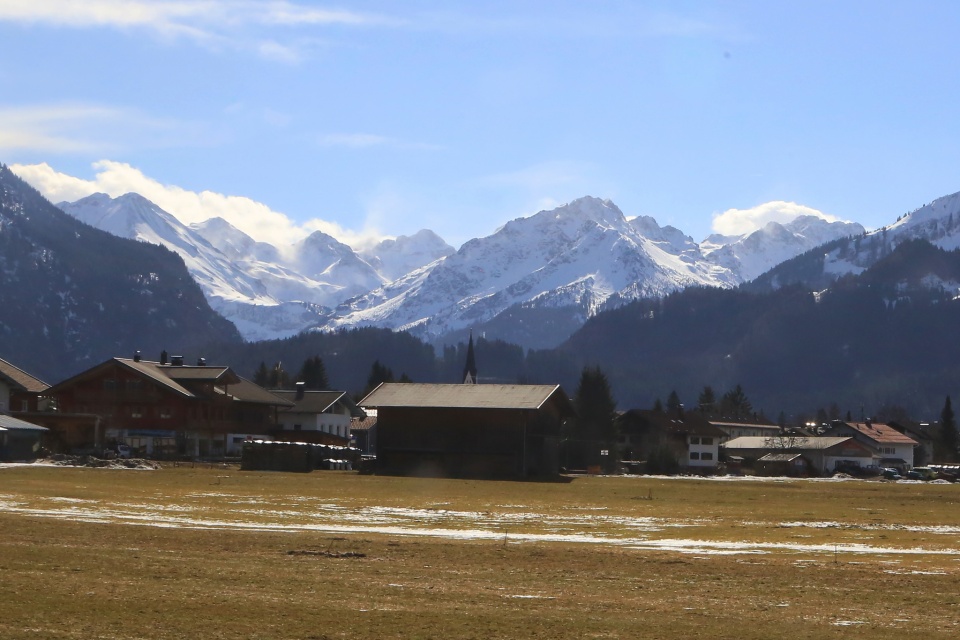
Oberstdorf, Oberbayern, Upper Bavaria, Bavaria, Allgaeu Alps, Alps, Germany, fotoeins.com

Oberstdorf: Sunday Allgäu night auf Deutsch

Why multiple languages rock my world

With fewer than ten-thousand inhabitants, Oberstdorf in southern Bavaria is as its German name suggests: an “upper village” tucked in the Allgäu Alps near the German-Austrian border. Yet, the town feels busy and full with skiers, snowboarders, and winter hikers.

It’s Sunday night and I’m on the hunt for “schnitzel and spätzle.” With my eye already on a place, I arrive at 630pm to a full house. I don’t have a reservation (which is dumb in a small town), but a table of four is available (which is fortunate). The server offers me the table, with the condition I’ll be sharing the table if two people want places. “Alles klar,” I reply.

I order a standard half-litre Weizen beer, along with the required schnitzel-and-spätzle platter. An elderly couple is offered two places at my table; they take one glance in my direction, and they’re gone. The server wears a puzzled look, and I can only shrug. A second couple arrives ten minutes later, and as they approach my table with curiosity, I tell them “die Plätze sind noch frei” (the places are available). They express their thanks, and take their seats across from me. Those last five German words set a positive tone for the rest of the evening.

( Click here for more )

Dessau: The Bauhaus Building, UNESCO WHS

21st-century Modernity, from 1919 on

The chair or couch on which you sit.
The table on which you’re resting your mobile or pad.
The desk on which your laptop or desktop resides.
The light fixture on your desk or above your head.
The windows in your room, your house, or in the café where you’re reading this.

The “universal” idea of living in a house or apartment with the furnishings we all take for granted from bathroom to bedroom and kitchen to living room is a relatively young idea by historical standards. It’s easy to imagine a time where only the rich upper-class could afford and were allowed to have and live in heated furnished residences, and the poor lower-class lived in unheated homes under damp dirty squalid conditions. Past designs with its heavy stone, porcelain, and ornate decorative components gave way to steel, glass, lightness of space, to favouring function over form. Simpler designs were meant to provide universal access: to the home, and to the essentials which furnished the home.

( Click here for images and more )