Fotoeins Fotografie

location bifurcation, place vs. home

Posts from the ‘Europe’ category

Tempelhofer Feld, Flughafen Tempelhof, THF, Tempelhof, Berlin, Hauptstadt, Germany, Deutschland, fotoeins.com

Previously, in Berlin (2006–2017)

Above/featured: Tempelhofer Feld: runway 09R/27L at former THF airport – 16 Oct 2017 (6D1).

I made the cross-country rail journey to Berlin for the first time in 2002 when I lived and worked in Heidelberg. In the years since, I’ve answered the siren’s frequent call by returning to Berlin multiple times. I’ve lost track of the precise count that’s north of 10, but less than 20.

Berlin is Germany’s capital city, but in many respects, the city isn’t very German at all. Berlin is an “internationally German place.” The enigmatic moody metropolis isn’t the prettiest and can be one of isolation, especially in autumn and winter. During a cold gloomy stretch in late-2012, I survived by accessing the diverse array of arts and culture events and venues. What is very familiar is how Berlin’s residents show up outside when sunshine returns.

The following 16 images in chronological sequence show a slow forward progression to a quiet contemplative observation of the city and her residents.
( Click here for images and more )

My Mittenwald: mountains, masks, music, Mahlzeit!

Above/featured: From the regional train: facing southwest over Schöttlkarstrasse and the eastern end of the Wettersteinwand at right.

In 1786, the German writer Johann Wolfgang von Goethe described the alpine town of Mittenwald as “lebendes Bilderbuch” – a living picture-book. Images and descriptions in print and provided by visitors became a real draw and lure. Funny thing is I’d stayed in nearby Garmisch-Partenkirchen several times, and I hadn’t taken the easy 20-minute train hop to Mittenwald.

I took care of that with two visits within a span of 15 months: with snow and without snow.

Wandering through Mittenwald is pure delight because of abundant fresh mountain air, picturesque surroundings, and the compact nature of the town. The description becomes a common refrain for alpine towns.

Mid-winter is special with the combination of seeing mountains freshly frosted with snow, people of all ages wearing masks and costumes during carnival season, houses painted in colourful “Lüftlmalerei”, and the town’s special place in music history. When the warm sun dominates in spring and summer, it seems like an endless vista of blue skies along with green meadows and mountains to accompany your time outside on walks and hikes in the area.


( Click here for images and more )

Vienna Central Cemetery: living city of the dead

Above/featured: The cemetery’s gate 2. Photo, 20 May 2018.

Where: Vienna Central Cemetery (Wiener Zentralfriedhof).
Who: Beethoven, Boltzmann, Falco, Lamarr, Schütte-Lihotzky, Strauss I and II, and many more.
Why: Cross-section of cultural and economic history for capital city and nation.

In Vienna, tram 71 begins in the Old Town; goes around the western half of the inner ring past City Hall, national Parliament, and the Opera House; and heads southeast to the city’s main cemetery or the Zentralfriedhof. Because coffins to the cemetery were once transported on the tram, there’s a saying particular to the city’s residents, a phrase which means they’ve died by “going to the end of the line.”

Sie haben den 71er genommen.
(They took/rode the 71.)

( Click here for images and more )

Vienna: Holocaust Memorial by Rachel Whiteread

Where: Judenplatz, in Vienna’s Altstadt.
What: Holocaust Memorial, by Rachel Whiteread (2000).

How do you commemorate or memorialize the absent or missing? How should the void be acknowledged, recognized, and remembered? Does the act of constructing a physical monument “draw a line”, creating a physical manifestation of marking an end that gathers and wipes away all subsequent future responsibility for remembering?

In Vienna’s Old Town, what was unjustly and violently removed from the city’s long historical memory and cultural identity comes into shape at Judenplatz. Under the public square are ruins of the medieval synagogue destroyed in the pogrom of 1421 with hundreds of Jews driven out, hundreds killed by burning, and the community erased. Directly above these ruins is the Holocaust Memorial which attempts to generate experiences and memories to address the void left behind after the systematic murder of 65-thousand people.

( Click here for images and more )

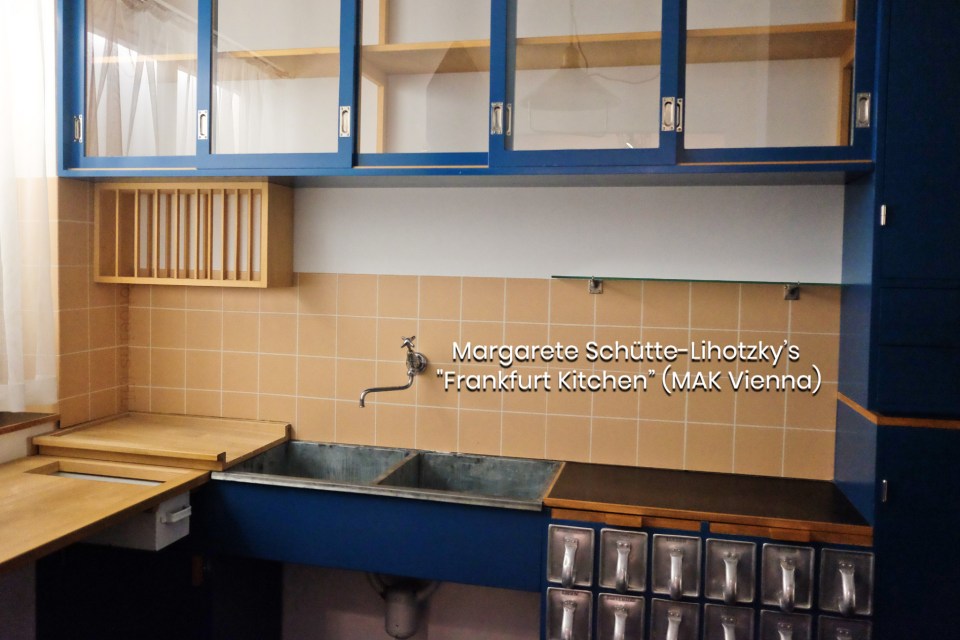
Frankurter Küche, Frankfurt kitchen, Margarete Schütte-Lihotzky, MAK Vienna, Vienna, Wien, Austria, Österreich, fotoeins.com

Vienna: Margarete Schütte-Lihotzky & the modern fitted kitchen

Who: Margarete Schütte-Lihotzky.
Key: 1st woman architect in Austria, designer of something we take entirely for granted.
Quote: “I developed the kitchen as an architect, not as a housewife.”

I always liked how cooking had well-defined endpoints: a desirable start, and a satisfying conclusion. I enjoy the process: the contemplation of “what to make,” the gathering of ingredients, the preparation, and naturally, the consumption. There might also be something to say about the duality of creation and annihilation …

That got me to thinking about kitchens as a critical unit of a home. Before the 20th-century, the wealthy could afford to have staffed kitchens; everybody else had access to no kitchen or an unsafe unhygienic kitchen in a building separate to their living quarters. The assumed universality of a kitchen within a home is a 20th-century concept and implementation that sought to overcome social and economic class. The design of a modern kitchen invites repeated patterns of movement and action around where cookware, utensils, condiments, glassware, etc. are stored and where the central focus of cooking activity takes place.

For everyone who spends any time in a kitchen, we have Margarete Schütte-Lihotzky (MSL) to thank.


( Click here for more )