Featured: Alter Markt, facing southwest to the former Schloss Blieskastel at upper-centre: Blieskastel, Saarland, Germany (X70).
David Oppenheimer: ✵ 1 January 1834 – 31 December 1897 ✟
As a child of the city, I learned the name of Vancouver’s 2nd mayor, David Oppenheimer, who served in the top post from 1887 to 1891. Escaping the violent revolutions spreading through Europe, David Oppenheimer and his brothers had long been immigrants from Germany, and after time in New Orleans and California, they arrived in what is now southwestern British Columbia and developed business success with their supply stores during the Gold Rush, and with wholesale trade and real estate in the newly incorporated city of Vancouver, where the national railway established its western terminus one year later in 1887. The Oppenheimers stamped their civic legacy not only with the location of the railway terminus, but also with an expansive infrastructure program including a new grand city park, fire department, extensive roadworks, a city-wide electricity grid, streetcar public transport network, and a city cemetery. On 11 April 2008, the Government of Canada’s Historic Sites and Monuments Board designated David Oppenheimer as a National Historic Person.
There’s little doubt the Oppenheimers spent plenty of time in what are now Vancouver’s Chinatown and Strathcona with their business interests and connections to the city’s Jewish community. These are neighbourhoods, respectively, where my parents sought closer ties with the Chinese-Canadian community, and where they bought a new house to raise their family. Decades later, I’ve flown out from Vancouver, and I’ve been on the train from Frankfurt to southwest Germany’s Saarbrücken for its proximity to the Völklingen Ironworks world heritage site. I also recently learned David Oppenheimer was from the area and born in the city of Blieskastel. I arrange to meet with a representative of Stadtarchiv Blieskastel (city archive), and I make my way to Blieskastel to see what I can learn about the Oppenheimer family.
2024 has been an interesting year of personal challenge and discovery. A conclusion for the family house provided fresh impetus to inhabit (in the short term) new spaces and places to improve overall health and happiness. In Vienna, I spent a full month for the third consecutive summer. Yes, it was continent hot, but time in the Austrian capital was both glorious and productive as expected. In Calgary is a city I hadn’t visited in many decades, and I witnessed a very happy aunt surrounded by many family members on her centenary year. In California’s Bay Area is a place where I hadn’t set foot in over ten years, but whose daily temperatures and chances of consistent sun offer a higher level of content.
I’m in Stuttgart for a few days, and I rediscover photographer Gerda Taro was born in the city. I’d already read some history of photography, including the Spanish Civil War and Gerda Taro as the first woman to photograph and publish images about open conflict. I’ve gone looking for some traces in the city of her birth, as a quick and spontaneous mini-project in the midst of 90 consecutive days in Europe.
Memorial, near Olgaeck
Near the bus and tram stop Olgaeck is Gerda Taro Plaza, in memory of the young woman photographer who was born “Gerta Pohorylle” in Stuttgart and who once lived with her family in the area. At the plaza is a 2014 memorial dedicated to Taro; the text on all nine panels is entirely in German.
Named for photographer Gerda Taro (1910-1937), the plaza was unveiled by the city in 2008, and redesigned in 2014 with the installation of the memorial.
“O”. Gerda Taro, a pioneer in war photography.
“R”. The 1920s: Jazz, Theater, and the Stuttgart Kickers.
“A”. Leipzig: distributing leaflets against Hitler.
“T”. Exile in Paris: meeting André Friedmann, and the creation of Gerda Taro and Robert Capa. There is no Capa without Taro.
“A”. The Spanish Civil War, 1936-1939.
“D”. Barricades, armed women, equitable distribution of land.
“R”. The camera as witness: misery and terror from bombs.
“E”. Getting up close, for the world at large.
“G”. The first woman war-photographer killed on location. Documenting Spain’s civil war with her camera, Gerda Taro was accidentally run over by a tank and died from her injuries in a hospital near Madrid on 26 July 1937. She was buried in a marked grave in Paris’ Cimetière du Père-Lachaise.
Republican militia women training on the beach outside Barcelona, Spain: photo by Gerda Taro, August 1936. Provided by Ur Cameras on Flickr via Creative Commons.
Family home
Not far from Gerda-Taro-Plaza, I found the Pohorylle family’s former home, based on this poignant essay. I didn’t see any Gedenktafel (memorial plaque) or any Stolpersteine (stumbling stones) in the pavement, at or in front of either building 170 or 170A. In 1929, when Gerta was 19 years old, the Pohorylle family moved from Stuttgart to Leipzig.
Obstructed view of the former Pohorylle family house (in light orange), as seen from passage off Cottastrasse.
Gate to path access for building address Alexanderstrasse 170A.
Former Pohorylle family house, at Alexanderstrasse 170A.
Taro, short bio
Born Gerta Pohorylle, 1910 in Stuttgart, Germany; died 1937 in El Escorial, Spain.
“… Studied in Leipzig starting in 1929. Emigrated to Paris in 1933. In 1935 began working with the photographer André Friedmann, later known as Robert Capa. In 1935-1936 worked for the Alliance Photo Agency. Shortly after the outbreak of the Spanish Civil War in the summer of 1936, she and Capa went to Spain; other photography assignments in Spain followed in early 1937. She was fatally wounded at the Brunete front in July 1937 and was the first female war correspondent killed in action.”
Source: “Women War Photographers: from Lee Miller to Anja Niedringhaus” (Munich: Prestel, 2019), p. 218.
I made all photos above with an iPhone15 on 22 Jul 2024. I received no support from an external organization. This post composed with Jetpack for iOS appears on Fotoeins Fotografie at fotoeins DOT com.
( Updote: On 18 September 2025, Bavarian state broadcaster BR24 reported the monthly price for the Deutschland-Ticket will go up by 5€to 63€, starting 1 January 2026. The price had already gone from 49€ to 58€ for the 2025 calendar year. My summer 2025 purchase went the same way as in 2024, whose details are described below. )
89 days within Europe includes by necessity substantial travel by train within Germany. I’ve already booked in advance a number of intercity express segments, but what about local transport and regional trains?
The “Deutschland Ticket” (D-Ticket) is a rail ticket for one person and costs 49€ per month on a rolling subscription. The ticket is generally valid for local transport (bus, tram, U-Bahn, S-Bahn, intracity ferry) and regional rail (RB, most RE, IRE), but not for long-distance IC and ICE routes. Intended primarily for commuters, visitors to Germany can also purchase these tickets.
It’s early-April 2024, and I’m about to buy the D-Ticket for 49€ for the entire month of May. The ticket’s “rolling subscription” means if I do nothing else before 10 May, I’ll also automatically purchase a D-Ticket for the month of June for 49€. I’ll need the D-Ticket for May, June, July, and August; but I can only buy one month at a time.
I choose Munich’s MVV-App, based on successes reported by other travellers. I’m only using the Munich app for ticket purchase, and I’m not planning to use public transport within Munich. To buy a D-Ticket, customers are neither limited by their choice of app/method, nor by the base/location where the app is based. My question is whether a Canadian-based credit card is an acceptable form of payment by the processing company in Germany for a German-based app.
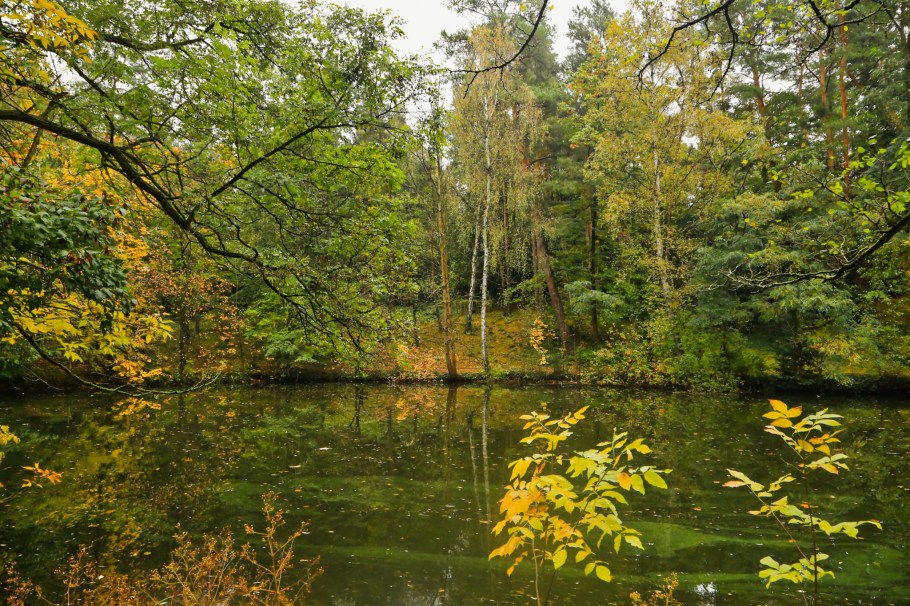
Is this a small park with plenty of trees, hilly terrain, and a small lake? Or is this simply a forest cemetery, a final resting spot for many prominent Berliners?
As part of an ongoing search for gravesites for physicists and mathematicians in Germany, I visited Berlin’s Friedhof Heerstrasse, near the city’s Olympic Stadium. Within the cemetery is Sausuhlensee lake, which settled into a former glacial gully, around which much of the cemetery came into being in 1924. Named after the early 20th-century Heerstrasse estate district whose residents were to be buried here, the cemetery stretches out over an area of almost 15 hectares (37 acres).
I found the grave for physicist Hermann Minkowski, but among the buried there are other “Promis” (prominent).
Forested park, forest cemetery.
The calm waters of Sausuhlensee lake on an autumn afternoon.