Fotoeins Fotografie

location bifurcation, place vs. home

Posts from the ‘Germany’ category

Rothenburg ob der Tauber: medieval night glow

Many visitors to Rothenburg ob der Tauber are here for the day, and when day turns to night, you can have the place to yourself for the opportunity to view and photograph. And judging by these photographs, you may well ask yourself: where did everybody go?

A good place to start to get your bearings straight is the Marktplatz (Market Square; photo above and map below). While you wait for Hans Baumgartner to begin his Nightwatchman nightly walking tours (in English or German), you can look up the Ratstrinkstube (Councillors’ Tavern) for a modest retelling of the Meistertrunk legend. The following 90-second video shows how the figures for Mayor Nusch and General Tilly greet curious onlookers at the square at 8pm.


( Click here for images and more )

Ratskeller, Speyer, Rheinland-Pfalz, Germany, fotoeins.com

Speyer: typically German in the Ratskeller

Normally, my passable handling of conversant German gets me far enough in a snack-joint (Imbiss) for a Döner or the gut-busting Dönerteller. On the infrequent occasion I’m inside a restaurant, it’ll be local German fare, much of which I’ve become accustomed while travelling within Germany since 2002.

The town or city hall in every city, town, or village is often accompanied by its own “Ratskeller” (Cellar) serving wine, beer, and food in an underground tavern. At the Speyer Ratskeller, a cold and wet Friday night is in full swing, the place packed with city residents filling all available tables and seats. My host apologizes for the wait, and I reply that it’s no problem. She suggests wine while I wait: definitely not a problem.

( Click here for more )

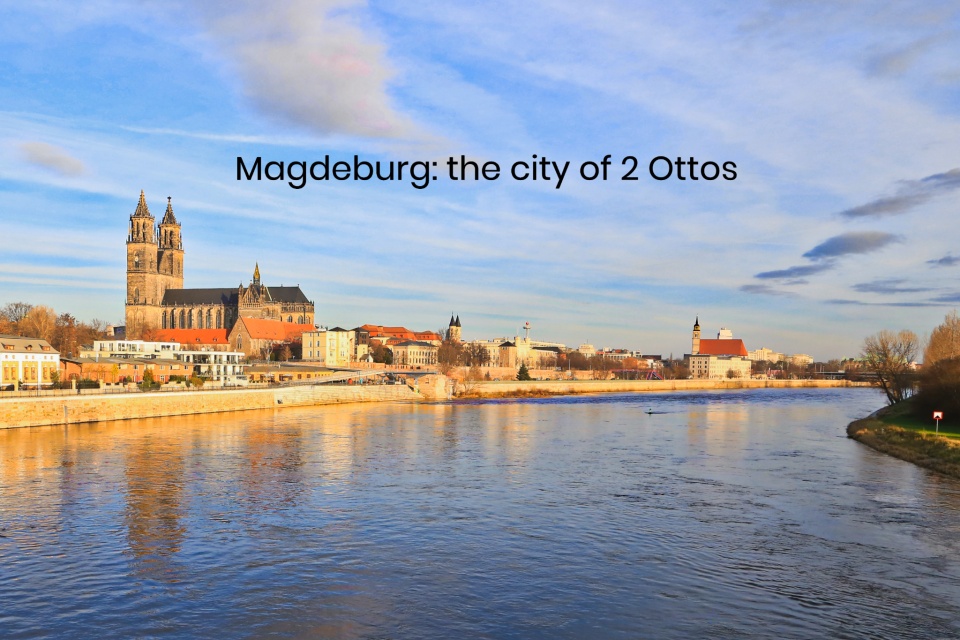
Magdeburger Dom: oldest Gothic cathedral in Germany

As the largest Gothic church in northern Europe, Cologne’s Cathedral gets a lot of love in words and pictures for its size and splendour. But the distinction of oldest Gothic church in Germany goes to Magdeburg. The church is the city’s landmark and the church’s benefactor is part of the city’s nickname as “Ottostadt”. The full name of the church is “Dom zu Magdeburg St. Mauritius und Katharina”, or Magdeburg Cathedral of Saints Catherine and Maurice, reflecting the history at this very location since the 10th-century.

Magdeburg Cathedral is important because:

  • it’s the burial place for Otto the Great, the first German Holy Roman Emperor,
  • it’s the first church constructed in Gothic style on German soil, and
  • it’s the largest consecrated space in east Germany.

( Click here for more )

Morning view, Morgenblick, city view, Stadtblick, Hubbruecke, Elbe river, Romanesque Road, Strasse der Romanik, Magdeburg, Sachsen-Anhalt, Saxony Anhalt, Germany, Deutschland, fotoeins.com

Magdeburg: the Otto city where Romanesque meets Luther

Above/featured: From Hubbrücke bridge over the Elbe river, churches left to right are Dom, Kloster Unser Lieben Frauen, and Johanniskirche, respectively. Photo on 3 Dec 2015.

I’ve seen the city on the map, lying halfway between Hannover and Berlin. Over the last 15 years, there’ve been far too many ICE trains along that very same stretch, bypassing the heart of Saxony-Anhalt. Curiosity eventually wins, and I’m on a train to Magdeburg.

Magdeburg is the capital city of the German federal state of Saxony-Anhalt, home to two famous Ottos, a centre for the state’s Romanesque Road, and one of the stations for (Martin) Luther Country. Founded by Charlemagne in 805 AD/CE, the city is one of the oldest German cities, celebrating their 1200th anniversary in 2005. Magdeburg was an important medieval city in the Holy Roman Empire, a member of the Hanseatic League and important trade centre along the Elbe river, a welcome settlement for Jews in the 10th-century, and one of the first places to begin separating church- from civic-rule of law in the 13th-century with the Magdeburger Recht (Magdeburg Rights).


( Click here for more )

Bayerische Vertretung, Behrenstrasse 21, Euler-Haus, Berlin Mitte, Germany, fotoeins.com

Berlin Mitte ‘Math’: where Euler lived for 23 years

In Berlin Mitte at address Behrenstrasse 21 is the Bayerische Vertretung, whose functions are described as “… die Aussenstelle der Staatskanzlei in der Bundeshauptstadt,” or “branch office of the Bavarian State Chancellery in the German capital.”

Swiss scientist Leonhard Euler spent some 20 years (1743-1766) in Berlin, living in this very building and working at the Académie Royale des Sciences et Belles-Lettres de Prusse (now, Berlin-Brandenburg Academy of Sciences). Euler’s name is very familiar to anyone who’s encountered and studied mathematics and physics. He is well known for his study and work in the fields of physics, astronomy, and engineering. But for his contributions to notation, functional analysis, number theory, and graph theory, Euler is considered one of the greatest mathematicians in history. Euler departed Berlin in 1766, accepting an invitation from Russia’s Catherine the Great to return to St. Petersburg where he remained for the rest of his life.

( Click here for more )