Vienna: Vollpension café, with love from Oma & Opa
Above/featured: Kühnplatz in the 4th district – 22 May 2022.
I never knew my grandparents, except for brief glimpses of mum’s mum, 阿婆, who died before I entered secondary school.
On a warm June day in 2022, I’m sitting in the basement of someone’s family home, lovingly decorated over decades by Omas and Opas. In Vienna’s 4th district, the idea behind Vollpension cafe is retirees do all the baking.
Upon arrival, a host seats me at a table where I’m presented with a “menu card” listing combination- and timing-options. Unlike other cafes in the city, one does not hang out or loiter here for hours, and that means there’s a maximum stay-duration for a specified combination purchase; that’s fine by me, as I choose one of the cake-and-beverage options. The server leaves to retrieve my cool drink, while I go up to the front counter and gauge the remaining options on Sunday mid-afternoon. I want something light on this warm late-spring day: Kardinalschnitt, made with sponge cake, meringue, and fruit jam. I order a slice of Kardinalschnitt mit Schlagobers (with whipped cream). Behind the counter is a kindly Oma to whom I relay in passable German I came all the way from Canada’s west coast to see this place. That impressed her enough that she asks me to come back for a 2nd but smaller piece.
There’s a good mix of ages among the staff. I chat briefly with one of the servers about what it’s like to work here at the café, the guests they’ve seen from different countries, and their favourite cake. Among some of the retired pensioners in house today, I have an additional conversation with a gentleman who has spent time with his family in Vancouver, Canada.
At the outset, some Viennese or Austrians might not seek this place out, although I can tell from surrounding conversations how much Viennese-German is being spoken. At any rate, this place works for me, and if I barely knew my grandparents, I can perhaps get a good taste and long look at life with Austrian grandparents, here at Vollpension in Vienna.
( Towards the end of this post is a 1-minute iPT6-video with a look inside the café. )

Inside Vollpension (X70).
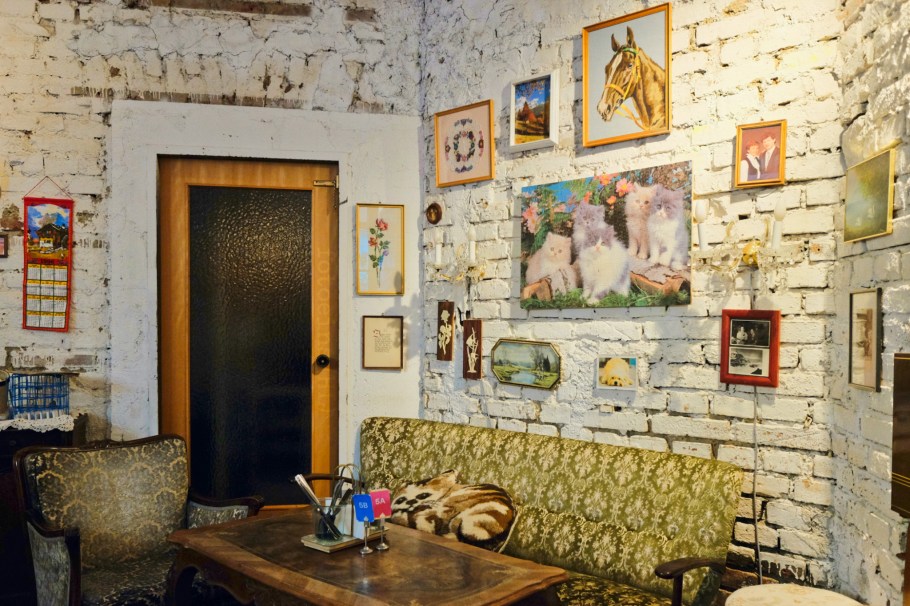
Table 5 (X70).

Tables 6 and 7 (X70).

Table 8 (X70).
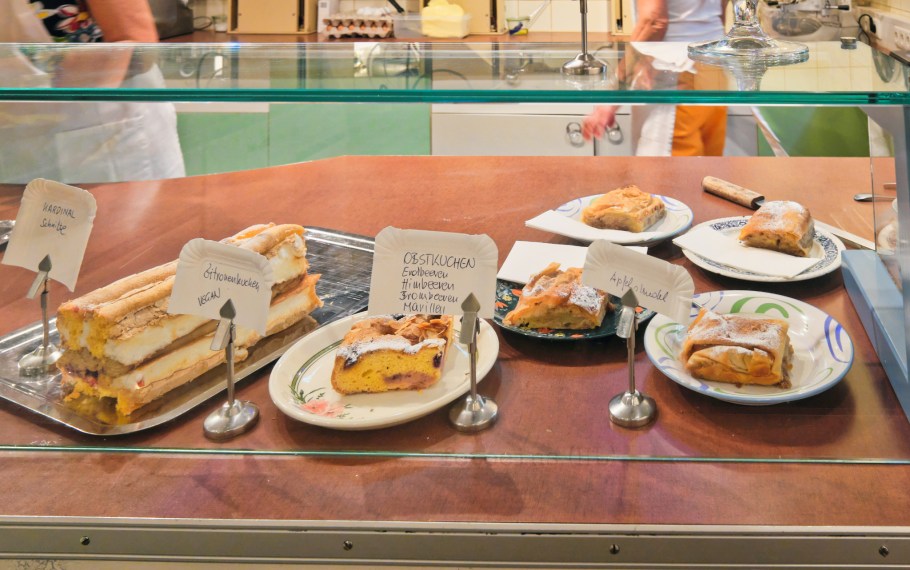
Front counter with daily offerings (X70).
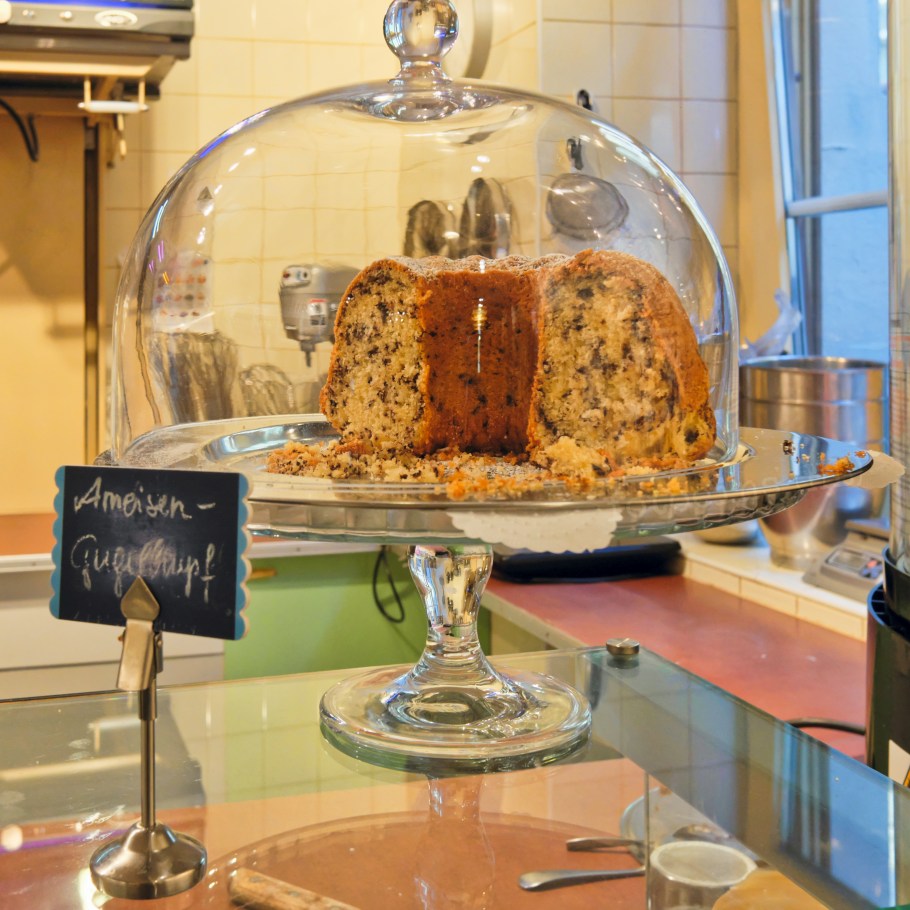
Ameisen-Gugelhupf / Bundt cake with chocolate chips. No “Ameisen” (ants) were harmed or included in the cake-making process (X70).

Topfentorte / cream-cheese torte (X70).
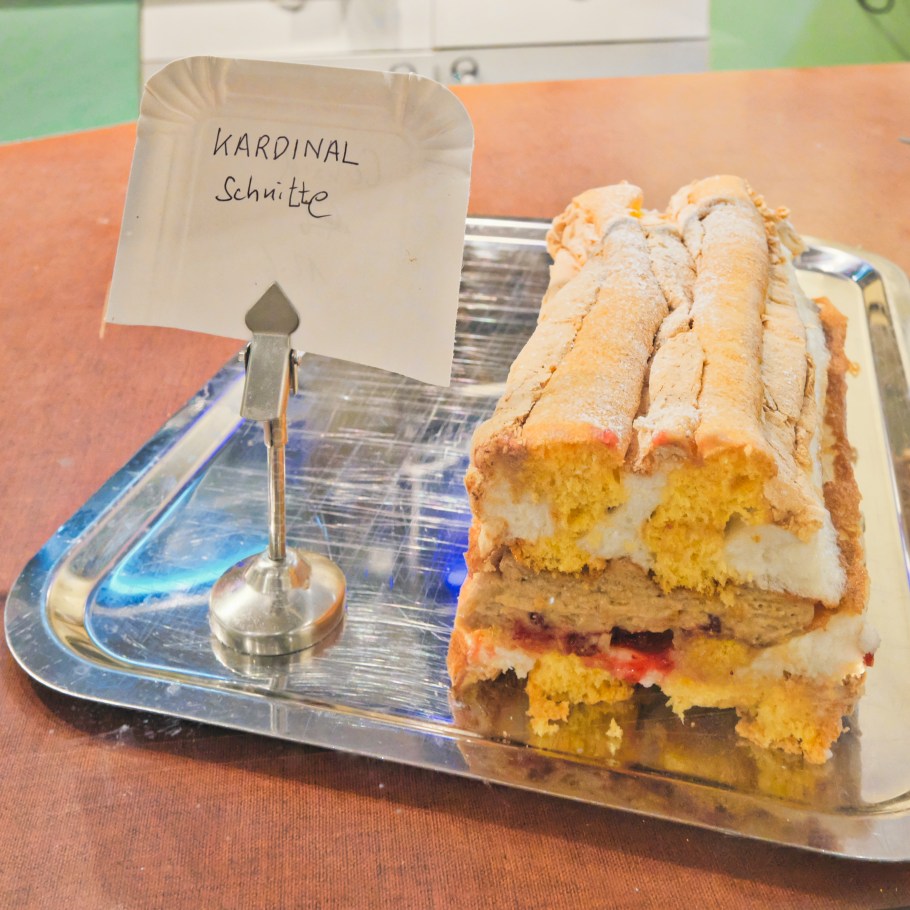
Kardinalschnitte, made with sponge cake, meringue, and fruit jam (X70).

2nd, complimentary, but smaller slice of Kardinalschnitte, accompanied by cool unsweetened non-alcoholic lemon spritzer (X70).
Directions
Vollpension is centrally located on Schleifmühlgasse 16 with a second location at the MUK Wien (Music & Arts University of Vienna). Smaller versions of Vollpension might “pop up” elsewhere in the city during the summer season.
Public transport with Wiener Linien: in between U1/(U2)/U4 Karlsplatz and U4 Kettenbrückengasse; bus 59A to stop Schleifmühlgasse; or tram 1, 62, or Badener Bahn to stop “Paulanergasse.”
( View map location at OpenStreetMap )
My independent visit to Vollpension was neither requested nor supported. I made all images above on 22 May and 12 Jun 2022 with an Apple 6th-generation iPod Touch (iPT6) and Fujifilm X70 fixed-lens prime (X70). This post appears on Fotoeins Fotografie at fotoeins DOT com as https://wp.me/p1BIdT-n7U.
 Fotoeins Fotografie