Fotoeins Fotografie

location bifurcation, place vs. home

Posts from the ‘Culture’ category

“Science is an integral part of culture. It’s not this foreign thing, done by an arcane priesthood. It’s one of the glories of the human intellectual tradition.” – S.J. Gould.

Palacio de Cibeles, Fuente de Cibeles, Plaza de Cibeles, Paseo del Prado, Madrid, Spain, España, fotoeins.com

Madrid: Paseo del Prado, new UNESCO WHS

Congratulations to Madrid and Spain!

In the Spanish capital city, the Paseo del Prado and the adjacent Parque del Retiro were inscribed together as a new UNESCO World Heritage Site on 25 July 2021. The Paseo del Prado is a wide tree-lined boulevard populated with big fountains, beautiful architecture, and buildings dedicated to scientific research and to collections of world-class art. As prototype to the Hispanic “alameda” found throughout Latin America towns and cities, Paseo del Prado is an display of vision and desire for an idyllic society within the (former) Spanish Empire.


Palacio de Cibeles, Fuente de Cibeles, Plaza de Cibeles, Paseo del Prado, Madrid, Spain, España, fotoeins.com

Plaza de Cibeles: Palacio de Cibeles (palace 1919); Fuente de Cibeles (fountain 1780, moved 1895).

Banco de España, Plaza de Cibeles, Paseo del Prado, Madrid, Spain, España, fotoeins.com

Plaza de Cibeles: Banco de España (1891).

Palacio de Linares, Casa América, Plaza de Cibeles, Paseo del Prado, Madrid, Spain, España, fotoeins.com

Plaza de Cibeles: Palacio de Linares (1877), host to Casa América.

Museo Nacional del Prado, Diego de Velázquez, Aniceto Marinas, Paseo del Prado, Madrid, Spain, España, fotoeins.com

Diego de Velázquez statue (1899) by sculptor Aniceto Marinas, in front of the Prado Museum (1819).


I made all images above on 9 May 2009 with a Canon EOS450D (Rebel XSi). This post appears on Fotoeins Fotografie at fotoeins DOT com as https://wp.me/p1BIdT-lhx.

Berlin Hauptbahnhof, B Hbf, Berlin, Germany, Deutschland, fotoeins.com

Germany: 30 years of ICE on the rails (2021)

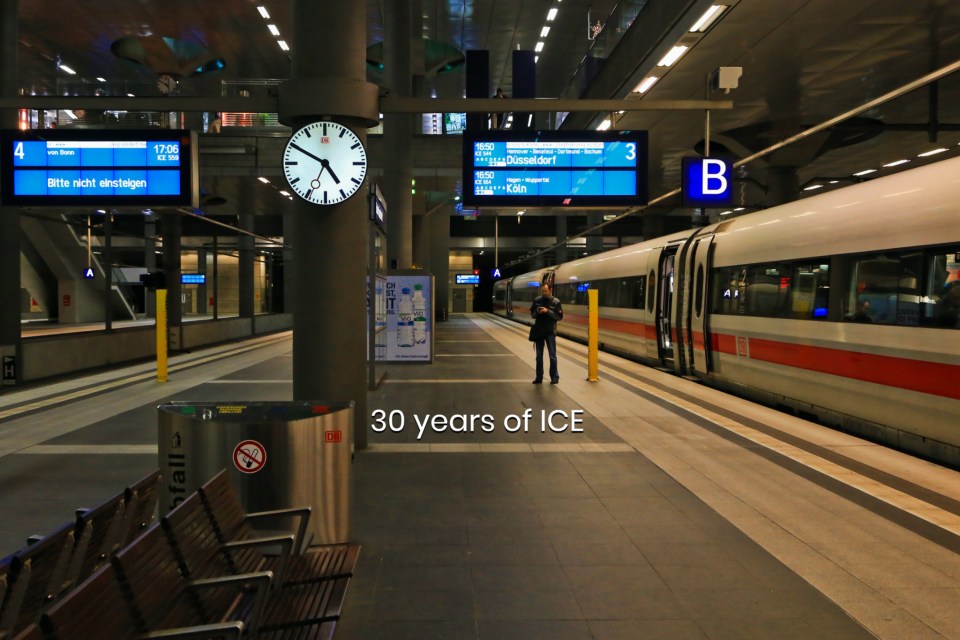
Above/featured: Berlin Hauptbahnhof – 9 Dec 2015 (6D1). Departing from track 3 is ICE 554 to Köln (front-half) and ICE 544 to Düsseldorf (back-half); trains split in the town of Hamm.

June 2021 marks the 30th anniversary of high-speed Intercity Express (ICE) service on German rail.

In the 1991 vs. 2021 comparison graphic provided by Deutsche Bahn, I’ve marked in green the ICE routes upon which I’ve made dozens of trips since late-2001 (when I moved to Heidelberg). Even after leaving in 2003, frequent annual trips back to Germany meant spending a lot of time planted on express trains across the country. Arriving in Europe mostly meant flying into Frankfurt am Main airport, from which I’d travel:

  • Frankfurt to Berlin, via Kassel
  • Frankfurt to Heidelberg, via Mannheim
  • Frankfurt to Köln
  • Frankfurt to Munich, via Stuttgart
  • Berlin to Frankfurt, via Kassel
  • Berlin to Köln, via Hannover
  • Köln to Berlin, via Hannover
  • Köln to Frankfurt
  • Munich to Frankfurt, via Stuttgart

Over the last few years, the express stretch between Erfurt and Halle/Leipzig has vastly improved the Berlin-Frankfurt and Berlin-Munich routes, cutting the one-way travel time for each route by about one hour. Except for the Erfurt-Halle/Leipzig stretch, I’ve travelled on every “Stundentakt” ICE route (thick red/green in the graphic below).

Intercity Express, Deutsche Bahn, German Rail, Germany, Deutschland

ICE coverage, including recent work on the Erfurt-Halle/Leipzig stretch; graphic courtesy of Deutsche Bahn. My “dozens on ICE” are marked in green; red filled circles indicate cities I frequented the most (B, F, HD, K, M).

Intercity Express, train fleet, Deutsche Bahn, German Rail, Germany, Deutschland

The ICE fleet of trains include vehicles with maximum speeds of over 300 km/h; graphic courtesy of Deutsche Bahn.

Frankfurt am Main Hauptbahnhof, F Hbf, Frankfurt am Main, Hesse, Hessen, Germany, Deutschland, fotoeins.com

Morning ICE 5 service from Frankfurt am Main to Basel; how to read this train station signage – 20 May 2016 (6D1).

Hackerbrücke, München, Munich, Bavaria, Bayern, Germany, Deutschland.

Morning light at Munich’s Hackerbrücke station. Foreground: westbound metallic-white ICE train just departing the city’s central station, traveling right to left. Background: red DB regional train approaching central station, from left to right. Photo on 23 Feb 2017 (6D1).

I made three images above with a Canon EOS6D mark1 (6D1). This post appears on Fotoeins Fotografie at fotoeins DOT com as https://wp.me/p1BIdT-l60.

Memorial for the Kamloops Residential School, Robson Square, Vancouver, BC, Canada, fotoeins.com

Vancouver: Memorial for the Kamloops Residential School

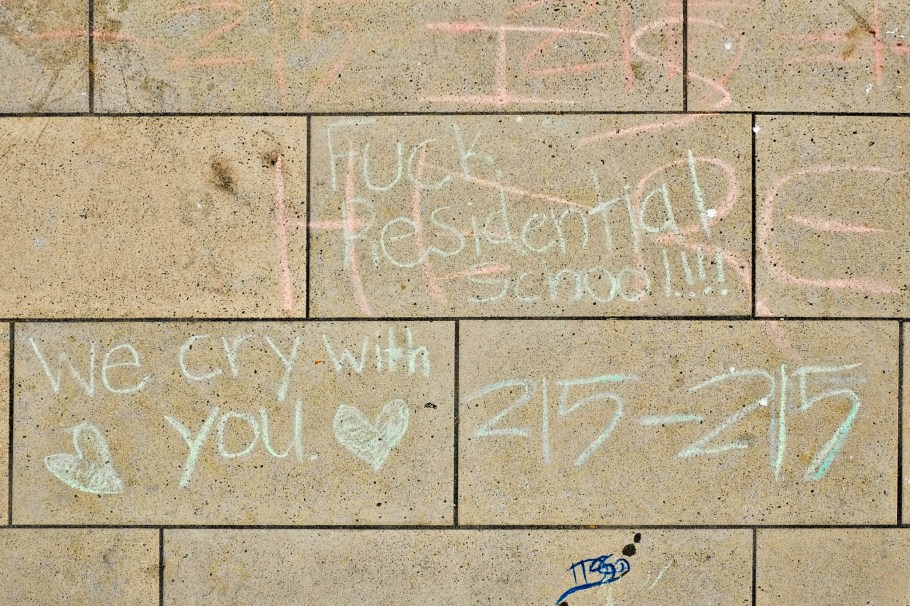
In late-May 2021, the Tk’emlúps te Secwépemc First Nation announced the discovery of 215 children buried in a mass grave at a former residential school near Kamloops, British Columbia; ground-penetrating radar was used to locate the remains.

During a period of 160 years, the Government of Canada in concert with churches constructed residential schools in a state-sponsored process of “aggressive assimilation” to make children of Indigenous people “less aboriginal and more white” with instruction in English and Christianity in order to erase the children’s traditions and cultural ties.

More than 150-thousand children were sent to some 130 residential schools across Canada between 1830s and the 1990s. Forcibly removed from their homes and parents, children of Indigenous peoples were forced into the schools where they faced neglect and physical and sexual abuse. Physical records indicate a total of over 4000 children deaths; the actual number is very likely much higher. Many children were not buried properly, parents were not notified about what happened to their children: many children who were forced into residential schools never returned home. For years, survivors have told their stories about what happened inside those schools: there is every expectation more mass graves and more children will be found.

The systematic removal of indigenous children from their families disrupted, divided, and destroyed living generations of indigenous families, robbing people of their respective culture and language and the wealth of lived experiences shared between generations. According to the terms and definitions laid out in the 1948 United Nations’ Convention, Canada committed genocide against their Indigenous Peoples. The destructive effects of white colonialism upon Indigenous Peoples in the country is not only historical but continues today with inequity, intransigence, obstruction and obfuscation, and injustice.

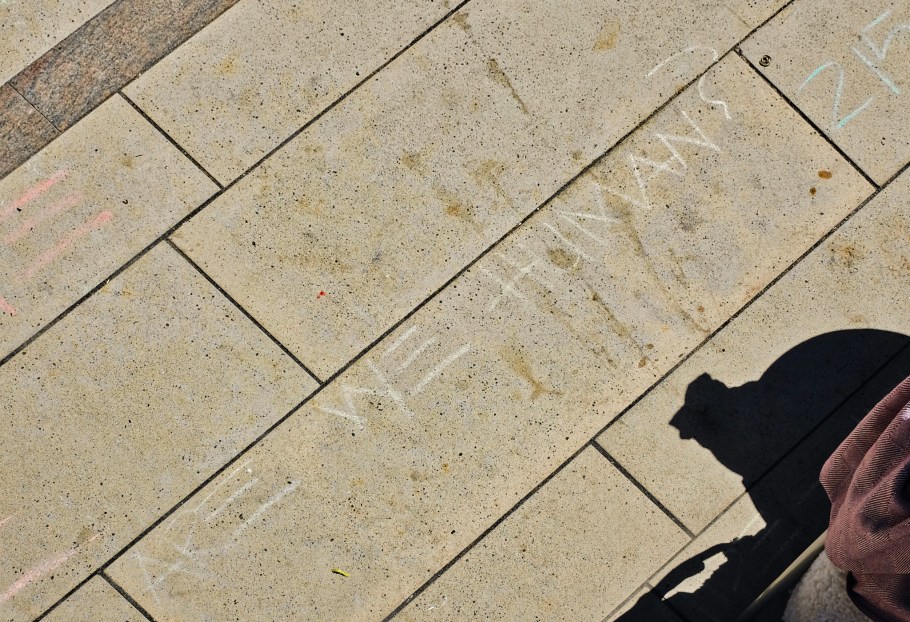
A makeshift memorial was quickly created at the steps of the Vancouver Art Gallery at Robson Square. It’s worth noting the Art Gallery is presently housed in the former provincial court house which opened in 1911 and would have served as a “legal” instrument of white- and settler-colonialism. That this National Historic Site is the location of an improvised tribute to the loss of life and dignity caused by state-sponsored acts of genocide is an enormous juxtaposition.

June is National Indigenous History Month in Canada.
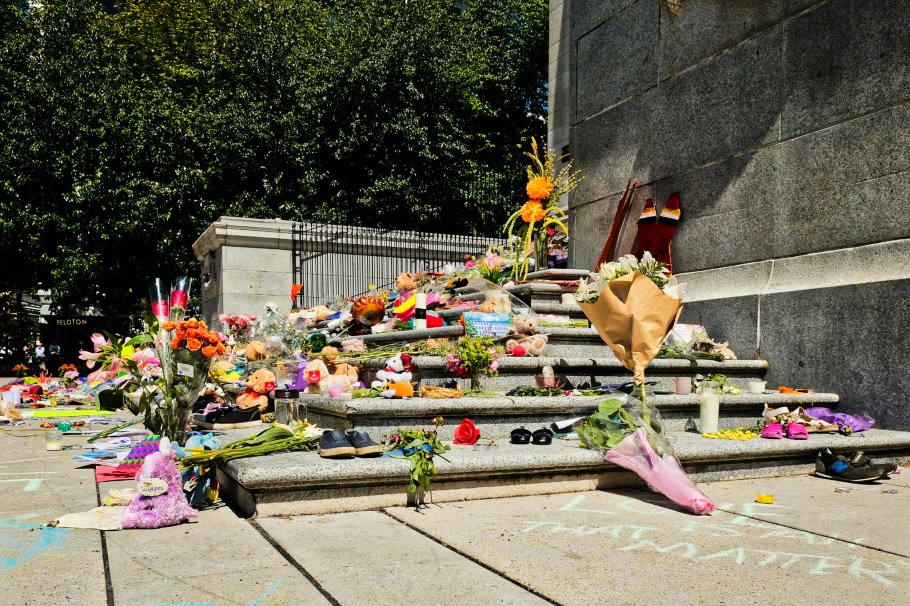

Memorial for the Kamloops Residential School, Robson Square, Vancouver, BC, Canada, fotoeins.com Memorial for the Kamloops Residential School, Robson Square, Vancouver, BC, Canada, fotoeins.com
Memorial for the Kamloops Residential School, Robson Square, Vancouver, BC, Canada, fotoeins.com

“Are we human?”

Memorial for the Kamloops Residential School, Robson Square, Vancouver, BC, Canada, fotoeins.com

“Bring our children home.”

Memorial for the Kamloops Residential School, Robson Square, Vancouver, BC, Canada, fotoeins.com

As a resident of Vancouver, I’m a guest on unceded traditional territory and land of the Coast Salish First Nations: Sḵwx̱wú7mesh (Squamish), Stó:lō and Səl̓ílwətaʔ/Selilwitulh (Tsleil-Waututh), and xʷməθkʷəy̓əm (Musqueam). I made all images above on 1 June 2021 with a Fujifilm X70 fixed-lens prime. This post appears on Fotoeins Fotografie at fotoeins DOT com as https://wp.me/p1BIdT-l2C.

herakut, Museum of Urban and Contemporary Art, MUCA, Munich, Muenchen, Bayern, Bavaria, Germany, Deutschland, fotoeins.com

Herakut: big wall art around Germany

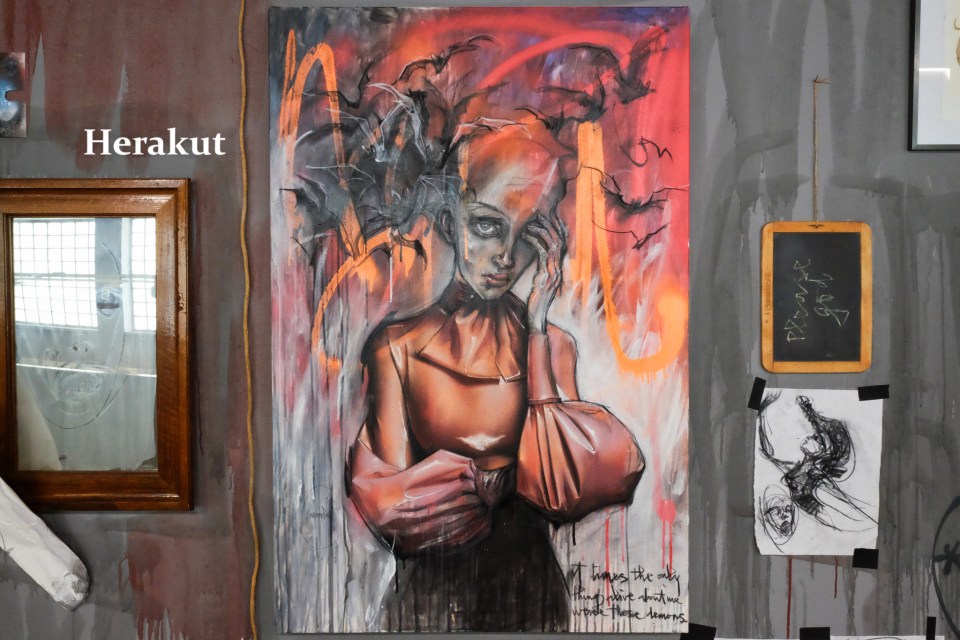
Above/featured: “At times the only thing alive about me were those demons.” MUCA Munich – 31 May 2018 (X70).

One of my favourite artists is Herakut, a German duo whose street murals have appeared in Europe and around the world since 2004. Hera (Jasmin Siddiqui) and Akut (Falk Lehmann) use walls and big spaces for their big art with a signature look that includes expressive faces and big eyes, lots of photo-like details, and sharp typography. Their work explores issues such as physical and emotional isolation, maternal relationships, gender and racial equality, and all the things we think and feel lurking inside. But I think their compositions also include long notes and pauses which allow and incorporate vivid fantasy and playful whimsy.

Examples shown below include Wittenberg 2016, Heidelberg 2017, Berlin 2017, Munich 2018, Berlin 2021, Frankfurt am Main 2024.

( Click here for more )

Seattle: Sand Point Sculptures (A Sound Garden)

Above/featured: On the Art Walk trail.

In northeast Seattle, the NOAA Art Walk is contained fully within the campus of the National Oceanic and Atmospheric Administration Western Regional Center (NOAA WRC), located at Sand Point next to Magnuson Park. Initially, I’d intended only to visit one sculpture from which a “fairly successful” local band got its name. I explored the entirety of the Art Walk on a breezy sunny early-spring morning for an easy peaceful walk on a trail hugging Lake Washington’s shoreline. Over a two- to three-hour period, I encountered only a handful of other visitors, some of whom may have been NOAA staff.


( Click here for images and more )