Fotoeins Fotografie

location bifurcation, place vs. home

Posts from the ‘Jewish-Euro History’ category

Past and present histories of Jewish communities and culture in AT, DE

Nuremberg: The Landmark Trials in Room 600, 80 years on

Above: In front of the Justizpalast (Palace of Justice) at the corner of Benjamin-Ferencz-Platz and FΓΌrther Strasse in Nuremberg, Germany.

On 20 November 1945, an extraordinary trial got under way in the German city of Nuremberg, only six months after the Nazis surrendered to the Allied nations in World War 2. For the first time in modern history, an assembled tribunal of international judges presided over trials against top leaders of a nation for crimes against peace, war crimes, crimes against humanity, and conspiracy to carry out these crimes.

What is called the “Nuremberg Trials” refers primarily to the “Major War Criminals Trial” where over 20 leaders in German Nazi high command were put on trial before the International Military Tribunal (IMT) from November 1945 to October 1946. The IMT consisted of judges from each of the four Allied nations: Great Britain, France, United States, and the U.S.S.R. Subsequently from late-1946 to 1949, 12 additional trials were held before American military tribunals to uncover and highlight the extent and depth to which additional leaders in German society supported the Nazi dictatorship.

“… The privilege of opening the first trial in history for crimes against the peace of the world imposes a grave responsibility. The wrongs which we seek to condemn and punish have been so calculated, so malignant and so devastating, that civilization cannot tolerate their being ignored because it cannot survive their being repeated. That four great nations, flushed with victory and stung with injury stay the hand of vengeance and voluntarily submit their captive enemies to the judgment of the law is one of the most significant tributes that power has ever paid to reason.”

– Opening statement by Robert H. Jackson, U.S. chief prosecutor, on the second day of the Nuremberg Trials (Major War Criminals Trial), 21 November 1945; see Sources below.


( Click here for images and more )

David Oppenheimer: from Blieskastel πŸ‡©πŸ‡ͺ to Vancouver πŸ‡¨πŸ‡¦

Featured: Alter Markt, facing southwest to the former Schloss Blieskastel at upper-centre: Blieskastel, Saarland, Germany (X70).

David Oppenheimer: ✵ 1 January 1834 – 31 December 1897 ✟

As a child of the city, I learned the name of Vancouver’s 2nd mayor, David Oppenheimer, who served in the top post from 1887 to 1891. Escaping the violent revolutions spreading through Europe, David Oppenheimer and his brothers had long been immigrants from Germany, and after time in New Orleans and California, they arrived in what is now southwestern British Columbia and developed business success with their supply stores during the Gold Rush, and with wholesale trade and real estate in the newly incorporated city of Vancouver, where the national railway established its western terminus one year later in 1887. The Oppenheimers stamped their civic legacy not only with the location of the railway terminus, but also with an expansive infrastructure program including a new grand city park, fire department, extensive roadworks, a city-wide electricity grid, streetcar public transport network, and a city cemetery. On 11 April 2008, the Government of Canada’s Historic Sites and Monuments Board designated David Oppenheimer as a National Historic Person.

There’s little doubt the Oppenheimers spent plenty of time in what are now Vancouver’s Chinatown and Strathcona with their business interests and connections to the city’s Jewish community. These are neighbourhoods, respectively, where my parents sought closer ties with the Chinese-Canadian community, and where they bought a new house to raise their family. Decades later, I’ve flown out from Vancouver, and I’ve been on the train from Frankfurt to southwest Germany’s Saarbrücken for its proximity to the Völklingen Ironworks world heritage site. I also recently learned David Oppenheimer was from the area and born in the city of Blieskastel. I arrange to meet with a representative of Stadtarchiv Blieskastel (city archive), and I make my way to Blieskastel to see what I can learn about the Oppenheimer family.

( Click here for images and more )

Vienna Ringstrasse & Architectural Historicism

Above/featured: Examples of the “Ringstraßenstil” historicism style at Maria Theresa Square, with Maria Theresa Monument at left and the Museum of Natural History at right. Photo, 15 May 2022 (X70).

•   Can a street alone define its surrounding architecture?
•   Do the buildings themselves establish the street’s visual impression?
•   Is Vienna (un)fairly defined by the Ringstrasse and the inner city?

The answers, as always, are a little complicated.

Like many, I’m also fond of Vienna’s Ringstrasse (Ring Road), as a kind of “hello” and re-introduction to the city after my first visit in 2002. At 5 kilometres in length, the Ringstrasse is one of the longest streets in Europe, longer than the nearly 2-km Champs-Élysées in Paris and longer than the 4.5-km Nevsky Prospekt in St. Petersburg. The boulevard is surrounded by Prachtbauten (buildings of splendour), constructed in the architectural style of “historicism,” a big nod to classic “forms” reflecting structural “functions”. The late-19th century “Ringstrassenstil” (Ring Road architectural style) continued the practiced habit of choosing a historical style which best identified with the purpose of the building. For example, the Neo-Baroque architectural style is represented in the Civic Theater; the Neo-Classical style in the Parliament and New Palace; the Neo-Gothic style in City Hall and the Votive Church; and the Neo-Renaissance style in the museums, palatial mansions, Opera House, and the University.

On Christmas Day 1857, the Wiener Zeitung newspaper published an imperial decree written 5 days earlier (on 20 December) by Habsburg emperor Franz Joseph I. He ordered the demolition of the inner-city wall and the subsequent creation of a circular boulevard, bordered by grand buildings and filled with green spaces. The large outward extension of the inner city changed and influenced the urban development of Vienna, still seen to this very day.

It is my will that the extension of the inner city of Vienna should proceed as soon as possible, providing for appropriate connections between the city and the suburbs as well as the embellishment of my imperial residence and capital. To this end, I authorise the removal of the walls and fortifications of the inner city as well as the ditches around it …

– Emperor Franz Joseph I: 20 Dec 1857, published 25 Dec 1857.

On 1 May 1865, Emperor Franz Josef unveiled the Ringstrasse in an official ceremony, even though large areas remained under construction. Ringstrasse structures included the religious and the secular, as well as the public and the private. The Ringstrasse symbolized the power of the imperial state, and the growth of a new arts and culture scene with the increasing popularity of coffee houses.

It’s also important to note the architectural impact made by the Jewish middle- and upper-class to integrate within the Habsburg empire. For example, the families Ephrussi, Epstein, and Todesco commissioned architect Theophil Hansen to construct palatial mansions as visible manifestations and partial realization of the dream of many Viennese Jews: assimilation into and emancipation within Viennese society. (Viennese journalist and political activist Theodor Herzl might have had a different opinion about that.)

For residents and long-term visitors today, it’s entirely possible to fit into the unintended shape and mentality of the “modern” city: that the inner-city wall was simply replaced by a different wall of “economic class”, that the architectural callback to historicism “freezes” the inner-city in time, and that like many, I can live, traverse, and work in the outer districts and avoid entering the inner city.

For short-term visitors today, the Ringstrasse buildings form a golden shiny “ring” around the “fingers” of the U1 and U3 metro lines traversing through the UNESCO World Heritage inscribed inner-city. For these visitors, all that’s needed for their limited time in Vienna is the inner city.


( Click here for images and more )

Vienna: Lichtzeichen testament to Jewish presence

Above/featured: Lichtzeichen number 10 (Stumperschul) in the city’s 6th district. Photo, 28 May 2022.

From a distance, the light seems suspended in mid-air.

Closing the distance widens my realization: it’s an illuminated sculpture that has a curved warped shape on top. That’s also when understanding narrows into sharp focus when I stand directly underneath: the shape “straightens” out, revealing itself as a Star of David.

Lichtzeichen Wien (LZ) consists of 26 structures in the Vienna region, marking former locations of synagogues, schools, temples, and prayer rooms destroyed by the Nazis in the pogrom of November 1938. During the night of 9–10 November 1938, the Nazi regime organized and carried out a systematic attack against the Jewish population in Germany and Austria. The rampage in Vienna continued for several days; most of the city’s synagogues, temples, and prayer-halls were destroyed.

Launched by the Jewish Museum Vienna and Austrian artist Brigitte Kowanz, an urban memorial project by joint collaboration of the Jewish Museum Vienna and the University of Applied Arts Vienna consists of identical columns, designed by artist Lukas Kaufmann. The commemorative project is called β€œOt” (אוΧͺ), which means β€œsymbol” in Hebrew. Each “light column” sculpture stands about 5-metres high with a star of David, and includes the name of the former Jewish structure and an accompanying QR-code. Official unveiling of the memorial project occurred in 2018 on the 80th anniversary of the 1938 pogrom.

I visited and photographed all 26 Lichtzeichen locations in Vienna over a period of three summers in 2022, 2023, and 2024.


( Click here for images and more )

Vienna Judenplatz: centuries & memories of the Jewish community

Above/featured: Judenplatz at night. The Holocaust memorial is in the foreground at centre. In the background are “To the little trinity” at centre and Misrachi House (Museum Judenplatz) at right. Photo, 10 Jun 2022.

At Judenplatz are clear visual reminders of the city’s first Jewish community in medieval times.

The first Jewish community in Vienna settled around present-day Judenplatz in the Middle Ages with mention in written documents dated mid- to late-13th century AD/CE. Daily Jewish life thrived around the Or-Sarua Synagogue, the Jewish School, and the Mikveh ritual bath. The community along with the surrounding Jewish neighbourhood came to an end with the Pogrom of 1421. Catholic Habsburg Duke Albrecht II rolled out a decree (Wiener Geserah, Vienna Gesera) which legitimatized the expulsion, incarceration, torture, and murder of some 800 Jewish residents; accompanied by destruction and forced takeover of buildings and property.

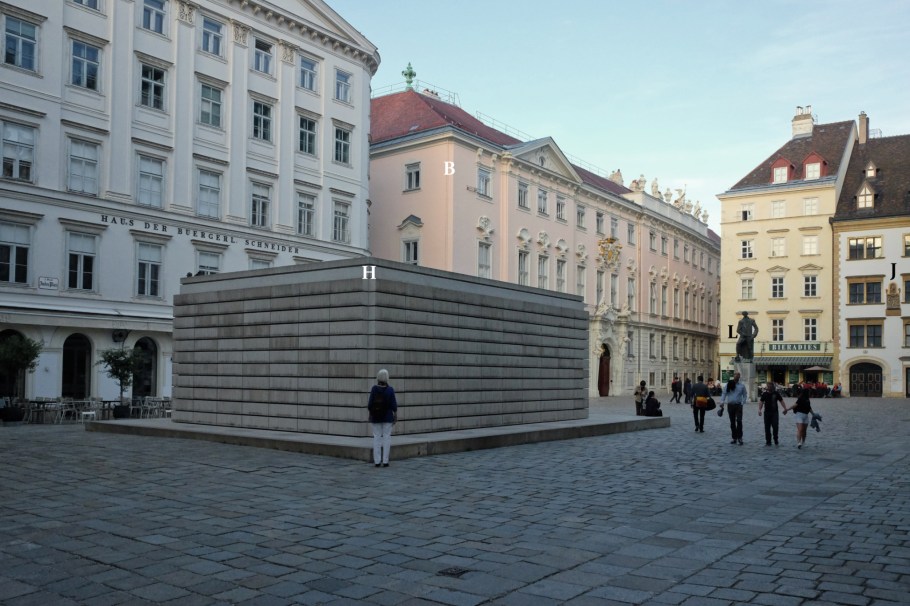
Below I highlight remnants and traces to the medieval Jewish community at this square in central Vienna.

Judenplatz, Vienna, Wien, Oesterreich, Austria, fotoeins.com

Facing northwest: B, Bohemian Chancellery; H, Holocaust Memorial; L, Lessing monument; M, Misrachi House; T, To the little Trinity. Photo, 20 May 2018.

Judenplatz, Vienna, Wien, Oesterreich, Austria, fotoeins.com

Facing southeast: B, Bohemian Chancellery; J, Jordan House; H, Holocaust memorial; L, Lessing monument. Photo, 20 May 2018.


( Click here for images and more )