Vienna Steinhof Church: city- & Wagner-landmark
Above/featured: East side of the church, in afternoon light. Photo on 28 May 2023, X70 with wide-field WCL-X70 lens attachment, image corrected for geometric distortion.
Building: Steinhof church, also St. Leopold Church, 1907 // Kirche am Steinhof, Kirche zum heiligen Leopold.
Address: Baumgartner Höhe 1, in Penzing, the city’s 14th district.
Up on the city’s Baumgartner Heights is an example of Europe’s first modernist church at Steinhof. Dedicated to St. Leopold, the structure is one of the city’s finest examples of turn-of-the-century architecture, and one of the world’s most important churches in the Jugendstil or Art Nouveau architectural style. The church was designed and built by architect Otto Wagner, inaugurated in 1907 for patients and staff within the surrounding hospital complex the Lower Austria state, sanatorium, and nursing home for the mentally ill (Niederösterreichische Landes-, Heil-, und Pflegeanstalt für Geistes- und Nervenkranke) which included over 30 buildings and room for over 2000 beds. The bright, airy, and spacious modern design was met at that time with skepticism and criticism by local church officials. Of utmost importance on Wagner’s mind were the hospital patients: his church design was about gentle solitude, not fire and damnation.
The church was a collaborative effort with other Viennese artists, including mosaics and stained glass by Koloman Moser, angel sculptures by Othmar Schimkowitz, and exterior tower sculptures by Richard Luksch. The church roof is topped with a dome covered in gold-plated copper plates, whose bright yellow appearance in daylight merits the nickname “Limoniberg” (lemon hill) that’s visible in different parts of the city. The Steinhof church is an example of a “Gesamtkunstwerk“, where every detail and fixture contributed to a “total and functional work of art”; an architectural masterpiece of the period; and one of Otto Wagner’s most important creations.
I included this building as part of my description of Otto Wagner’s architectural legacy in Vienna and of the recent centenary celebration in Vienna of the city’s 19th- to 20th-century architectural transition from historicism to modernism.
St. Leopold Church at Steinhof
• Sources
Church frontage

Exterior, front-facade on the south-side. Photo, 16 May 2018 (6D1).

Sculptural figures by Richard Luksch on the two front towers: at left is the patron saint of Austria, St. Leopold, with the model of the very church bearing his name; and at right is St. Severin, “Apostle to Noricum” (modern Austria). Photo, 18 May 2018 (6D1).

Detail above the front entrance: sculptural angels by Othmar Schimkowitz, glass window by Koloman Moser. Photo on 18 May 2018 (6D1).
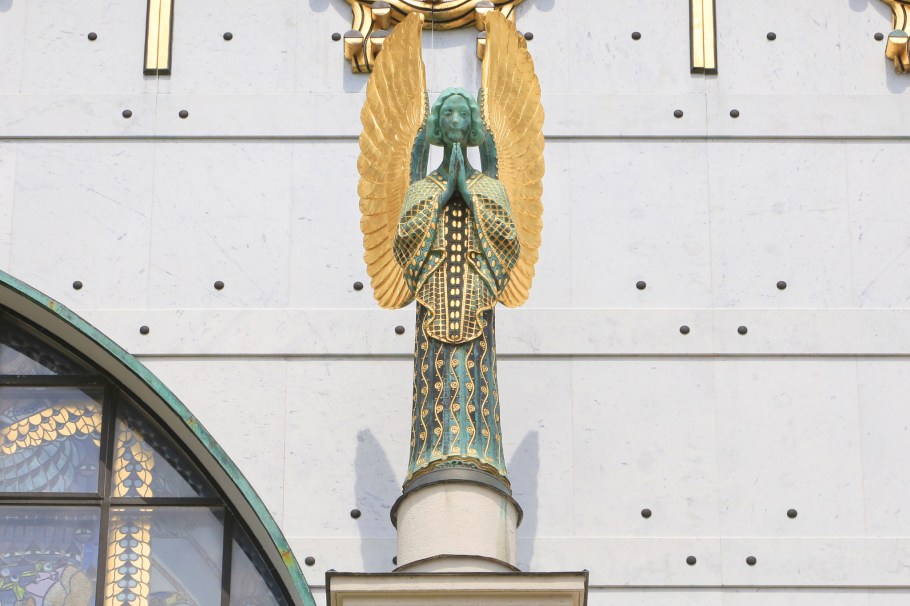
Above the front entrance, one of the four angel sculptures by Othmar Schimkowitz. Photo, 18 May 2018 (6D1).
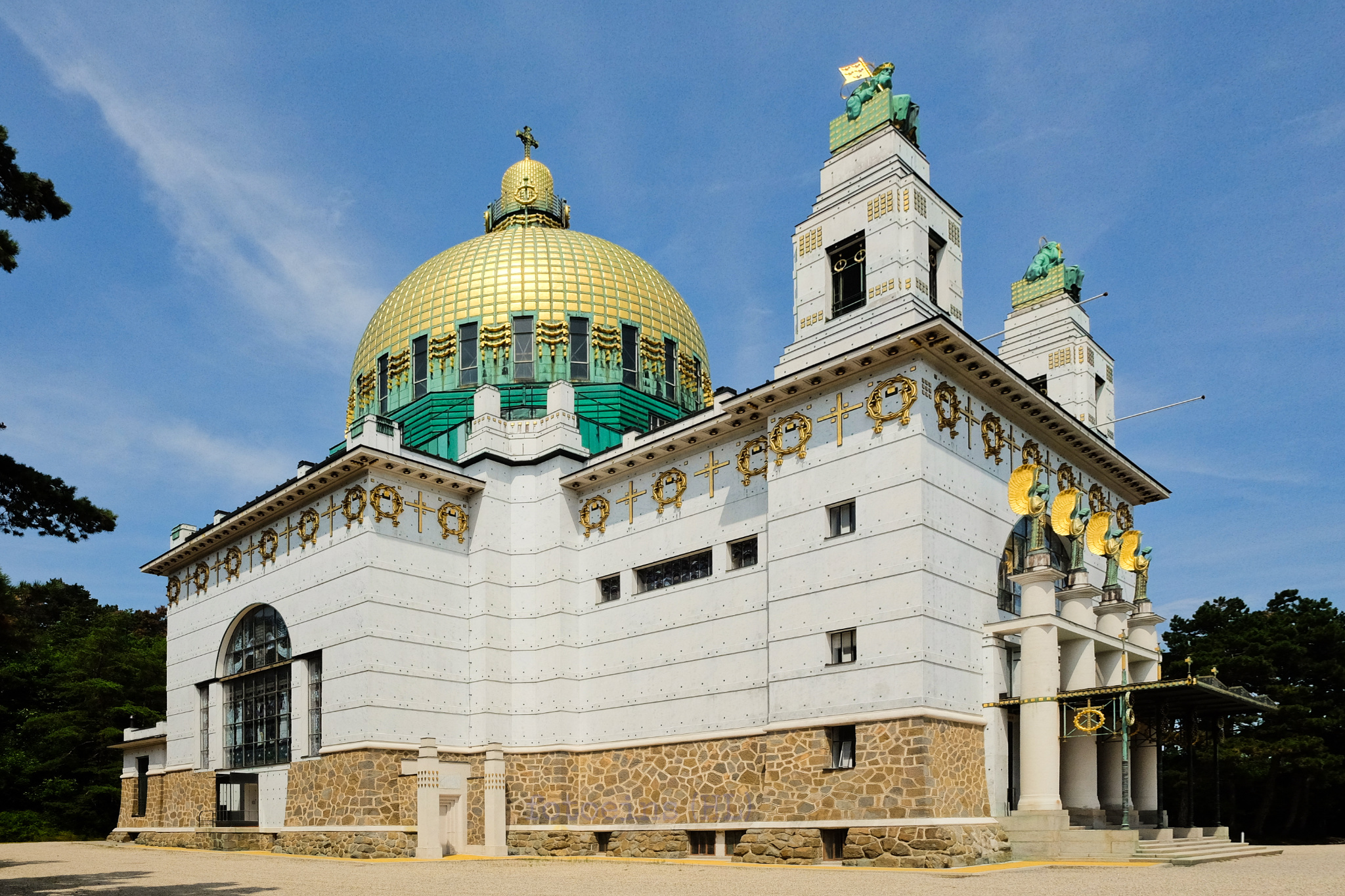
Exterior, west side; the front entrance is at right. Photo, 6 Jul 2025 (X70), corrected for geometric distortion.
Church interior
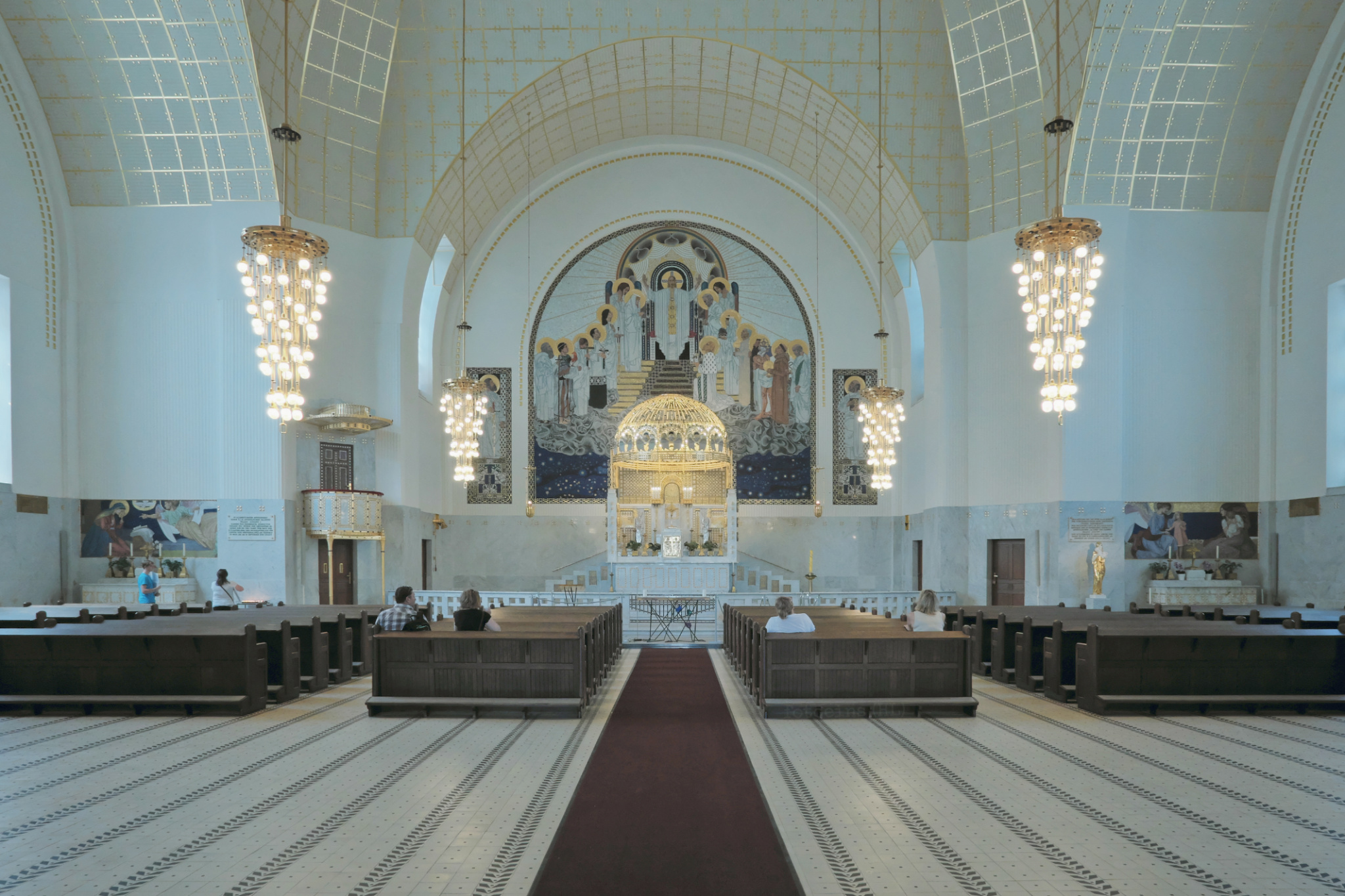
Facing north to the front, along the nave. Photo, 6 Jul 2025 (X70).
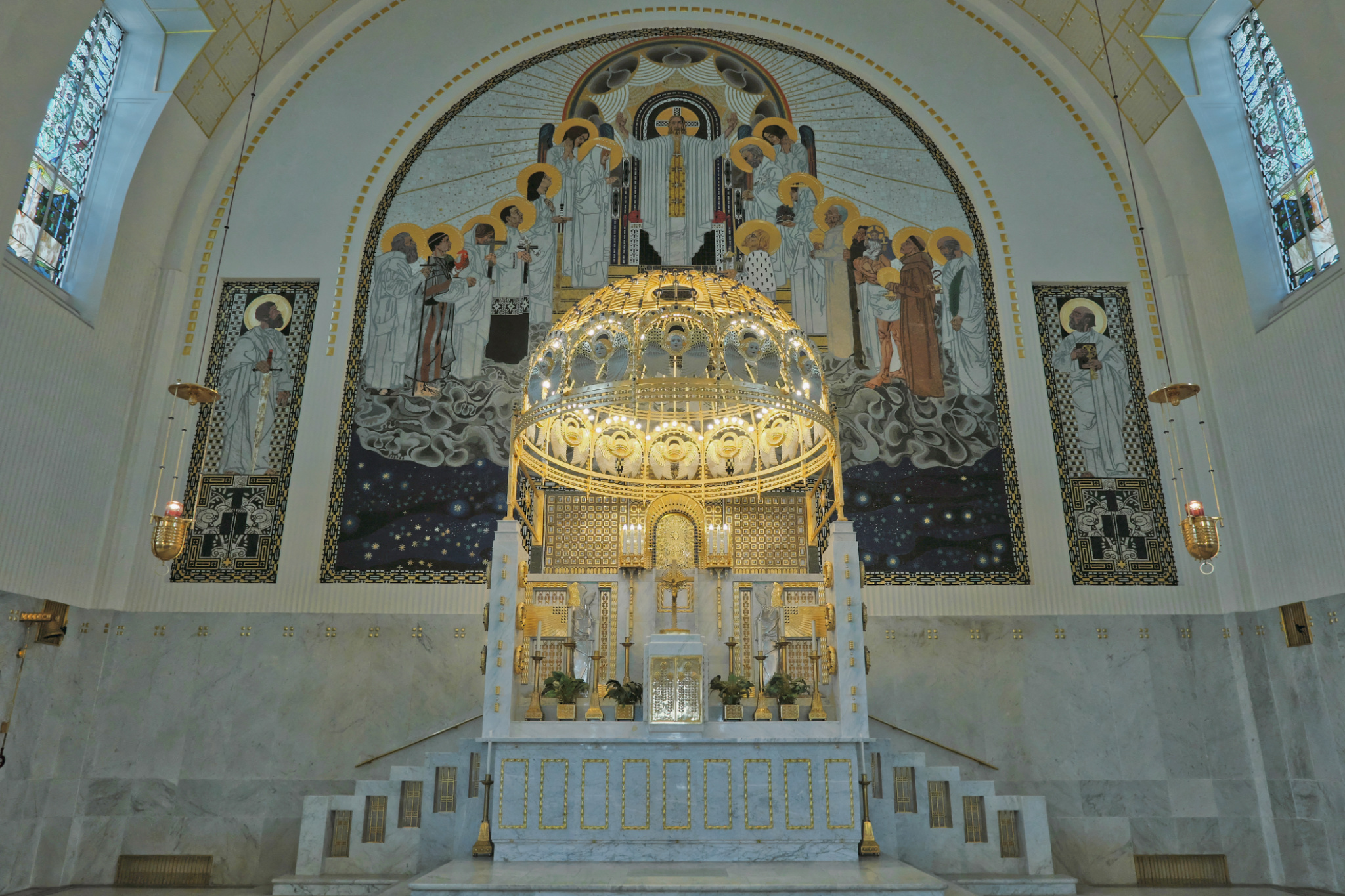
High altar and wall mural by Remigius Geyling and Leopold Forstner. The glass windows at upper-left and -right are by Koloman Moser. Photo, 6 Jul 2025 (X70).
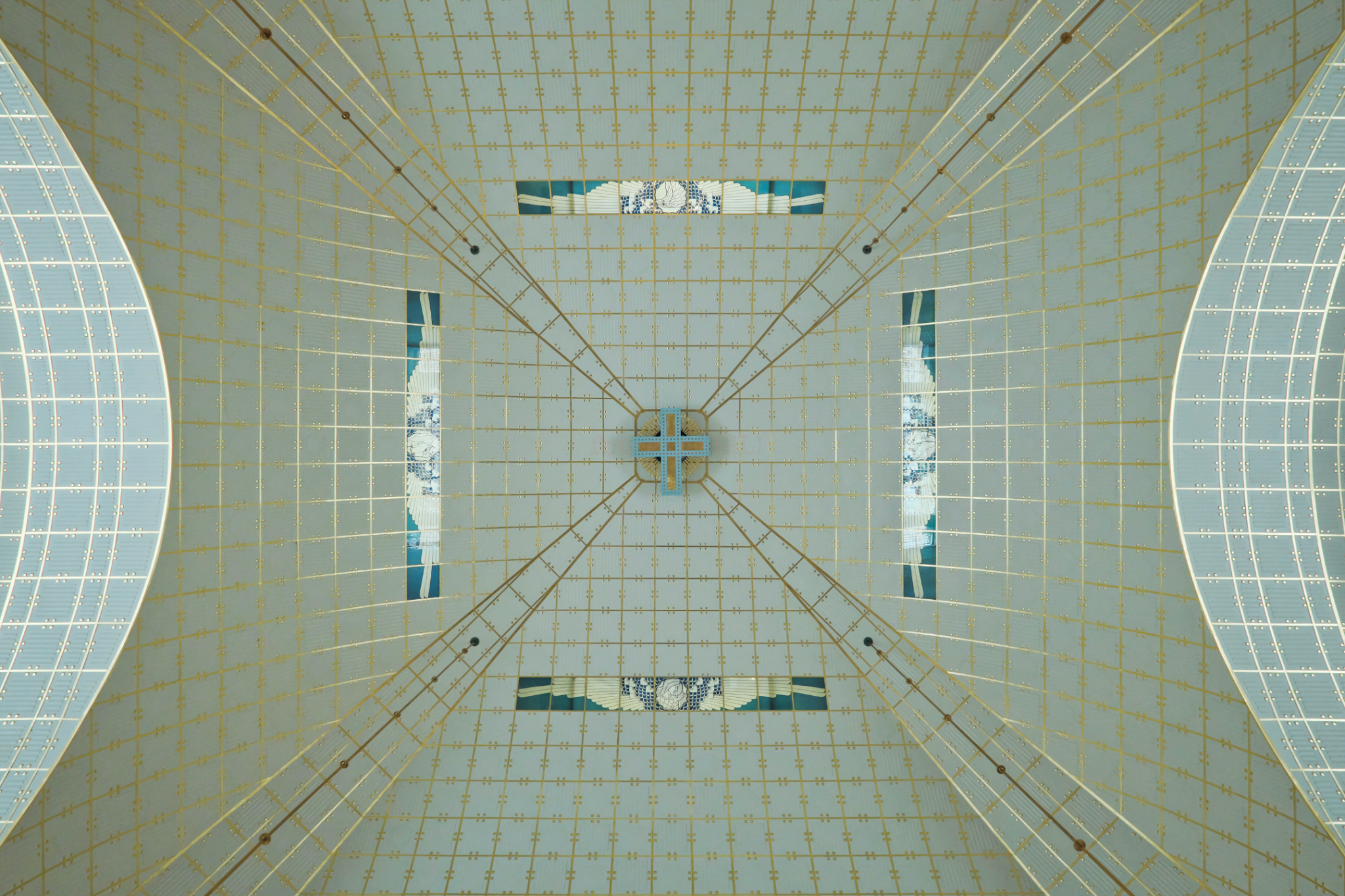
Looking overhead, directly beneath the dome. Photo, 6 Jul 2025 (X70).
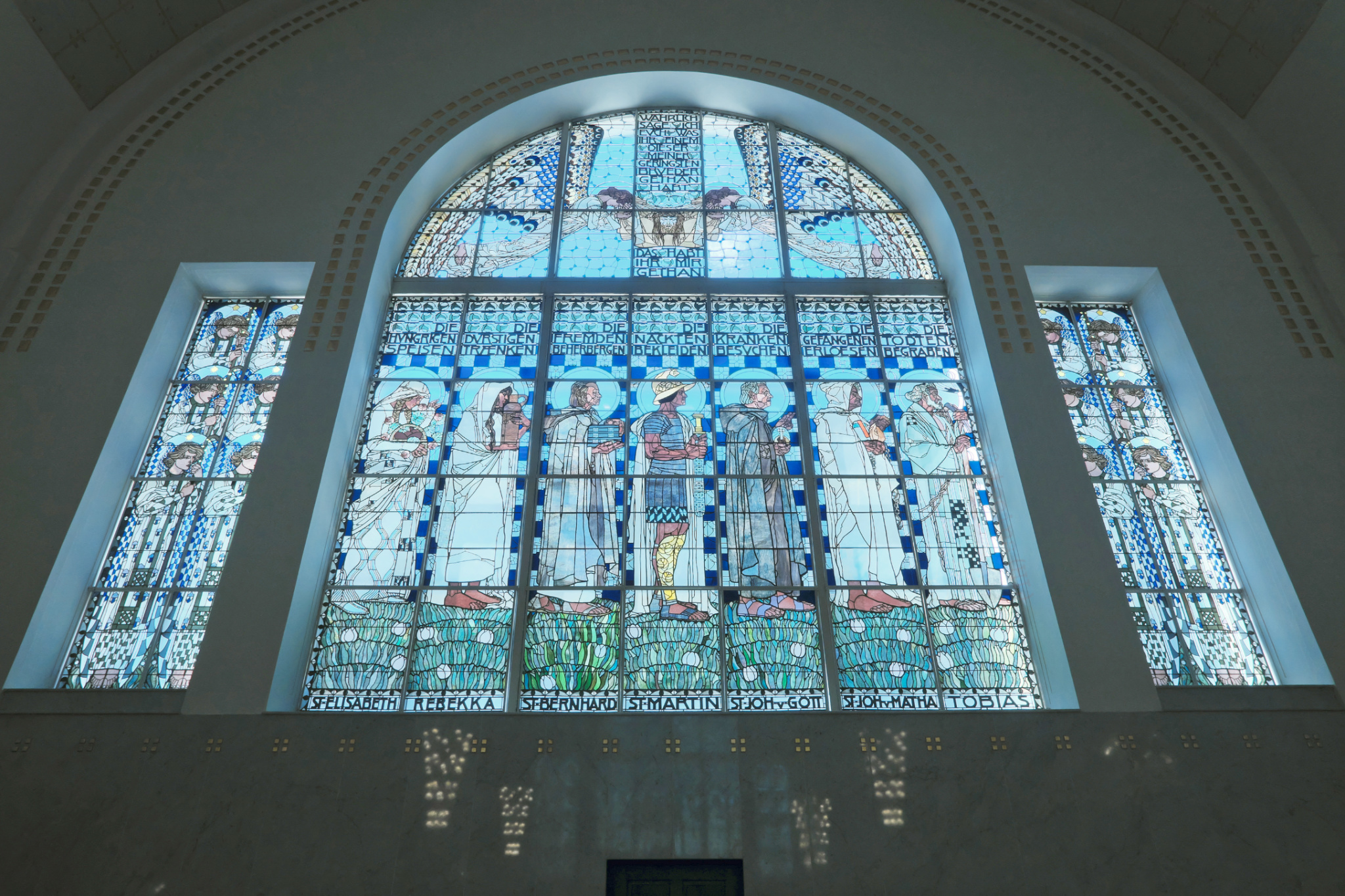
West glass-windows by Koloman Moser. The main altar is to the right (north). Photo, 6 Jul 2025 (X70).
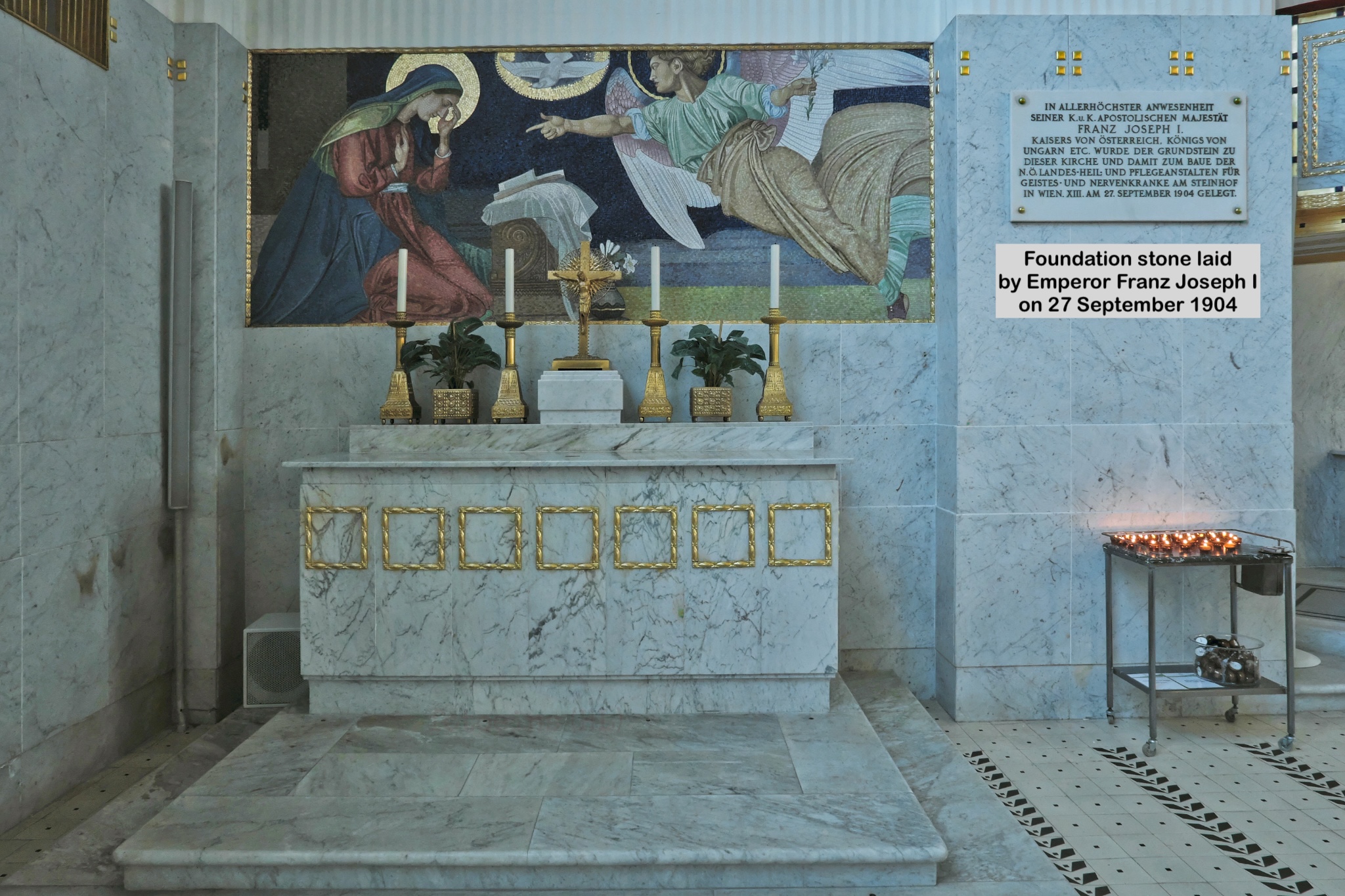
Northwest corner, side-altar: mosaic by Rudolf Jettmar; commemorative plaque for foundation stone laid by Emperor Franz Joseph I on 27 September 1904. Photo, 6 Jul 2025 (X70). “In allerhöchster Anwesenheit seiner K.u.K. apostolischen Majestät Franz Joseph I Kaisers von Österreich, Königs von Ungarn etc. wurde der Grundstein zu dieser Kirche und damit zum Baue der Niederösterreichischen Landes-Heil- und Pflegeanstalten für Geistes- und Nervenkranke am Steinhof in Wien. 13. Bezirk, am 27. September 1904 gelegt.” (In the presence of His Imperial and Royal Apostolic Majesty Franz Joseph I, Emperor of Austria, King of Hungary, etc., the foundation stone for this church, and thus for the construction of the Lower Austrian State Sanatorium and Nursing Home for the Mentally and Nervously Ill at Steinhof in Vienna’s 13th district, was laid on 27 September 1904.)
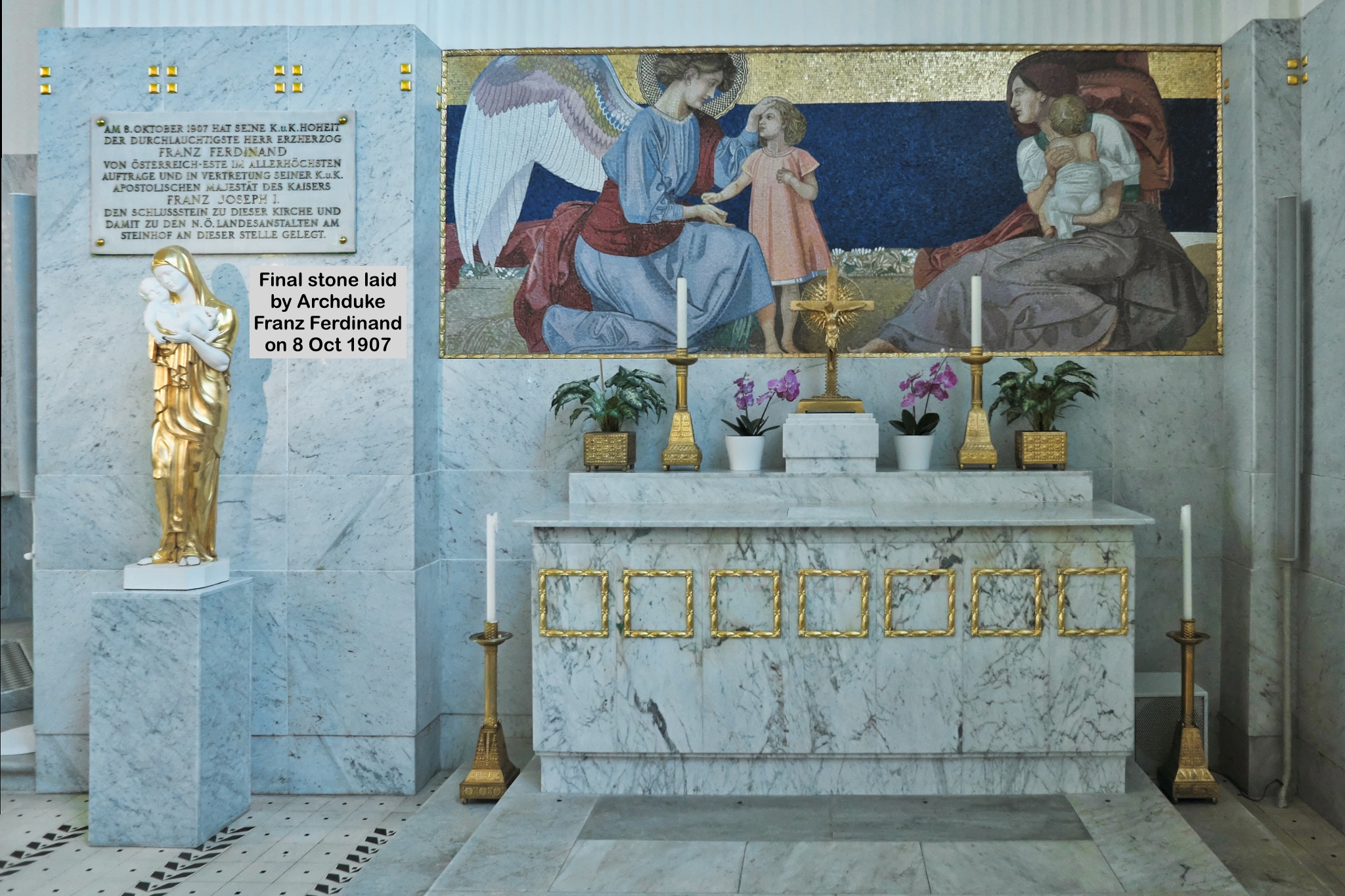
Northeast corner, side-altar: mosaic by Rudolf Jettmar; commemorative plaque for the final stone laid by Archduke Franz Ferdinand on 8 October 1907. Photo, 28 May 2023 (X70). “Am 8. Oktober 1907 hat seine K.u.K. Hoheit der durchlauchtigste Herr Erzerhog Franz Ferdinand von Österreicheste im allerhöchsten Auftrage und in Vertretung seiner K.u.K. apostolischen Majestät des Kaisers Franz Joseph I. den Schlussstein zu dieser Kirche und damit zu den Niederösterreichischen Landesanstalten am Steinhof an dieser Stelle gelegt.” (On 8 October 1907, His Imperial and Royal Highness Archduke Franz Ferdinand of Austria, on the orders of and representing His Imperial and Royal Apostolic Majesty Emperor Franz Joseph I, laid the final stone for this church, and thus for the Lower Austrian State Sanatorium at Steinhof, at this very location.)

East glass-windows by Koloman Moser; detail of the “thin sides” below. The main altar is to the left (north). Photo, 6 Jul 2025 (X70).
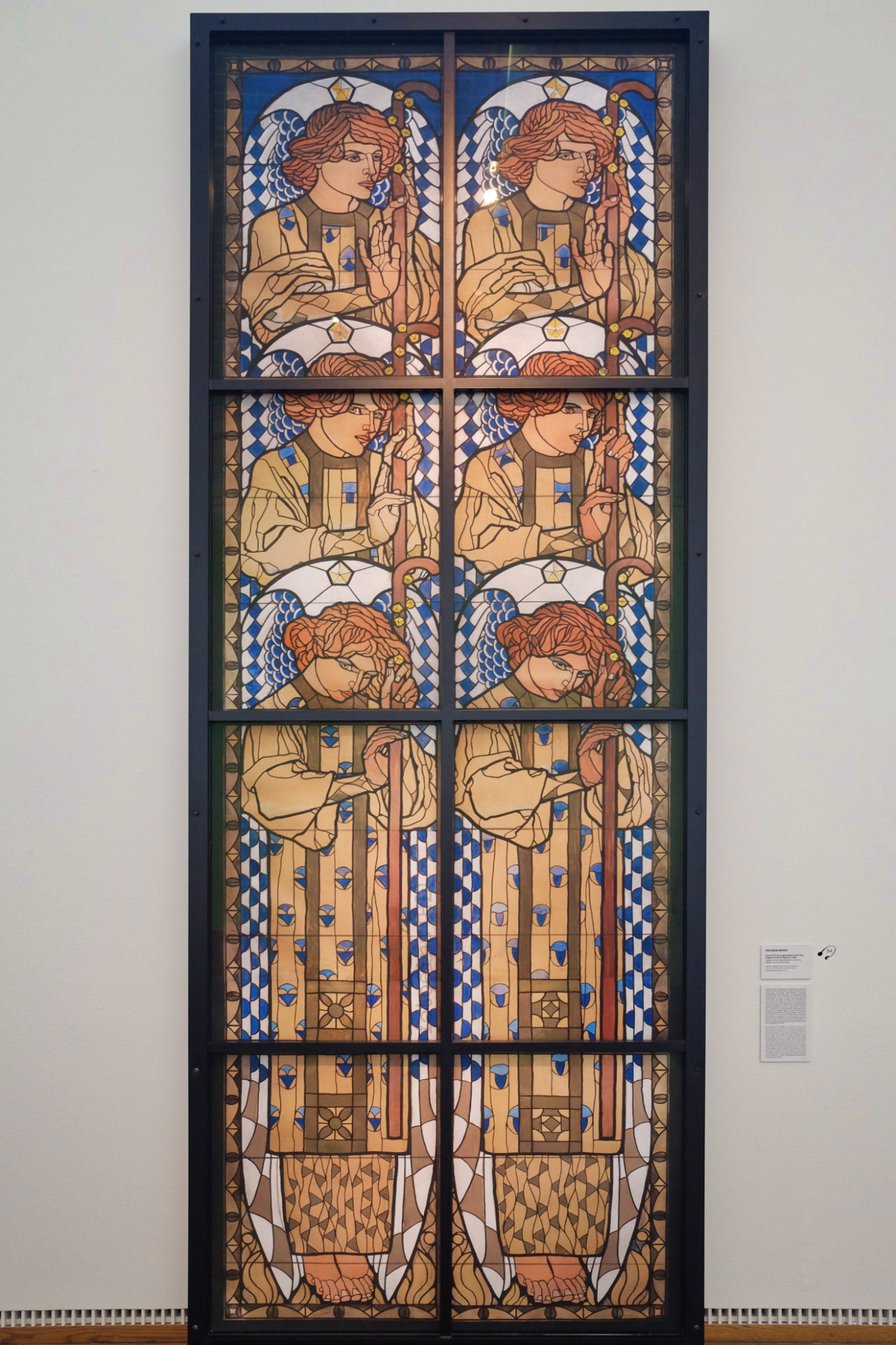
Koloman Moser’s 1905 design of the angel windows for Otto Wagner’s Steinhof church: gouache and black india ink on paper (facsimile), from the collection of the Leopold Museum in Vienna. Photo of display at Wien Museum Karlsplatz, 19 May 2018 (X70).
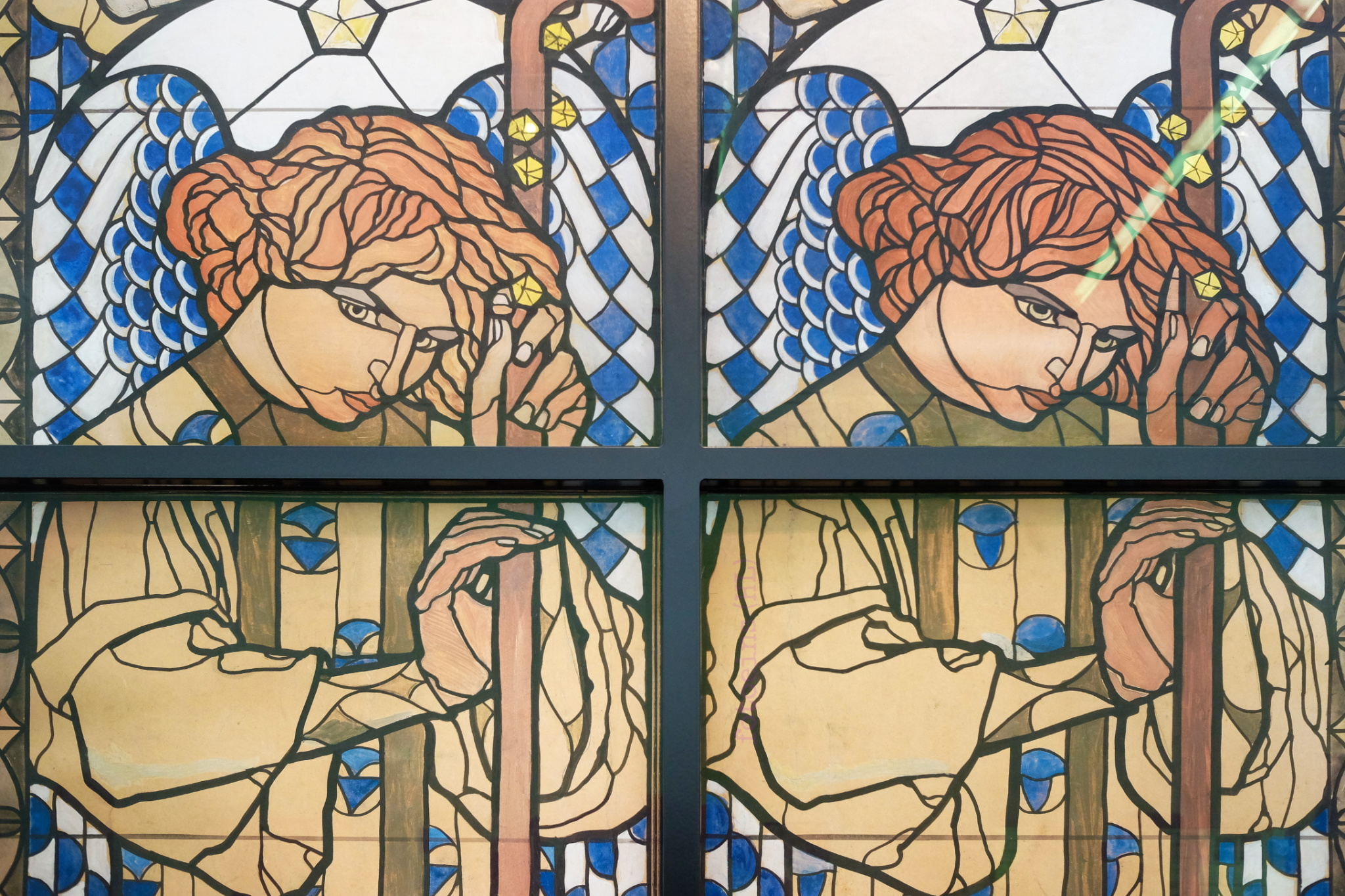
Close-up of angel windows designed by Koloman Moser (1905), from the collection of the Leopold Museum in Vienna. The greenish stripe at upper-right is a reflection of the overhead lighting in the room. Photo of display at Wien Museum Karlsplatz, 19 May 2018 (X70).

Front: high altar and wall mural by Remigius Geyling and Leopold Forstner. I like how the golden dome-like baldachin above the high altar is a nod to the much larger golden dome on the roof of this very church. Photo, 6 Jul 2025 (X70).
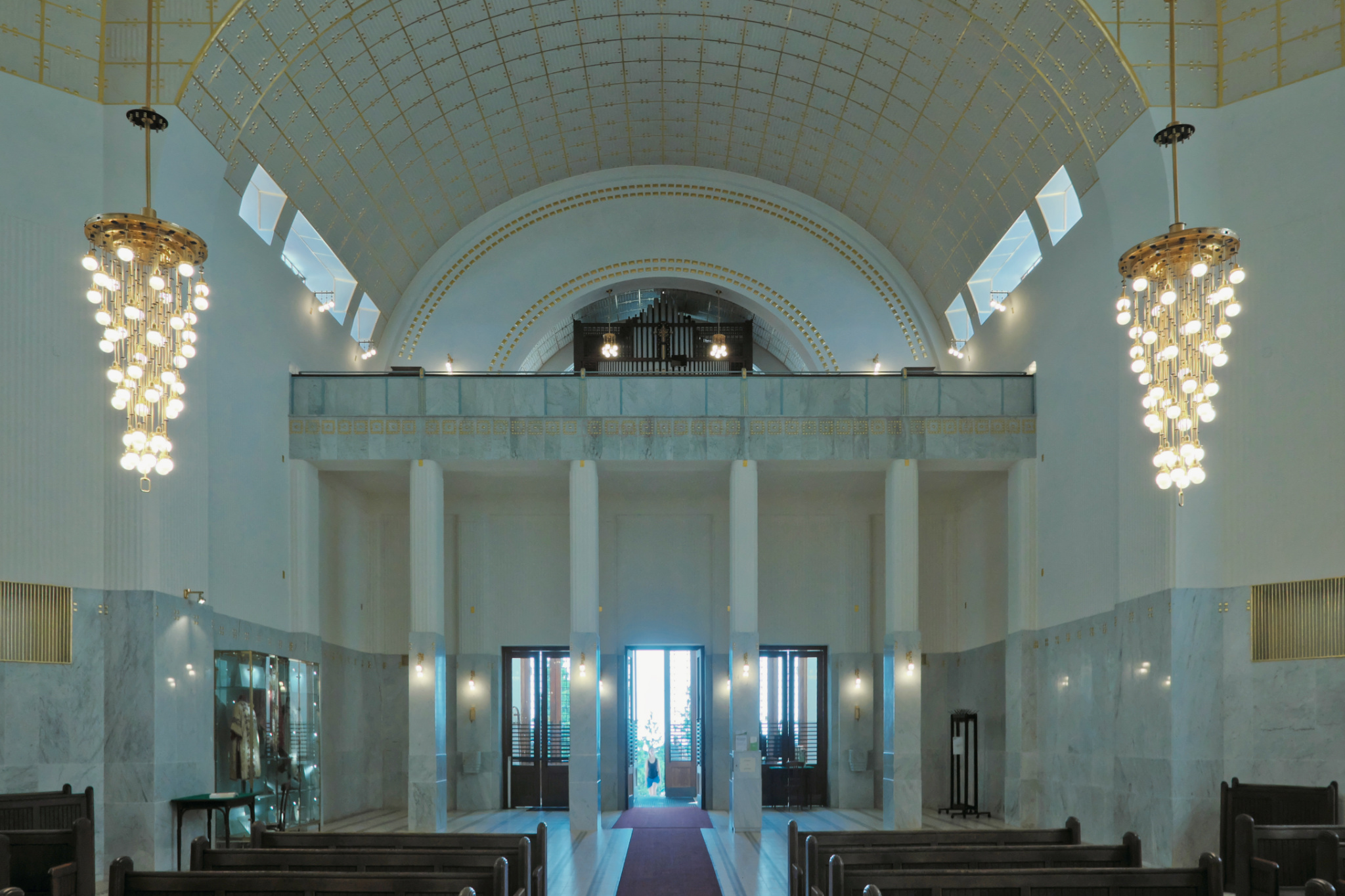
Facing south towards the building entrance, organ on the upper floor. Photo, 6 Jul 2025 (X70).
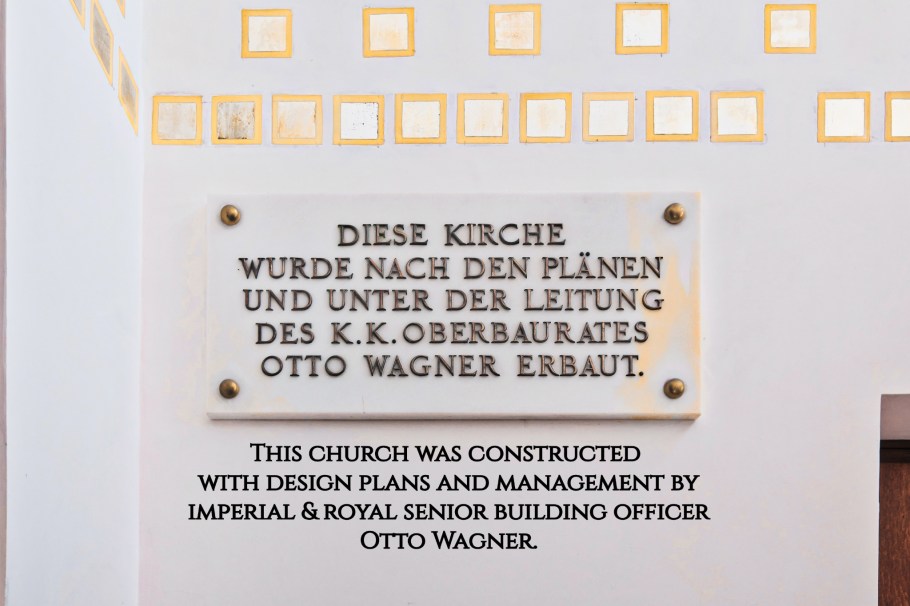
In recognition of Otto Wagner. Photo, 28 May 2023 (X70).
In the vicinity
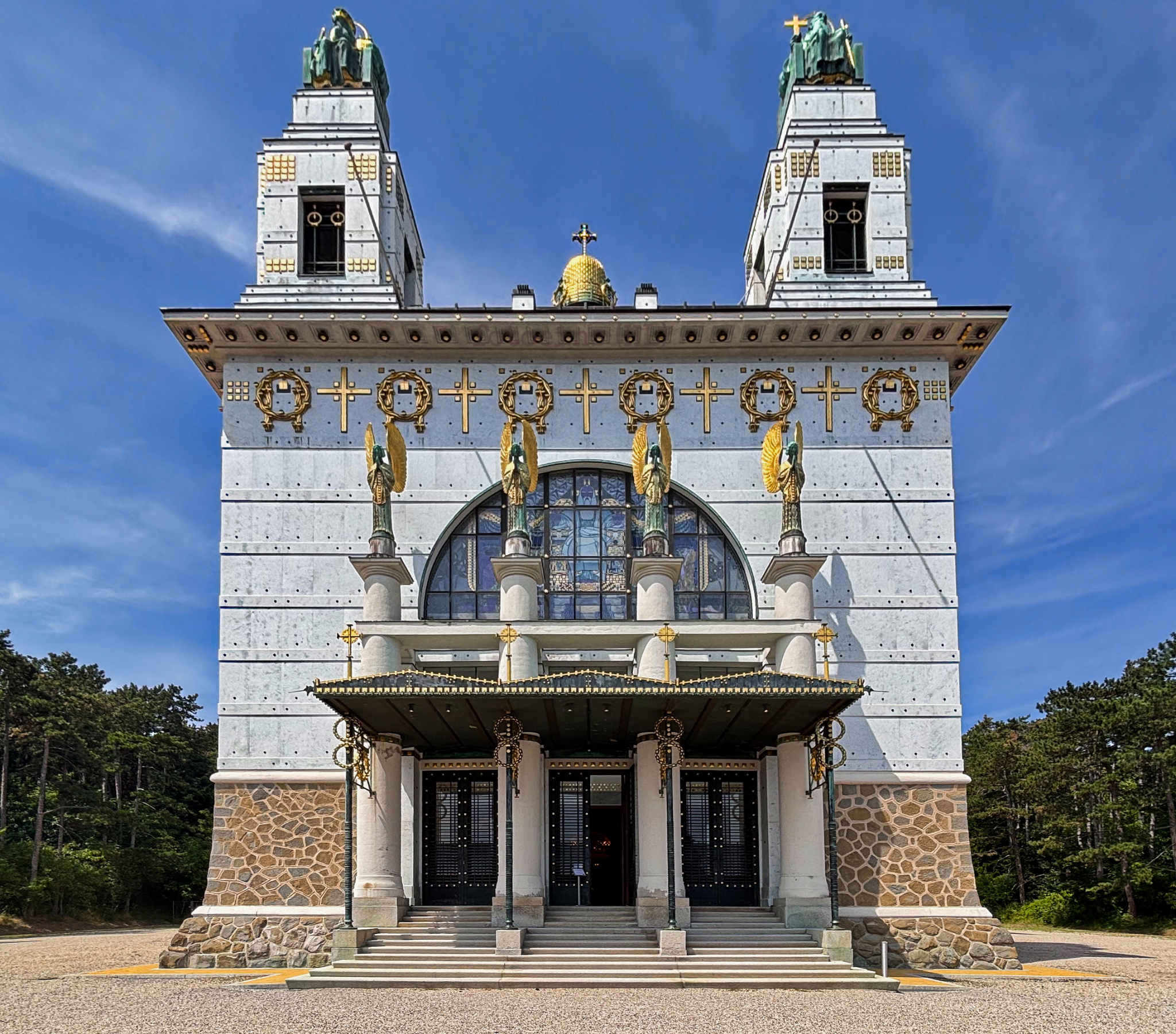
Outside the front entrance. Photo, 6 Jul 2025 (P15), corrected for geometric distortion.
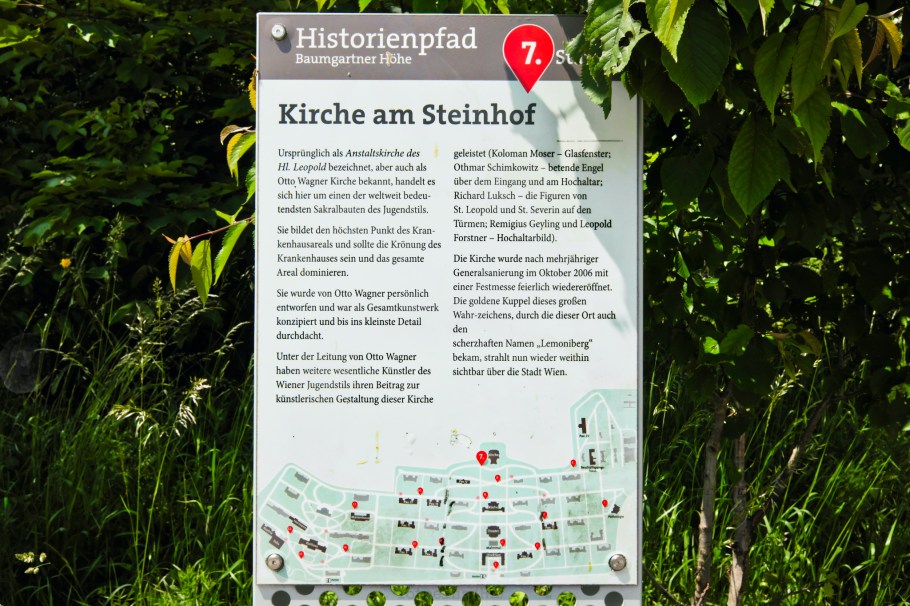
Station number 7, Historienpfad Baumgartner Höhe (history path, Baumgartner Heights). Photo, 28 May 2023 (X70).
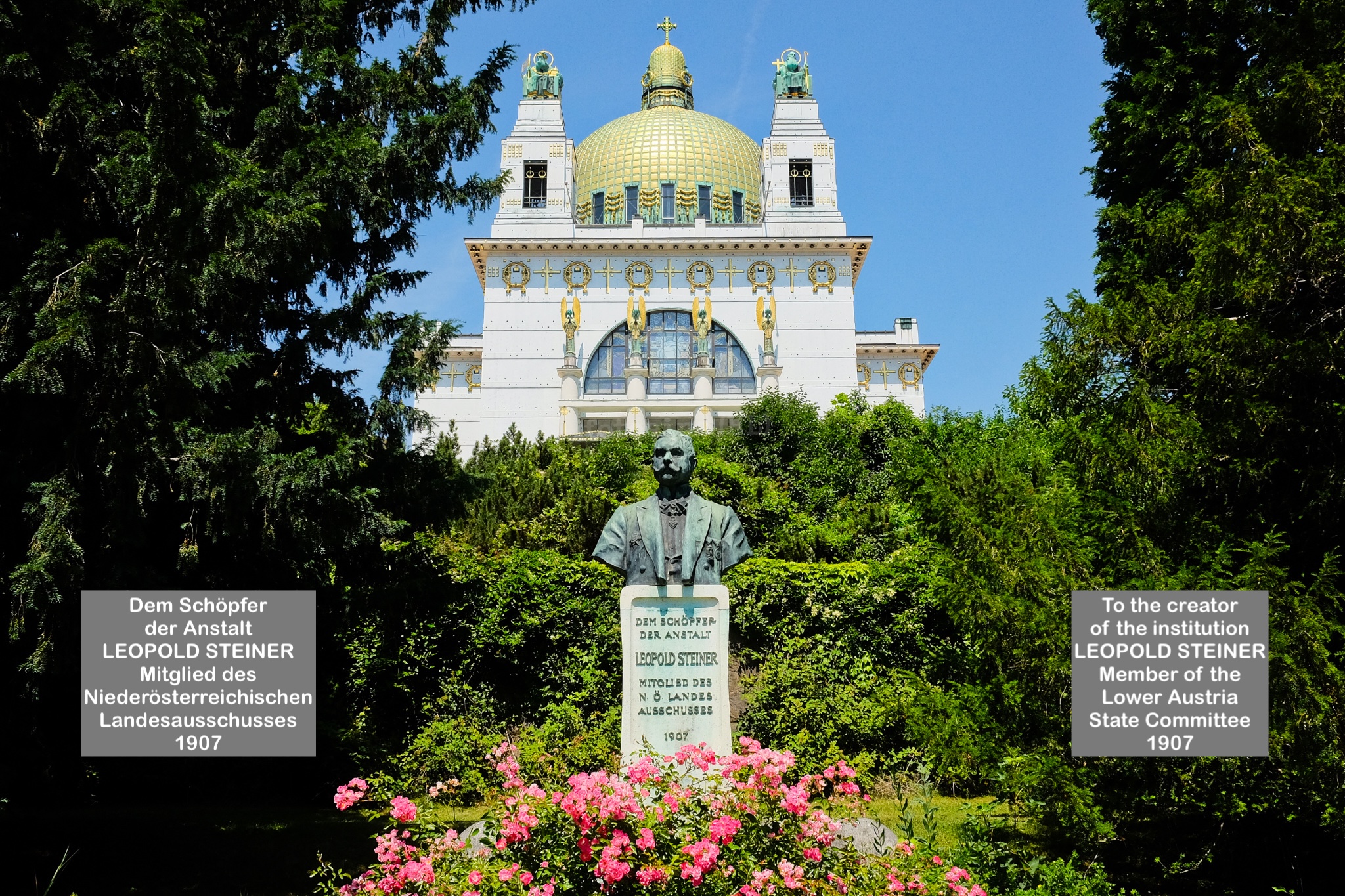
On the terrace path below the church is a memorial statue for Leopold Steiner, who as site manager organized the planning and construction for the overall medical complex in 1907. Photo, 6 Jul 2025 (X70).
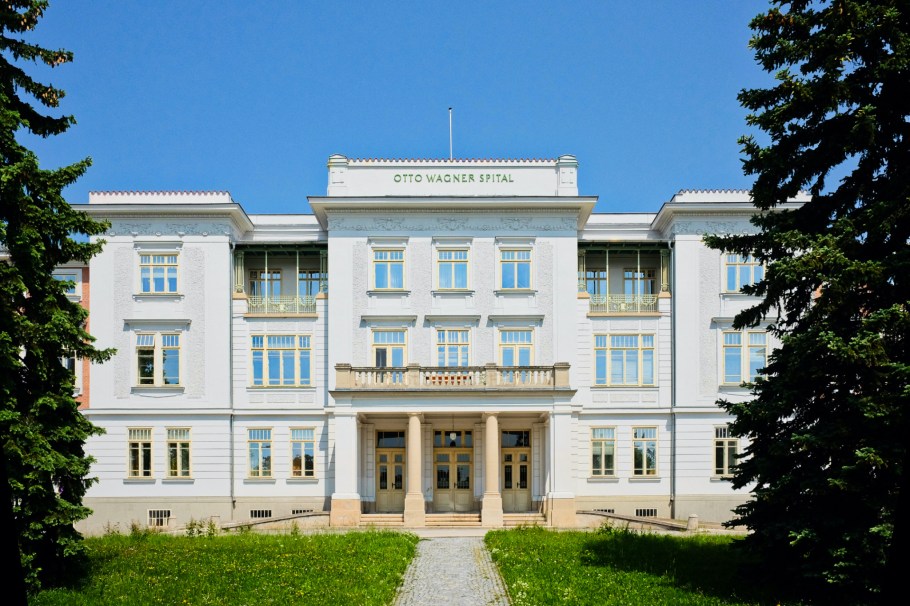
Building for the former hospital Otto Wagner Spital, at the front entrance (southern end) of the compound on street Baumgartner Höhe. Photo, 28 May 2023 (X70).
Sources
• Architektenlexikon Wien 1770–1945; available at <https://www.architektenlexikon.at/de/670.htm> [accessed Dec 2025].
• Bugler, C., Vienna (Boston: Little, Brown and Company; 1995).
• Christmann, D., Kirche am Steinhof (Otto Wagner Church), for Vielfalt der Moderne; available at <https://vielfaltdermoderne.de/en/otto-wagner-church/> [accessed Dec 2025].
• Geretsegger, H. & Peintner, M.; Otto Wagner 1841–1918: The Expanding City, The Beginning of Modern Architecture, English translation (New York: Praeger Publishers, 1970).
• Orosz, E.-M., Otto Wagner Kirche am Steinhof: Vom Glauben bei Licht, for WM Magazin on 14 June 2022; available from Wien Museum: <https://magazin.wienmuseum.at/otto-wagner-kirche-am-steinhof> [accessed Dec 2025].
• Parsons, N., Vienna: A Cultural History (Oxford: Oxford University Press, 2009).
• Sarnitz, A. (ed.), Architecture in Vienna (Wien: Springer-Verlag, 1998).
• Sarnitz, A., Otto Wagner 1841–1918: Forerunner of Modern Architecture (Köln: Taschen, 2005).
• Smith, D.J.D., Only In Vienna: Guide to Unique Locations, Hidden Corners and Unusual Objects, 4th edition (The Urban Explorer, 2015).
• Stadt Wien, Geschichte Wiki: <https://www.geschichtewiki.wien.gv.at/Wien_Geschichte_Wiki> [accessed Dec 2025].
• Vergo, P., Art in Vienna, 1898–1918: Klimt, Kokoschka, Schiele, and their Contemporaries (Ithaca: Cornell University, 1981).
• Wagner, O., Einige Skizzen, Projecte, und ausgeführte Bauwerke, 3. Band (Wien: Schroll/Berté, 1906). Available from Wien Bibliothek: <https://www.digital.wienbibliothek.at/wbrobv/content/titleinfo/2033205> [accessed Dec 2025].
Directions
Public transport with Wiener Linien: U-Bahn U4 to station “Unter St. Veit”, then bus 47A to stop “Otto Wagner Areal”. Alternatively, U-Bahn U3 to station “Ottakring”, then bus 48A to stop “Otto Wagner Areal”.
There is no cost to enter and walk the grounds, but there’s a modest admission charge to visit the church interior; check the official website for seasonal hours.
Commemorated at the nearby Gedenkstätte Am Steinhof memorial site are patients who were hospitalized here during World War II and who were targeted by Nazis for mistreatment, inhumane medical experiments, and murder.
( View the church location at OpenStreetMap )
I received no prior support or post-visit compensation for this post. I made all photos above in the summers of 2018, 2023, and 2025 with Canon EOS6D mark1 (6D1), Fujifilm X70 fixed-lens prime (X70) with WCL-X70 wide-field lens attachment, and iPhone15 (P15). This post appears on Fotoeins Fotografie at fotoeins DOT com as https://wp.me/p1BIdT-bqE. Last edit: 26 Dec 2025.
 Fotoeins Fotografie
One Response to “Vienna Steinhof Church: city- & Wagner-landmark”
[…] • Click • for more images and separate description here. […]
LikeLike