Vienna: Othmar Schimkowitz sculptures in the capital
Above/featured: Musenhaus (Muse House), Linke Wienzeile in Vienna – 18 May 2018.
Early 20th-century European artist Othmar Schimkowitz was one of many key figures in Vienna Modernism, an art movement which celebrated its centennial in 2018 in the Austrian capital city. Schimkowitz was born in Hungary and became well-known in Vienna for his architectural sculptures. In 1898, he joined the (Vienna) Secession, a group of artists which included Josef Hoffmann, Gustav Klimt, Max Kurzweil, Carl Moll, Koloman Moser, and Joseph Maria Olbrich.
Sculptures by Schimkowitz are often seen in a variety of architectural creations by Otto Wagner. Here below are four Schimkowitz examples in Vienna; all are accessible with public transit from Wiener Linien (WL) transport authority.
Key Examples
- Austria National Bank (9.)
- Austria Post Savings Bank (1.)
- Muse/Medallion House (6.)
- Secession (1.)
- Steinhof Church (14.)
Austria National Bank
9th district
WL: Tram 5, 12, 43, or 44 to stop “Lange Gasse”.
• Dutz, E., Die Reliefe an der Fassade der Oesterreichischen Nationalbank, from Kunstgeschichte aktuell, volume 33, number 3 (Wien: Verband österreichischer Kunsthistorikerinnen und Kunsthistoriker, 2016). Available at <https://voekk.at/de/publikationen/archiv> [accessed Dec 2025].

Front door to Austria National Bank (Österreichische Nationalbank) at Otto-Wagner-Platz. Completed in 1915, the decoration around the portal is by Schimkowitz; the central figure of the seven is the Roman goddess Fortuna. Photo, 15 May 2023 (X70).
Austria Post Savings Bank
1st district
A gorgeous angel almost leaps out into your line of sight in morning light, if you look up from Georg-Coch Plaza in central Vienna. The Austrian Post Savings Bank (Österreichische Postsparkasse) was completed in 1912 and considered an architectural masterpiece by Otto Wagner. Over the central section are two acroteria: aluminum angels by Schimkowitz.
WL: U-Bahn U3 to station “Stubentor”; U-Bahn U3 or U4, to station “Landstrasse”.

The Austria Post Savings Bank is an icon of 20th-century Vienna architecture; check out the roofline. Photo, 18 May 2018 (6D1, IG).
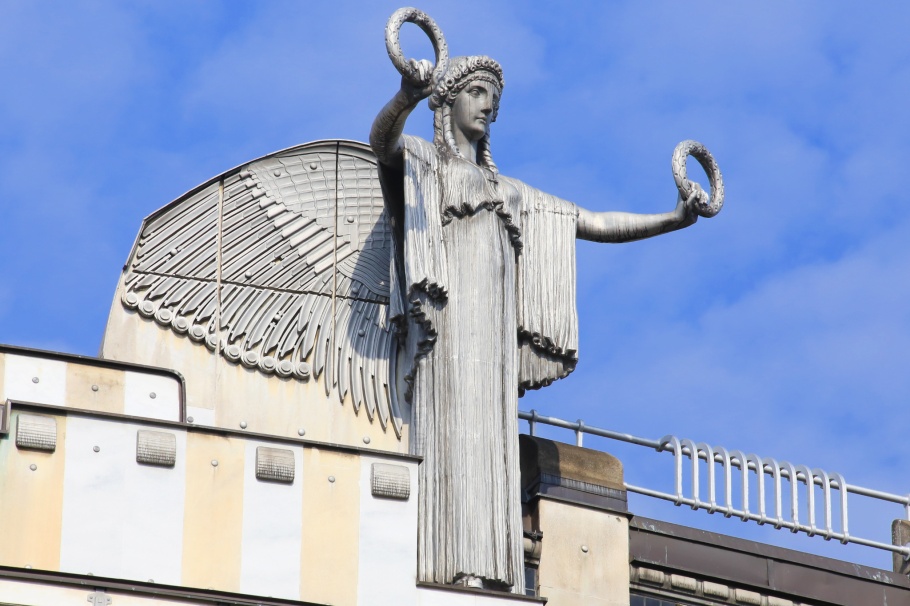
Angel by Schimkowitz on the roof of the bank – 18 May 2018 (6D1, IG).
Muse House (Medallion House)
6th district
Across from Vienna’s famous Naschmarkt on the north side of Linke Wienzeile street are leading examples of Otto Wagner architecture in the city. Completed in 1898 were he Majolica House and the Muse House; the latter is known also as Medallion House for the golden medallions with muses’ heads on the building’s front facade. At the corners of the roofline of the Muse House are Schimkowitz statues called “Die Ruferin”, or The Shouters.
WL: U-Bahn U4 to Kettenbrückengasse.

Four “shouters” are visible on the roofline of the Muse/Medallion House. Photo, 18 May 2018 (6D1).
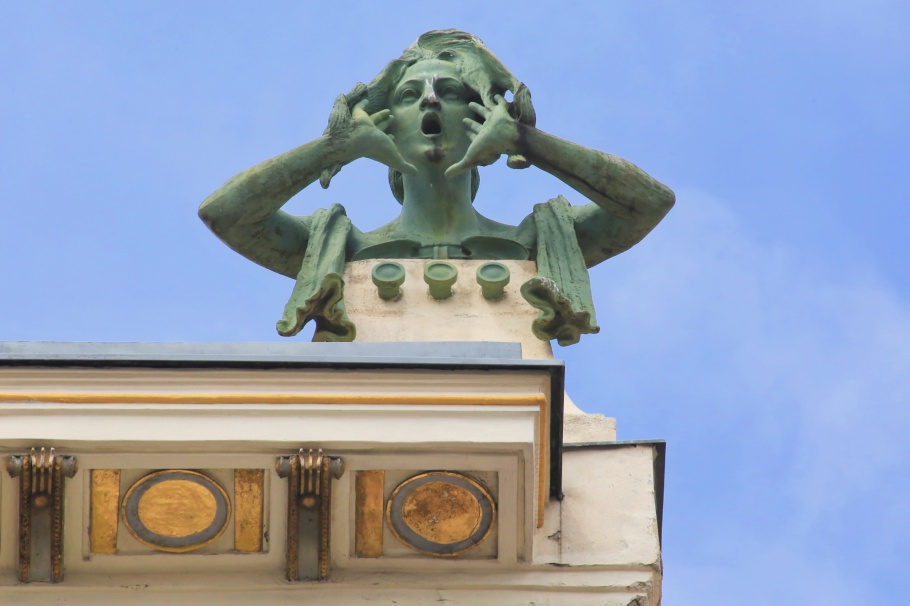
One of Schimkowitz’s “The Shouter” on the Musenhaus roof – 18 May 2018 (6D1, IG).
Secession building
1st district
Over the main door are three mascarons: 3 gorgon heads, below which is the phrase “Malerei, Architektur, Plastik” for painting, architecture, and sculpture, respectively. Schimkowitz created the sculptural heads for the Secession building which opened in 1898.
WL: U-Bahn U1 or U4, to Karlsplatz.
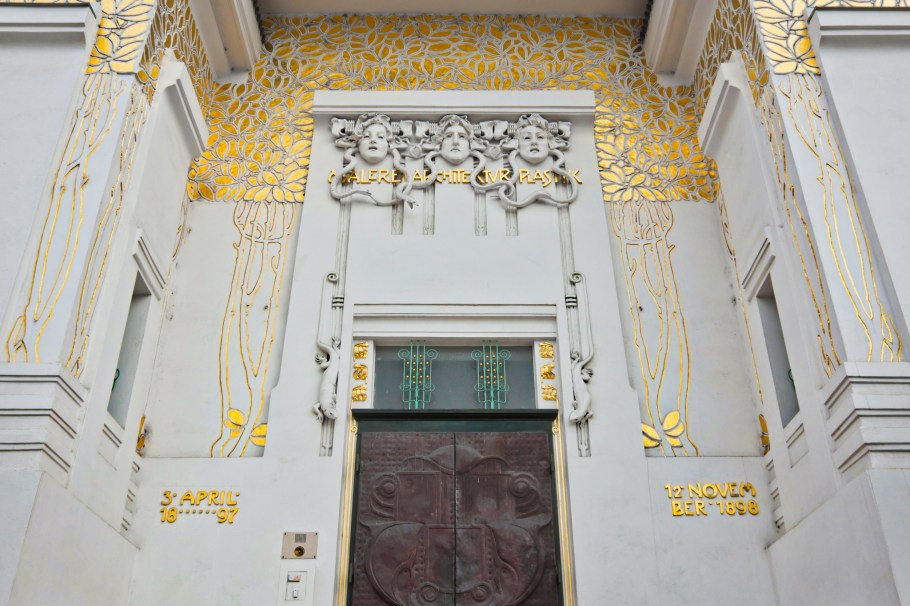
Photo, 15 May 2023 (X70).
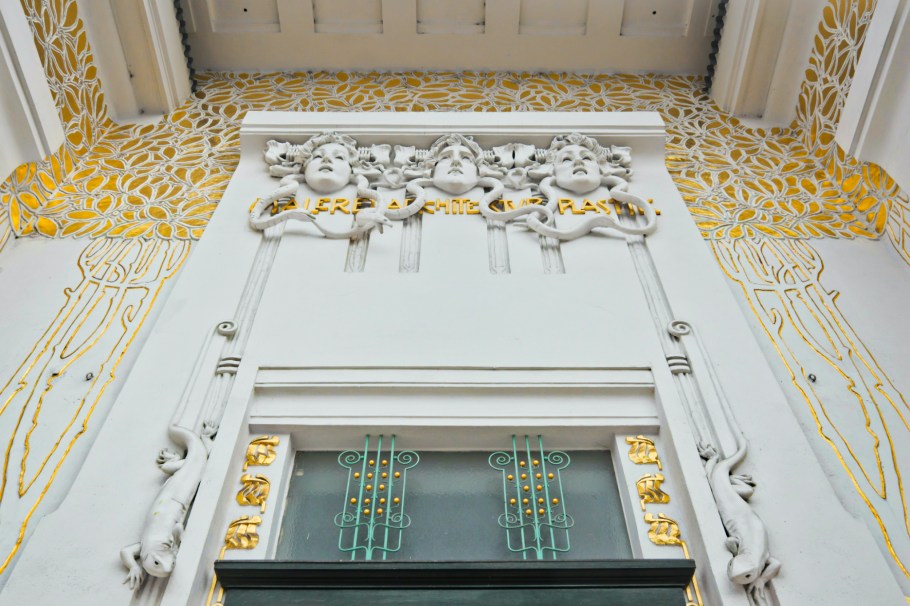
3 mascarons above the main entrance: gorgon heads by Othmar Schimkowitz. Photo, 15 May 2023 (X70).
Steinhof Church
14th district
Designed and built by Otto Wagner, the Steinhof Church was inaugurated in 1907 for the patients of the Steinhof Psychiatric Hospital, which is now the Klinik Penzing complex. Schimkowitz provided four angel sculptures standing over the building’s front entrance. With additional contributions by fellow artists Koloman Moser and Richard Luksch, the Steinhof Church is considered a masterpiece of modern early 20th-century architecture by Wagner.
WL: U-Bahn U4 to Unter St. Veit, then bus 47A to stop “Flötzersteig”.

Check out the decorative elements on the church’s front facade, including 4 angels. Photo, 18 May 2018 (6D1, IG).
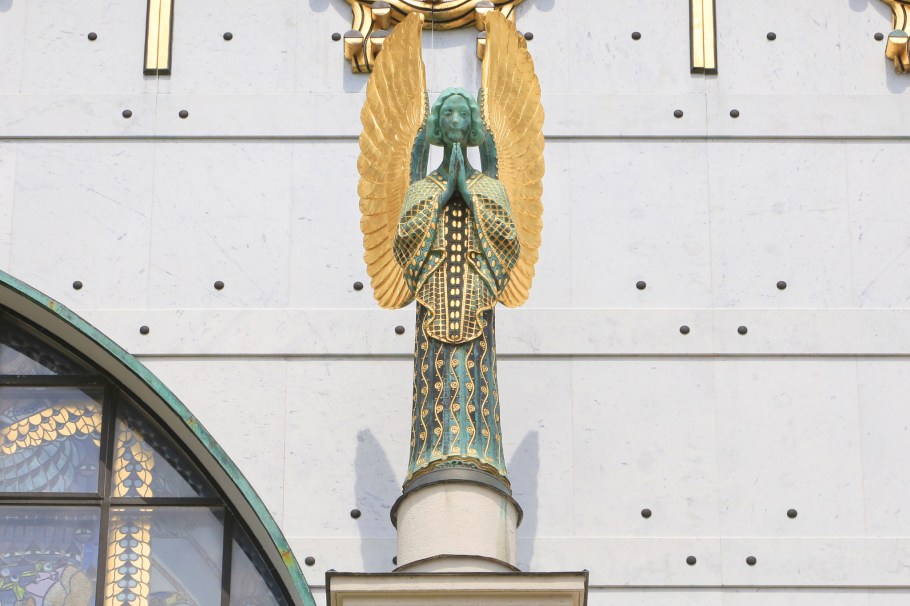
1 of 4 angel sculptures by Schimkowitz over the church’s front entrance. Photo, 18 May 2018 (6D1, IG).
I made all photos above on 18 May 2018 with a Canon EOS6D mark1 (6D1) and 15 May 2023 with a Fujifilm X70 fixed-lens prime (X70). This post appears on Fotoeins Fotografie at fotoeins DOT com as https://wp.me/p1BIdT-ggV.
 Fotoeins Fotografie
6 Responses to “Vienna: Othmar Schimkowitz sculptures in the capital”
The architecture back than was so most beautiful , presenting the art movement of that area of time.
LikeLiked by 1 person
Hi, Cornelia. I think there’s a certain kind of “age-old classic turn-of-the-century mystery” to these three Schimkowitz sculptures: the reasons why Wagner wanted these sculptures for his buildings, the choices Schimkowitz made for the figures as sculptures, and the reasons for the sculptures’ expressions on their faces.
LikeLike
Thank you Henry, that is really interesting to learn, their face expressions are indeed very unique.
LikeLiked by 1 person
[…] • Hungarian-born artist and architectural sculptor. • Joined Secession, 1898. • Contributions to Vienna landmarks, including sculptures for Otto Wagner’s architectural creations; e.g., Austrian Post Savings Bank, Muse House, Steinhof Church. […]
LikeLike
[…] other Vienesse artists, including mosaics and stained glass by Koloman Moser, angel sculptures by Othmar Schimkowitz, and exterior tower sculptures by Richard Luksch. The Steinhof church and the Austria Post Savings […]
LikeLike
[…] above the front entrance: sculptural angels by Othmar Schimkowitz, glass window by Koloman Moser. Photo on 18 May 2018 […]
LikeLike