Vienna Central Cemetery: living city of the dead
Above/featured: The cemetery’s gate 2. Photo, 20 May 2018.
Where: Vienna Central Cemetery (Wiener Zentralfriedhof).
Who: Beethoven, Boltzmann, Falco, Lamarr, Schütte-Lihotzky, Strauss I and II, and many more.
Why: Cross-section of cultural and economic history for capital city and nation.
In Vienna, tram 71 begins in the Old Town; goes around the western half of the inner ring past City Hall, national Parliament, and the Opera House; and heads southeast to the city’s main cemetery or the Zentralfriedhof. Because coffins to the cemetery were once transported on the tram, there’s a saying particular to the city’s residents, a phrase which means they’ve died by “going to the end of the line.”
“Sie haben den 71er genommen.”
(They took/rode the 71.)
Short intro
Amalgamating burial functions once dispersed among many cemeteries throughout the city, the central cemetery was established in 1863 with the first burial taking place in 1874. Today as Europe’s 2nd largest cemetery, the Zentralfriedhof covers a surface area of 2.5 square kilometres (1 square mile)%. There are over 300-thousand graves; among them 1000 are in the “honorary” or Ehrengräber category. The cemetery’s nickname is Totenstadt (city of the dead) with over 3 million buried, exceeding the current living population at 1.9 million (2022). At present, about 20 funerals take place every day in the cemetery.
Connections between life and death and between the living and the dead are symbolized by the physical layout; the graves of multiple backgrounds, creeds, and occupations; and countless sculptures. The size of the park invites residence of many animals, including deer, hares, foxes, hamsters, hedgehogs, and squirrels. There are also beehives on the grounds, thanks to the abundance and variety of trees and flowers; you can even buy “Friedhofshonig” honey at the cemetery gift shop. The large green space also serves joggers, bicycle rides, and long walks on many a path. In truth, the working central cemetery is also an urban recreation area.
I had at the outset wanted to find the graves of a couple of physicists whose work formed an important part of my scientific education. Then, I discovered the names of musicians buried here. Then, I learned the names of important figures in the city’s history. And then, I realized a visit to the central cemetery would be a measured sweeping wave through the artistic, cultural, and industrial history of Austria.
Was dieser kleine Raum umschlossen hält, war für mich die ganze Welt.
(What this little space keeps enclosed is my entire world.)
% 2023: the world’s largest cemetery park is in Hamburg-Ohlsdorf with an area encompassing 4 square kilometres (1.5 square miles).
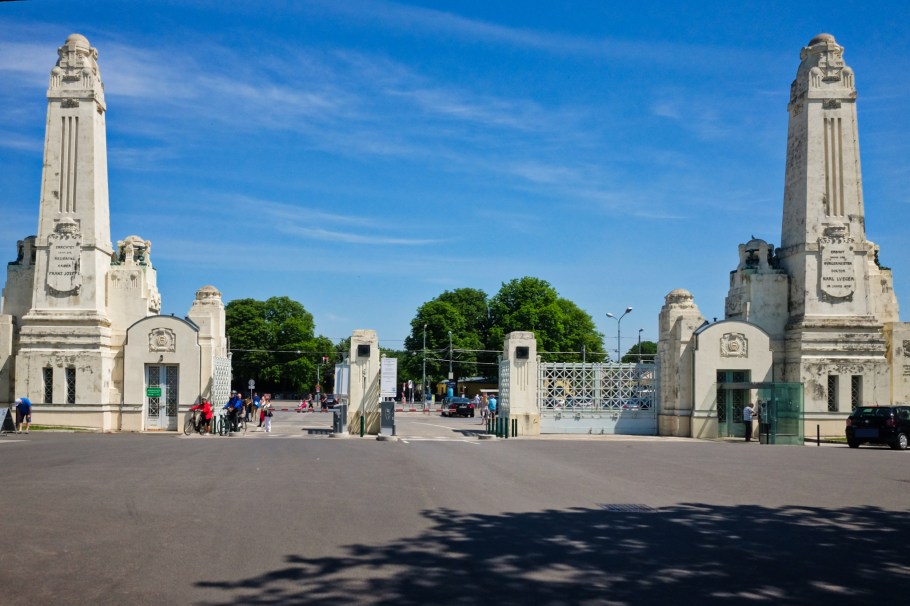
Entry columns from inside Tor 2 (gate 2), the cemetery’s main entrance designed by Maximilian (Max) Hegele. A student of Otto Wagner, Hegele also designed the Fillgraderstiege. Left (west) column: “Errichtet unter der Regierung Kaiser Franz Josef I.” (Constructed with the support of Emperor Franz Josef I.); right (east) column: “Erbaut unter dem Bürgermeister Doktor Karl Lueger im Jahre 1905.” (Built in 1905 with the support of Mayor Dr. Karl Lueger.) The tram stop “Zentralfriedhof, Tor 2” for lines 11 and 71 is located past the gate, only 60 metres (200 feet) from where this image was made. Photo, 20 May 2018.
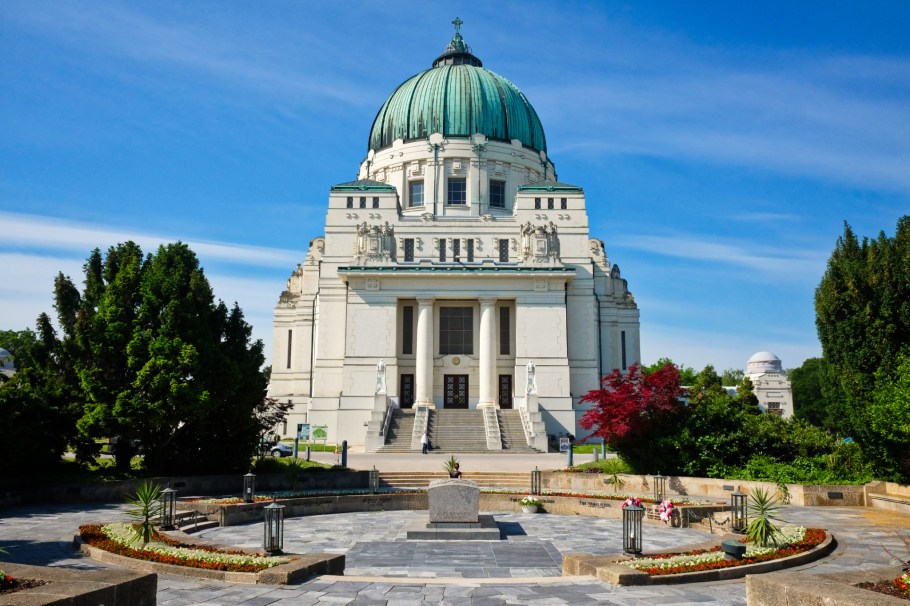
Near the centre of the cemetery is the 1911 church designed by architect Max Hegele in the Jugendstil architectural style and named Dr.-Karl-Lueger-Gedächtnis-Kirche (Dr. Karl Lueger Memorial Church). As Vienna’s mayor from 1897 to 1910, Lueger’s legacy as visionary modernist was tarnished by his opportunistic and virulent anti-Semitism. The church was renamed in 2000 as Friedhofskirche zum heiligen Karl Borromäus (St. Charles Borromeo Cemetery Church) after completion of full renovations. Photo, 20 May 2018.
Notable Graves & Memorials
Graves are located in the primary sections of the cemetery through gates 2 and 3 (2. Tor, 3. Tor). The ✡ symbol indicates graves in the Old Jewish section through gate 1 (Alter Jüdischer Friedhof, 1. Tor), and the New Jewish section administered by the city’s Jewish Cultural Community (IKG Wien) and accessed through gate 4 (Neuer Jüdischer Friedhof, 4. Tor).
Every numbered item in the list correesponds to its numbered location in the map below. This is by no means a complete list, and is not intended as such.
- Viktor ADLER
- Rudolf von ALT
- Friedrich AMERLING
- Ludwig van BEETHOVEN
- Marietta BLAU ✡
- Ludwig BOLTZMANN
- Johannes BRAHMS
- Evelyn BREZINA
- Otto DEUTSCH
- Familie EPHRUSSI ✡
- Gustav EPSTEIN ✡
- Anton FERNKORN
- FLÖGE Sisters: Emilie, Helene, Pauline
- Egon FRIEDELL
- Samuel FROMMER (Holocaust memorial) ✡
- Christof Willibald GLUCK
- Josef HACKHOFER
- Theophil HANSEN
- Karl HASENAUER
- Ludwig HEVESI
- Johann HÖLZEL, a.k.a. Falco
- Josef HOFFMANN
- Adolf JELLINEK ✡
- Mercédès JELLINEK
- Udo JÜRGENS
- Ludwig KÖCHEL
- Moritz KÖNIGSWARTER ✡
- Josef KORNHÄUSEL
- Brigitte KOWANZ
- Hedy LAMARR
- Josef LANNER
- Franz LITTROW
- Adolf LOOS
- Hans MAKART
- Siegfried MARCUS
- Oskar MARMOREK ✡
- Vincenz MORZIN
- Hans MOSER
- Wolfgang Amadeus MOZART
- Familie MUNK, Josef Stefan
- Alois NEGRELLI
- Johann NESTROY
- Peter von NOBILE
- Eduard van der NÜLL
- Robert ÖRLEY/OERLEY
- Friedrich OHMANN
- Elfriede OTT
- Julius von PAYER
- Ida PFEIFFER
- Gabriele POSSANNER
- Gustav Adolf RAUPENSTRAUCH
- Familie ROTHSCHILD, Austria branch ✡
- Anton SALIERI
- Emil Jakob SCHINDLER
- Arthur SCHNITZLER ✡
- Arnold SCHÖNBERG
- Franz SCHUBERT
- Margarete SCHÜTTE-LIHOTZKY
- Camillo SITTE
- Minona von STACKELBERG
- Eduard “Edi” STRAUSS
- Johann STRAUSS I (dad)
- Johann STRAUSS II (son)
- Josef “Pepi” STRAUSS, Anna STRAUSS (mum)
- Viktor TILGNER
- Familie WALDMÜLLER
- Robert WEIGL
- Franz WERFEL
- Familie WIENER VON WELTEN ✡
- Hugo WOLF
- Friedrich “Fritz” WOTRUBA
- Josef “Joe” ZAWINUL
- Familie ZSIGMONDY
- Kaspar ZUMBUSCH
- Moritz & Ida ZWEIG ✡
- Memorial to Armenian victims in 1915
- Memorial to the victims for a free Austria 1934–1945
- Soviet Red Army WW2 soldiers
• Fauna: European hamster, red squirrel, roe deer.
• Transport
Viktor Adler
Rudolf von Alt
Friedrich Amerling
• b/✵ 14 Apr 1803 – d/✟ 14 Jan 1887.
• Austrian portraiture painter.
• Friedrich (Ritter von) Amerling grave: group 14A, number 30.
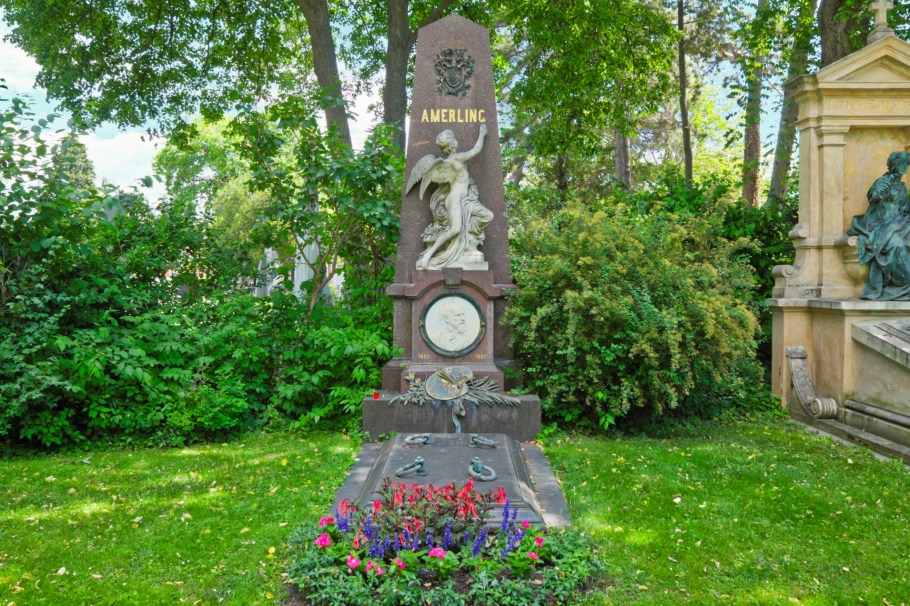
Friedrich Amerling grave. Photo, 28 May 2022.
Ludwig van Beethoven
• b/✵ 16 Dec 1770 – d/✟ 26 Mar 1827.
• Composer of over 700 works.
• From his 9th symphony: “Ode an die Freude (Ode to Joy)“, adapted from Friedrich Schiller’s poem.
• Originally buried in Währinger Ortsfriedhof cemetery, his remains were exhumed and moved here to the much larger Zentralfriedhof in 1888 when this memorial was also unveiled.
• Ludwig van Beethoven grave: group 32A, number 29.
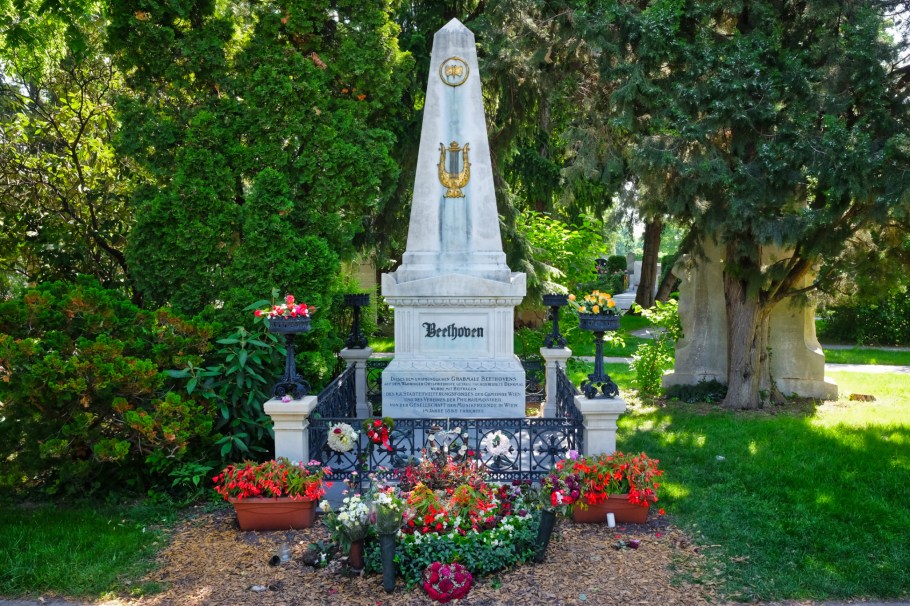
Ludwig van Beethoven grave. Photo, 20 May 2018.
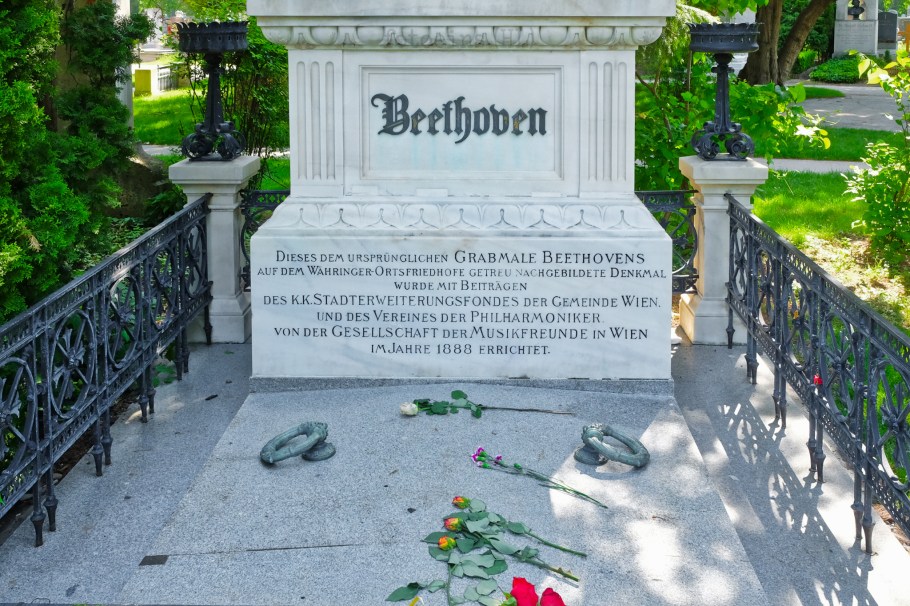
Originally buried 1827 in Währinger Ortsfriedhof, his remnants exhumed and reburied here in 1888. Photo, 20 May 2018.
Marietta Blau
• b/✵ 29 Apr 1894 – d/✟ 27 Jan 1970.
• Physicist; pioneered methods for imaging and tracking high-energy cosmic rays.
• Marietta Blau buried with her father Markus (died 9 Dec 1919), burial location: group 6, row 2, number 16 (New Jewish section).
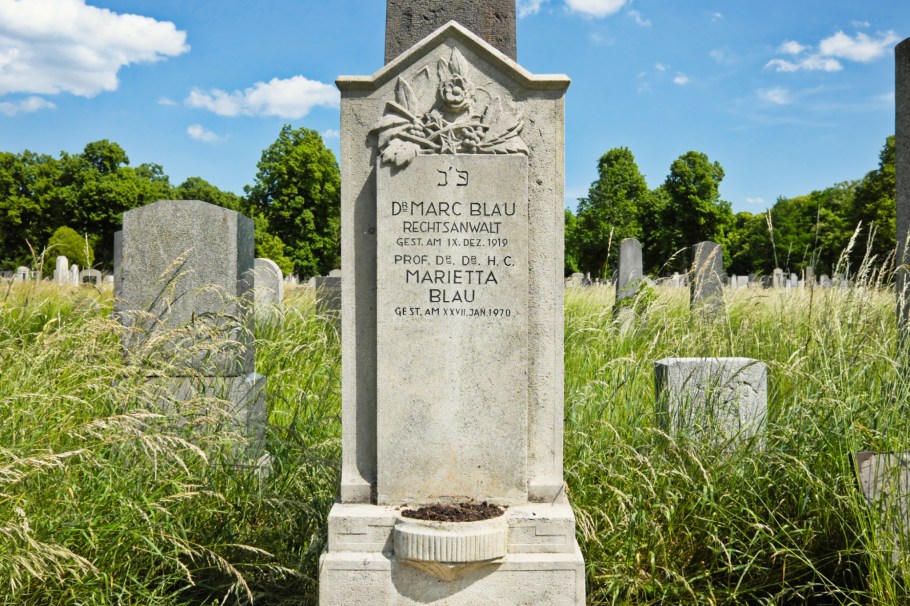
Father and daughter, New Jewish section. Photo, 2 Jun 2022.
Ludwig Boltzmann
• b/✵ 20 Feb 1844 – d/✟ 5 Sep 1906.
• Physicist, student of Josef Stefan. Became professor of mathematics and physics at University of Vienna.
• Contributions include Stefan-Boltzmann Law, Maxwell-Boltzmann distribution, entropy equation.
• Originally buried in Döbling cemetery, his remains were exhumed and moved to the central cemetery for reburial in December 1929.
• Austrian sculptor Gustinus Ambrosi created in 1933 the gravestone seen today.
• Ludwig Boltzmann grave: group 14C, number 1.

Finding Ludwig Boltzmann. Photo, 20 May 2018.

The entropy equation, S = k log W, really should be attributed to Max Planck.
Johannes Brahms
• b/✵ 7 May 1833 – d/✟ 3 Apr 1897.
• Composer; e.g., “Ungarischer Tanz Nr. 5″ (Hungarian Dance no. 5)“, WoO 1 (1879).
• Johannes Brahms grave: group 32A, number 26.
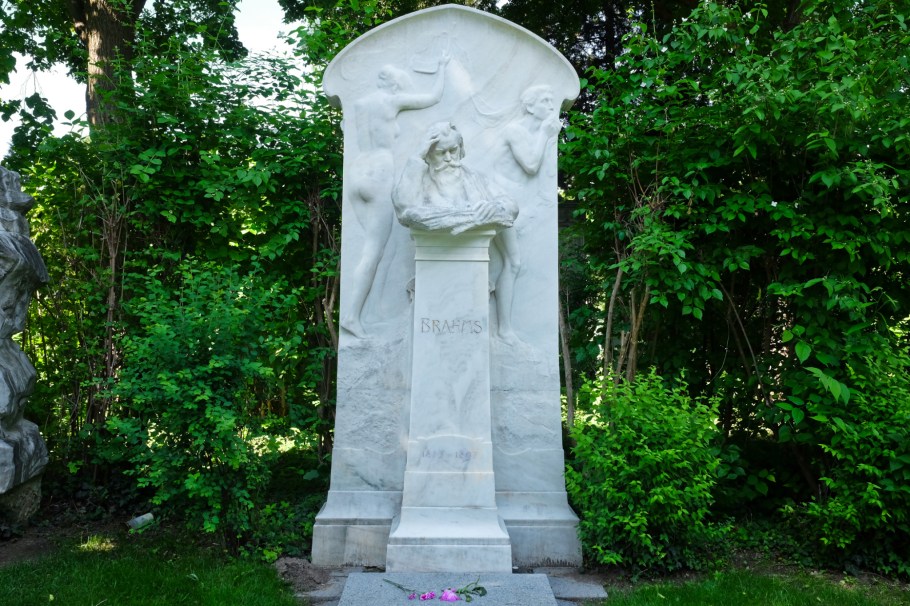
Johannes Brahms. Photo, 20 May 2018.
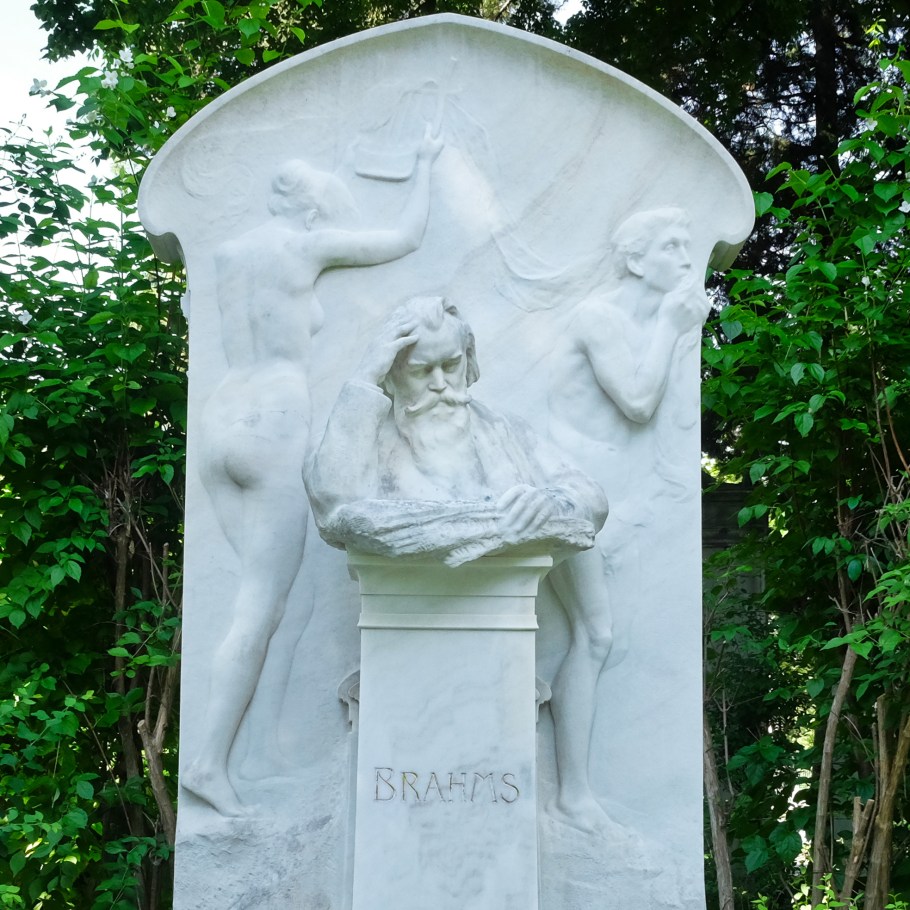
Photo, 20 May 2018.
Evelyn Brezina
• b/✵ 1 May 1977 – d/✟ 11 Jan 2024.
• Advocate for rights of the physically-challenged and for improved accessibility in Vienna.
• Observed Vienna beautifully from a different wheelchair perspective.
• Evelyn Brezinas Leben mit Glasknochen / Her life with brittle-bone disease: radio piece by ÖRF, 28 November 2020.
• Evelyn Brezina’s final resting place in the Anatomiegedenkstätte: group 26, number 0224 (plaque 110).
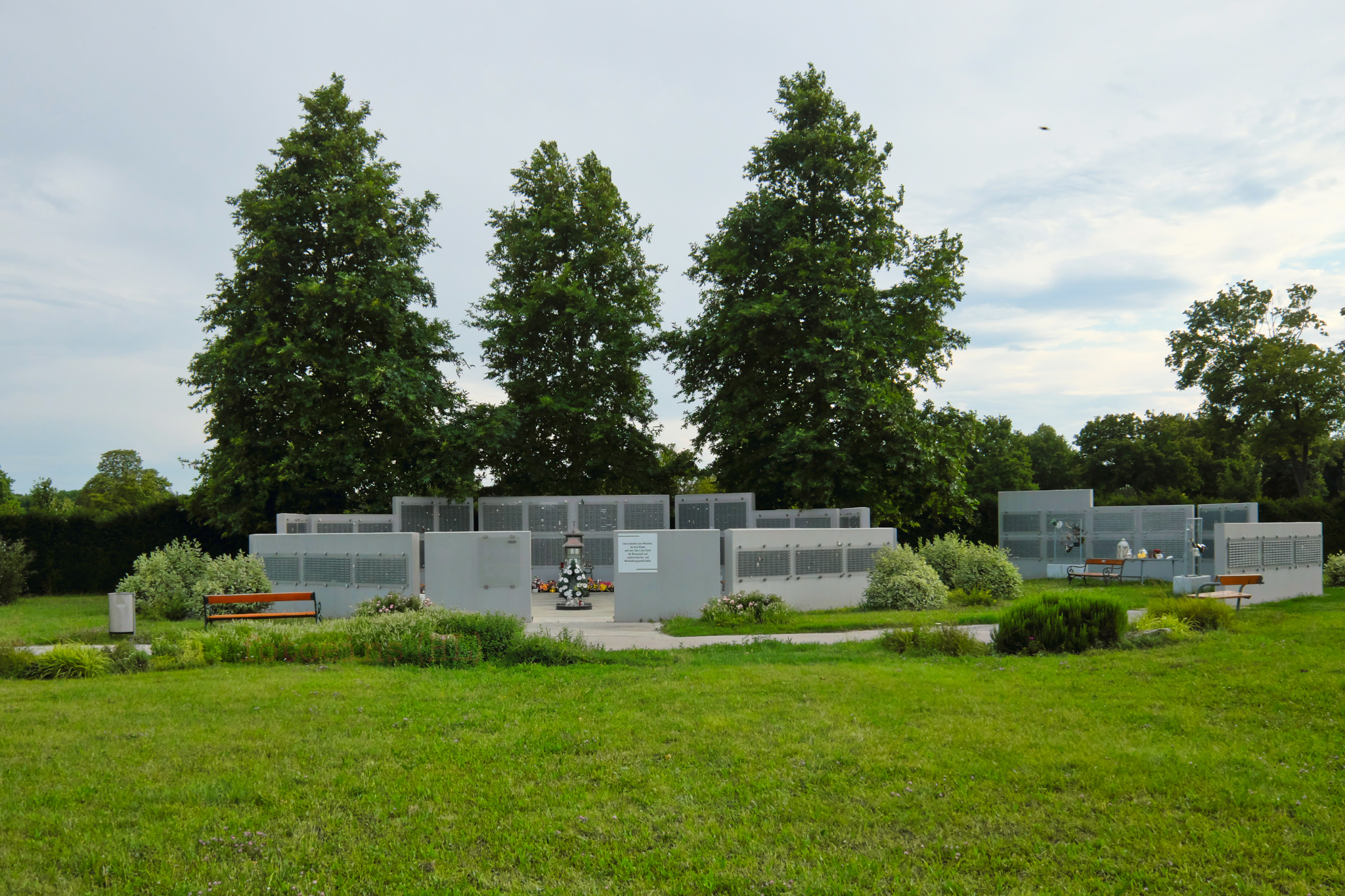
Anatomiegedenkstätte (group 26), 14 Jul 2025.
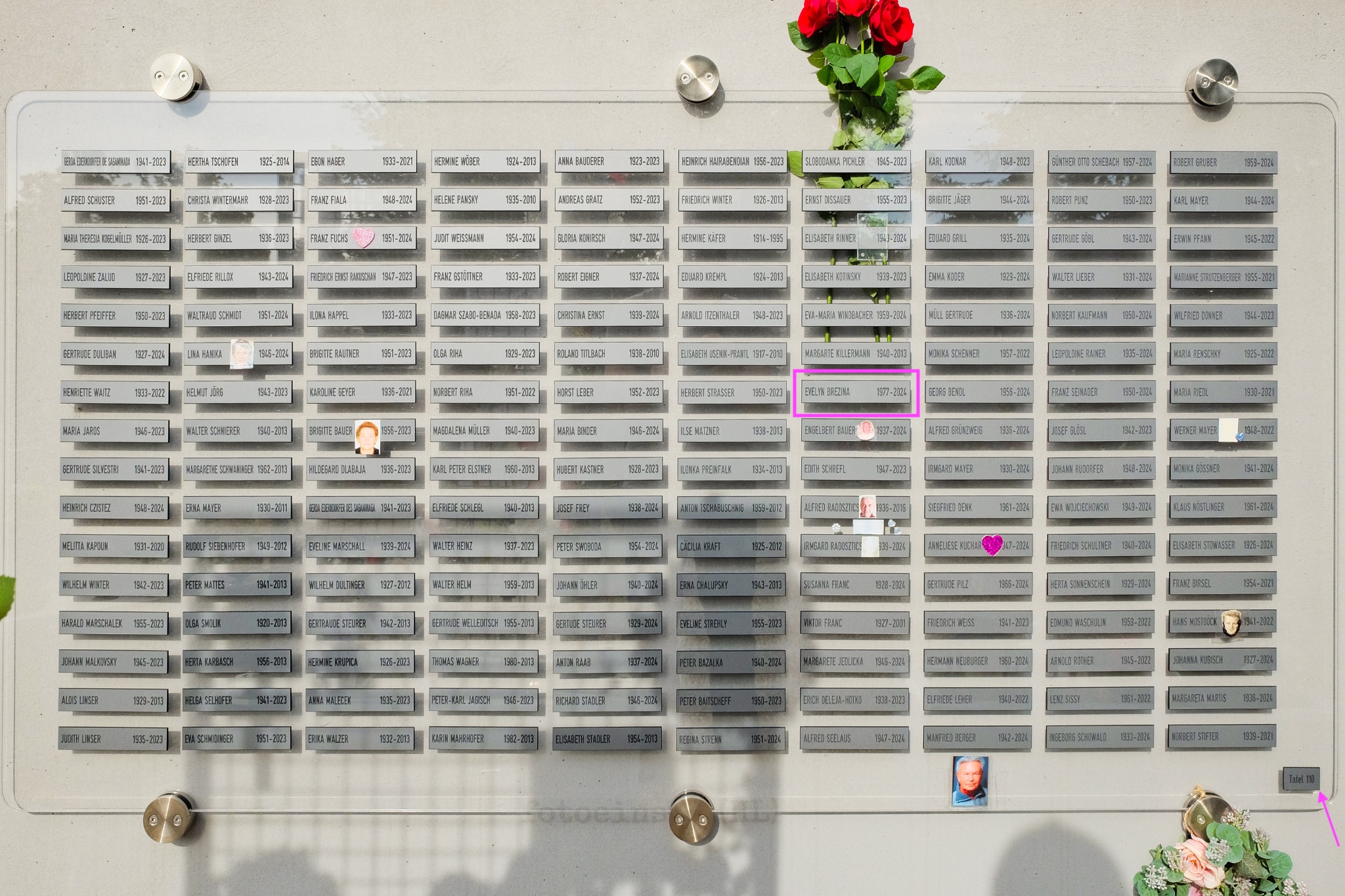
Anatomiegedenkstätte (group 26). Highlighted with a purple arrow and a purple rectangle, respectively, are “Tafel 110” (plaque 110) and the name-plate for Evelyn Brezina (number 224). The latter is located 4th column from the right and 7th row from the top. Photo, 14 Jun 2024.
Otto Erich Deutsch
• b/✵ 5 Sep 1883 – d/✟ 23 Nov 1967.
• Austrian musicologist; the “D.” in Franz Schubert‘s catalog is named after Otto Deutsch who organized and produced the first complete catalog of Schubert’s works in 1951: Schubert Thematic Catalog | Deutsch-Verzeichnis.
• Univ. Prof. Dr. phil. Otto Erich Deutsch grave: group 40, number 12.
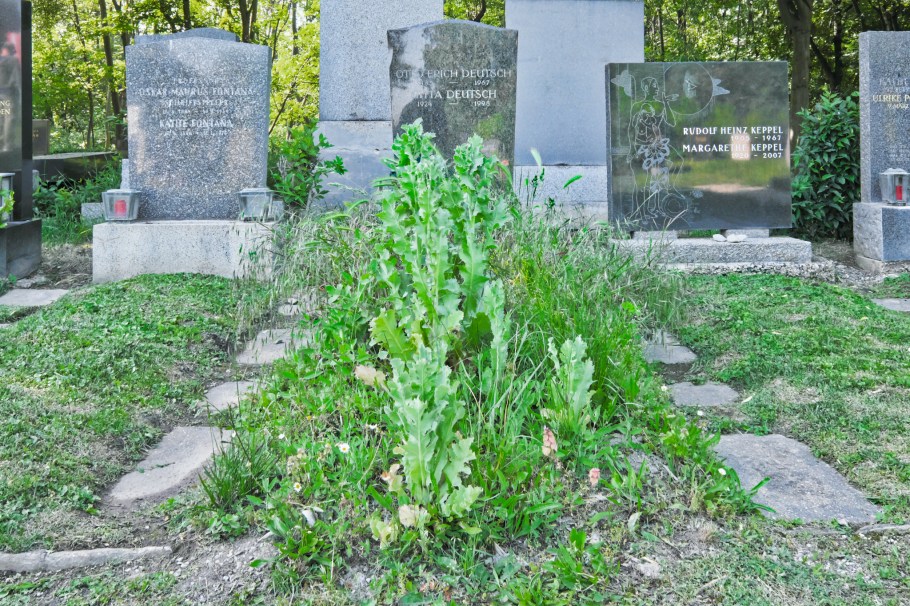
Otto Erich Deutsch & Gitta Deutsch. Photo, 25 May 2023.
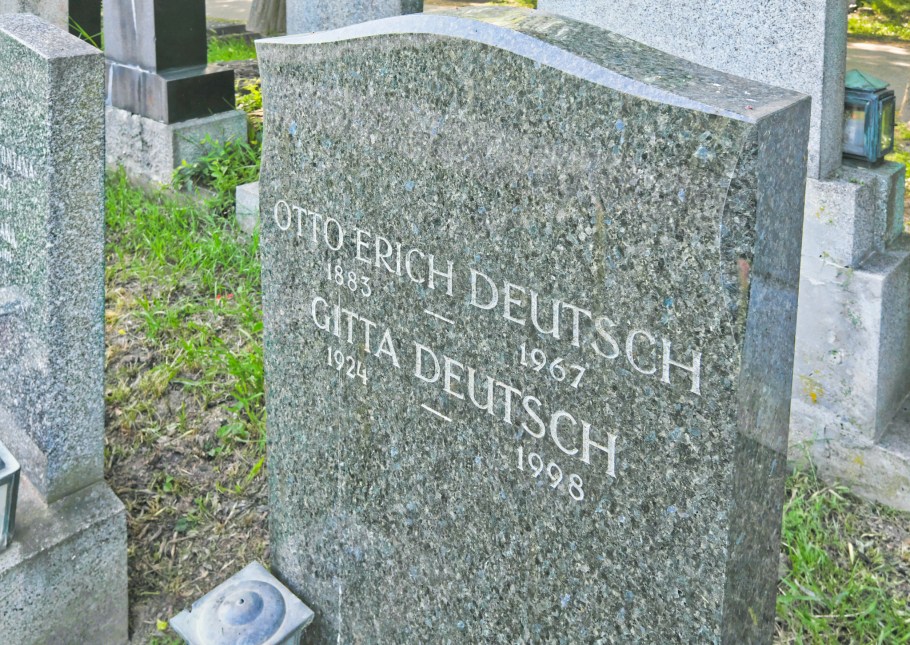
Otto Erich Deutsch & Gitta Deutsch. Photo, 25 May 2023.
Ephrussi family
• Charles Joachim Ephrussi: b/✵ 1793 – d/✟ 24 Nov 1864.
• Charles Joachim considered progenitor of the Ephrussi banking family; son Ignaz/Ignace and his wife Emilie (née Porgès)
• Charles Joachim Ephrussi mausoleum and grave: group 8, row 62, number 49 (Old Jewish section).
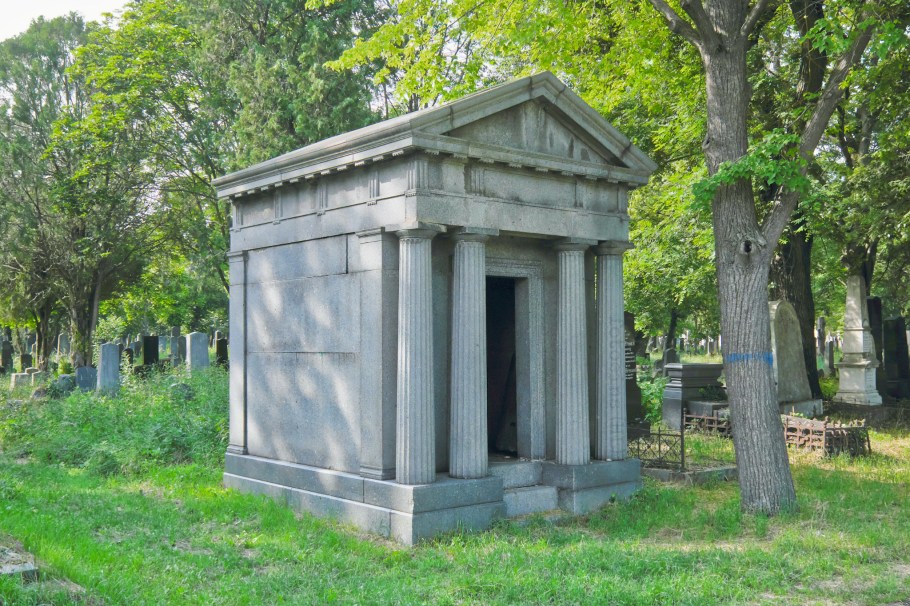
Mausoleum, Ephrussi family. Photo, 9 Jun 2023.
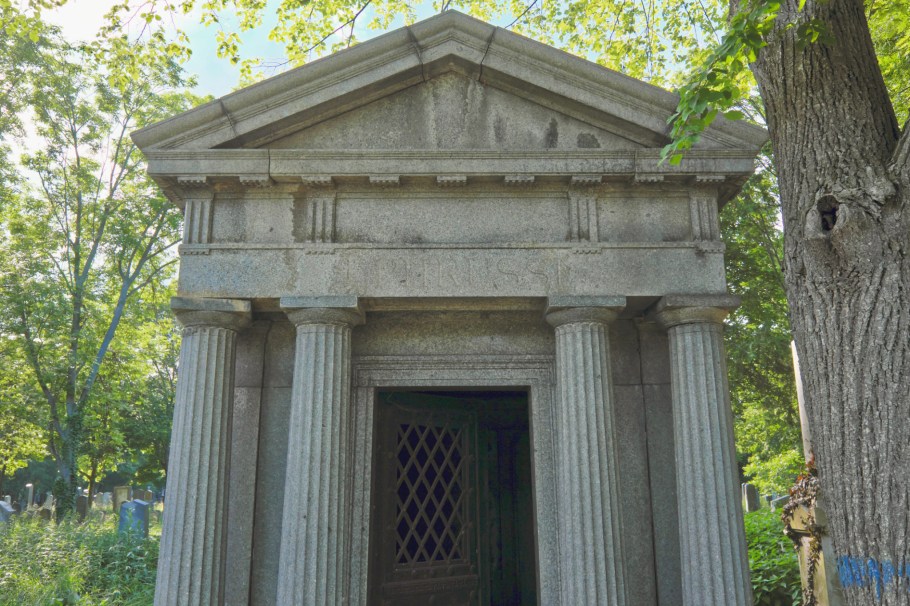
Front of the Mausoleum, with the faded/eroded “EPHRUSSI” over the door. Photo, 9 Jun 2023.
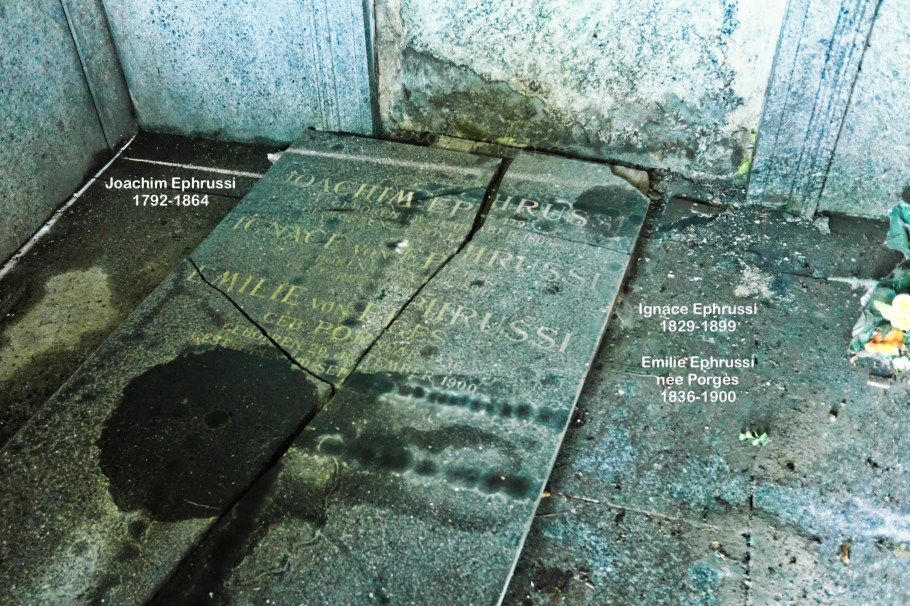
Inside the dark mausoleum interior is the (broken) headstone with the names (Charles) Joachim Ephrussi, his son Ignace/Ignaz, and the latter’s wife Emilie (née Porgès). Photo, 9 Jun 2023.
Gustav Epstein
• Gustav Epstein: b/✵ 10 Apr 1828 – d/✟ 23 Sep 1879.
• Industralist, banker; commissioned construction of Palais Epstein in Vienna and Villa Epstein (now, Villa Rainer) in Baden bei Wien.
• Gustav’s son, Leopold: b/✵ 26 May 1877 – d/✟ 29 Apr 1906.
• Epstein grave: group 6, row 1, number 7 (Old Jewish section).
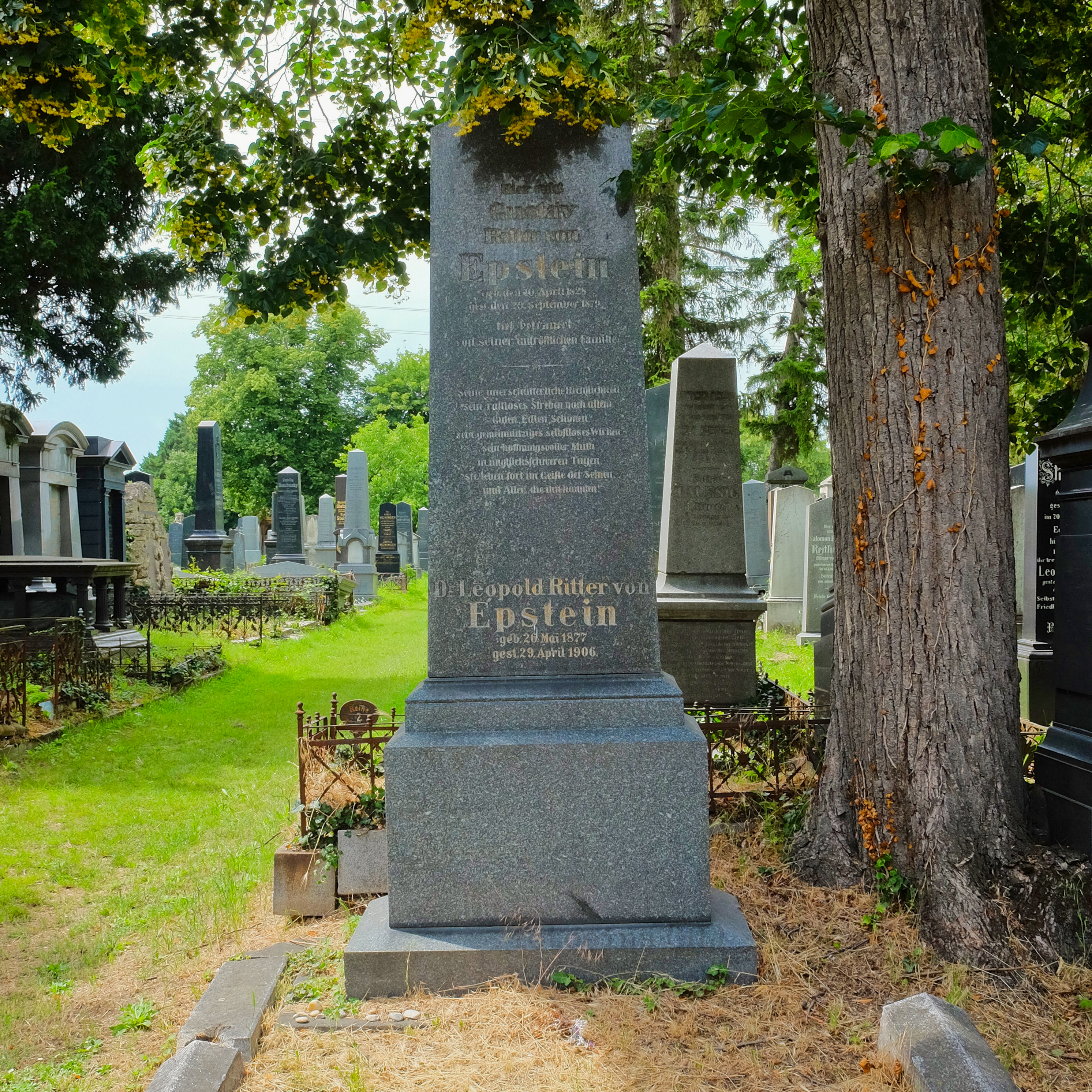
Gustav Epstein grave. Photo, 14 Jun 2024.

Gustav Epstein and son Leopold. Photo, 14 Jun 2024.
Anton Fernkorn
• b/✵ 17 Mar 1813 – d/✟ 16 Nov 1878.
• Sculptor, big and small, in the Biedermeier period.
• Anton Dominikus von Fernkorn Ritter grave: group 14A, number 18
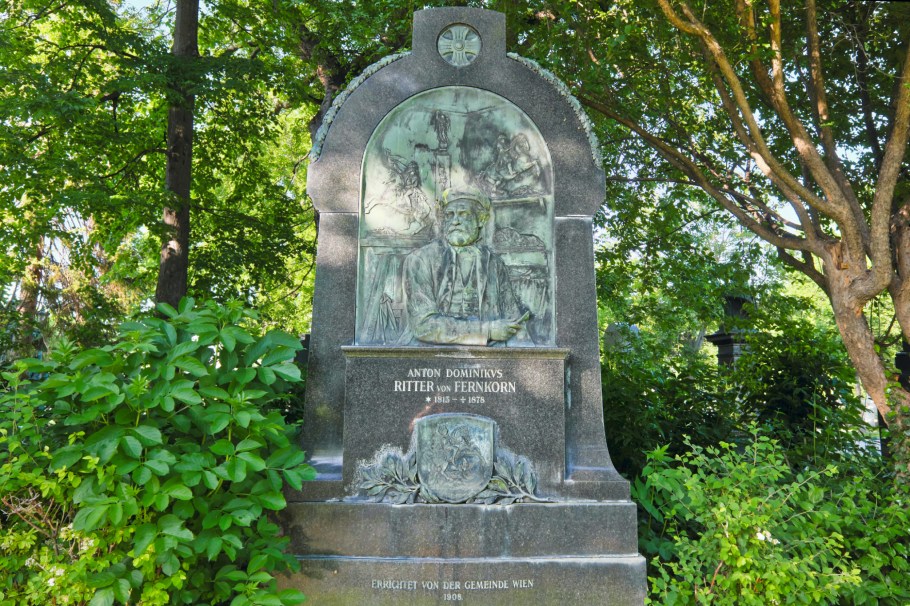
Fernkorn’s grave. Photo, 25 May 2023.
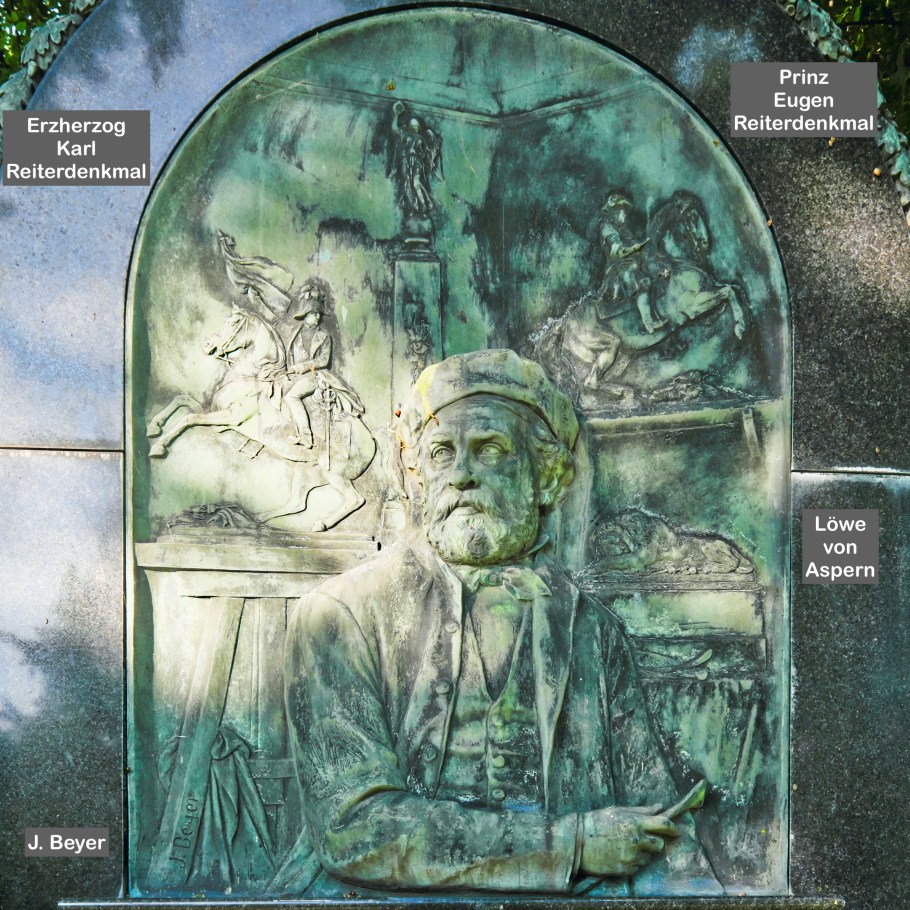
Anton Fernkorn’s grave faceplate, by Josef Beyer. Photo, 25 May 2023.
Flöge-Schwestern (Flöge Sisters)
• Emilie Flöge: b/✵ 30 Aug 1874 – d/✟ 26 May 1952
• Helene Klimt (née Flöge): 1871–1936
• Pauline Flöge: 1866–1917.
• The Flöge sisters operated their fashion shop “Schwestern Flöge” in the city’s 6th district from 1904 to 1938.
• Emilie was Gustav Klimt’s longtime partner, and understood to have been the model and inspiration for the woman in Klimt’s famous painting “The Kiss”.
• Flöge sisters grave: Group 8, row Kreuzallee, number 4 (Protestant/evangelical section).
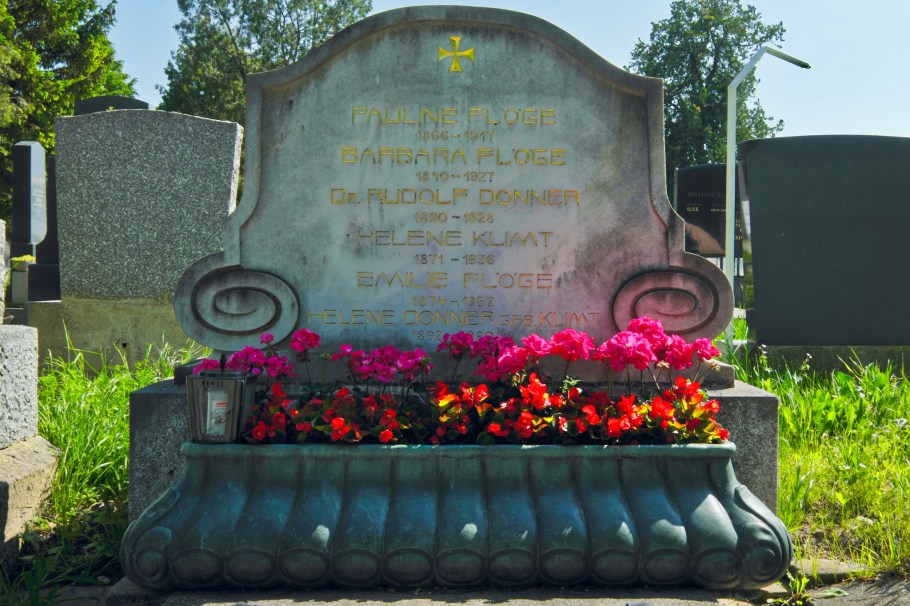
Flöge sisters Emilie, Helene, and Pauline; their mum Barbara; Helene Flöge Klimt’s daughter, Helene Donner; and latter’s husband, Rudolf Donner. Photo, 25 May 2023.
Egon Friedell Friedmann
• b/✵ Egon Friedmann, 21 Jan 1878 – d/✟ 16 Mar 1938.
• Austrian cultural historian, playwright, theater critic.
• Memorial plaque at Gentzgasse 7 (18.), where he committed suicide preventing arrest by the Nazi SA.
• His name appears among the over 64-thousand in the Shoah Wall of Names Memorial.
• Egon Friedell grave: group 9, row 1, number 29 (Protestant/evangelical section).
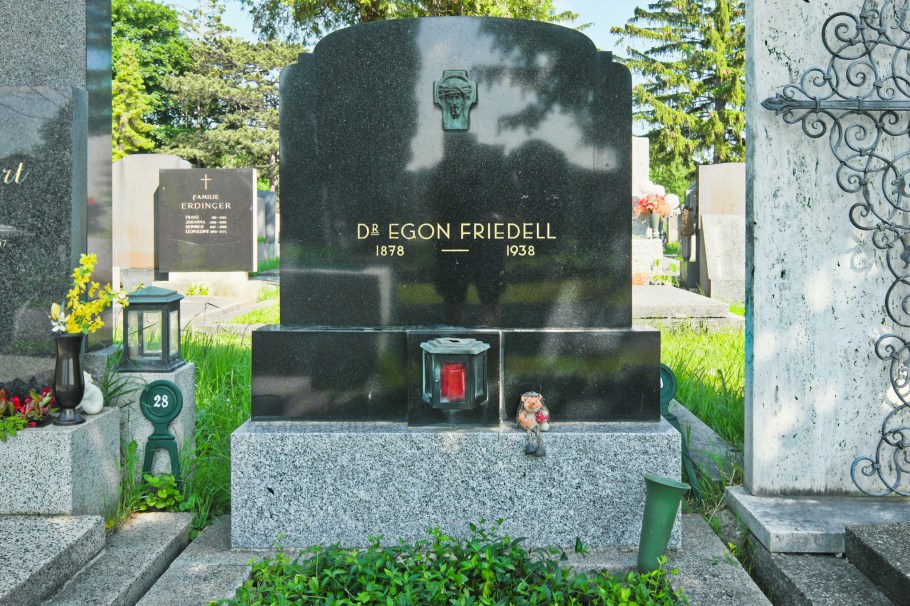
Egon Friedell grave. Photo, 25 May 2023.
Samuel Frommer
• Rabbi Samuel Frommer and his wife; located in the southern reaches of the Old Jewish Cemetery.
• Desperate prayers and messages inside the mausoleum structure, most between 1936–1939. That the grave remained intact makes this a Holocaust memorial.
• “Erkundungen auf Friedhöfen: Das Grab des Rabbis Samuel Aron Frommer”
• “Helf uns lieber Gott …” Zur Entdeckung eines einzigartigen Holocaustdenkmals am Wiener Zentralfriedhof”
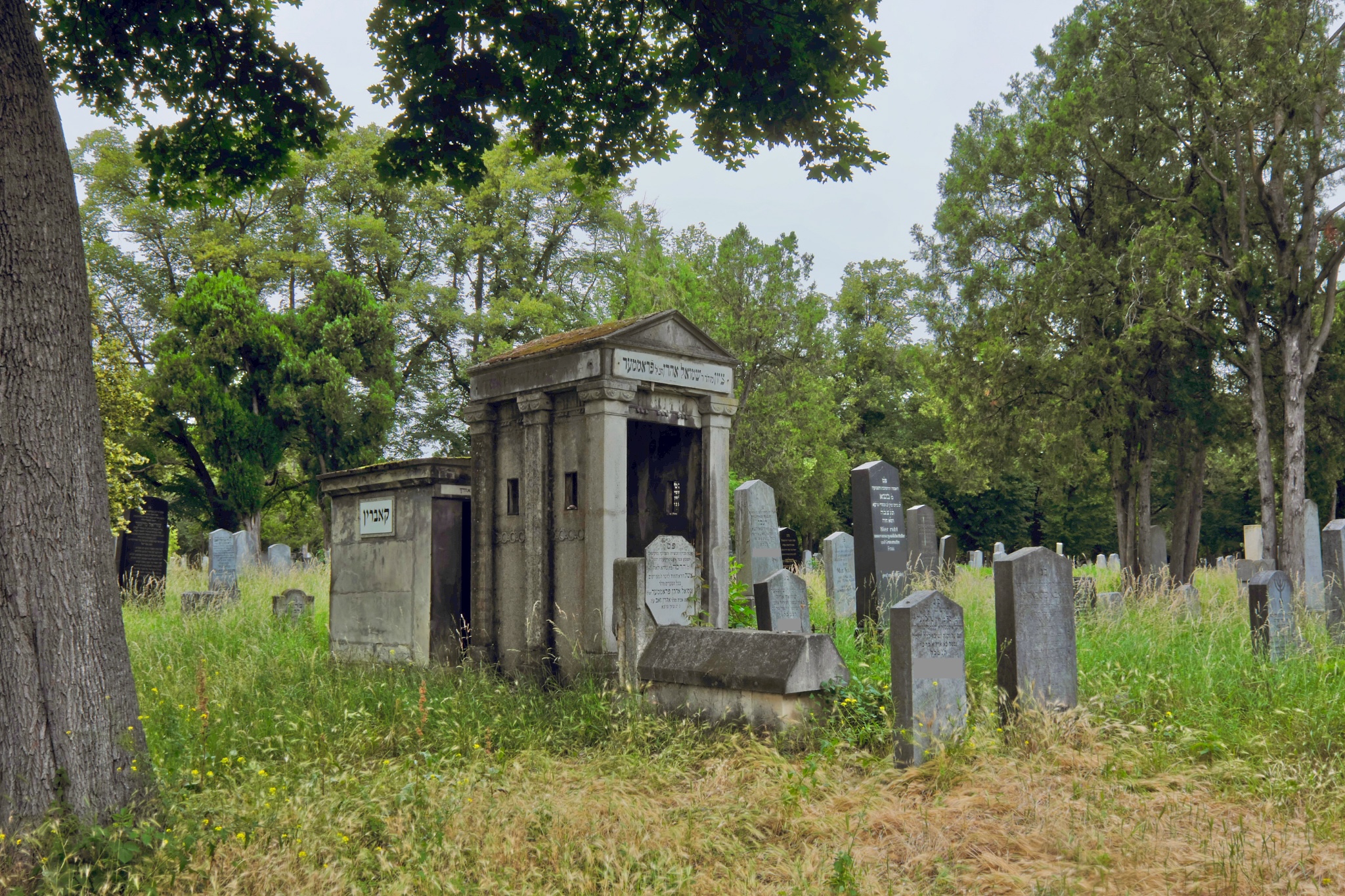
Rabbi Samuel Frommer mausoleum. Photo, 14 Jun 2024.
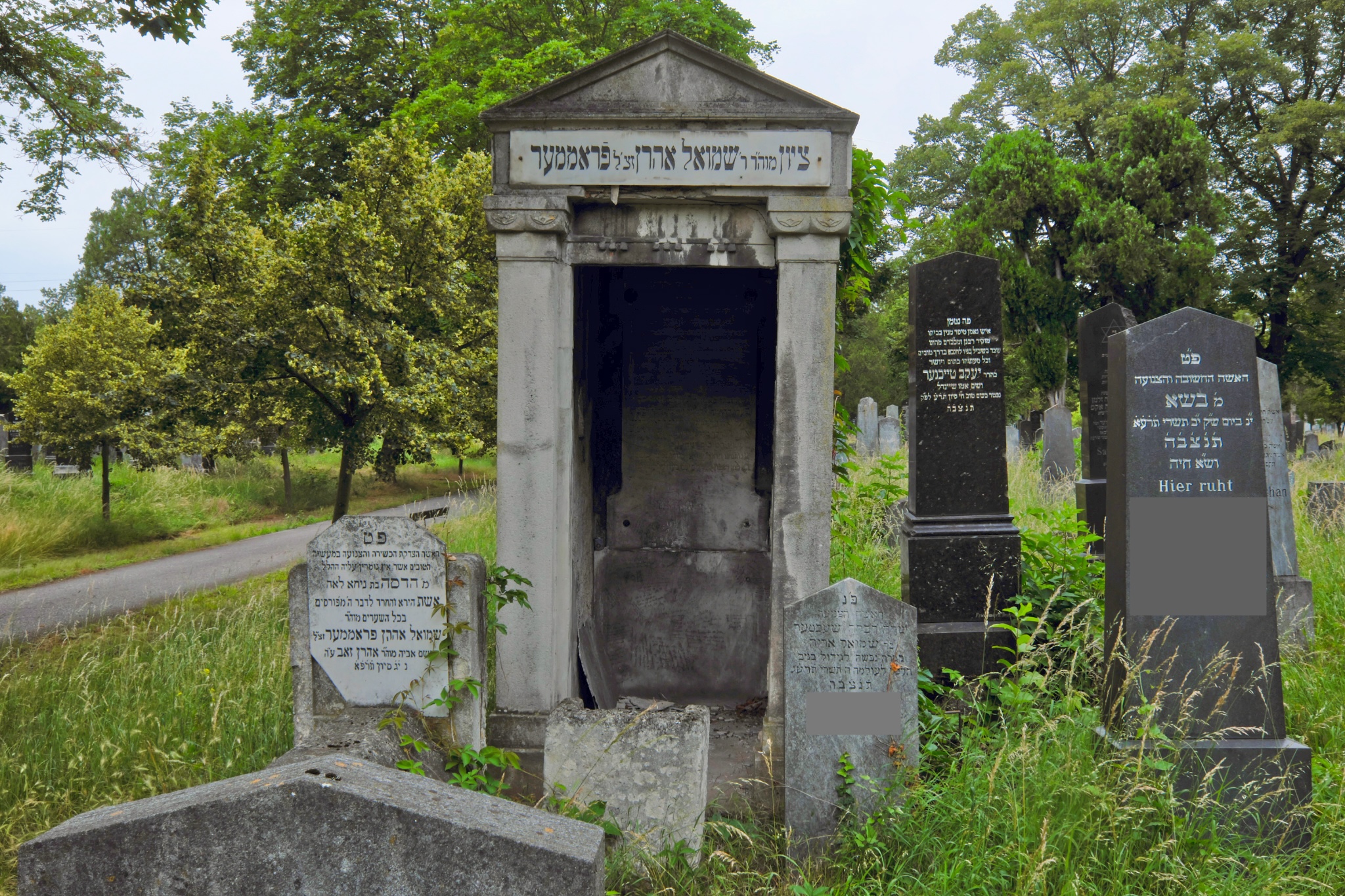
Rabbi Samuel Frommer mausoleum. Photo, 14 Jun 2024.
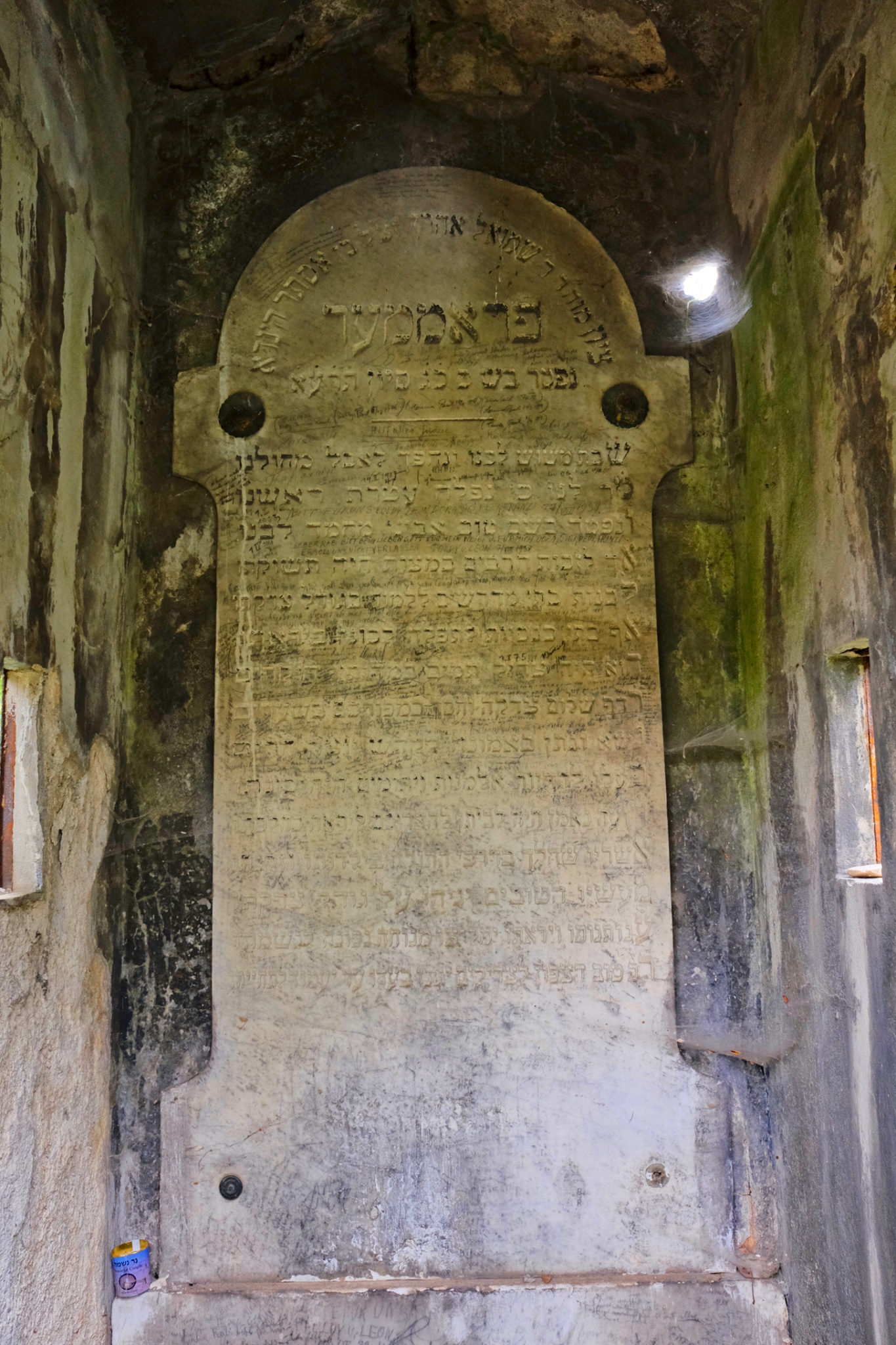
Rabbi Samuel Frommer gravestone, inside the mausoleum. Note how many handwritten messages appear between the Hebrew inscriptions. Photo, 14 Jun 2024.
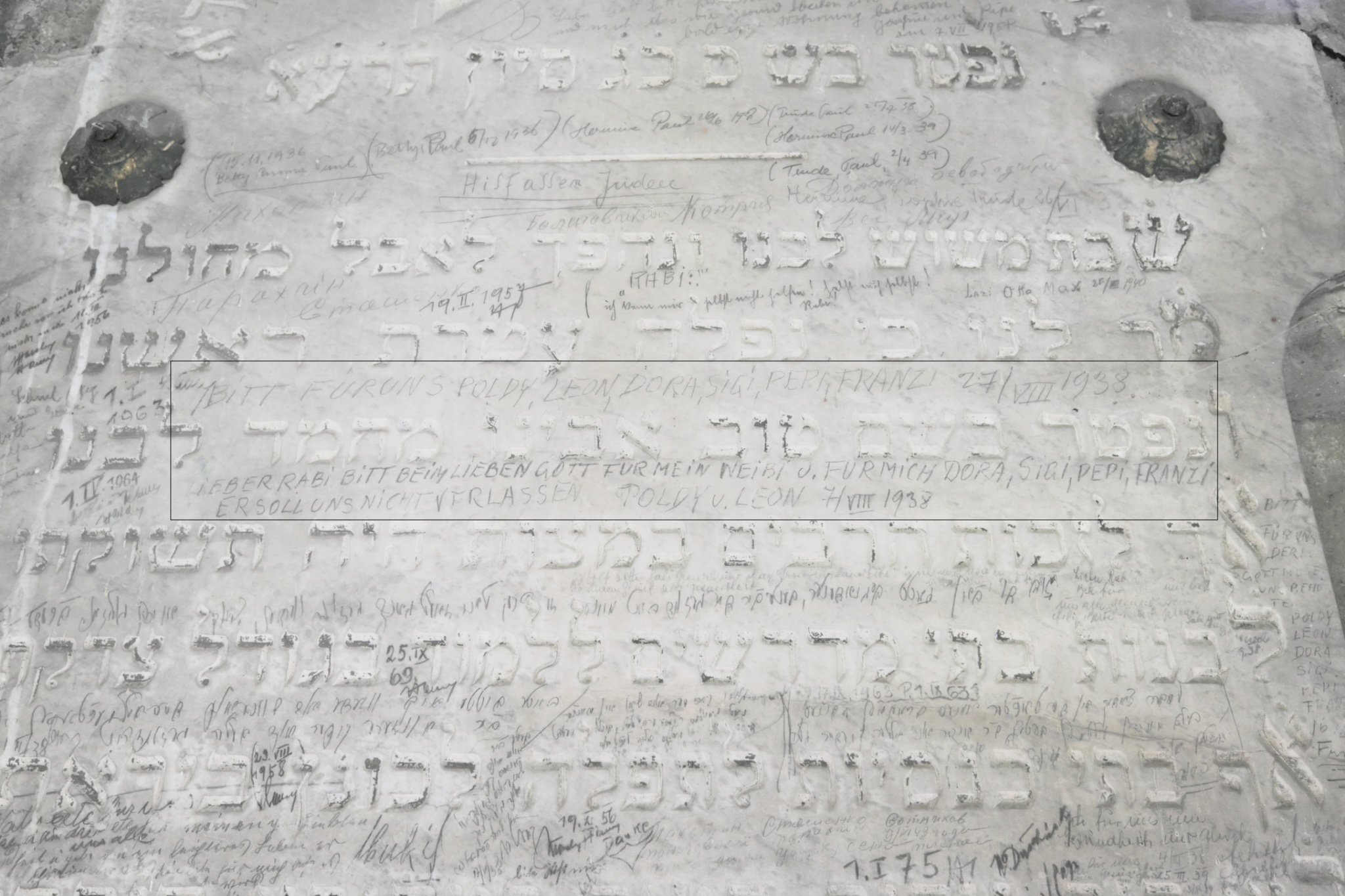
Left behind on the gravestone; see below for messages inside the rectangle. Photo, 14 Jun 2024.
• Bitt für uns Poldy, Leon, Dora, Sigi, Pepi, Franzi. 27 August 1938.
• Lieber Rabi bitt beim lieben Gott für mein Weibi und für mich, Dora, Sigi, Pepi, Franzi. Er soll uns nicht verlassen. Poldy und Leon. 7 August 1938.
Christof Willibald Gluck
Familie Hackhofer
• Josef Hackhofer: b/✵ 18 Mar 1863 – d/✟ 8 Sep 1917.
• Austrian architect; projects included the Hohe Brücke, Radetzkybrücke, Wienflussportal, Zollamtssteg.
• Josef Hackhofer grave: group 15A, row 3, number 20.
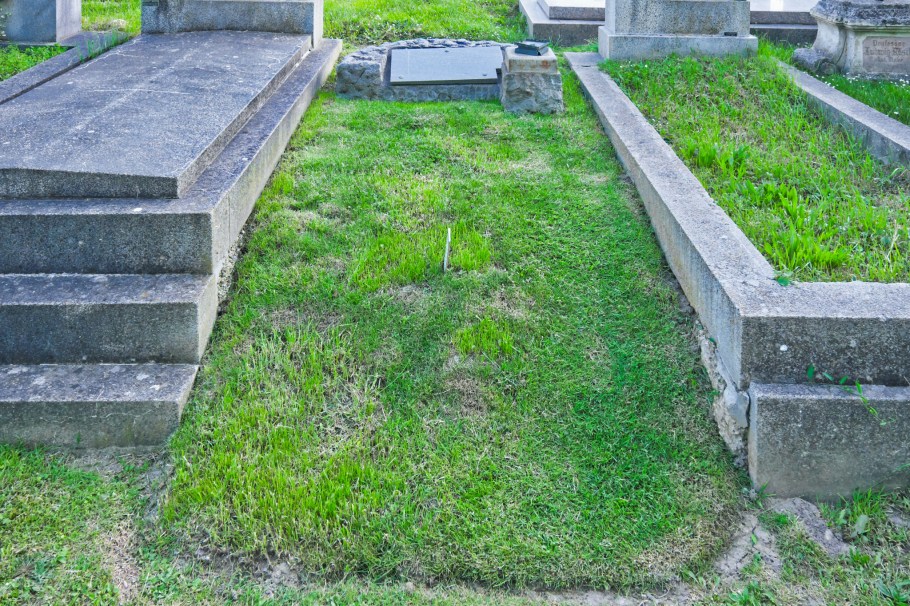
Hackhofer family grave, at top-centre. Photo, 25 May 2023.
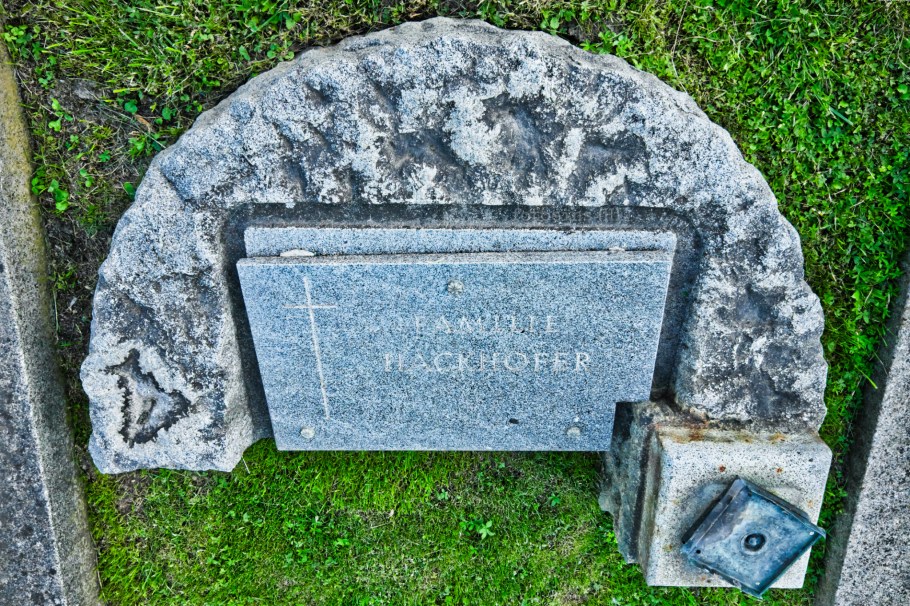
“Familie Hackhofer.” Photo, 25 May 2023.
Theophil Hansen
• b/✵ 13 Jul 1813 – d/✟ 17 Feb 1891.
• Danish architect, naturalized Austrian; Ringstrasse architect
• Theophil Hansen grave: group 14A, number 20
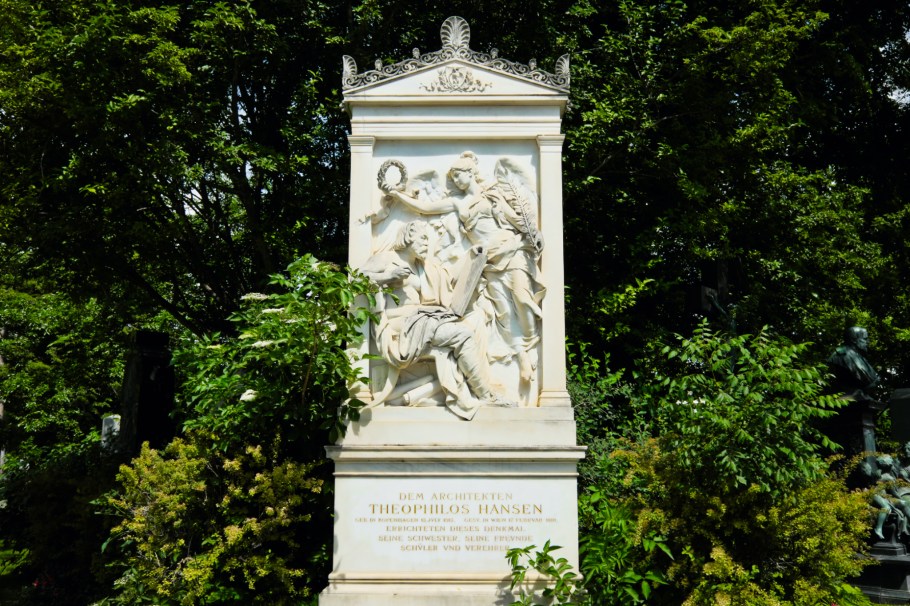
Theophil Hansen grave. Photo, 28 May 2022.
Karl Hasenauer
• b/✵ 20 Jul 1833 – d/✟ 4 Jan 1894.
• Austrian- and Ringstrasse-architect, especially with Gottfried Semper: Burgtheater, Neue Burg, NHM, KHM.
• His name also appeared as Carl Hasenauer.
• Karl Freiherr von Hasenauer grave: group 32A, number 33.
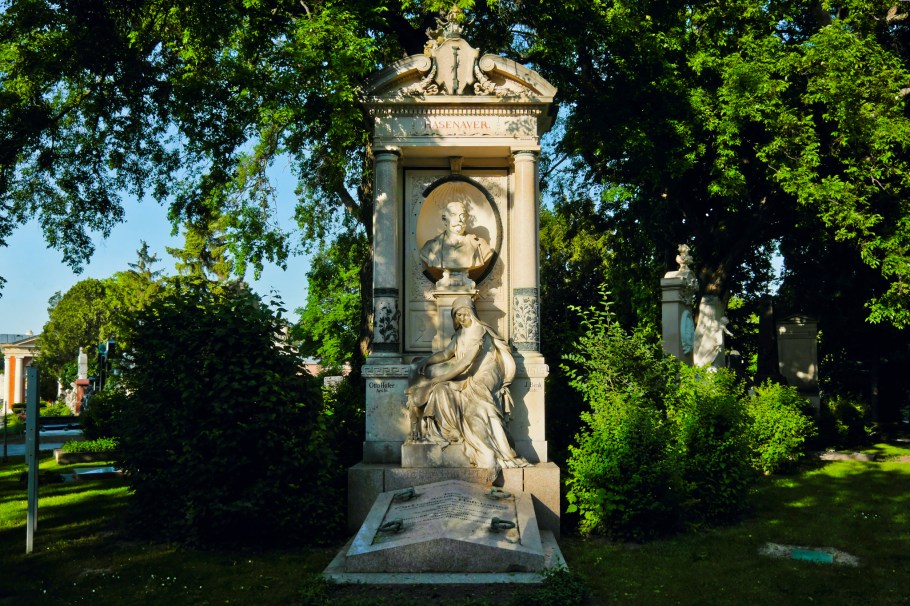
Carl (Karl) Hasenauer grave. Photo, 25 May 2023.
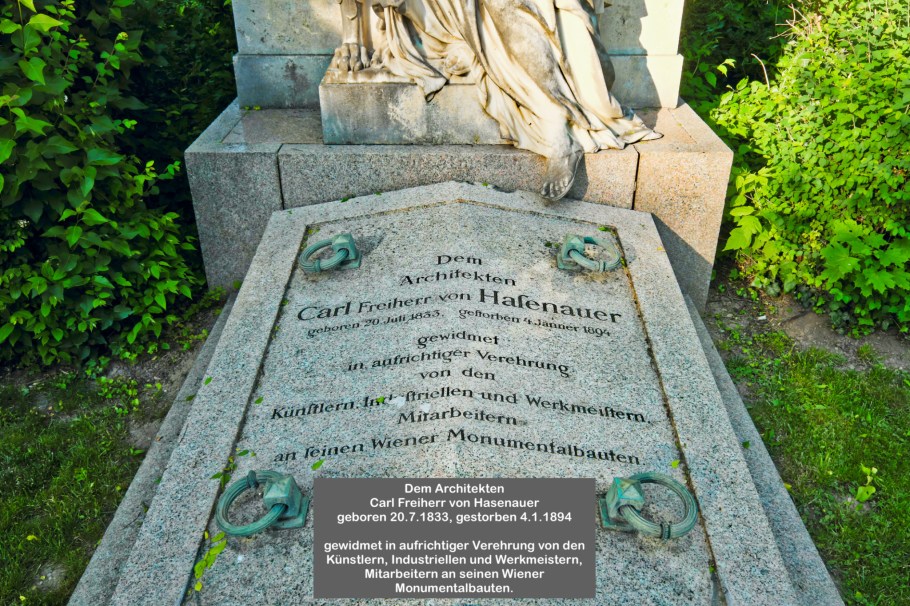
Inscription: “To architect Carl (Karl) Hasenauer: dedicated in sincere veneration by artists, industrialists, master craftsmen, and by all who worked on his majestic buildings in Vienna.” Photo, 25 May 2023.
Ludwig Hevesi
• b/✵ (Lőwy Hevesi Lajos) 20 Dec 1843 – d/✟ 17 Feb 1910.
• Austro-Hungarian journalist and author; famous for the motto at the top of the Secession building: “Der Zeit ihre Kunst. Der Kunst ihre Freiheit.”
• Ludwig Hevesi grave: group 2, number 541 (Protestant/evangelical section).
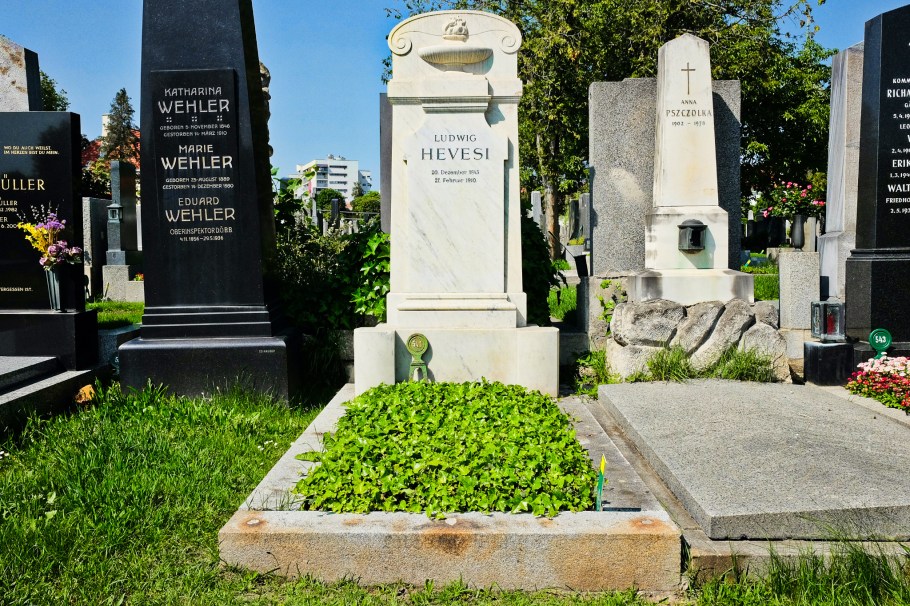
Ludwig Hevesi grave. Photo, 25 May 2023.
Johanns (Hans) Hölzel, a.k.a. Falco
• b/✵ 19 Feb 1957 – d/✟ 6 Feb 1998.
• Musician, 1980s radio hit and ode to Mozart: “Rock Me Amadeus“.
• “Scandal Calling: The Story of Falco, Austria’s Biggest Popstar“, by Jacob Wingate-Bishop, 2021.
• His mother, Maria, died in 2014 and is buried next to her son; these two graves are the most visited in the entire cemetery. Grave: group 40, number 64.
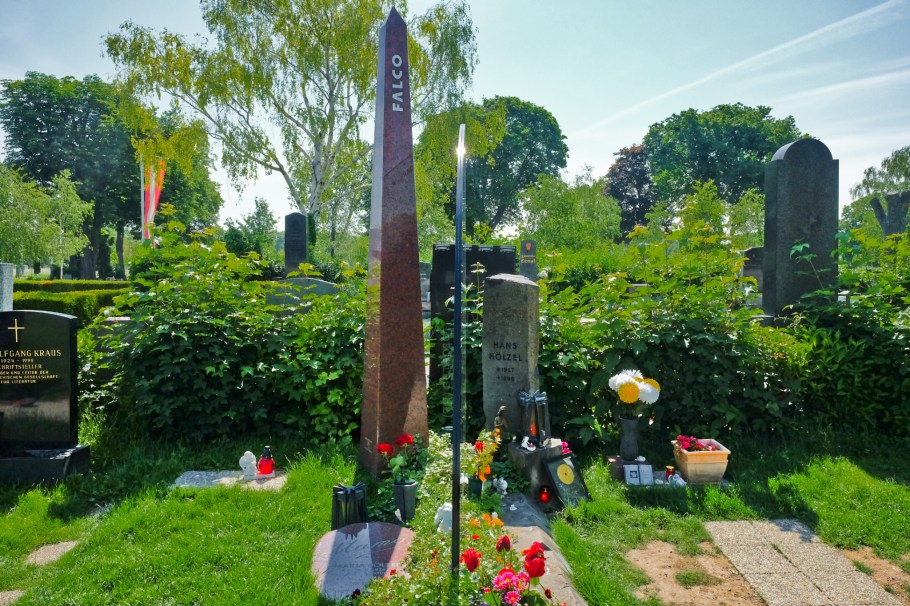
Graves for Maria Hölzel (lower left-centre), Hans Hölzel (centre-right). Photo, 20 May 2018.
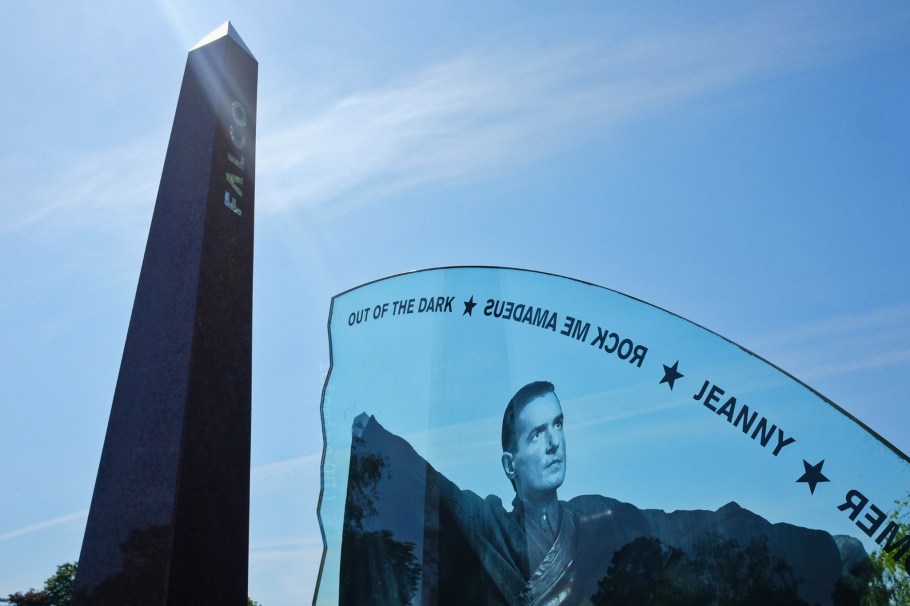
“Two one zero, der Alarm ist Rot, Wien in Not … Vienna calling …” Photo, 20 May 2018.
Josef Hoffmann
• b/✵ 15 Dec 1870 – d/✟ 7 May 1956.
• Architect, designer, co-founder of both Secession and Wiener Werkstätte.
• Grave design by Fritz Wotruba.
• Grave for Josef Hoffmann & 2nd wife Karoline (Karla) Hoffmann (née Schmatz, 1894–1980): group 14C, number 20.
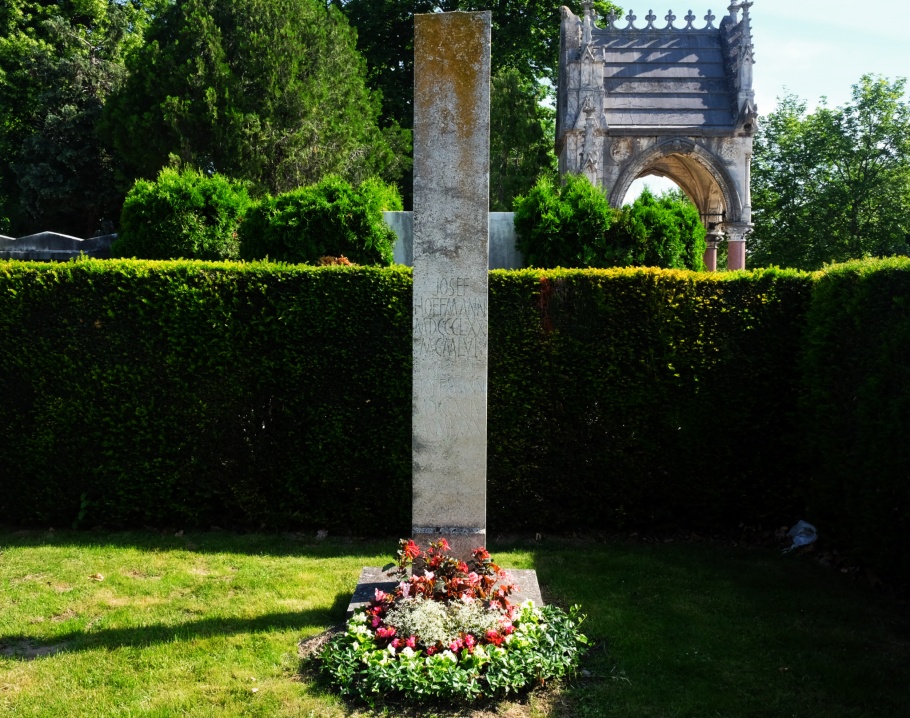
Grave for Josef Hoffmann & his 2nd wife Karoline (Karla). Photo, 20 May 2018.
Adolf Jellinek
• b/✵ 29 Oct 1820 – d/✟ 20 Dec 1893.
• Jewish scholar and rabbi; 1856, joins Vienna’s Leopoldstädter Tempel as preacher.
• Granddaughter Mercedes, after whom his 3rd son and businessman Emil Jellinek named a set of Daimler racing cars; see below.
• Rabbi Adolf Jellinek grave: group 5B, row 1, number 2 (Old Jewish section).
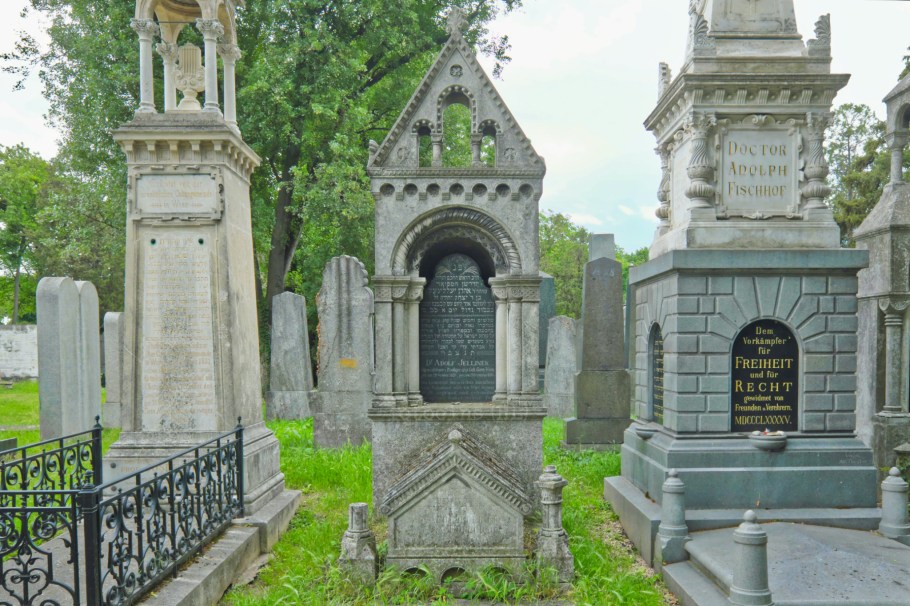
Adolf Jellinek. Photo, 28 May 2022.
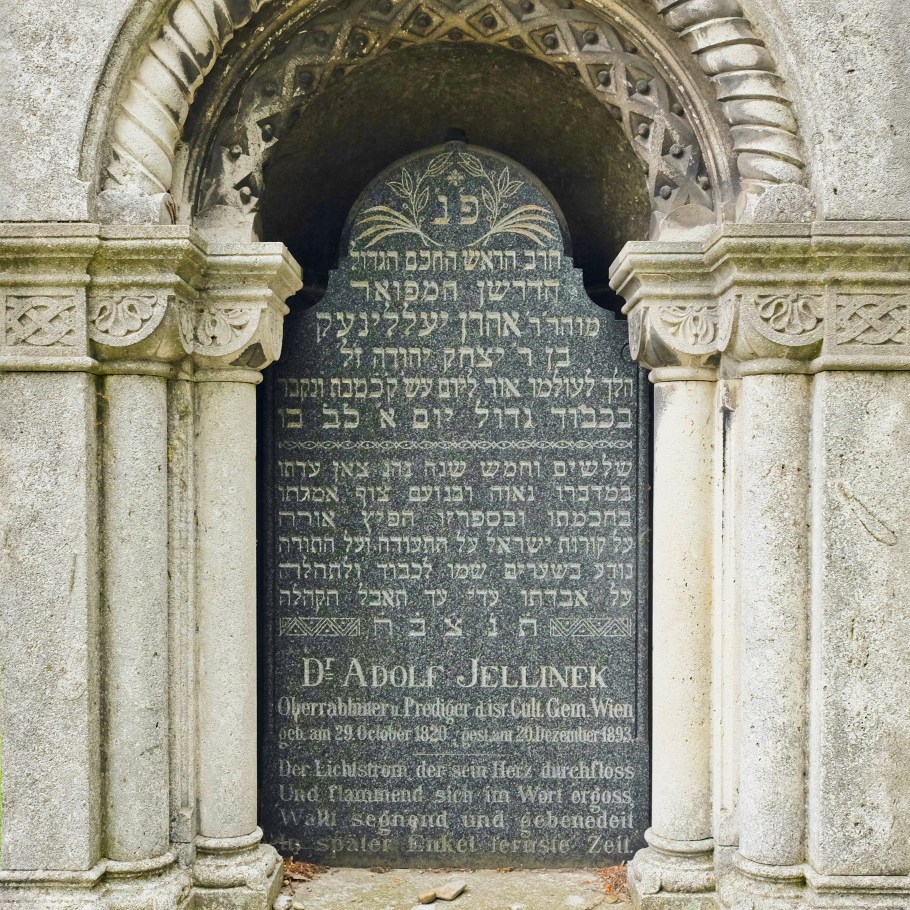
Photo, 28 May 2022.
Mercédès Adrienne Ramona Manuela Jellinek
• b/✵ 16 Sep 1889 – d/✟ 23 Feb 1929.
• Mercédès Adrienne Ramona Manuela Jellinek was born to Rachel and Emil Jellinek. An automobile merchant and promoter of Daimler vehicles in Austria, Emil Jellinek named a set of newly manufactured racing cars, “Mercedes”, after his daughter around 1899-1900. The Mercedes name and brand live on today. Mercédès’ grandfather was Adolf Jellinek, Jewish scholar and rabbi in Vienna; see above.
• Familie Jellinek grave: group 59C, number 26.
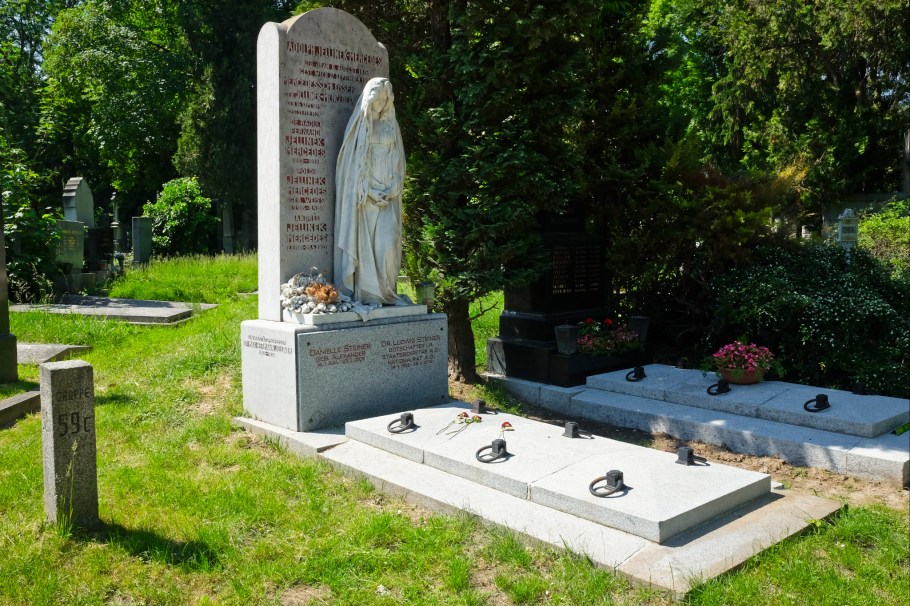
Jellinek family. Photo, 20 May 2018.
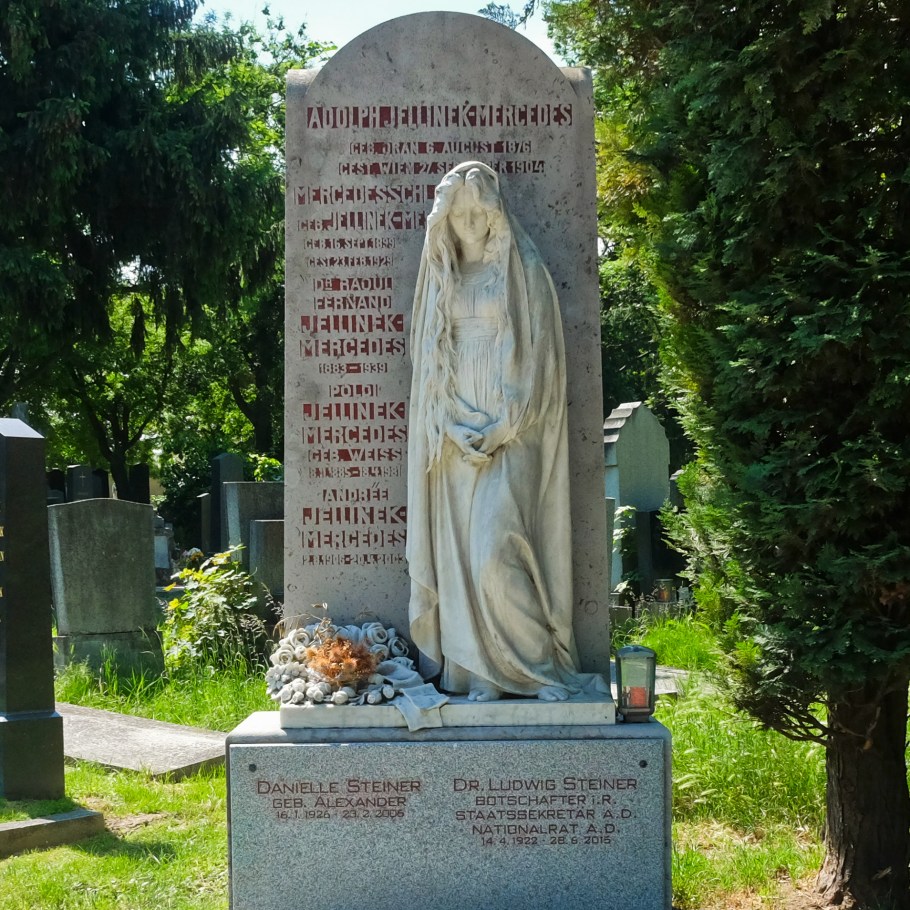
Jellinek family, with Mercedes Schlosser (née Jellinek) as the 2nd member from the top. Photo, 20 May 2018.
Udo Jürgens
• b/✵ 30 Sep 1934 – d/✟ 21 Dec 2014.
• Austrian musician, singer, songwriter; known as Europe’s Frank Sinatra.
• Udo Jürgens grave: group 33G, number 85.
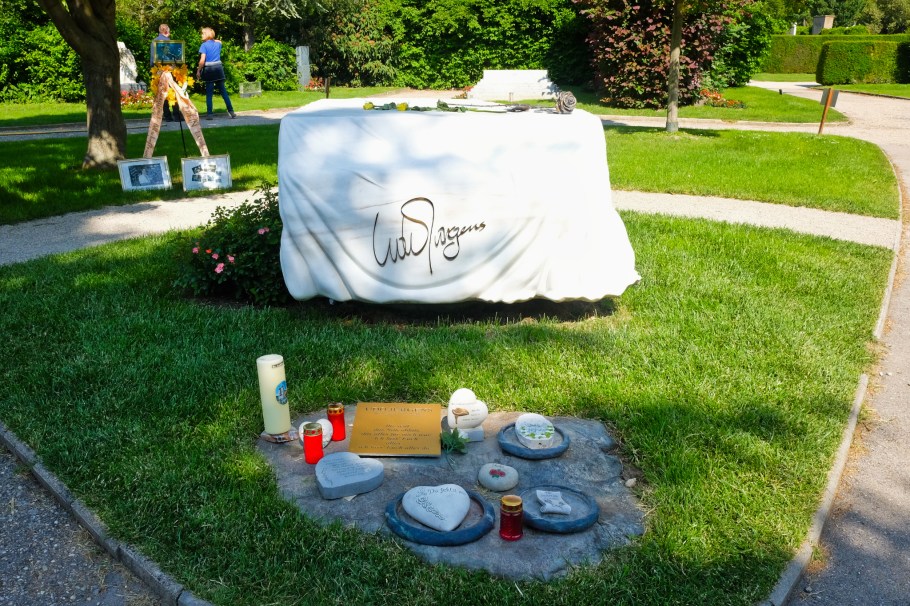
Udo Jürgens. Photo, 20 May 2018.
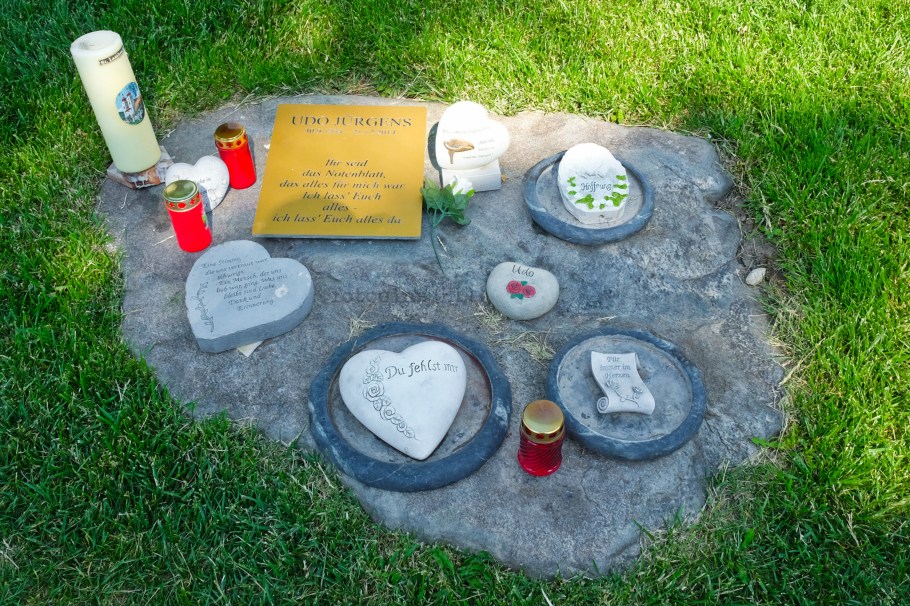
Photo, 20 May 2018.
Ludwig Köchel
• b/✵ 14 Jan 1800 – d/✟ 3 Jun 1877.
• Catalogued and organized Mozart’s works into the “Köchel-Verzeichnis” (KV; Köchel-catalogue or -index), first published in 1862. For example, Mozart’s Requiem Mass in D minor is listed as KV 626 or K.626.
• Ludwig (Ritter von) Köchel grave: group 16A, row 7, number 23.
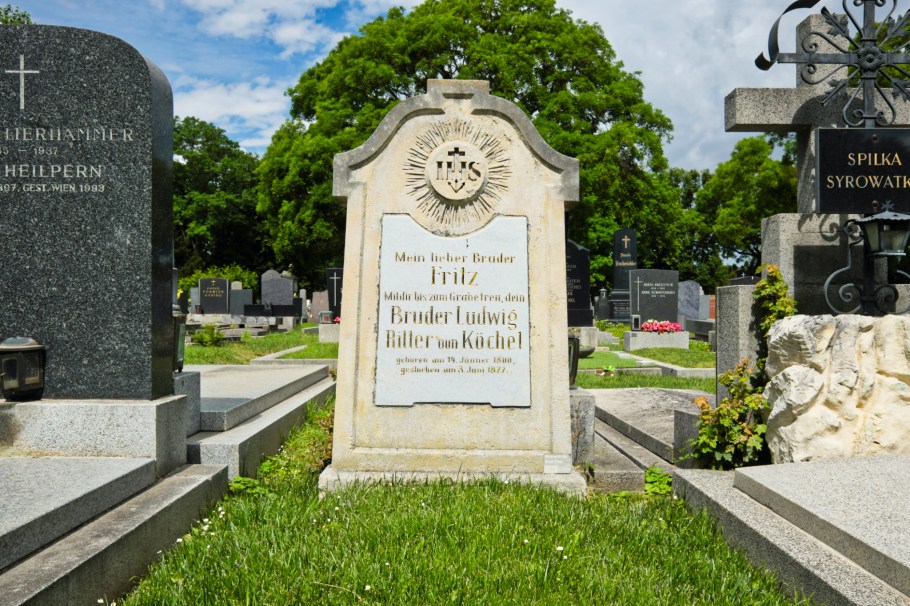
Ludwig Köchel. Photo, 28 May 2022.
Moritz Königswarter
• b/✵ 16 Jul 1837 – d/✟ 14 Nov 1893.
• Banker, entrepreneur.
• Moritz Königswarter grave: group 5b, row 1, number 7 (Old Jewish section).
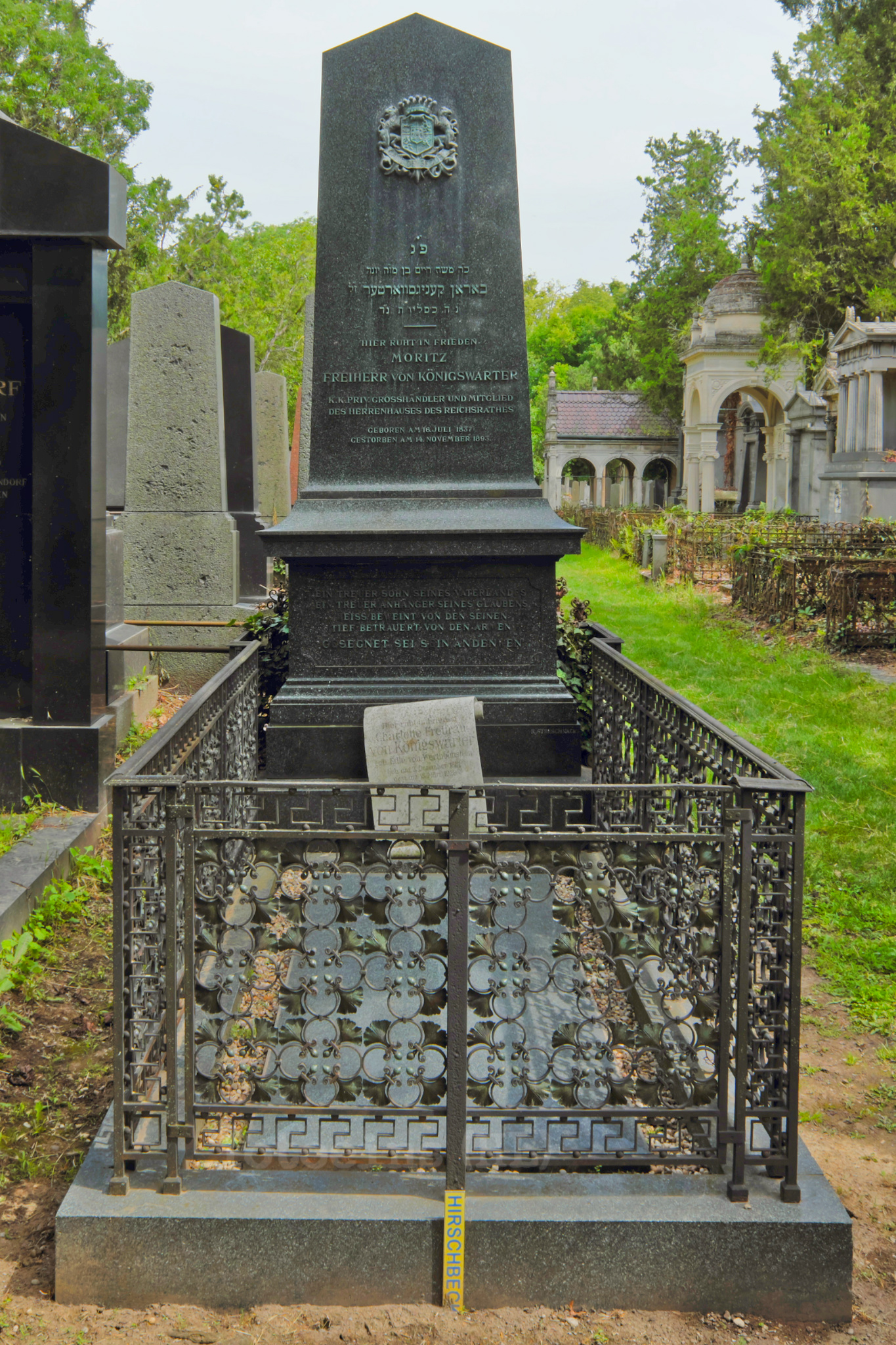
Moritz & Charlotte Königswarter. Photo, 14 Jun 2024.
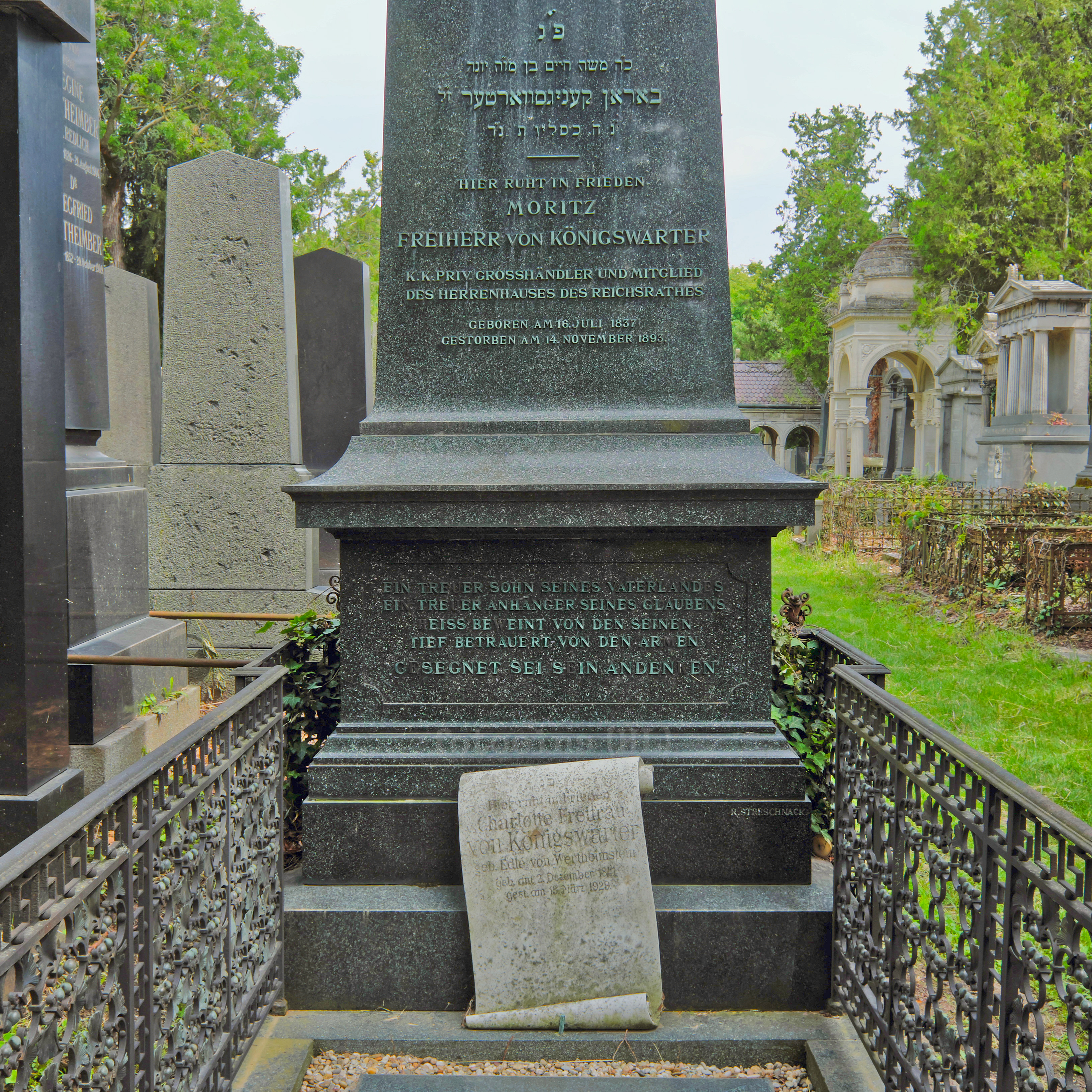
Moritz & Charlotte Königswarter. Photo, 14 Jun 2024.
Josef Kornhäusel
• b/✵ 13 Nov 1782 – d/✟ 31 Oct 1860.
• Architect, Biedermaier period: many buildings in Vienna and Baden bei Wien.
• Originally buried in St. Marx cemetery; remains exhumed, moved, and reburied at Zentralfriedhof in 1934.
• Josef Kornhäusel (Kornhäusl) grave: group 14A, number 45A.
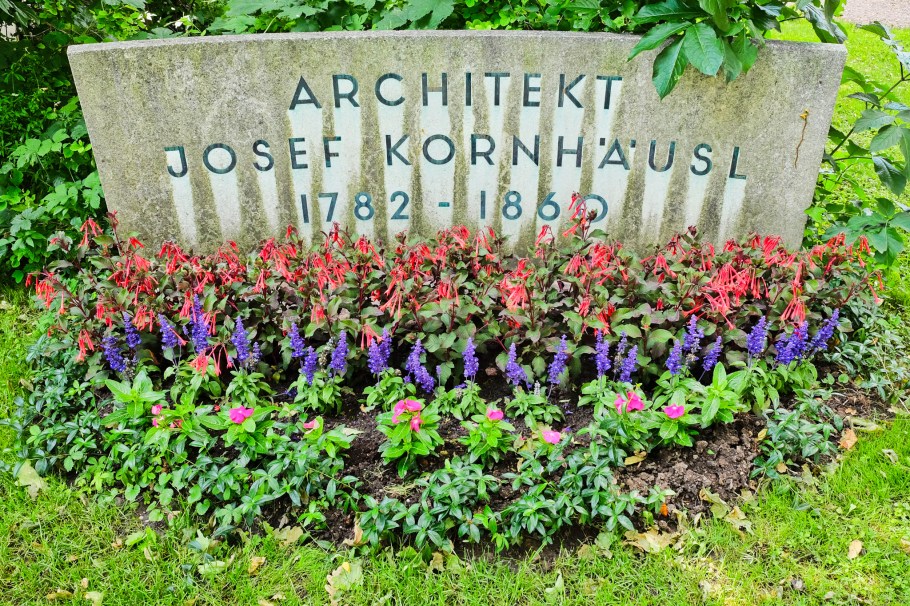
Josef Kornhäusel. Photo, 28 May 2022.
Brigitte Kowanz
• b/✵ 13 Apr 1957 – d/✟ 28 Jan 2022.
• Artist, sculptor; “ambassador of light”.
• Brigitte Kowanz grave: group 33G, number 57.
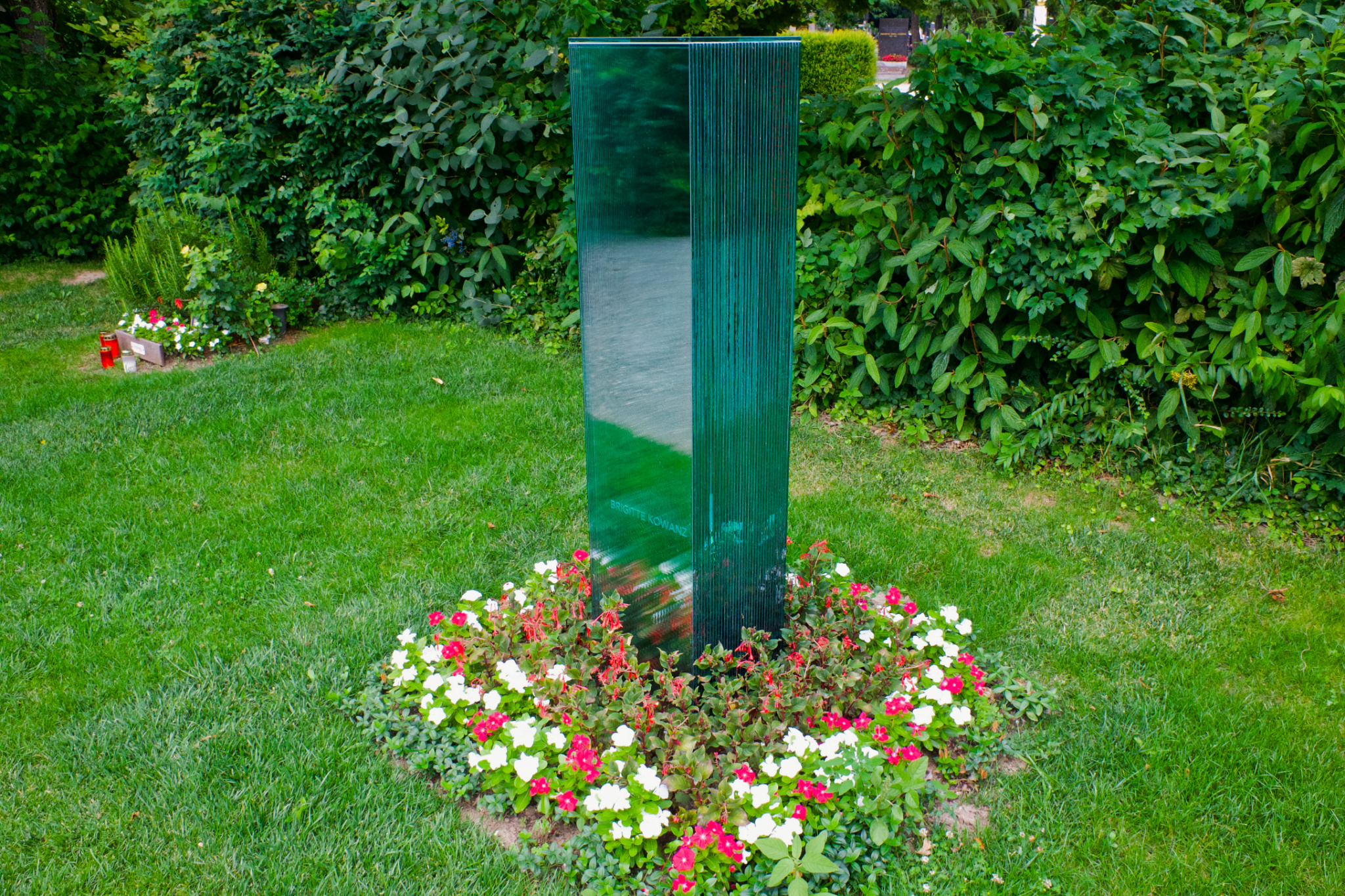
Brigitte Kowanz. Photo, 14 Jul 2025.
Hedy Lamarr
• b/✵ Hedwig Eva Maria Kiesler, 9 Nov 1914 – d/✟ 19 Jan 2000.
• Inventor and actress. The world has her to thank for co-inventing the technique of “frequency hopping” (spread spectrum) which is crucial to the ubiquity of bluetooth, mobile, and WiFi technology.
• Hedy Lamarr grave: group 33G, number 80.
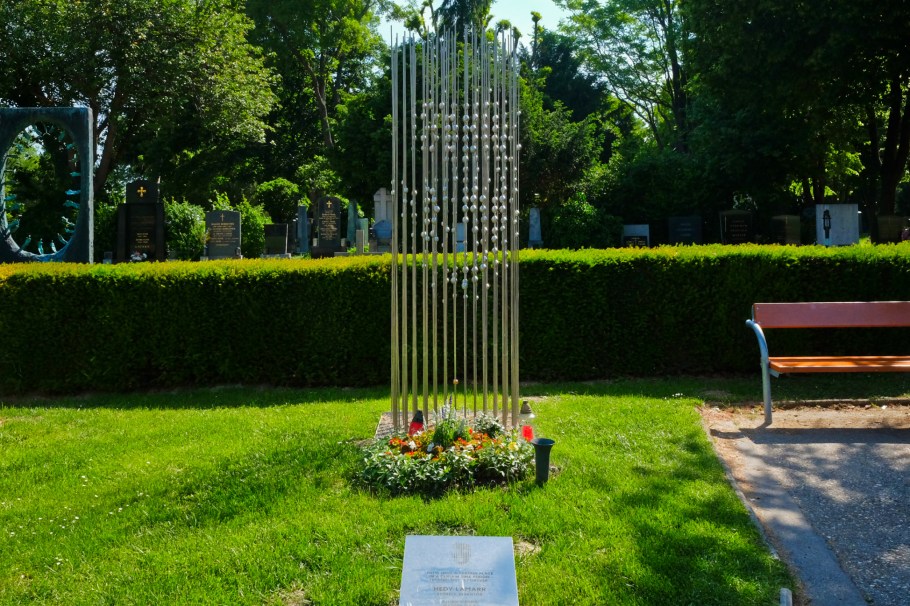
Finally in 2014, she gets an Ehrengrab (grave of honour) from the city of Vienna. Photo, 20 May 2018.
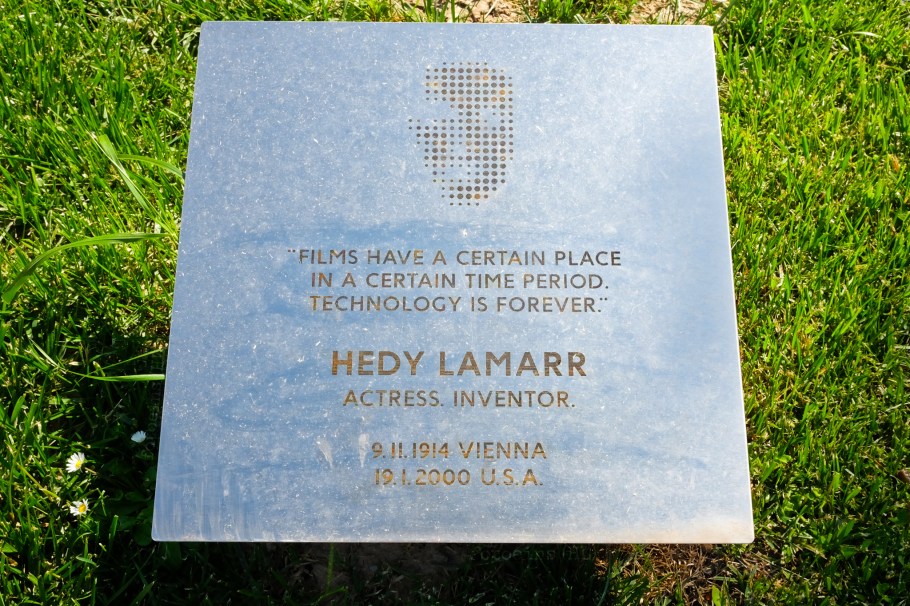
“Films have a certain place in a certain time period. Technology is forever.” Photo, 20 May 2018.
Josef Lanner
• b/✵ 12 Apr 1801 – d/✟ 14 Apr 1843.
• Austrian violinist and composer; reformed and popularized “contemporary dance music” in the form of walzes (Walzer).
• Originally buried in Döblinger Ortsfriedhof; his remains exhumed and moved to Zentralfriedhof in 1904. Döblinger Ortsfriedhof redeveloped into Strauss-Lanner-Park with 1928 opening.
• Josef Lanner grave: group 32A, number 16 (next to friend and rival Johann Strauss I).
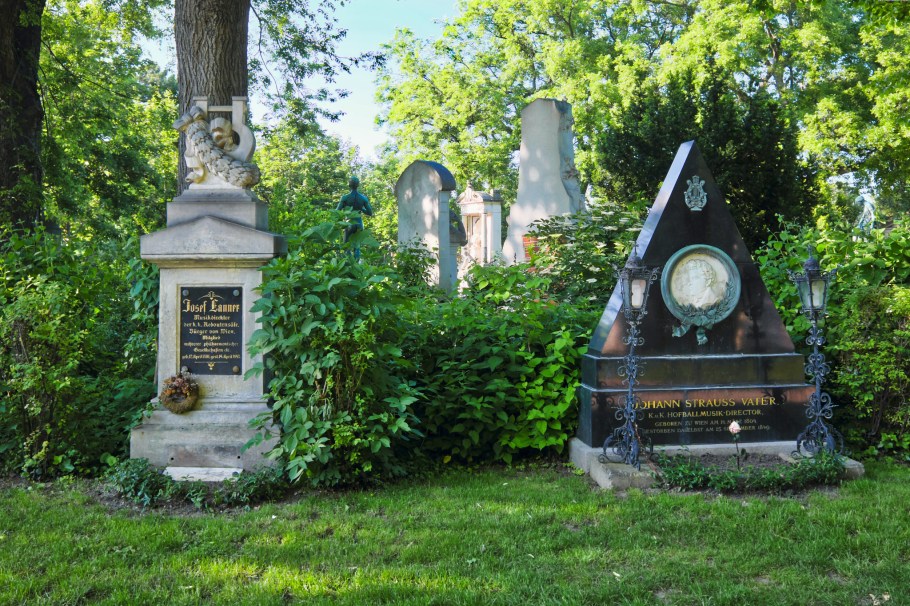
Josef Lanner (left) and Johann Strauss I/Sr (right). Photo, 25 May 2023.
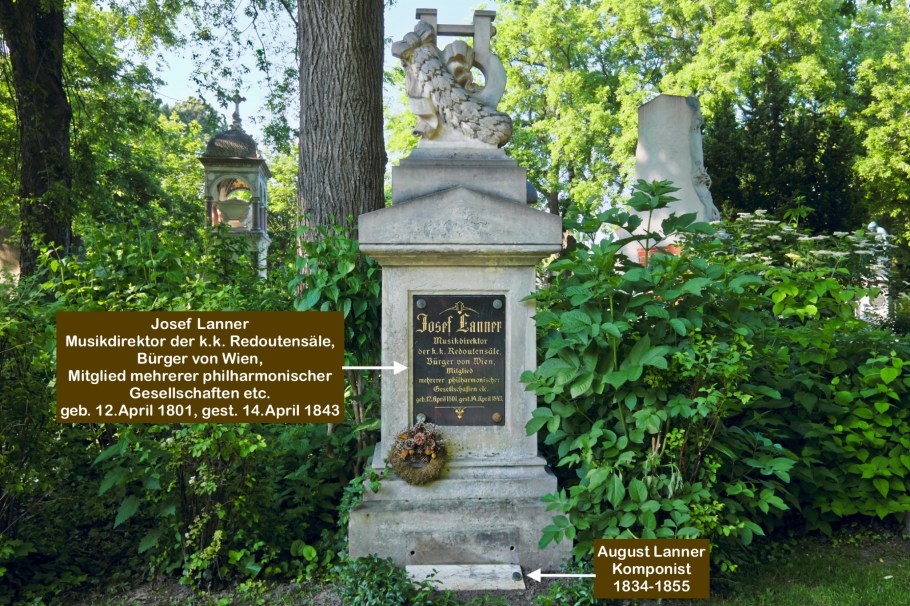
Josef Lanner and his song, August. Photo, 25 May 2023.
Franz Littrow
• b/✵ 1821 – d/✟ 1886.
• Franz (Ritter von) Littrow: group 13A, row 2, number 1.
• Lieutenant Field Marshall Franz Littrow was son of astronomer Josef Johann Littrow and brother of astronomer Karl Littrow. Both astronomers had been directors of Vienna Observatory; both are honoured with a memorial plaque at the University of Vienna’s arcade courtyard.
• Karl Littrow’s son, Otto (1843–1864), designed the Littrow prism which would become the Littrow spectrograph.
• From 1833, the Littrow family had a burial crypt in the cemetery (group 11, row 1, number 49). Research within the cemetery website revealed that in 1974, the Littrow family crypt was dug up and reallocated with the initial burial location cleared. A PDF document from 2019 stated a possible relocation to group 68A, row 3, number 5.
• On visits to the central cemetery in 2022 and 2023, I saw location 68A-3-5 was vacant, whereas location 11-1-49 was occupied by another family.
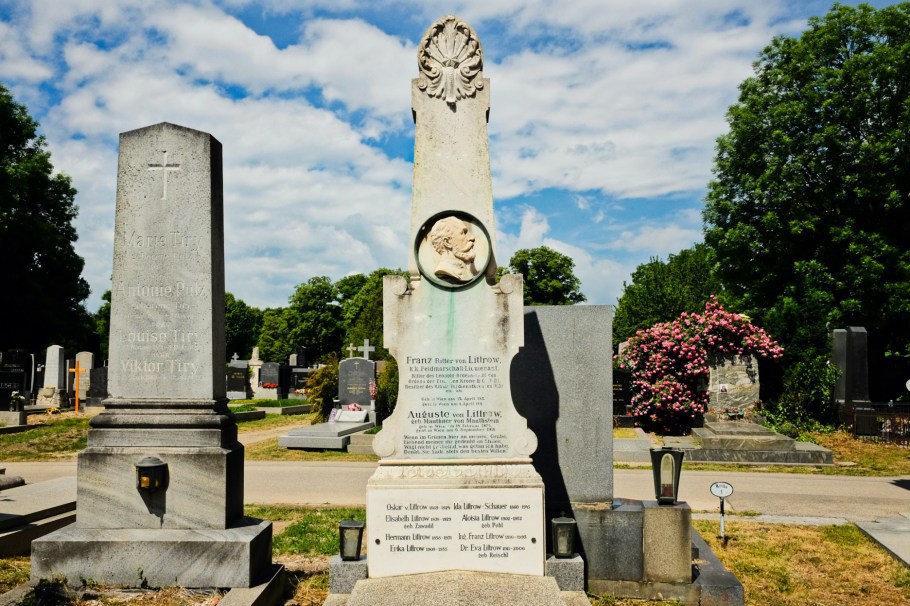
Franz Ritter von Littrow and descendants. Photo, 28 May 2022.
Adolf Loos
• b/✵ 10 Dec 1870 – d/✟ 23 Aug 1933.
• Architect, part of early 20th-century Vienna Modernism (Wiener Moderne) movement.
• Adolf Loos grave: group 0, row 1, number 105.
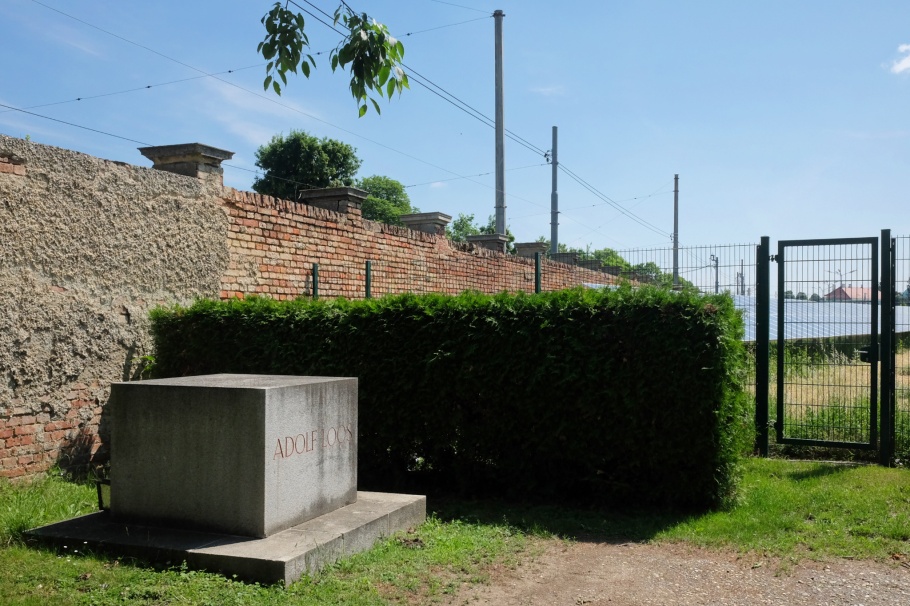
Adolf Loos. Photo, 20 May 2018.
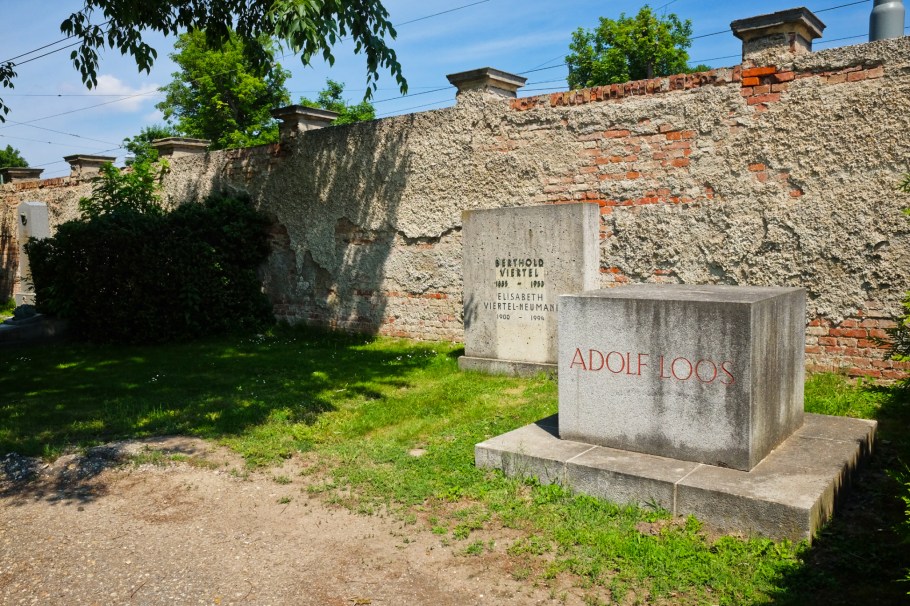
Photo, 20 May 2018.
Hans Makart
• b/✵ 28 May 1840 – d/✟ 3 October 1884.
• Austrian painter and artist.
• Hans Markart grave: group 14A, number 32.
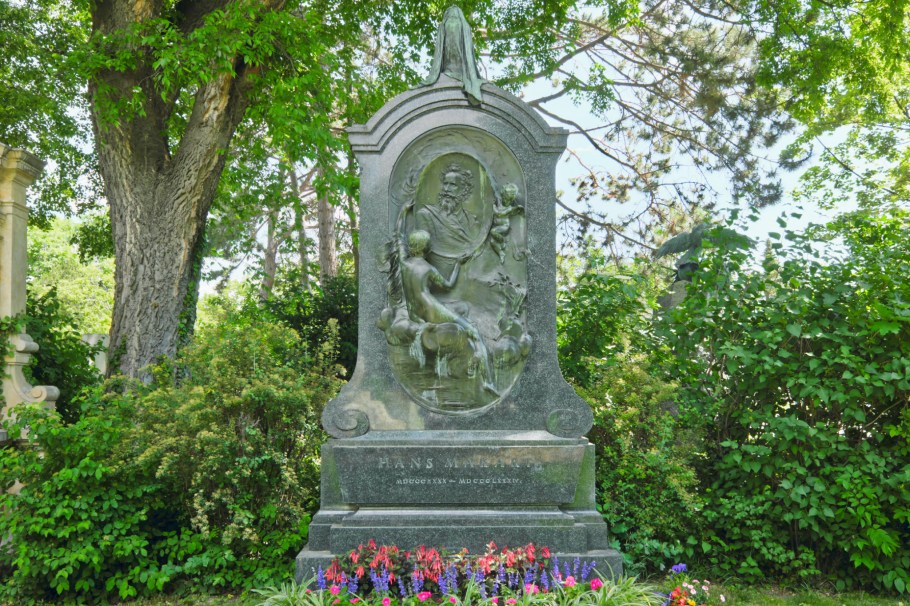
Hans Makart, MDCCCXXXX 1840 – 1884 MDCCCLXXXIV. Photo, 28 May 2022.
Siegfried Marcus
• b/✵ 18 Sep 1831 – d/✟ 1 Jul 1898.
• Inventor, one of the earliest automobiles. Because of his Jewish heritage, the Nazis tried to erase his name from history.
• “Siegfried Markus” grave: group 0, row 1, number 101.
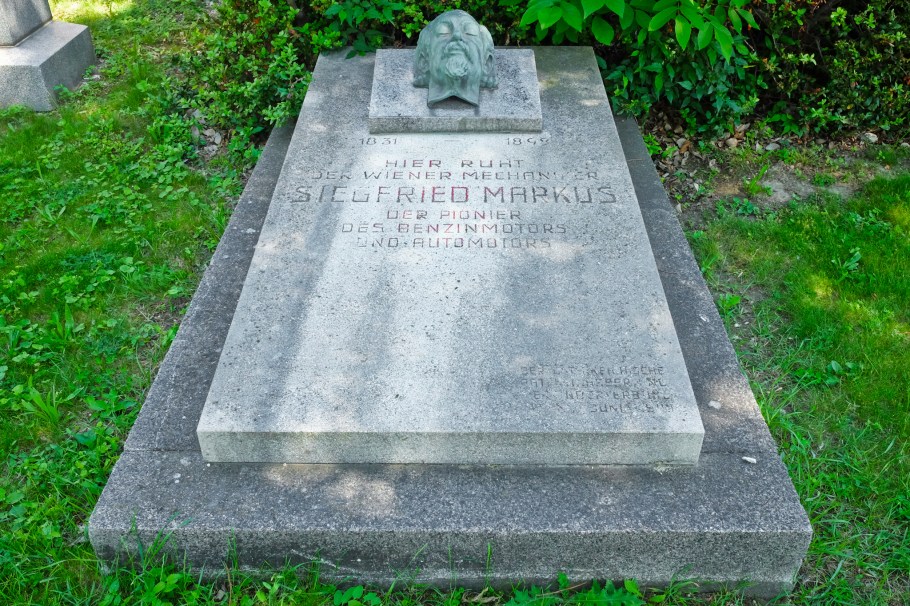
Siegfried Markus. Photo, 20 May 2018.
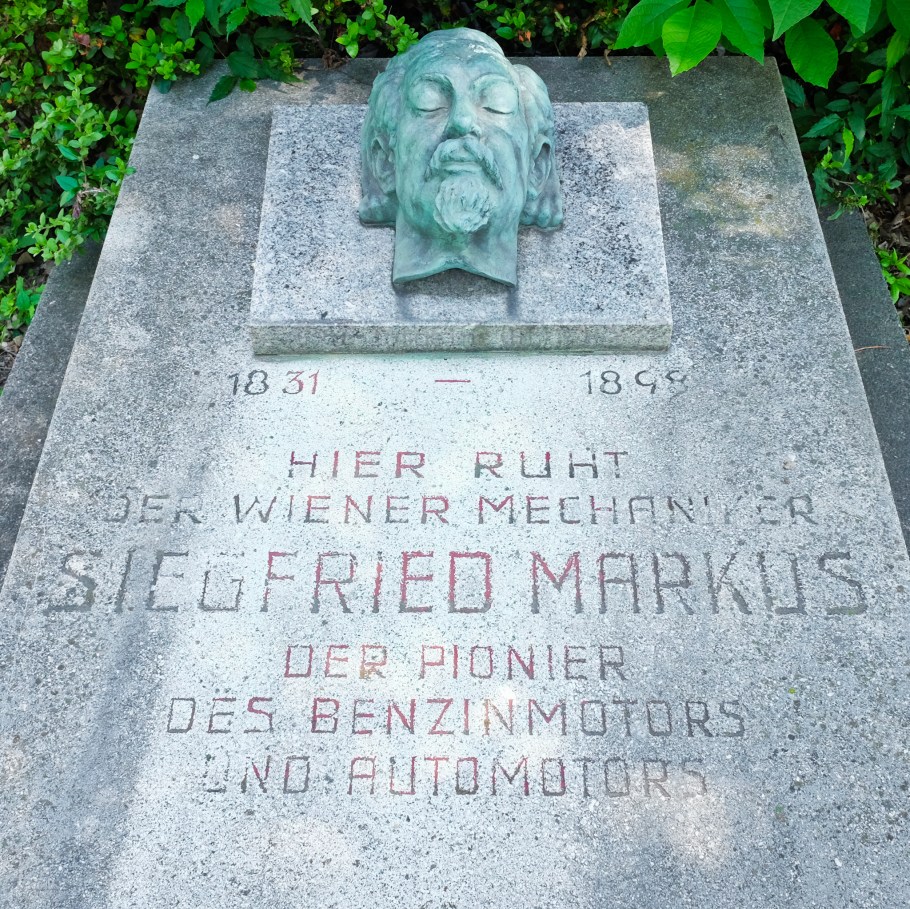
Siegfried Markus: “pioneer, gasoline (petrol-) engine and car engine.” Photo, 20 May 2018.
Oskar Marmorek
• b/✵ 9 Apr 1863 – d/✟ 6 Apr 1909.
• Architect; designed the building which houses Café Rüdigerhof.
• Shot himself over his father’s grave; buried with his father.
• Oskar & father Isidor grave: group 20, row 17b, number 5 (Old Jewish section).
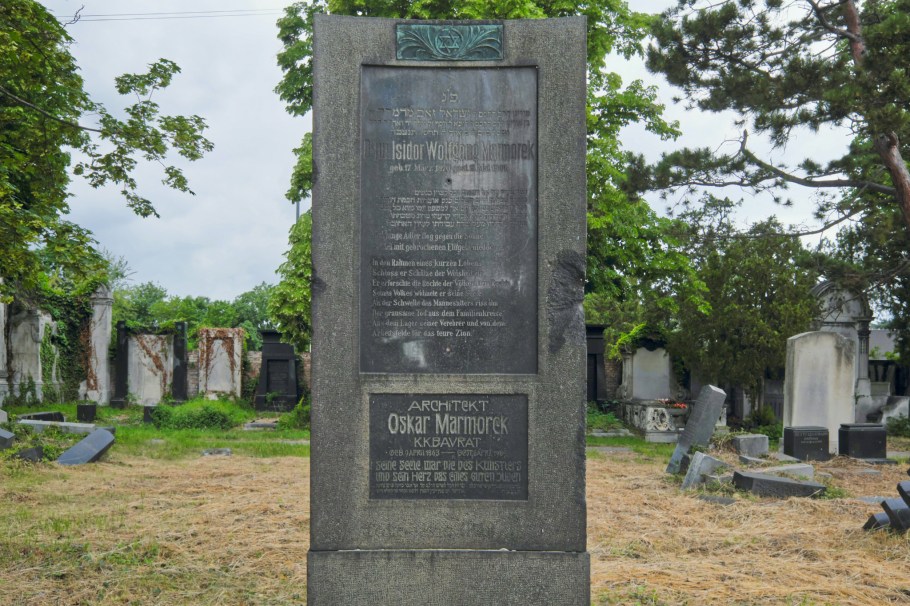
Oskar Marmorek (& his father Isidor). Photo, 28 May 2022.
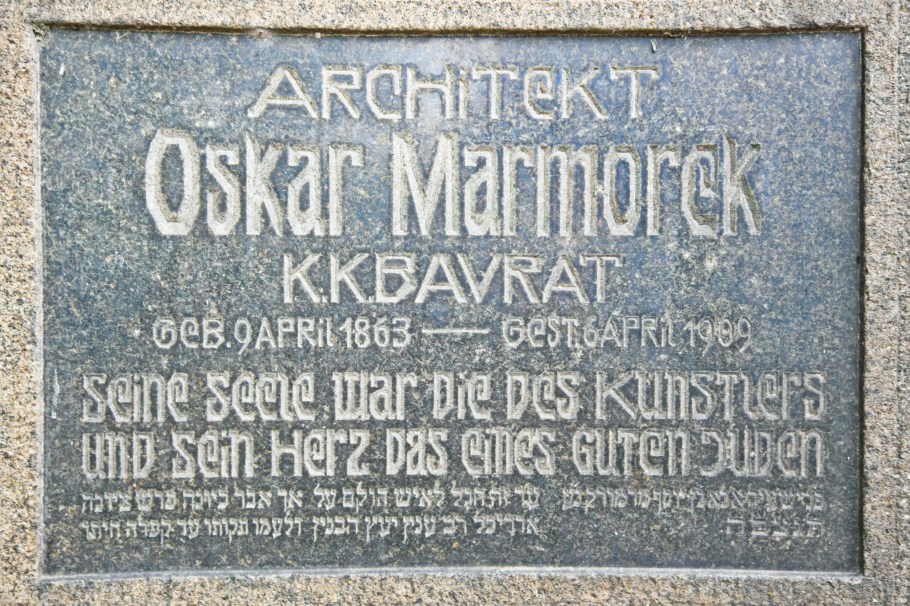
Oskar Marmorek: kaiserlicher & königlicher Baurat. “Seine Seele war die des Kunstlers und sein Herz das eines guten Juden.” (Imperial and royal chief architect. “His soul was that of an artist, and his heart that of a good Jew.”)
Vincenz Morzin
Hans Moser
• b/✵ (Johann Julier) 6 Aug 1880 – d/✟ 19 Jun 1964.
• Austrian actor of stage and screen.
• Johann Julier grave: group 32C, number 27.
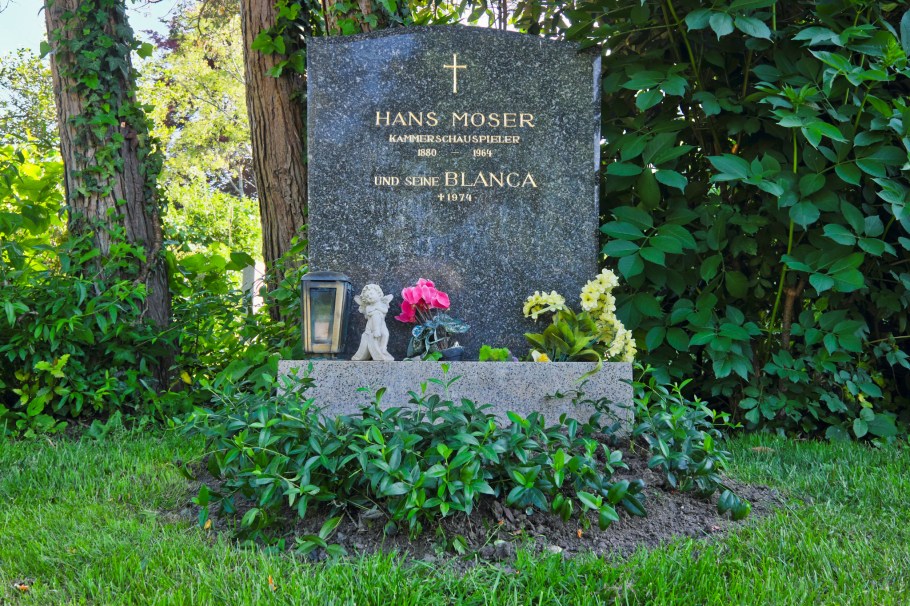
Grave, Hans Moser and his wife Blanca Moser (née Hirschler). Photo, 25 May 2023.
Wolfgang Amadeus Mozart
• b/✵ 27 Jan 1756 – d/✟ 5 May 1791.
• Composer; “Eine kleine Nachtmusik“, K.525, I. Allegro (1787).
• Mozart was buried at St. Marx cemetery in an unmarked grave for an individual citizen (non-aristocrat), as was the burial custom of the time. The 1859 memorial marker by Hanns Gasser over Mozart’s presumed grave at St. Marx cemetery was moved to its present location in the central cemetery in 1891 on the 100th anniversary of Mozart’s death.
• Mozart memorial: group 32A, number 55.
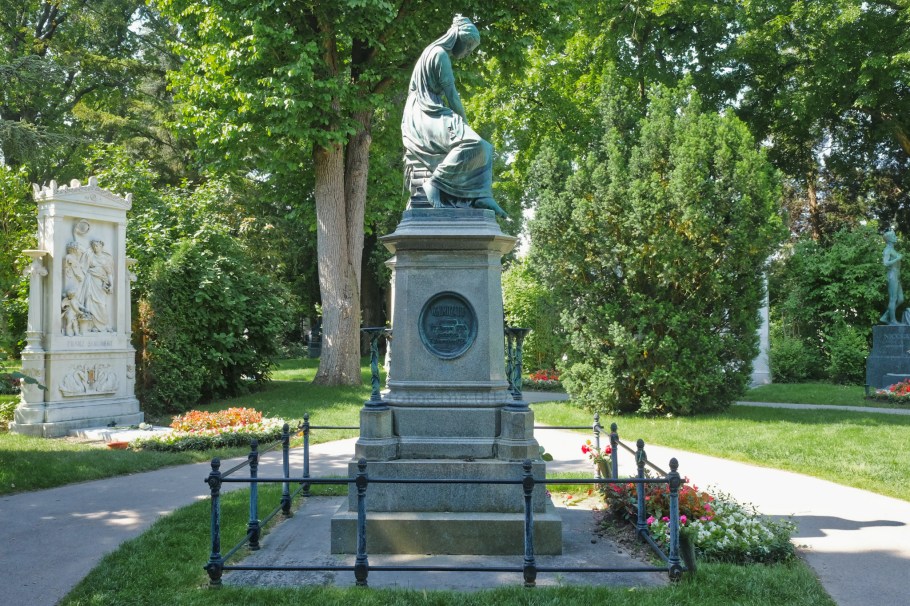
Wolfgang Amadeus Mozart: 1859 memorial marker by Hanns Gasser. Photo, 20 May 2018.
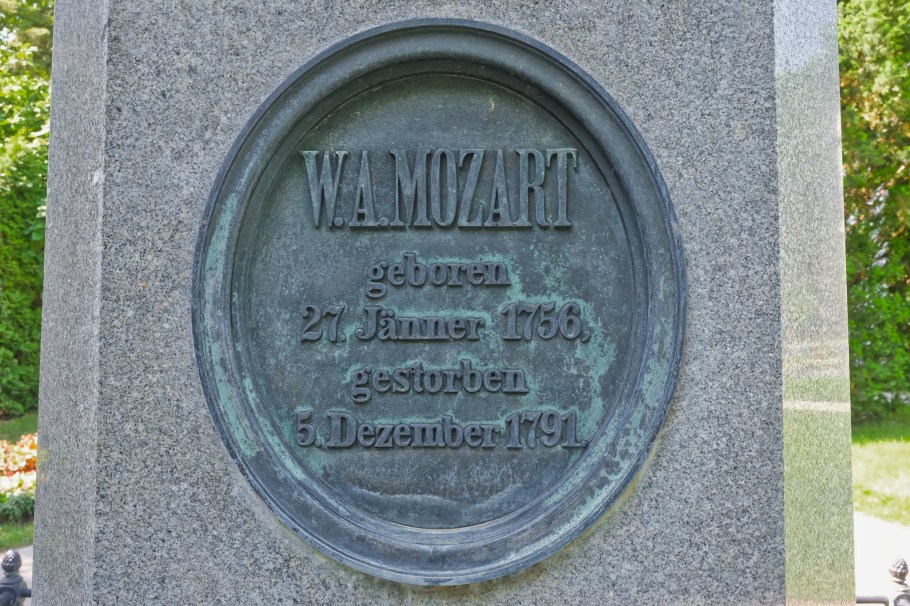
Mozart memorial. Photo, 20 May 2018.
Familie Munk (Josef Stefan)
• Josef Stefan (Jožef Štefan: Slovenian): b/✵ 24 Mar 1835 – d/✟ 7 Jan 1893.
• Physicist; professor of mathematics and physics, Vienna University.
• Heat transfer; solid-liquid phase transitions; development of Stefan-Boltzmann Law with student Ludwig Boltzmann.
• He had neither siblings nor children. His wife Maria Karoline (1839–1929) and step-granddaughter Aloisia Rohm (1897–1969) are also buried here. According to administration records, burial-duration rights are in the Stefan-Munk family name. Stefan family name has disappeared; only names of Rudolf (1907–1982) and Rudolfine (1916–1995) Munk appear on headstone.
• Josef Stefan, eine biografische Spurensuche zum 120. Todestag, Karl Westritschnig (2012).
• Familie Munk (Rudolf, Rudolfine) grave: group 46D, row 1, number 30.
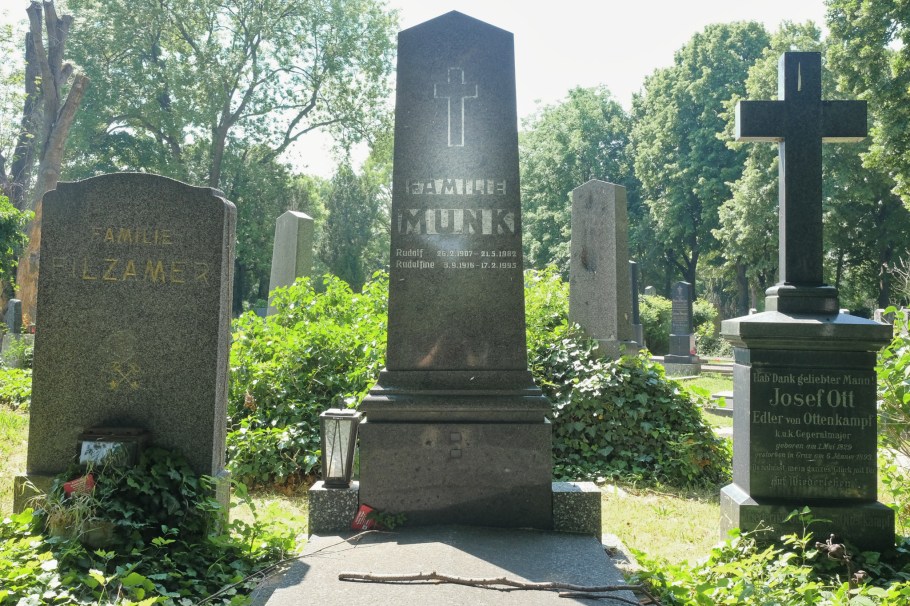
Familie Munk. Photo, 20 May 2018.
Alois Negrelli
• b/✵ 23 Jan 1799 – d/✟ 1 Oct 1858.
• Civil engineer; bridge and railway construction.
• Planned and designed Suez Canal, but completed after his death.
• Originally buried in St. Marx cemetery; his remains exhumed, moved, and reburied in the central cemetery in 1929.
• Ing. Alois Negrelli Ritter von Moldelbe grave: group 32A, number 23.
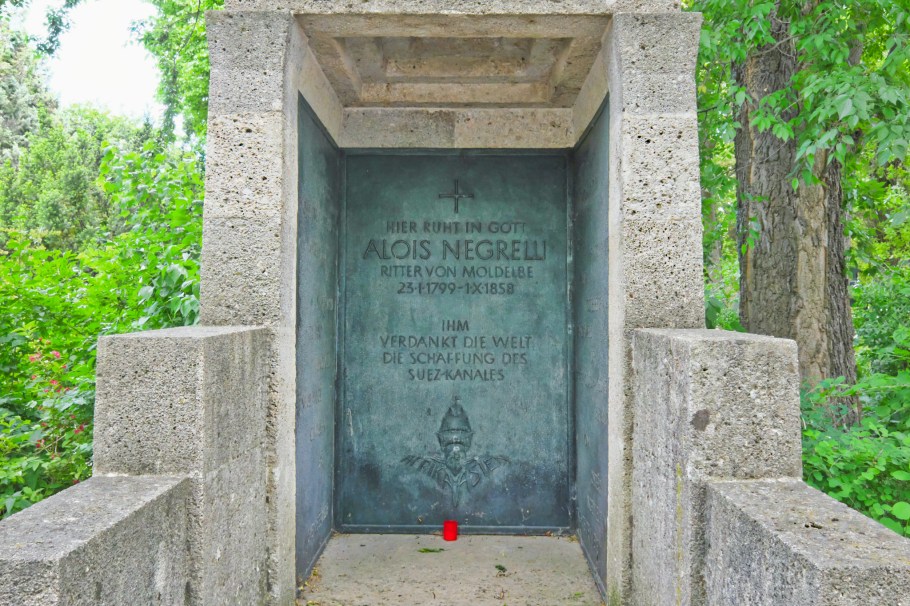
Alois Negrelli. Photo, 28 May 2022.
Johann Nestroy
• b/✵ 7 Dec 1801 – d/✟ 25 May 1862.
• Singer, playwright, actor.
• His 1842 comedy “Einen Jux will er sich machen” became the basis for the play and subsequent movie “Hello, Dolly!” (1964, 1969).
• Originally buried in Währinger Ortsfriedhof; his remains exhumed, moved, and reburied in a grave of honour at Zentralfriedhof in 1881.
• Johann Nepomuk Nestroy grave: group 32A, number 6.
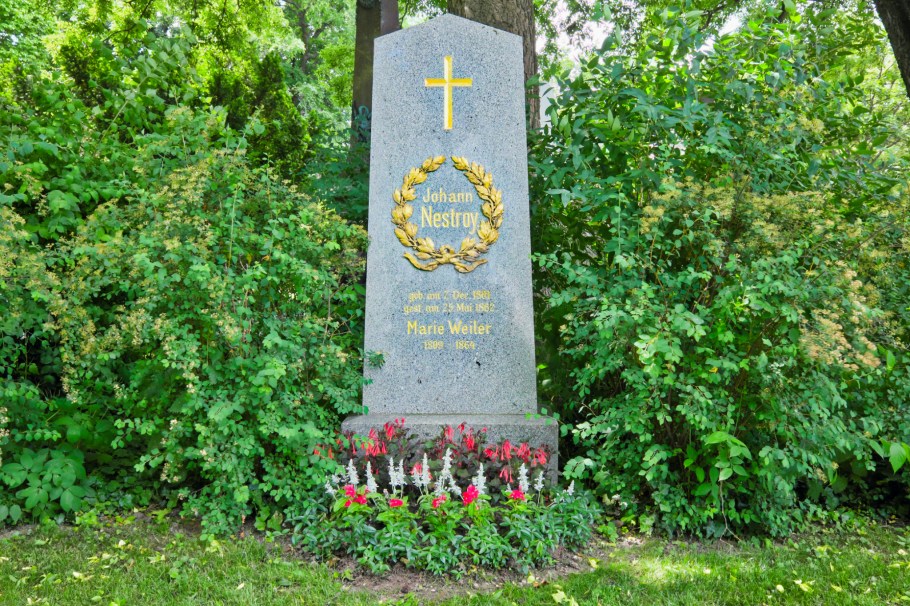
Johann Nestroy. Photo, 28 May 2022.
Peter von Nobile
Eduard van der Nüll
• b/✵ 9 Jan 1812 (baptism) – d/✟ 4 Apr 1868.
• Architect, in partnership with friend August Sicard von Sicardsburg.
• Originally buried in Währinger Ortsfriedhof; his remains were exhumed, moved, and reburied at Zentralfriedhof by 1889 (at the latest).
• Eduard van der Nüll grave: group 32A, number 5.
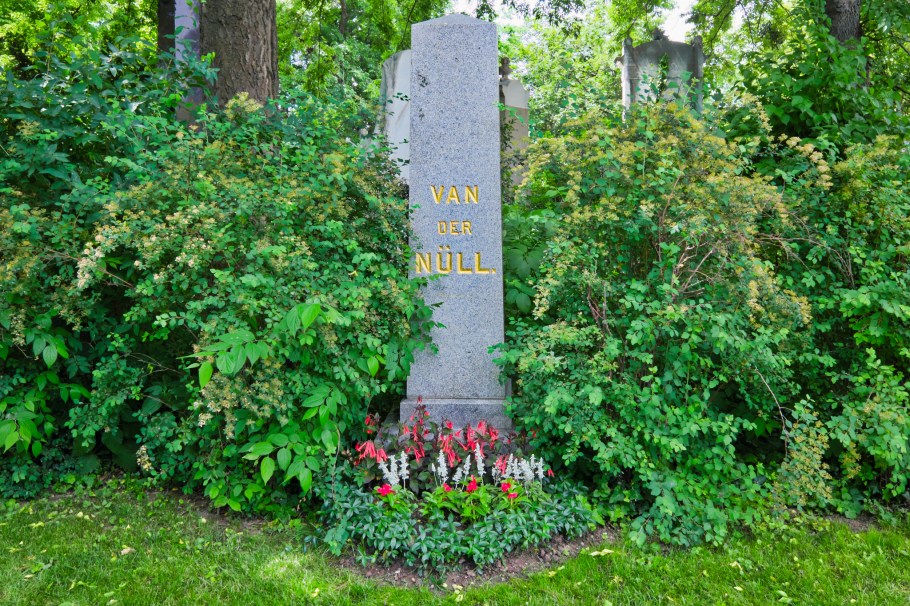
Ehrengrab (grave of honour) for Eduard van der Nüll. Photo, 28 May 2022.
Robert Örley/Oerley
• b/✵ 24 Aug 1876 – d/✟ 15 Nov 1945.
• Architect; e.g., Strauss-Lanner memorial at Rathauspark; plant bowls at Secession; Beethoven memorial at Heiligenstadt Park.
• Robert Örley (Oerley) grave: group 34B, row 14, number 10.
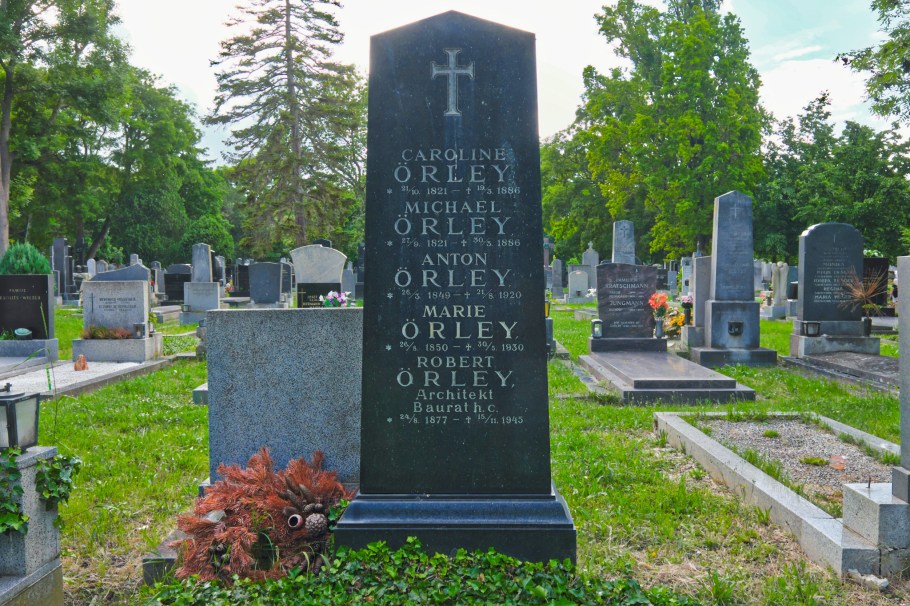
Robert Örley/Oerley and family. Photo, 9 Jun 2023.
Friedrich Ohmann
• b/✵ 21 Dec 1858 – d/✟ 6 Apr 1927.
• Austrian architect; projects included Radetzkybrücke, Sisi-Denkmal (Volksgarten), Wetterstation Stadtpark, Wienflussportal, Zollamtssteg.
• Prof. Dr. tech. Friedrich Ohmann grave: group 33E, row 3, number 32.
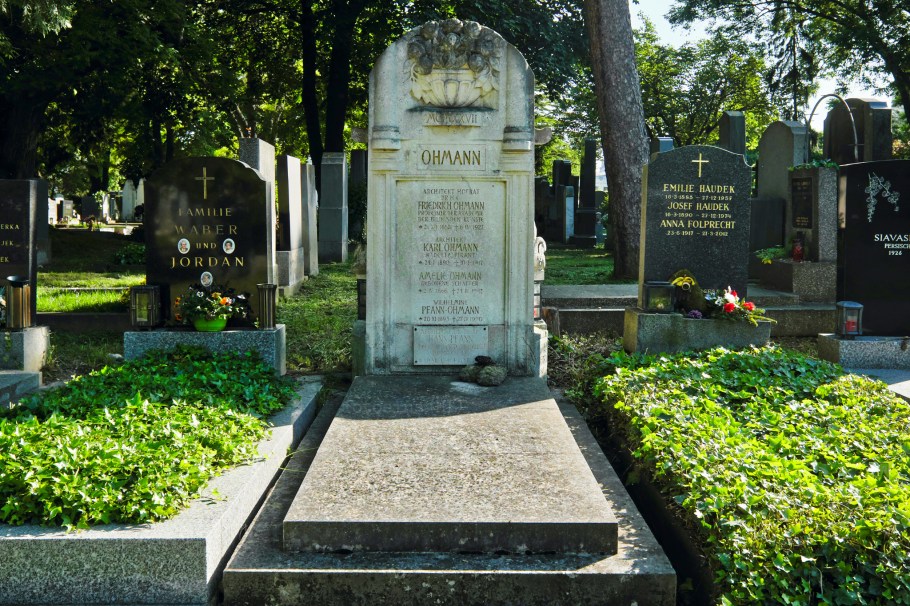
Ohmann family grave. Photo, 25 May 2023.
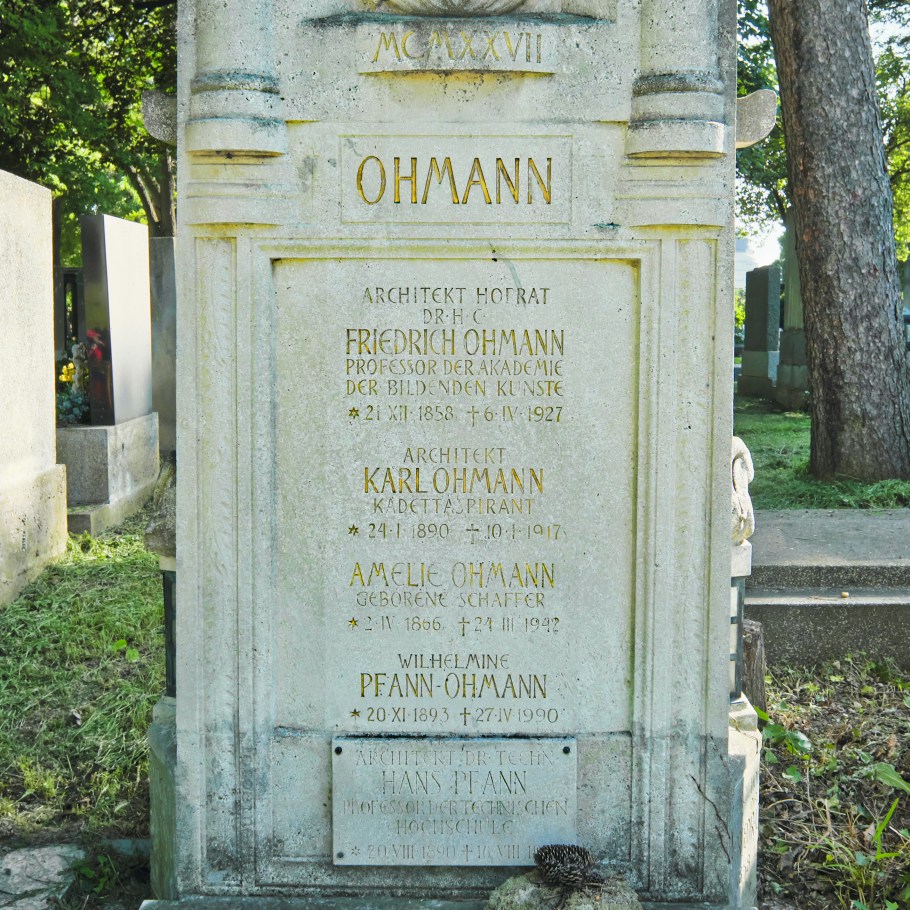
Dr. Friedrich Ohmann: “Architect, Imperial Advisory Council – Professor, Academy of Fine Arts”. Photo, 25 May 2023.
Elfriede Ott
• Elfriede Cäcilia Maria Ott grave: group 33G, number 79.
Julius von Payer
• b/✵ 2 Sep 1841 – d/✟ 30 Aug 1915.
• “Führer der Nordpol-Expedition 1872–1874 und Historien-Maler” (Leader of North Pole expedition 1872–1874 and historical painter).
• Austrian-Hungarian expedition reported existence of archipelago in Arctic Ocean; named Franz Josef Land after Emperor Franz Josef I.
• Payer’s paintings during expedition found in Vienna’s Museum of Military History; e.g., “Nie Zurück“.
• Dr. phil. Julius Ritter von Payer grave: group 32A, number 37.
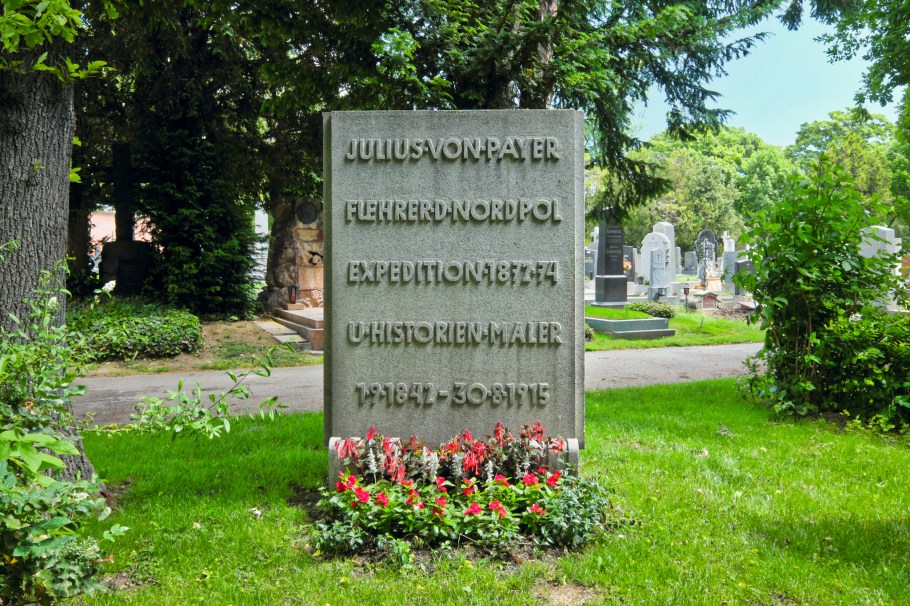
Julius von Payer. Photo, 28 May 2022.
Ida Pfeiffer
• b/✵ 14 Oct 1797 – d/✟ 27 Oct 1858.
• Early 19th-century solo explorer, world traveller, travel writer.
• Originally buried in St. Marx cemetery; remains exhumed, moved, and reburied at Zentralfriedhof in 1892.
• Ida Laura Pfeiffer grave: group 0, row 1, number 12.
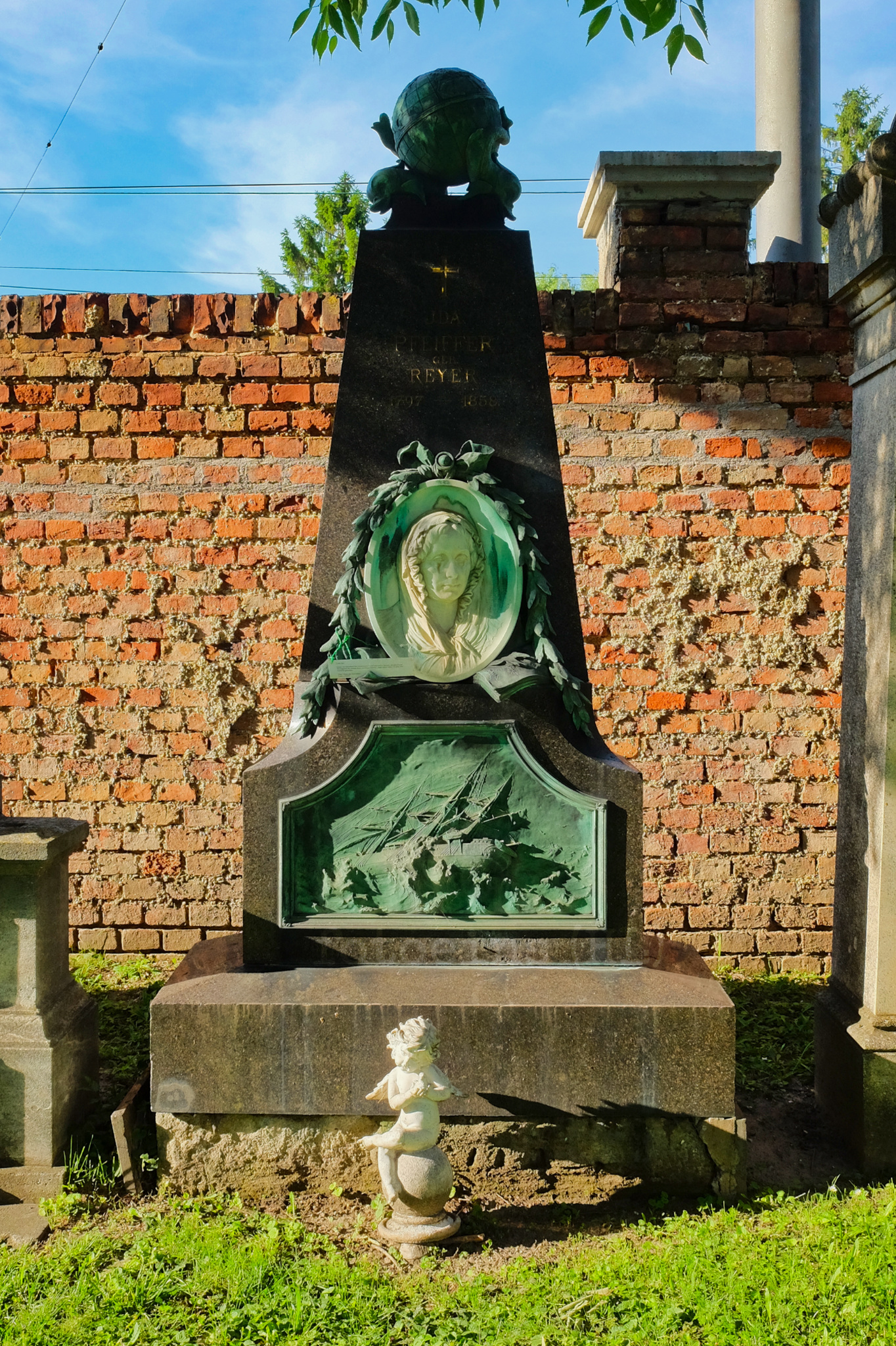
Ida Pfeiffer – 14 Jun 2024.

Ida Pfeiffer – 14 Jun 2024.
Gabriele Possanner (Familie)
• b/✵ 27 Jan 1860 – d/✟ 14 Mar 1940.
• University of Vienna, 2 Apr 1897: 1st woman awarded doctoral degree from the university, and 1st woman awarded doctor of medicine from the university.
• With the opening of her medical practice in Vienna’s 9th district on 10 May 1897, she became the 1st woman medical doctor to practice medicine in Austria.
• Dr. Gabriele Possanner Freiin von Ehrental grave: group 33E, row 16, number 22.
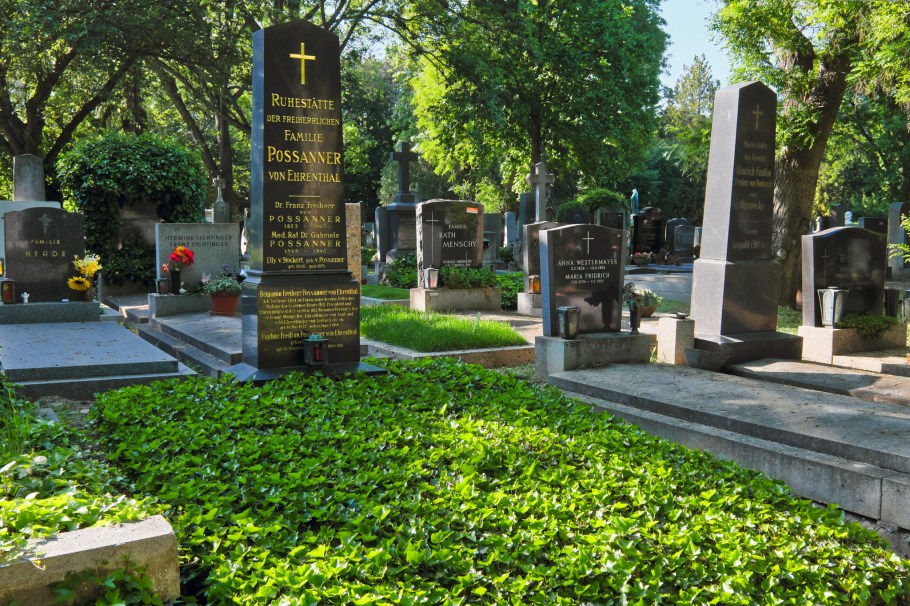
Possanner family grave. Photo, 25 May 2023.
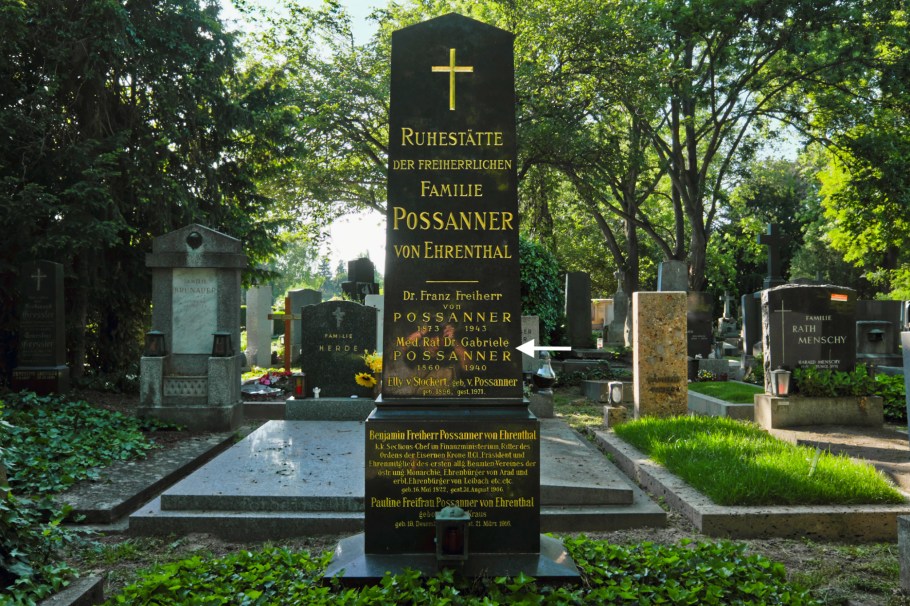
Dr. Gabriele Possanner’s name highlighted with arrow. Photo, 25 May 2023.
Gustav Adolf Raupenstrauch
• b/✵ 21 Jun 1859 – d/✟ 21 Apr 1943.
• Austrian pharmacist and manufacturer; doctorate from University of Vienna in 1886 after studies in pharmacy and chemistry.
• Developed in 1889 antiseptic disinfectant known as “Lysol” to fight cholera. Well-known today are cleaning products marketed under brands Lysol, Dettol, Sagrotan.
• Gustav Adolf Raupenstrauch grave: group 3, number 44/45 (Protestant/evangelical section).
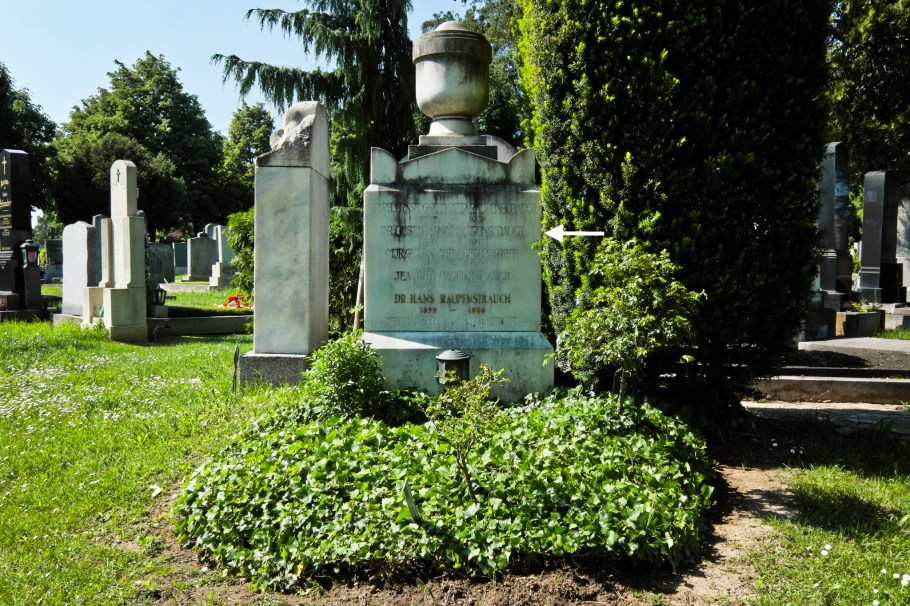
Familie Raupenstrauch grave; the arrow points to the name Gustav Adolf. Photo, 25 May 2023.
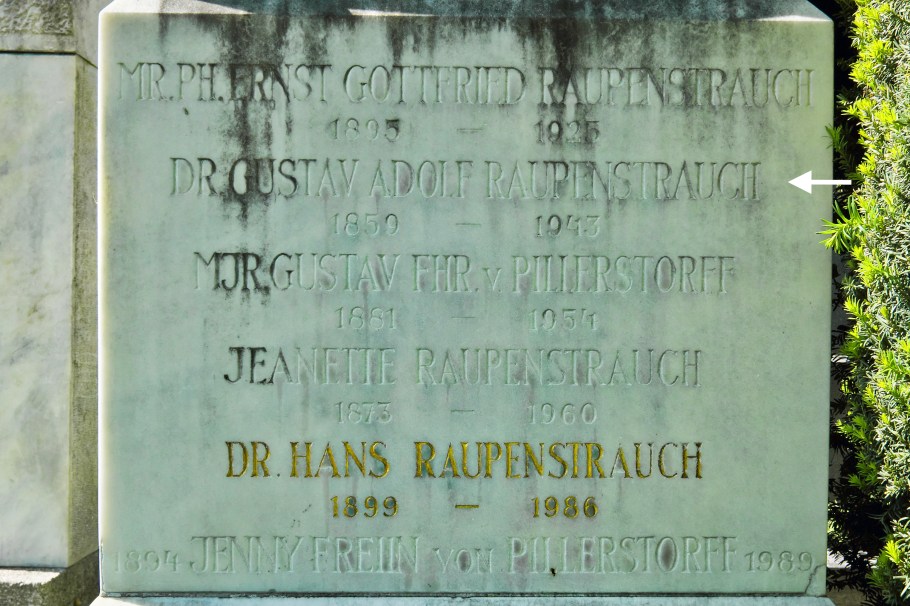
Familie Raupenstrauch grave. Photo, 25 May 2023.
Familie ROTHSCHILD
• Established banking and finance houses in Europe.
• Nathaniel; brother Albert married Bettina; Albert & Bettina’s children Charlotte, Oskar, Georg, Louis. Nathaniel and Albert: sons of Salomon Mayer who established the Austria branch, and grandsons of founder Mayer Amschel.
• Rothschild family mausoleum: group 6, row 29, number 49 (Old Jewish section).
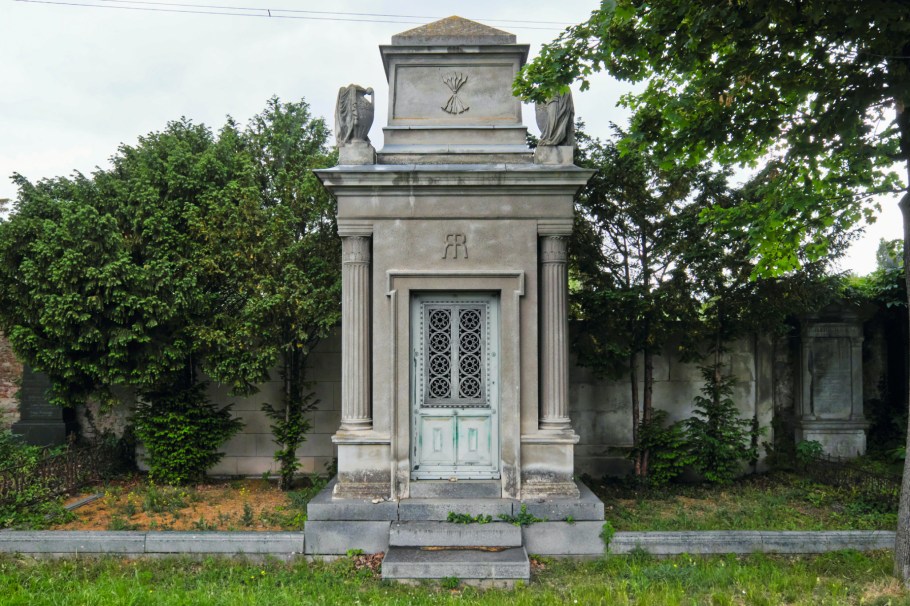
Family mausoleum. Photo, 28 May 2022.
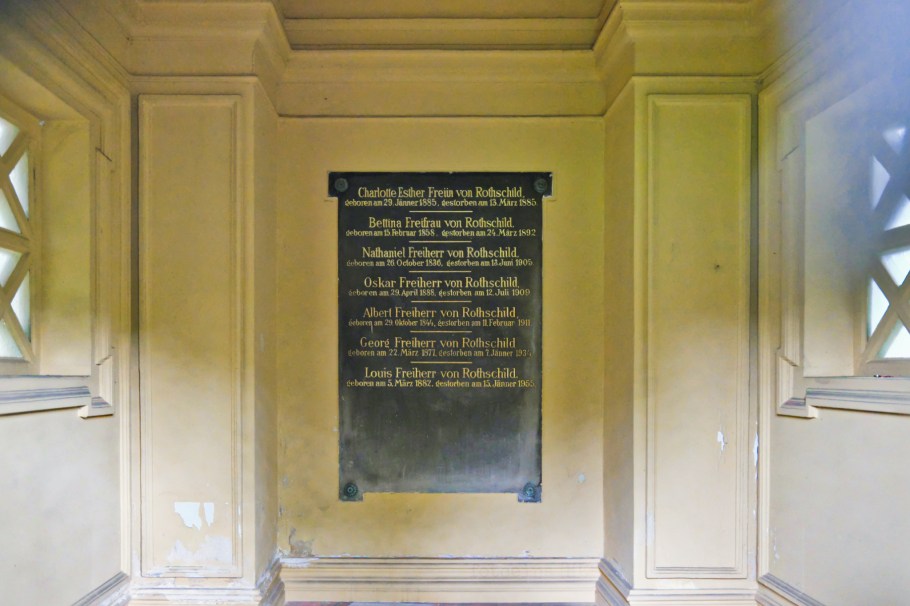
Rothschild family names. Photo, 28 May 2022.
Antonio Salieri
• b/✵ 18 Aug 1750 – d/✟ 7 May 1825.
• Composer, late 18th-century opera, royal court music director.
• Exploding the Salieri myth, by Erica Jeal, for The Guardian, 2003.
• Best known for Italian operas, as music director & composer for the Austrian court as “Hofkapellmeister”.
• Teacher to Beethoven, Liszt, Schubert.
• Antonio Salieri grave: group 0, row 1, number 54.
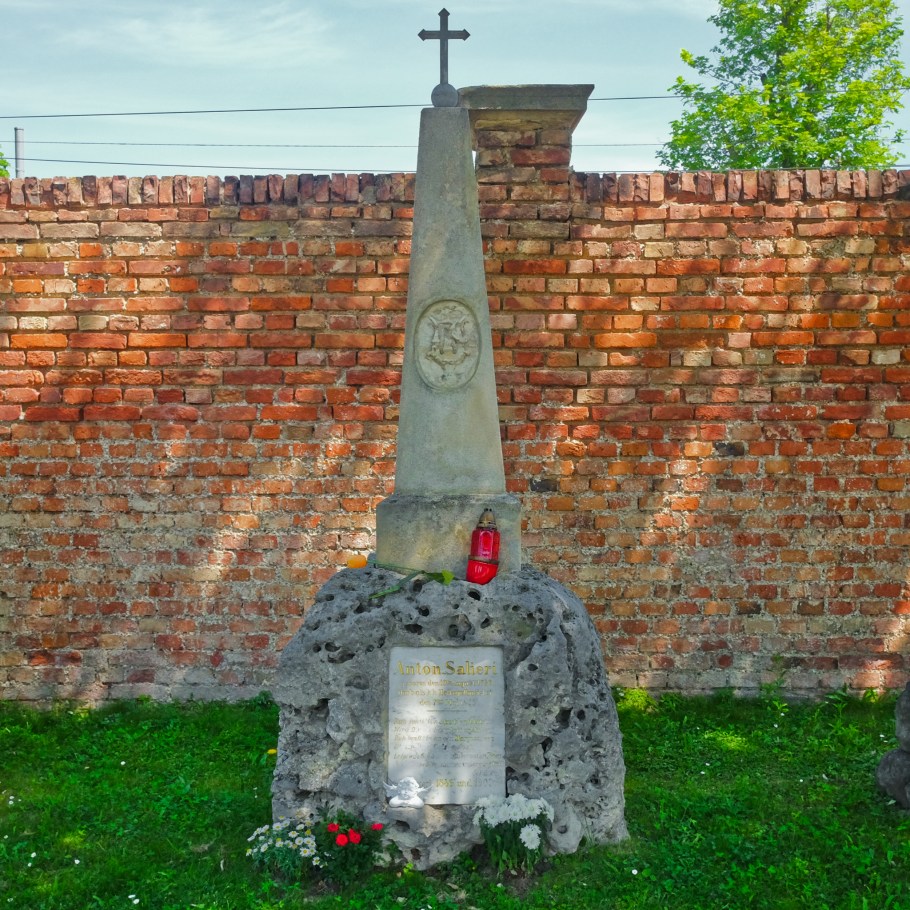
Antonio Salieri. Photo, 20 May 2018.
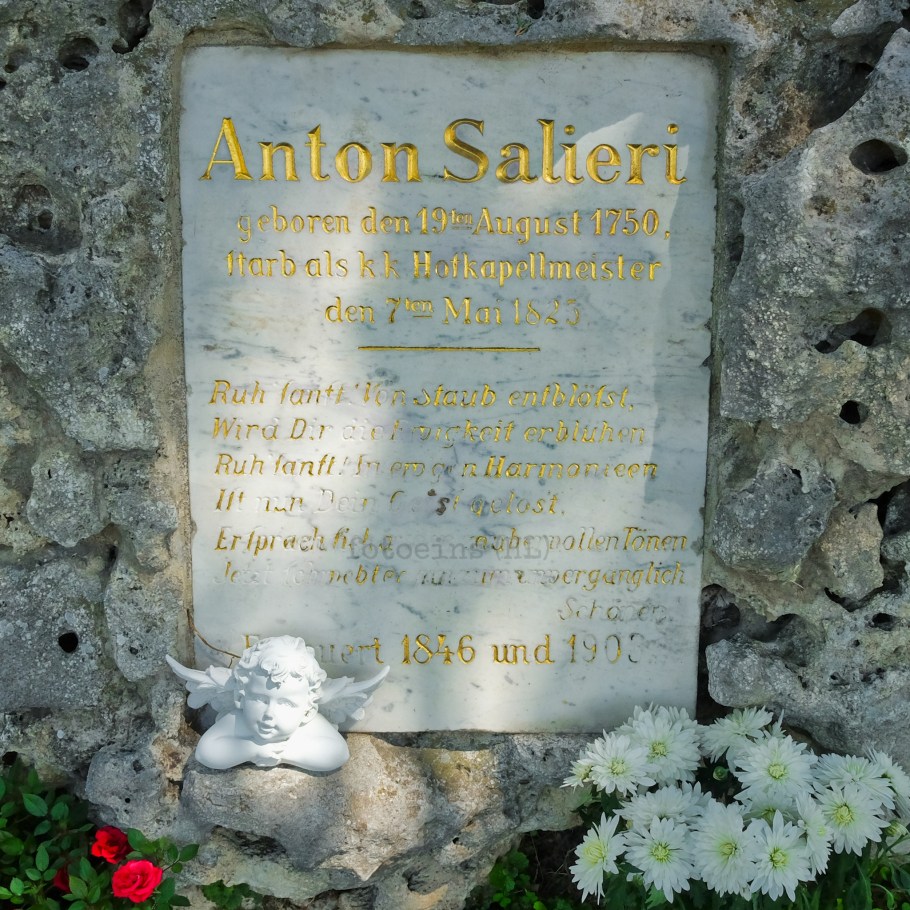
Photo, 20 May 2018.
Emil Jakob Schindler
• b/✵ 27 Apr 1842 – d/✟ 9 Aug 1892.
• Austrian landscape painter.
• Father of Alma Schindler, later Alma Mahler-Werfel.
Arthur Schnitzler
• b/✵ 15 May 1862 – d/✟ 21 Oct 1931.
• Writer, playwright; his 1926 “Traumnovelle” (Dream Novel) forms the basis for 1999 film “Eyes Wide Shut” by Stanley Kubrick.
• Arthur Schnitzler grave: group 6, number 4 (Old Jewish section).

Arthur Schnitzler. Photo, 28 May 2022.
Arnold Schönberg
• b/✵ 13 Sep 1874 – d/✟ 13 Jul 1951.
• Austrian-American artist, music composer and theorist; considered one of the most influential 20th-century composers.
• Grave design by sculptor Fritz Wotruba.
• Prof. Arnold Franz Walter Schönberg grave: group 32C, number 21A.
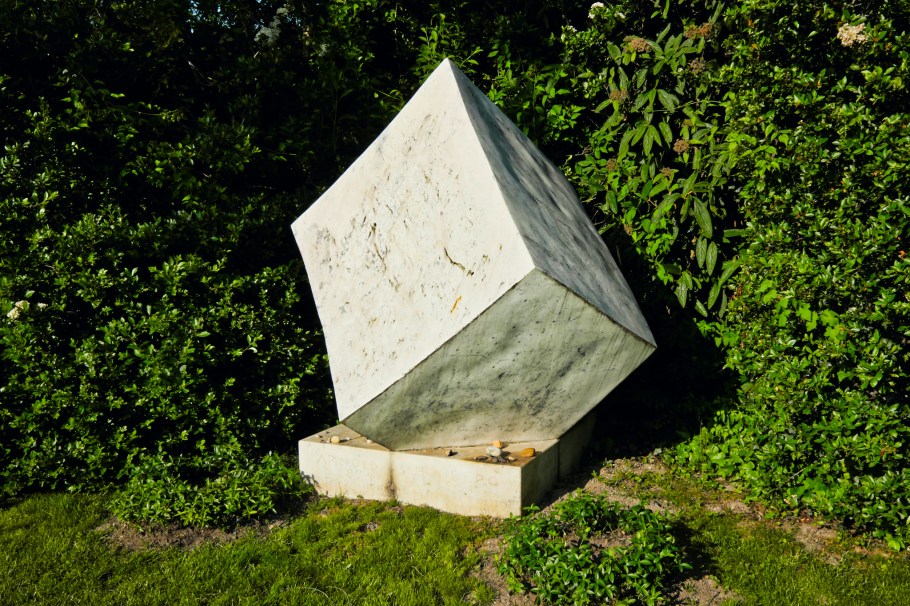
Schönberg “cubic” grave, designed by Fritz Wotruba. Photo, 25 May 2023.
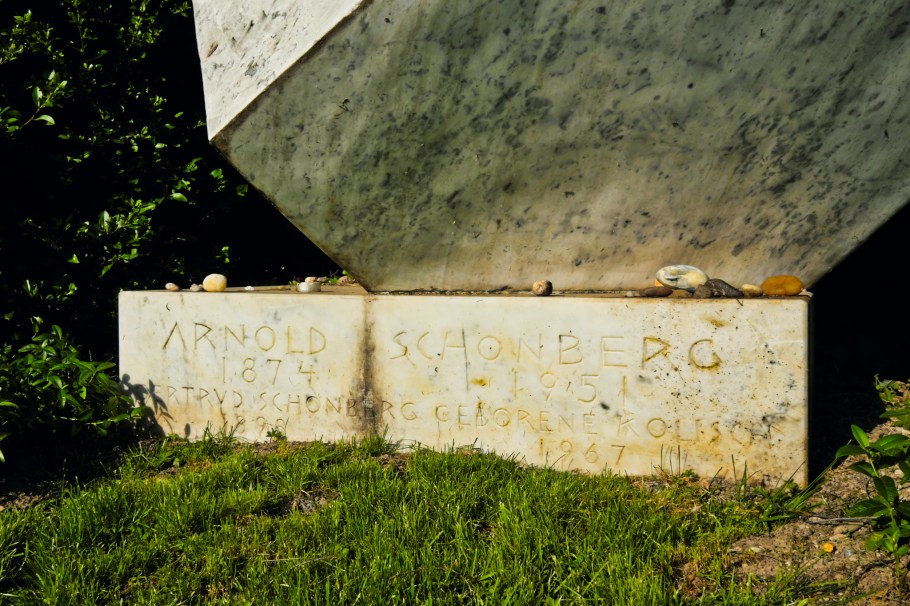
Grave, Arnold Schönberg and his wife Gertrud (née Kolish). Photo, 25 May 2023.
Franz Schubert
• b/✵ 31 Jan 1797 – d/✟ 19 Nov 1828.
• Composer: “Der Erlkönig“, Op.1, D.328 (1815) adapted from Goethe’s text; “Ellens Dritter Gesang“, Op.52, No.6, D.839 (1825).
• The “D” in Schubert’s catalog is for Austrian musicologist Otto Deutsch, who organized and produced the first thorough catalog of Schubert’s works in 1951.
• Originally buried in Währinger Ortsfriedhof cemetery, Schubert’s remains were exhumed and moved here to Zentralfriedhof in 1888.
• Franz Peter Schubert grave: group 32A, number 28.
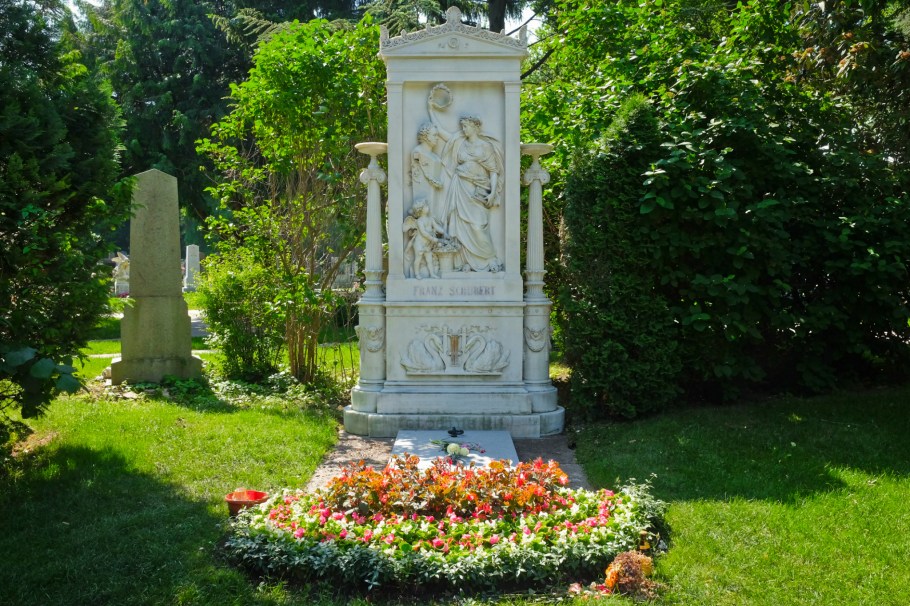
Franz Schubert. Photo, 20 May 2018.
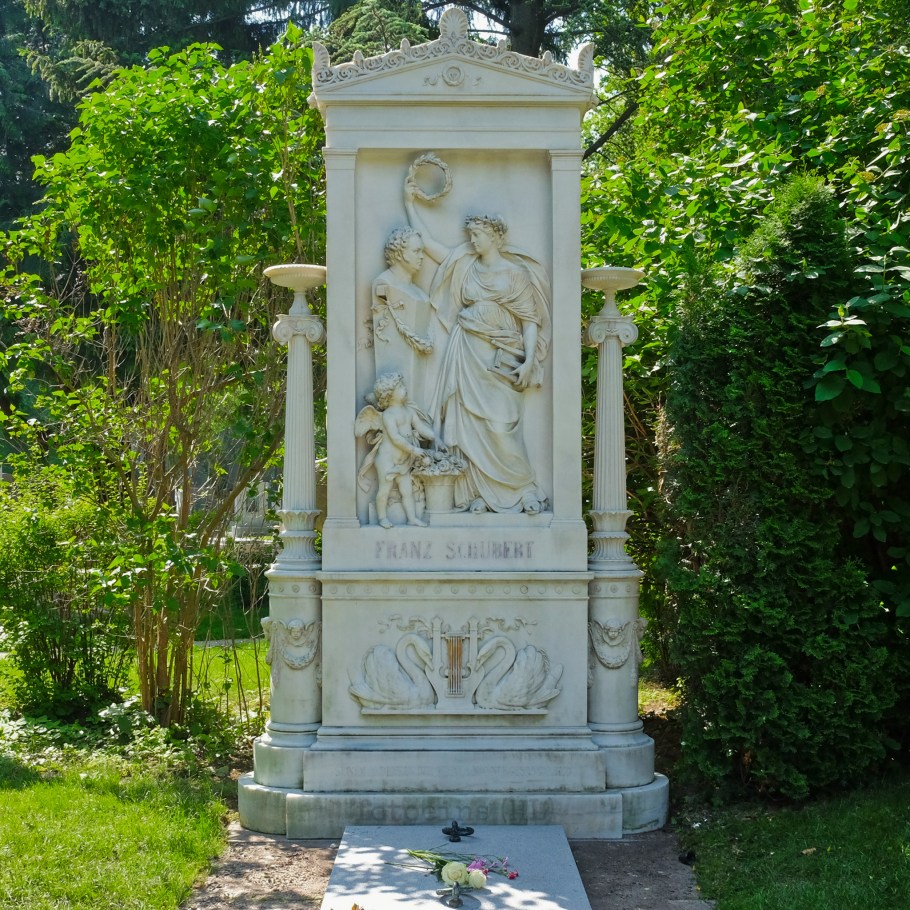
Franz Schubert’s grave designed by Theophil Hansen. Photo, 20 May 2018.
Margarete Schütte-Lihotzky
• b/✵ 23 Jan 1897 – d/✟ 18 Jan 2000.
• Architect, mother of the modern fitted kitchen, activist.
• Prof. Margarethe Helene Rudolfine Schütte grave: group 33G, number 28.
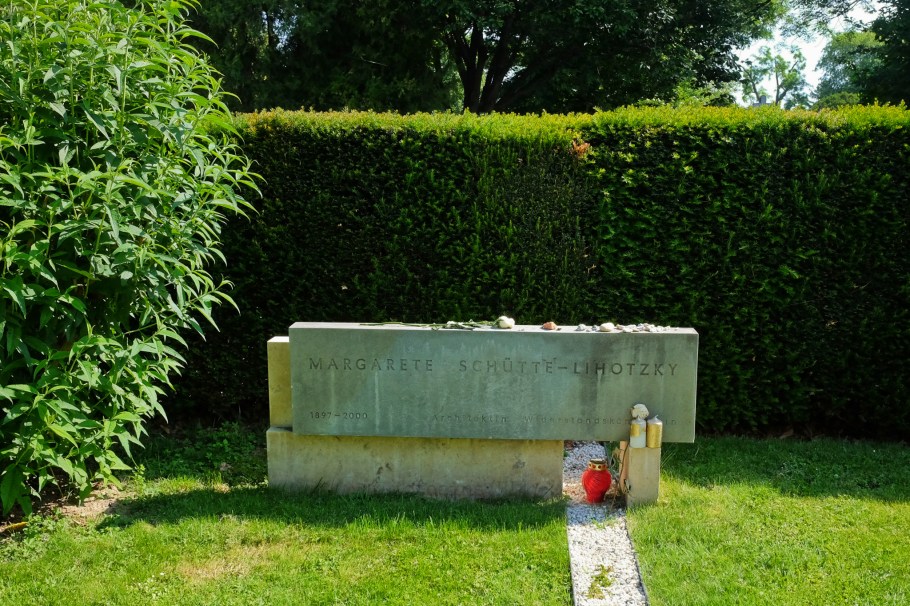
Margarete Schütte-Lihotzky. Photo, 20 May 2018.
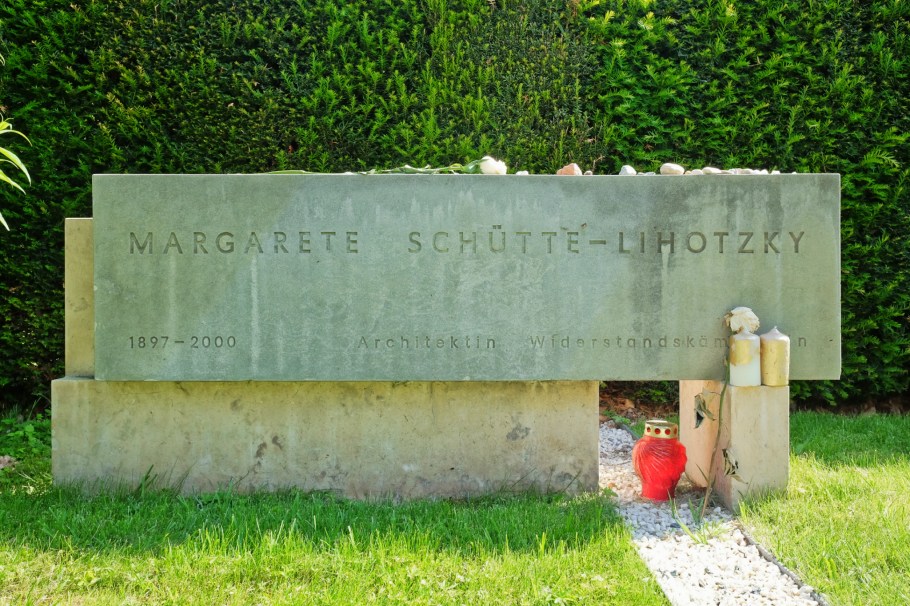
Margarete Schütte-Lihotzky: architect, (WW2) resistance fighter. Photo, 20 May 2018.
Camillo Sitte
Minona von Stackelberg
• b/✵ 8 Apr 1813 – d/✟ 27 Feb 1897.
• Was Minona the daughter of Ludwig van Beethoven? Perhaps; we’ll probably never know.
• The Bánffy family grave includes Dionys Bánffy Graf (count), Johanna Bánffy Gräfin (countess), and Minona Stackelberg Baronin (baroness), as Minona lived with the Bánffy family.
• Originally buried in Währinger Ortsfriedhof; the Bánffy remains were exhumed, moved, and reburied at Zentralfriedhof in 1896.
• Minona Stackelberg Baronin grave: group 48A, row G1, number 1.
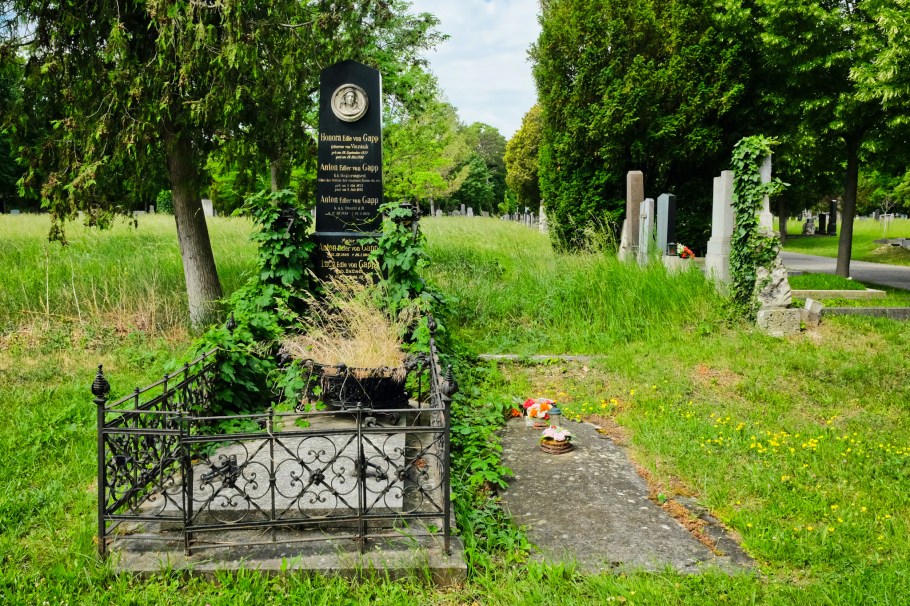
At right is the Bánffy grave at group 48A, row G1, number 1 (48A/G1/1). The broken headstone is missing, and any inscription on the large rectangular stone cover has been lost to erosion and time. At left is the von Gapp family grave at 48A/G1/2. Photo, 28 May 2022.
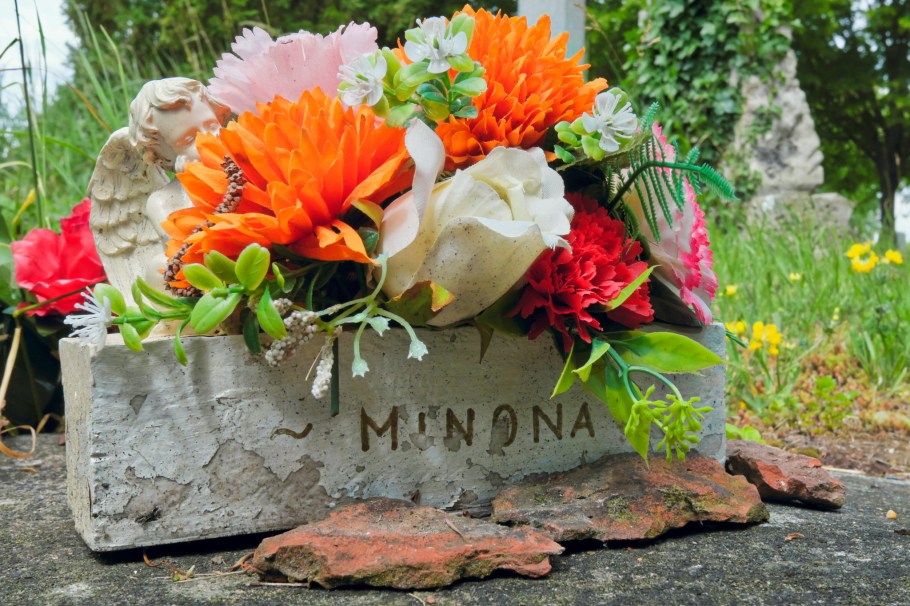
At the head of the Bánffy grave (48A/G1/1) is a small surface memorial with flowers dedicated to “Minona” (von Stackelberg). Photo, 28 May 2022.
Minona von Stackelberg (1813-1897) was born to Maria Josepha Aloysia (Joséphine) Brunswick. Josephine got along well with her piano instructor who was Beethoven. How well did they get along? After the death of her 1st husband, Josephine wed Baron Christoph Stackelberg in 1808; however, Stackelberg’s relation with their children was at best complicated and at worst neglectful. Pinning down Minona’s paternal origins are another matter entirely: was she Stackelberg’s daughter? Or someone else’s? Naturally, the latter would’ve been juicy and scandalous. Later in life, Minona lived with the Banffy aristocratic family, possibly related as extended family of nobility. That’s why Minona’s grave is with the Bánffys in Vienna’s central cemetery, although now, the headstone is gone and the grave stone cover is devoid of all markings.
The anadrome (reverse anagram) of “Minona” is “anonim”, similar to the German word “anonym” or anonymous. This seems like one heckuva loaded coincidence until learning that the great German writer Johann Wolfgang von Goethe used the name “Minona” frequently in his 1774 novel “Die Leiden des jungen Werthers” (The Sorrows of Young Werther), which in turn is related to a set of Scottish poems. “Minona” is itself coined from Gaelic, meaning “a gentle air” or “a gentle melody”.
Eduard “Edi” Strauss
• b/✵ 15 Mar 1835 – d/✟ 28 Dec 1916.
• Johann II’s brother, composer, royal court music director.
• His father Johann I/Vater, see above; his mother Anna buried with brother Josef, see below.
• Eduard Strauss (grandson Eduard II, wife Elisabeth) grave: group 32A, number 42.
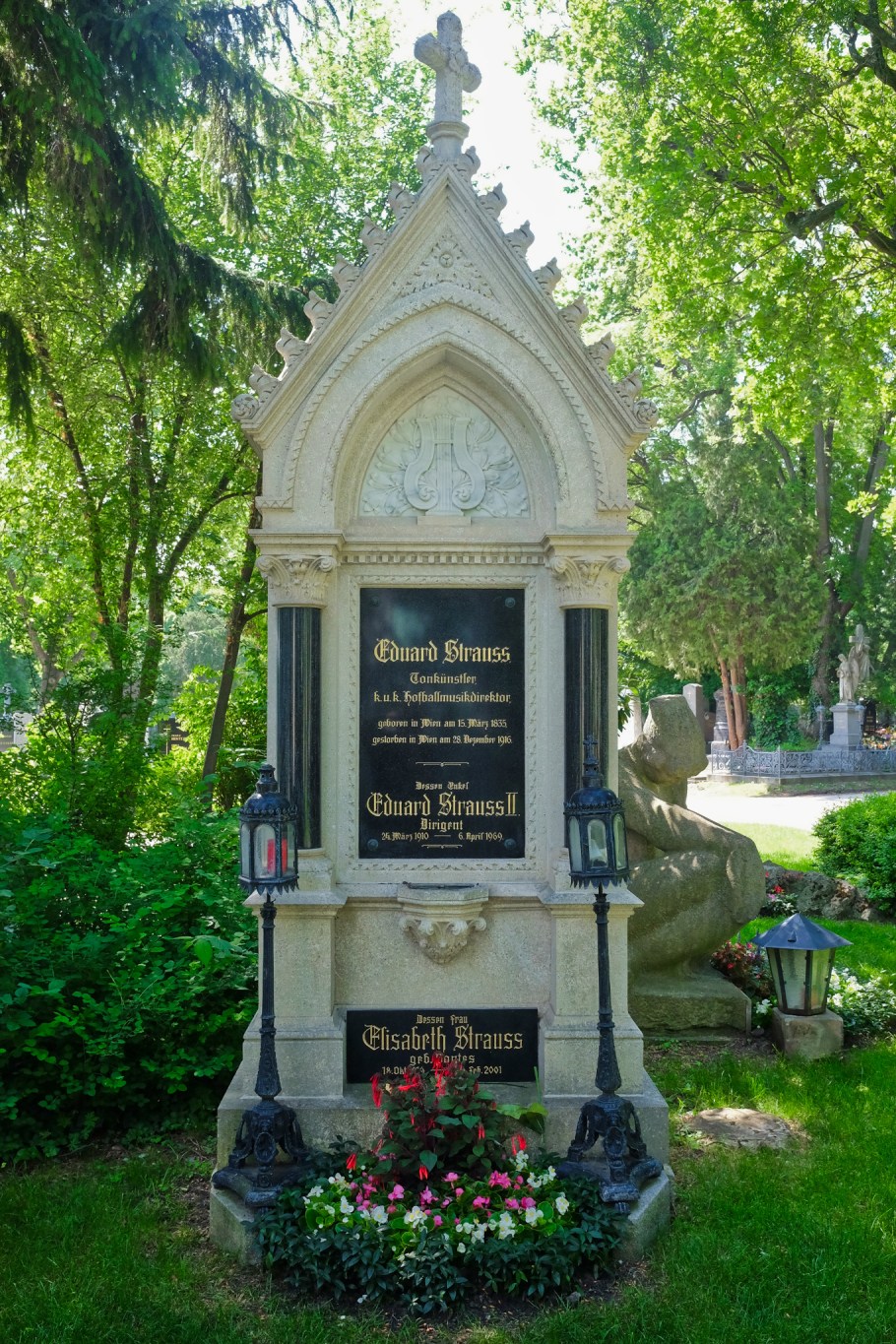
Eduard Strauss. Photo, 20 May 2018.
Johann Strauss I (dad)
• b/✵ 14 Mar 1804 – d/✟ 25 Sep 1849.
• Composer, imperial court royal ball music director, known for his “Radetzky March”
• His sons Johann II, Eduard, and Josef formed an informal contemporary dynasty of “Wiener Walzer” (Vienna Waltzes)
• Originally buried in Döblinger Ortsfriedhof; his remains exhumed and moved to Zentralfriedhof in 1904. Döblinger Ortsfriedhof redeveloped into Strauss-Lanner-Park with 1928 opening.
• His wife Anna Strauss (née Streim) buried with son Josef; see below.
• Johann Baptist Strauss grave: group 32A, number 15 (next to friend and rival Joseph Lanner).
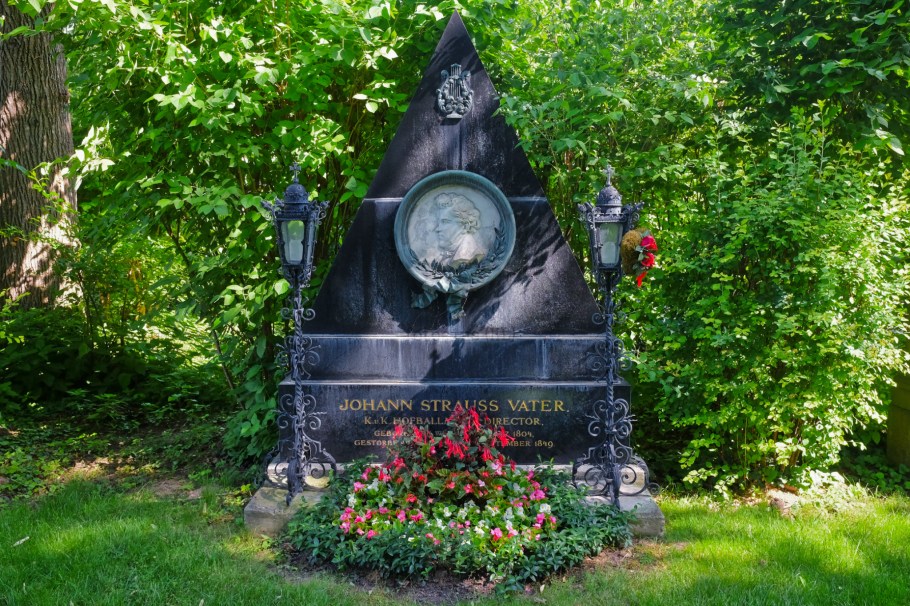
Johann Strauss I (father/senior). Photo, 20 May 2018.
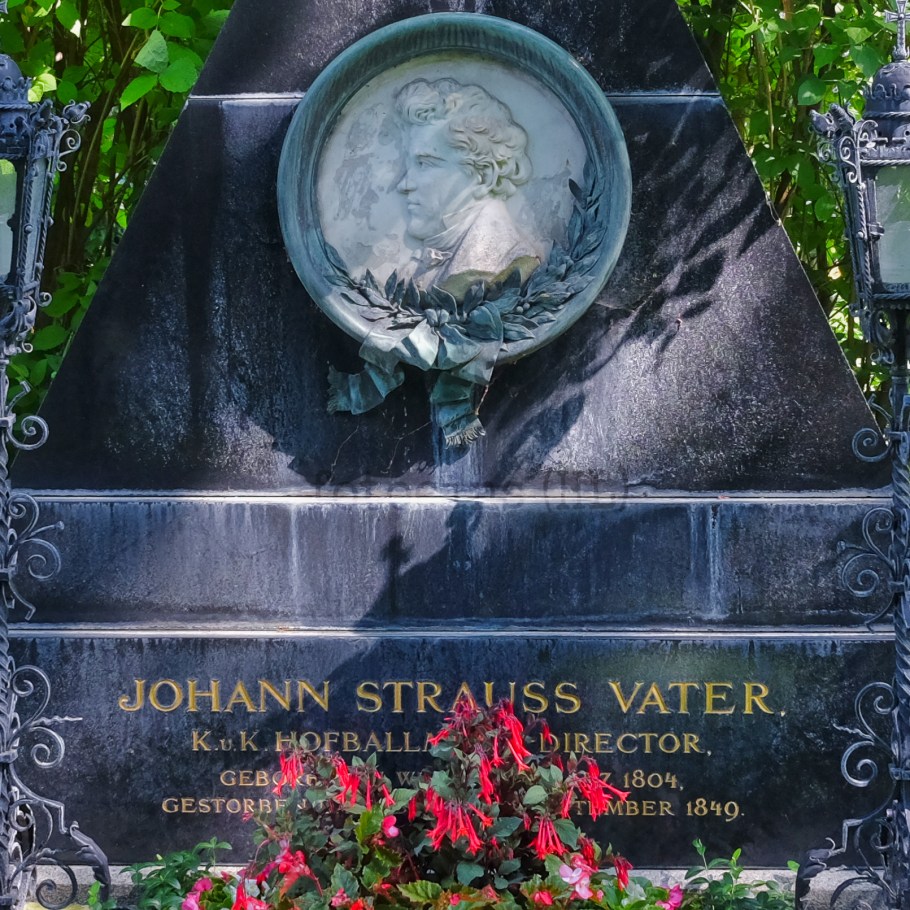
Photo, 20 May 2018.
Johann Strauss II (son)
• b/✵ 25 Oct 1825 – d/✟ 3 Jun 1899.
• Composer, royal music director.
• Best known for “An der schönen blauen Donau (On the blue Danube)“, Walzer op.314, 1866, considered the unofficial anthem of Vienna.
• His brother Josef and mother Anna in another grave, see below.
• Grave for Johann Strauss II (son/junior) & his 3rd wife Adele: group 32A, number 27.

Johann Strauss II (son/junior). Photo, 20 May 2018.
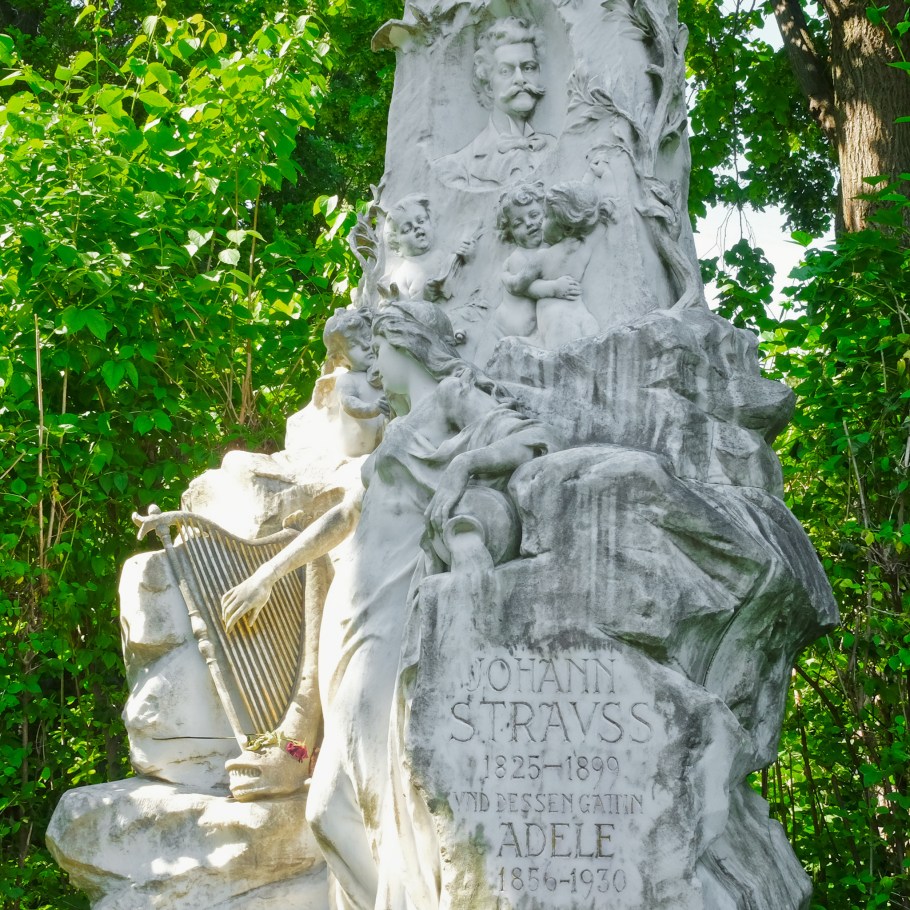
Photo, 20 May 2018.
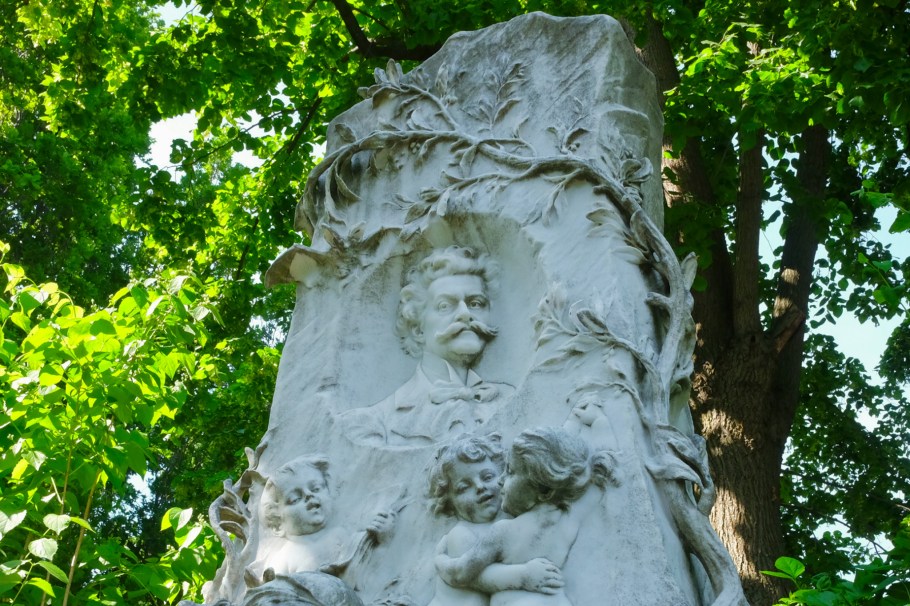
Photo, 20 May 2018.
Josef “Pepi” Strauss, Anna Strauss (mum)
• b/✵ 22 Aug 1827 – d/✟ 22 Jul 1870.
• Composer, Johann II’s younger brother. Johann II once said of Josef: “Pepi (Josef) is the more gifted of us; I’m merely more popular.”
• Josef and his mother Anna Strauss (née Streim) were first buried at St. Marx cemetery. Both sets of remains were exhumed, moved, and reburied here at Zentralfriedhof in 1909.
• Grave for Josef Strauss & Anna Strauss: group 32A, number 44.
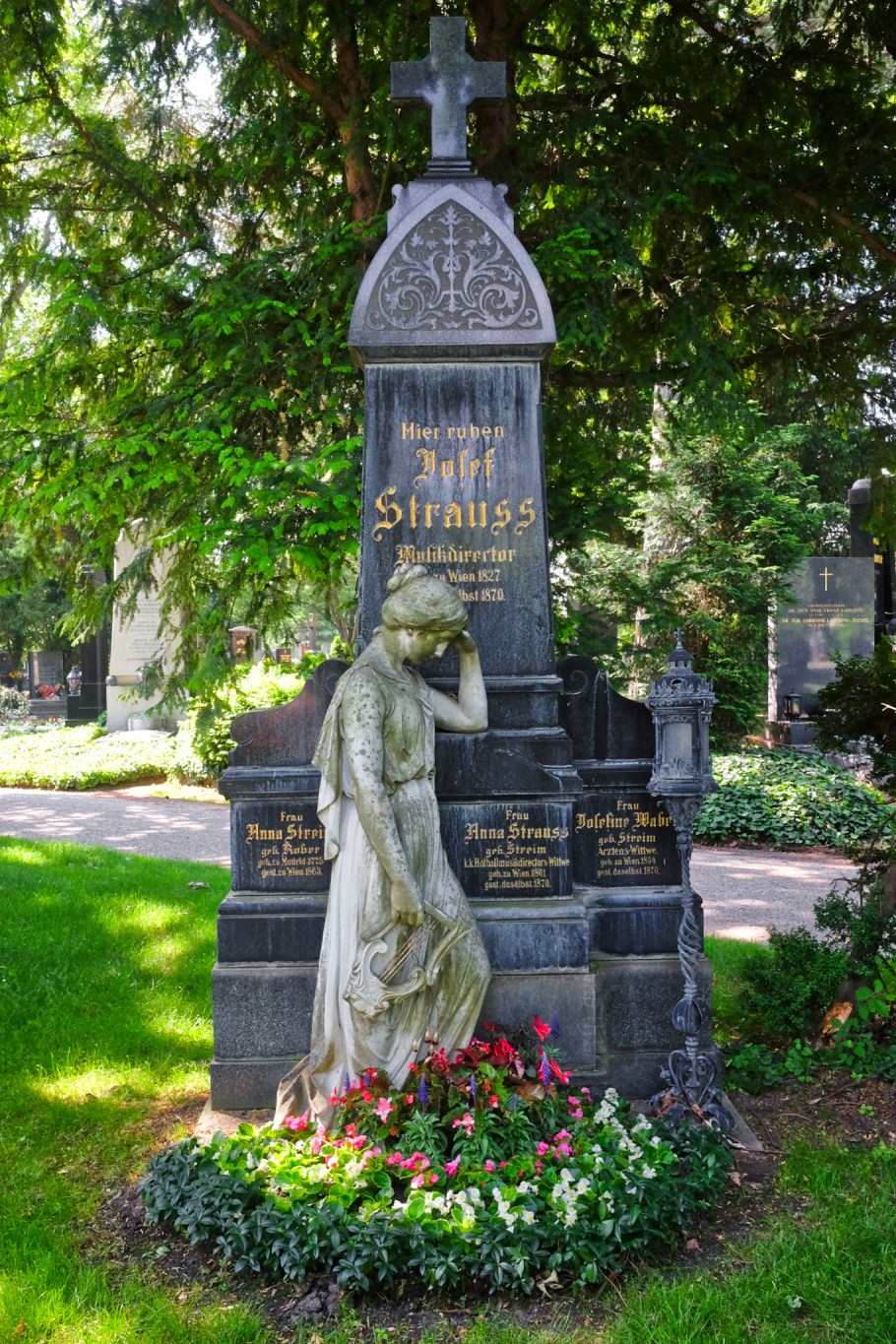
Josef Strauss at upper-centre; mum Anna Strauss (née Streim) at lower-centre. Photo, 20 May 2018.
Viktor Tilgner
Familie Waldmüller
• Painter Ferdinand Georg Waldmüller buried in Grabmalhain Waldmüllerpark (former Matzleinsdorf cemetery); wife Katharina buried in St. Marx cemetery. Their children buried here in Zentralfriedhof: daughter Aloisia (son-in-law Alfred Wurmb), son Ferdinand Franz.
• Grave for Aloisia Wurmb, Ferdinand Waldmüller: group 33E, row 4, number 11.
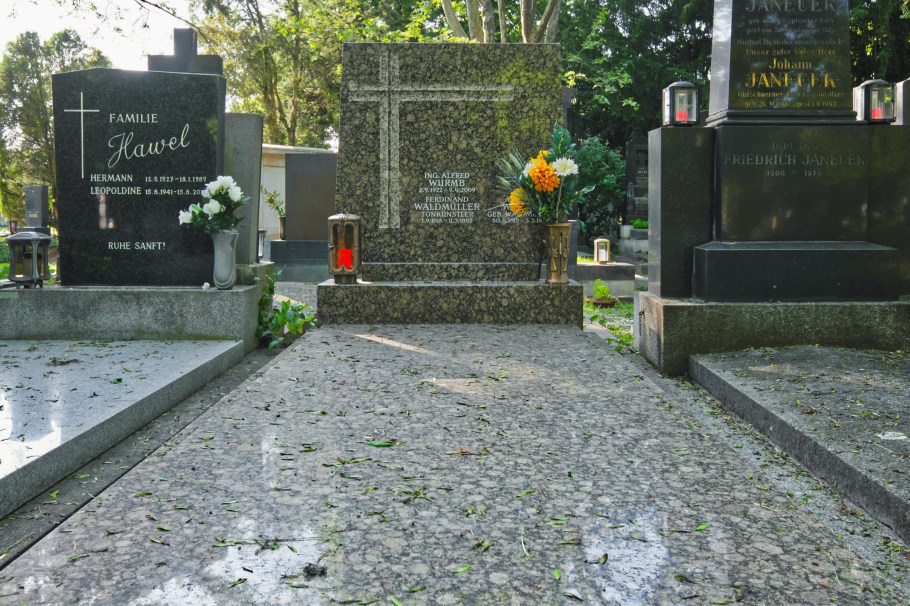
Waldmüller family grave. Photo, 25 May 2023.
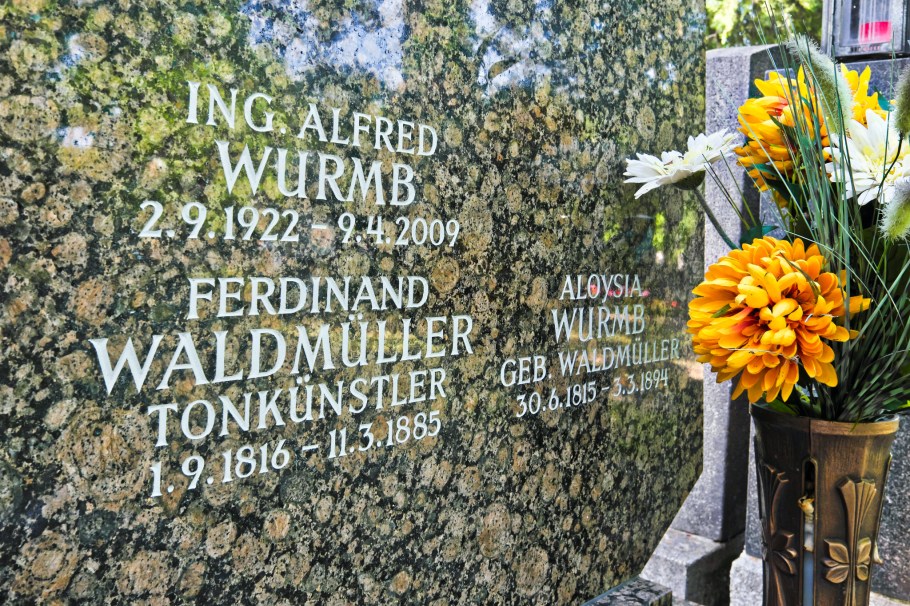
Aloysia Wurmb (née Waldmüller), her husband Alfred Wurmb, her brother Ferdinand Waldmüller. Photo, 25 May 2023.
Robert Weigl
• b/✵ 16 Oct 1851/1852 – d/✟ 27 Dec 1902.
• Austrian artist and sculptor; e.g., Beethoven memorial at Heiligenstadt Park.
• Originally buried in Gersthof cemetery in 1902; assigned “grave of honour” in the central cemetery in 1903.
• Robert Weigl grave: group 32A, number 9.
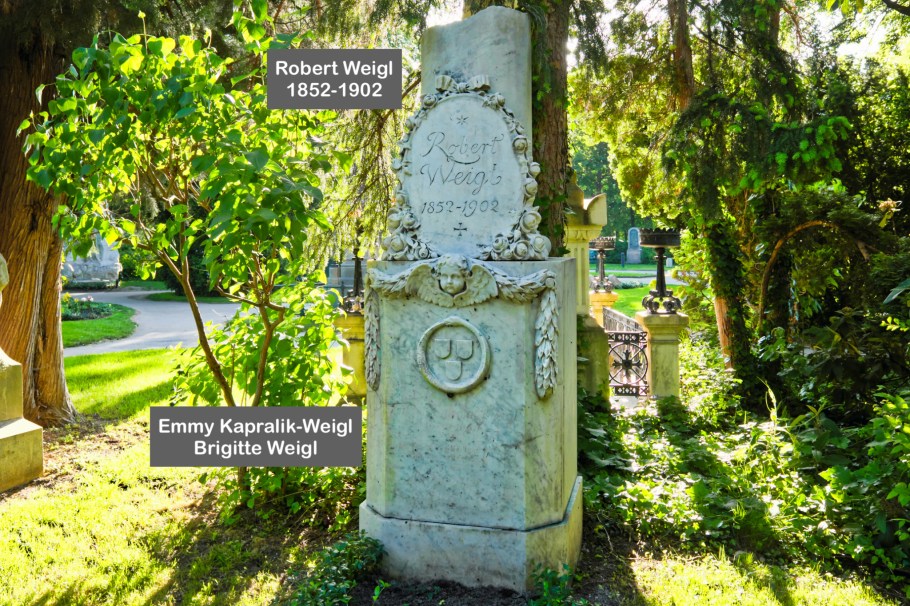
Robert Weigl, his wife Emmelina Weigl (née Kapralik), their daughter Brigitta Weigl. Photo, 25 May 2023.
Franz Werfel
• b/✵ 10 Sep 1890 – d/✟ 26 Aug 1945.
• Writer, novelist, playwright, poet; author of “Die vierzig Tage des Musa Dagh” (1933), translated to English as “The Forty Days of Musa Dagh” (1934).
• Alma Mahler-Werfel’s 3rd husband, 1929–1945.
• Originally buried in Los Angeles upon death in 1945; his remains exhumed, transported, and reburied in Vienna in 1975.
• Franz Werfel grave:group 32C, number 39.
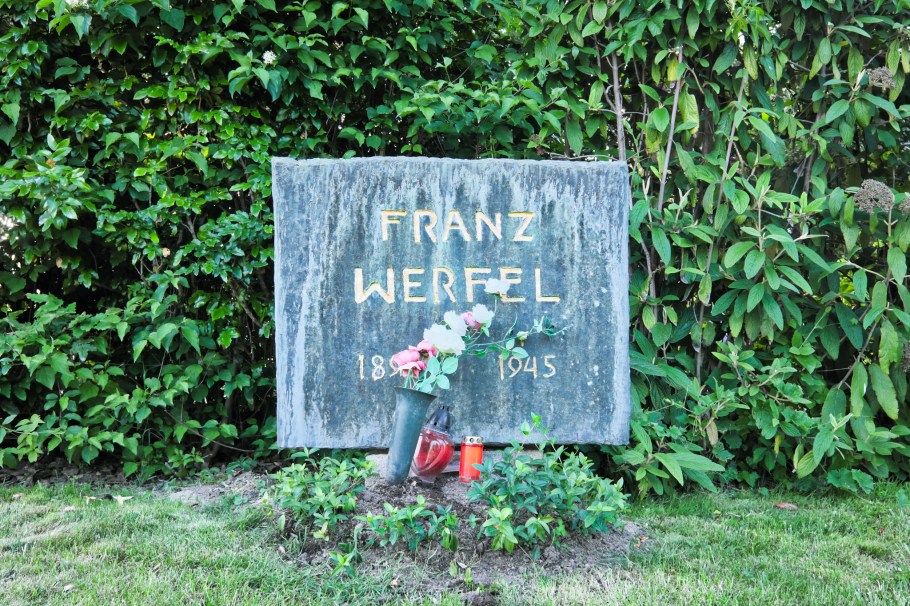
Franz Werfel reburied here in 1975, 30 years after initial burial in Los Angeles. Photo, 25 May 2023.
Familie Wiener von Welten
• Merchant wholesaler and banker Eduard Wiener (von Welten) b/✵ 8 Jul 1822 – d/✟ 14 Oct 1886; son Alfred b/✵ 4 Feb 1854 – d/✟ 13 Jun 1886.
• Palace building at Schwarzenbergplatz 2 named after family, and home to city’s smallest vineyard.
• Mausoleum for Familie Wiener von Welten: group 6, row 29, number 43 (Old Jewish section).
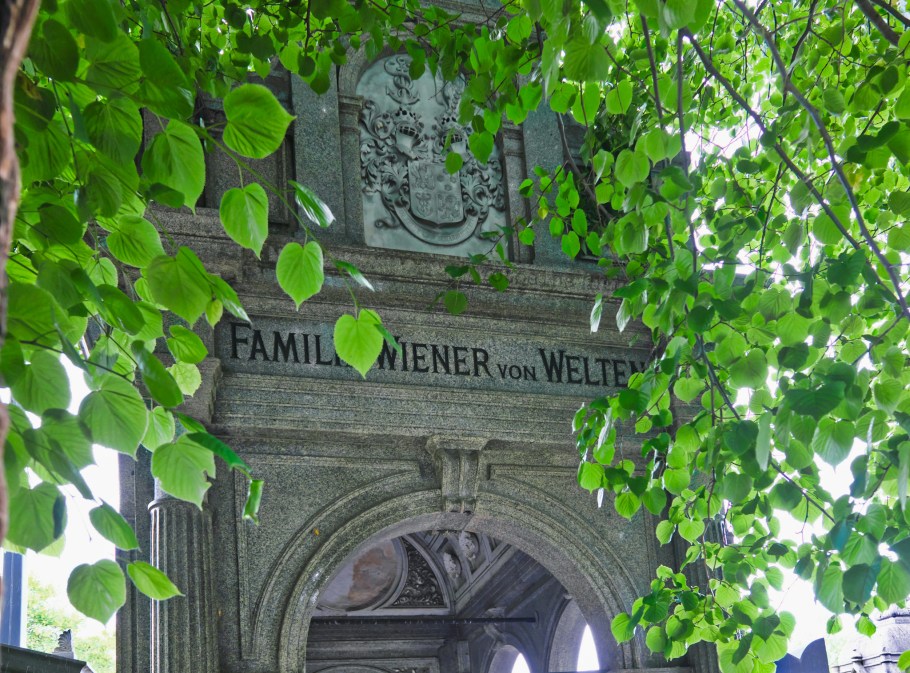
Mausoleum, Familie Wiener von Welten. Photo, 28 May 2022.
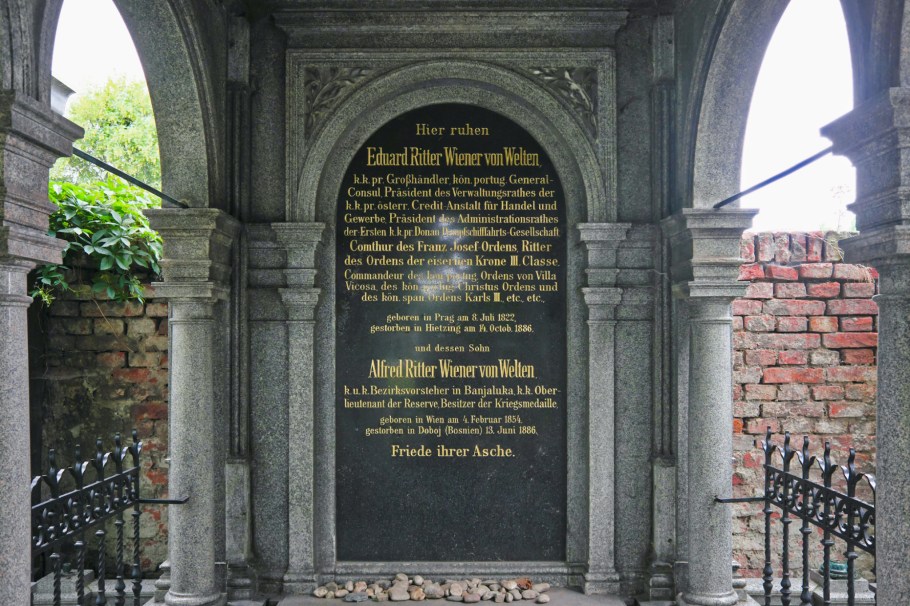
Eduard Wiener (father), Alfred Wiener (son). Photo, 28 May 2022.
Hugo Wolf
Friedrich “Fritz” Wotruba
• b/✵ 23 Apr 1907 – d/✟ 28 Aug 1975.
• Sculptor; blocky column over grave as reminder of his design of the Wotruba Church in the city’s 23rd district.
• Wotruba designs at the graves of Josef Hoffmann and Arnold Schönberg.
• Prof. Friedrich Wotruba grave: group 32C, number 32.
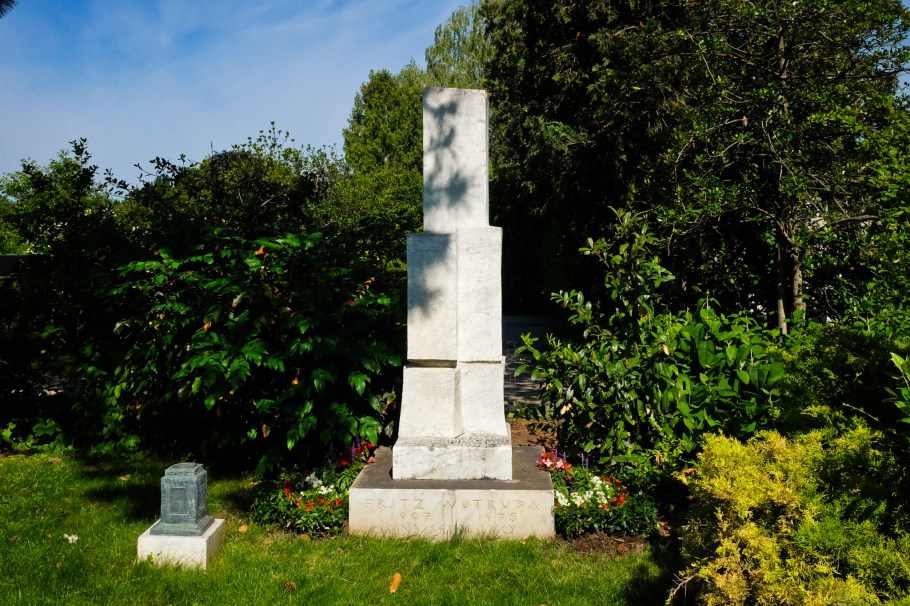
Fritz Wotruba. Photo, 20 May 2018.
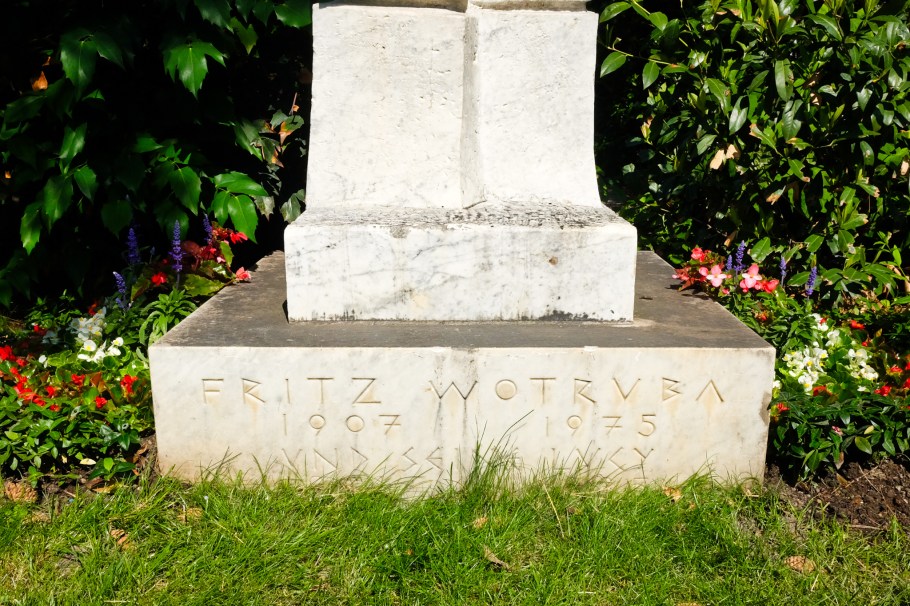
Grave, Fritz and Lucy Wotruba. Photo, 20 May 2018.
Josef “Joe” Zawinul
• b/✵ 7 Jul 1932 – d/✟ 11 Sep 2007.
• Best-known jazz musician from Austria; keyboardist, composer, co-founded 1970s American jazz-rock fusion group Weather Report.
• Grave for Joe & Maxine Zawinul: group 33G, number 39.
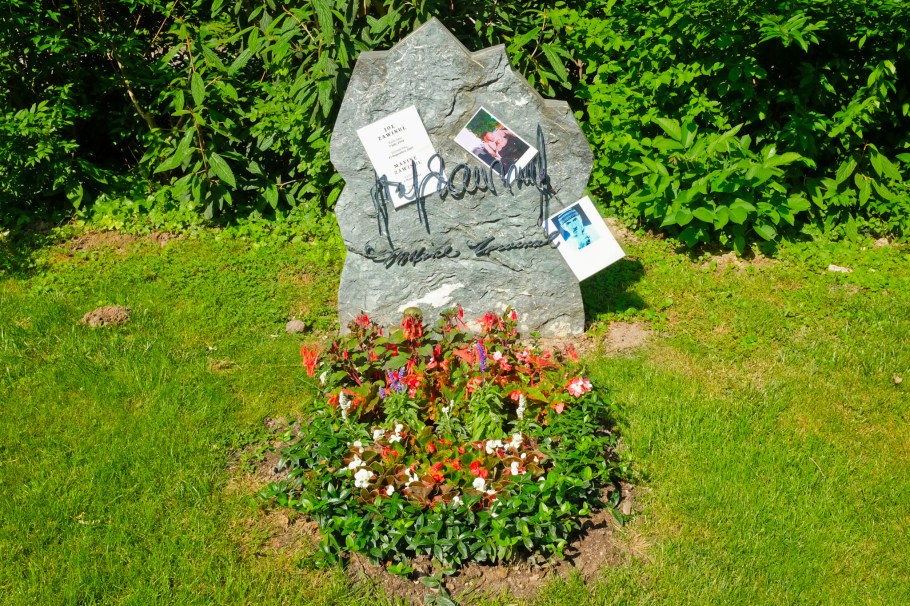
Joe & Maxine Zawinul. Photo, 20 May 2018.
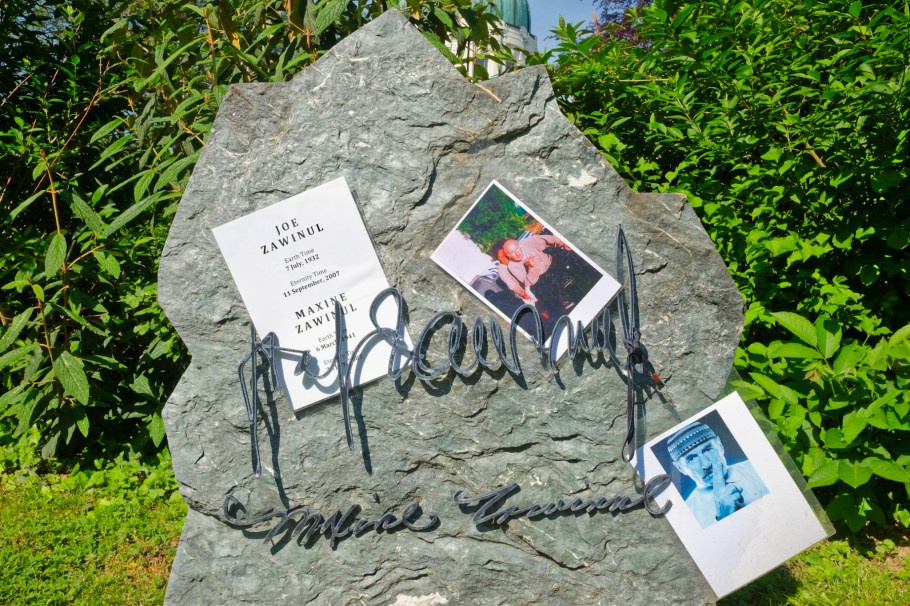
“From earth time to eternity time”. Photo, 20 May 2018.
Familie Zsigmondy
• Grave for the Zsigmondy family.
• Missing in the list of names is Richard Zsigmondy (1865–1929): born in Vienna; doctorate in chemistry from University of Erlangen in 1889; Professor and Director, Institute for organic chemistry at the University of Göttingen from 1909 to 1929; won the 1925 Nobel Prize in Chemistry. Richard and his wife, Laura, are buried in Göttingen.
• Grave for Zsigmondy family: group G (Gruft bei der Mauer), number 101 (Protestant/evangelical section).
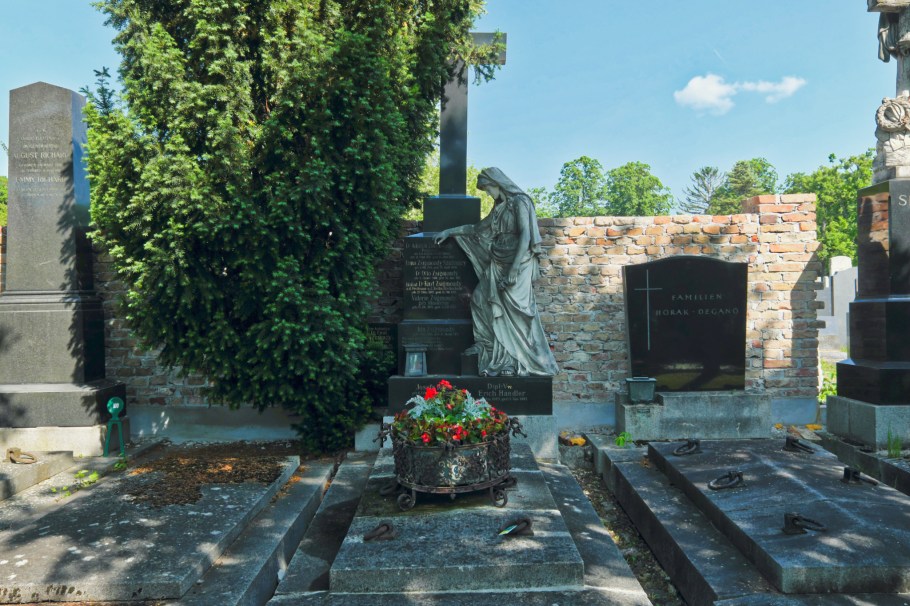
Familie Zsigmondy – 25 May 2023.
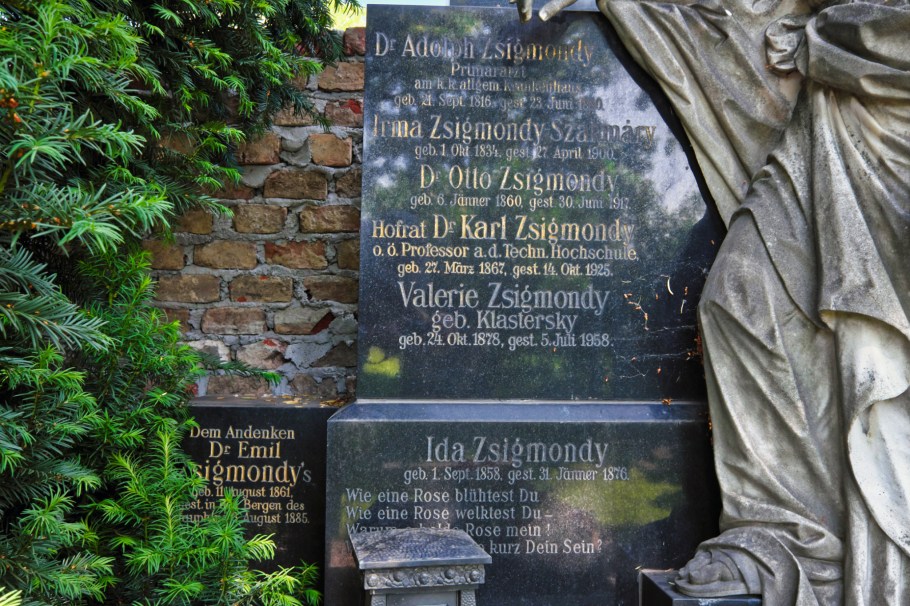
Familie Zsigmondy – 25 May 2023.
Kaspar Zumbusch
• b/✵ 23 Nov 1830 – d/✟ 27 Sep 1915.
• German artist and sculptor; e.g., Beethoven memorial at Beethovenplatz, Maria Teresa memorial at Maria-Theresien-Platz, Albrecht memorial, Radetzky memorial.
• Prof. Kaspar Ritter von Zumbusch grave: group 32A, number 39.
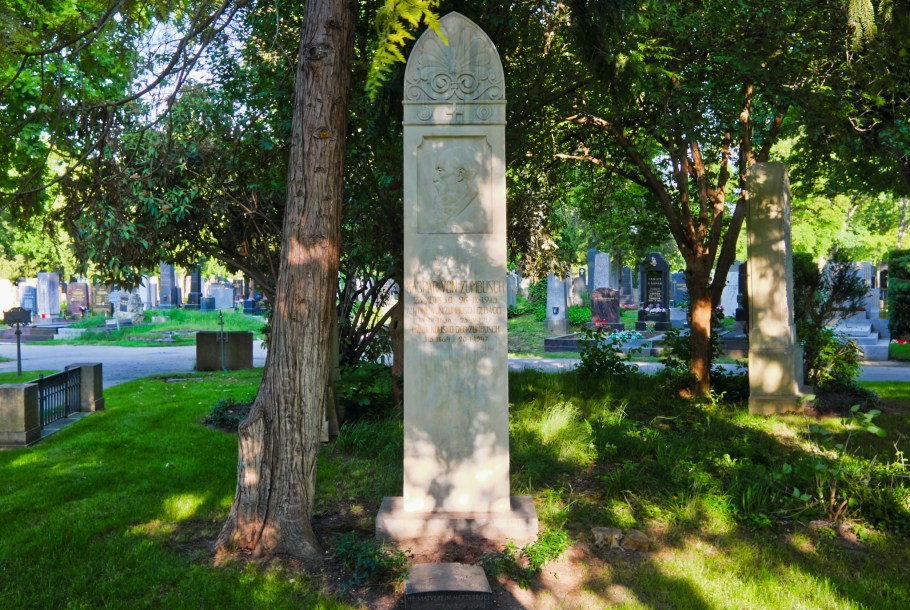
Caspar (Kaspar) Zumbusch. Photo, 25 May 2023.
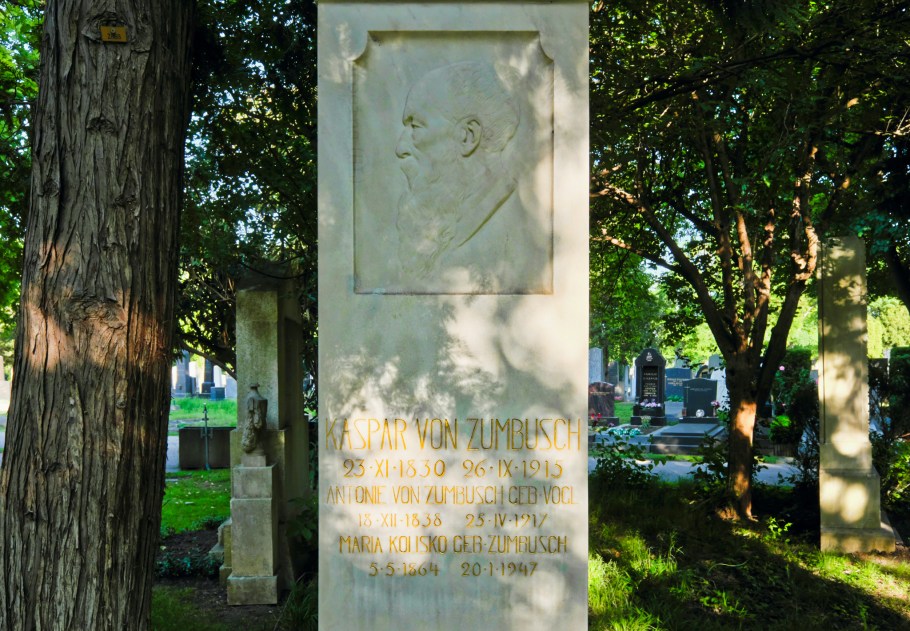
Photo, 25 May 2023.
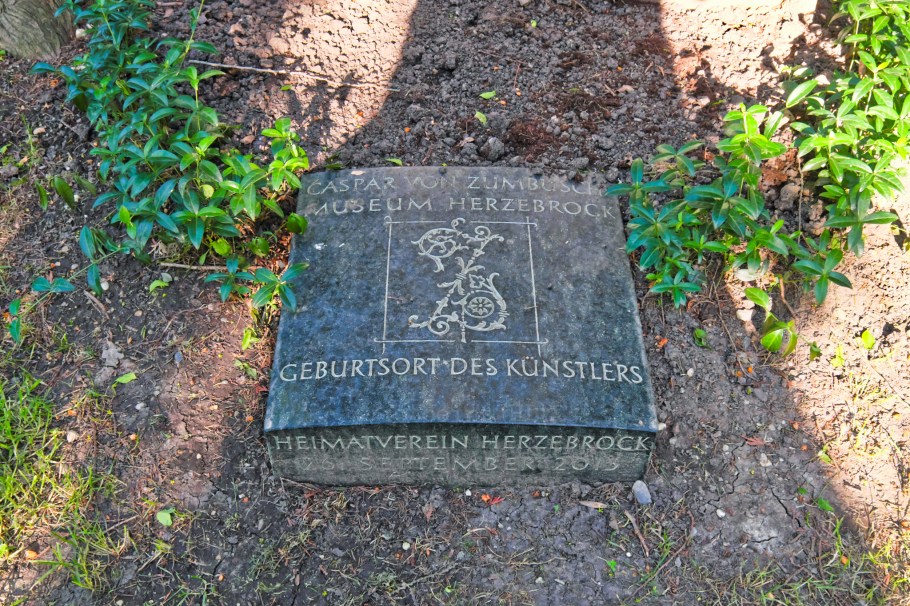
Caspar/Kaspar Zumbusch memorial stone at the base of the headstone, on the 100th anniversary of his death (26 Sept 2015), from the town museum in Herzebrock where he was born. Photo, 25 May 2023.
Moritz & Ida Zweig
• Moritz b/✵ 28 Dec 1845 – d/✟ 2 Mar 1926; Ida d/✟ 23 Aug 1938 (85 years old).
• Parents of Stefan Zweig who is buried in Brazil.
• Grave for Moritz & Ida Zweig: group 6, row 1, number 11 (Old Jewish section).
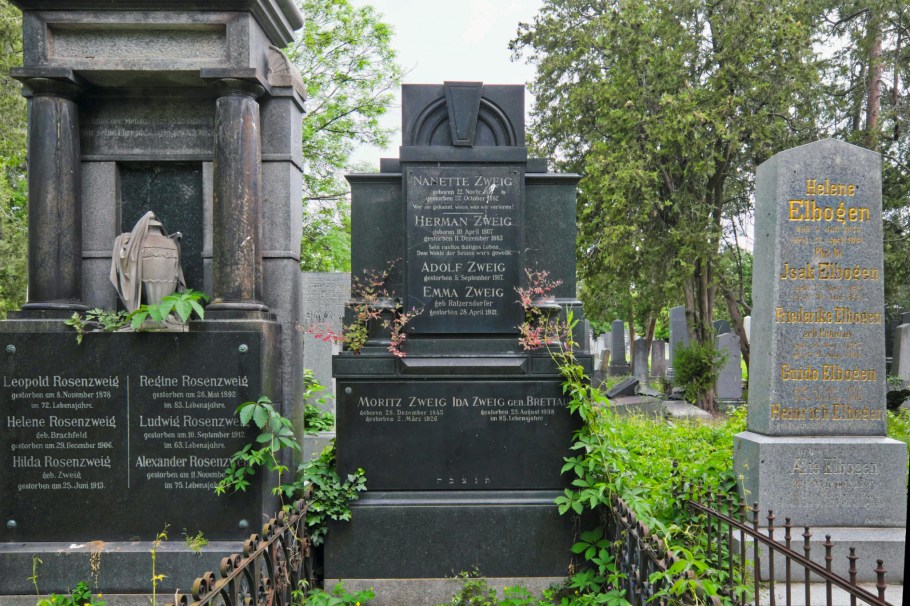
Familie Zweig. Photo, 28 May 2022.
Memorial to Armenian victims in 1915
• Zum Andenken an die Opfer des Armenischen Volkes im Jahre 1915.
• Location at group 12A, row 14, “number 0” (corner).
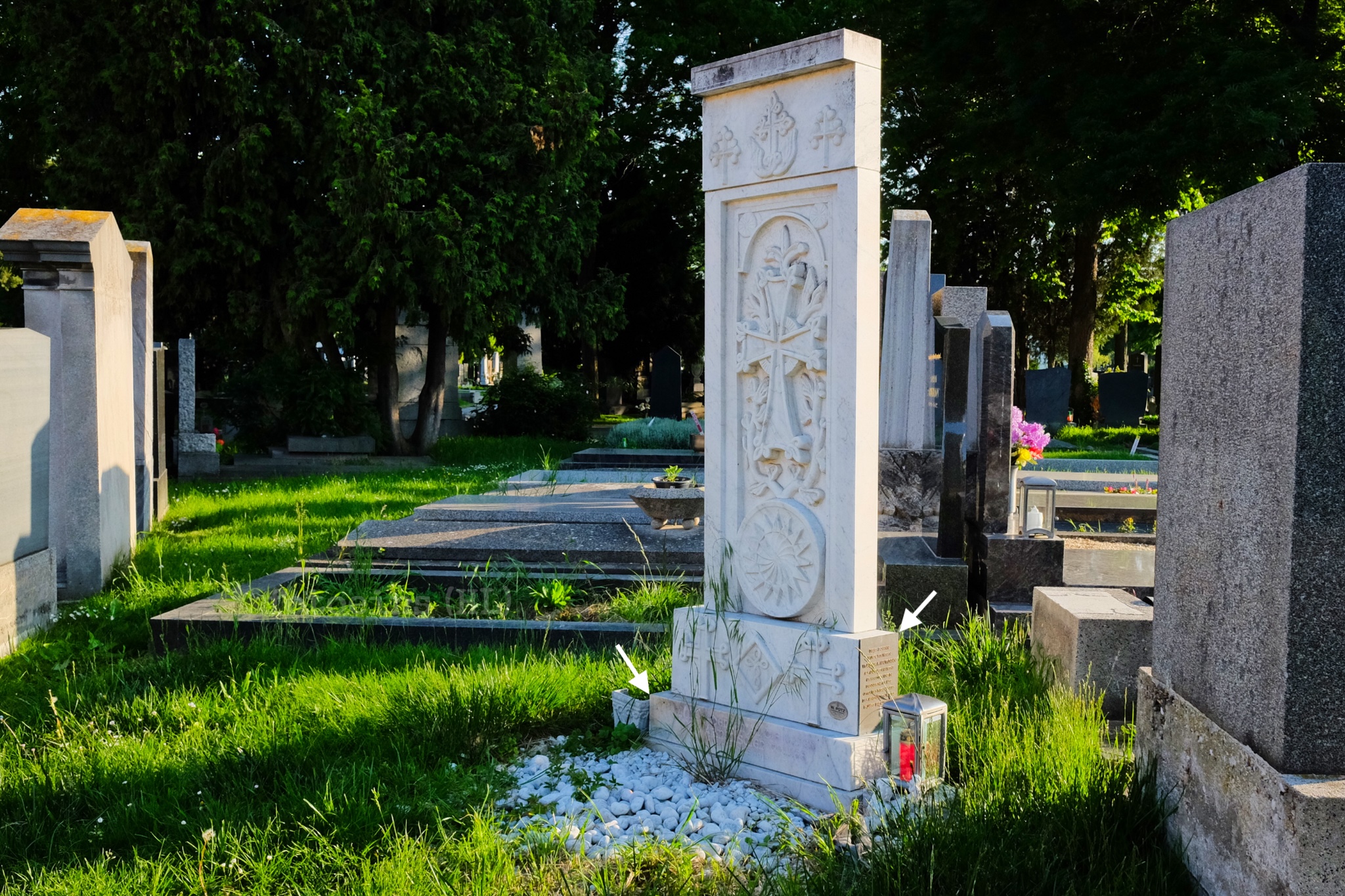
Memorial to Armenian victims in 1915. The next two images are closeups of the areas indicated by arrows. Photo, 25 May 2023.
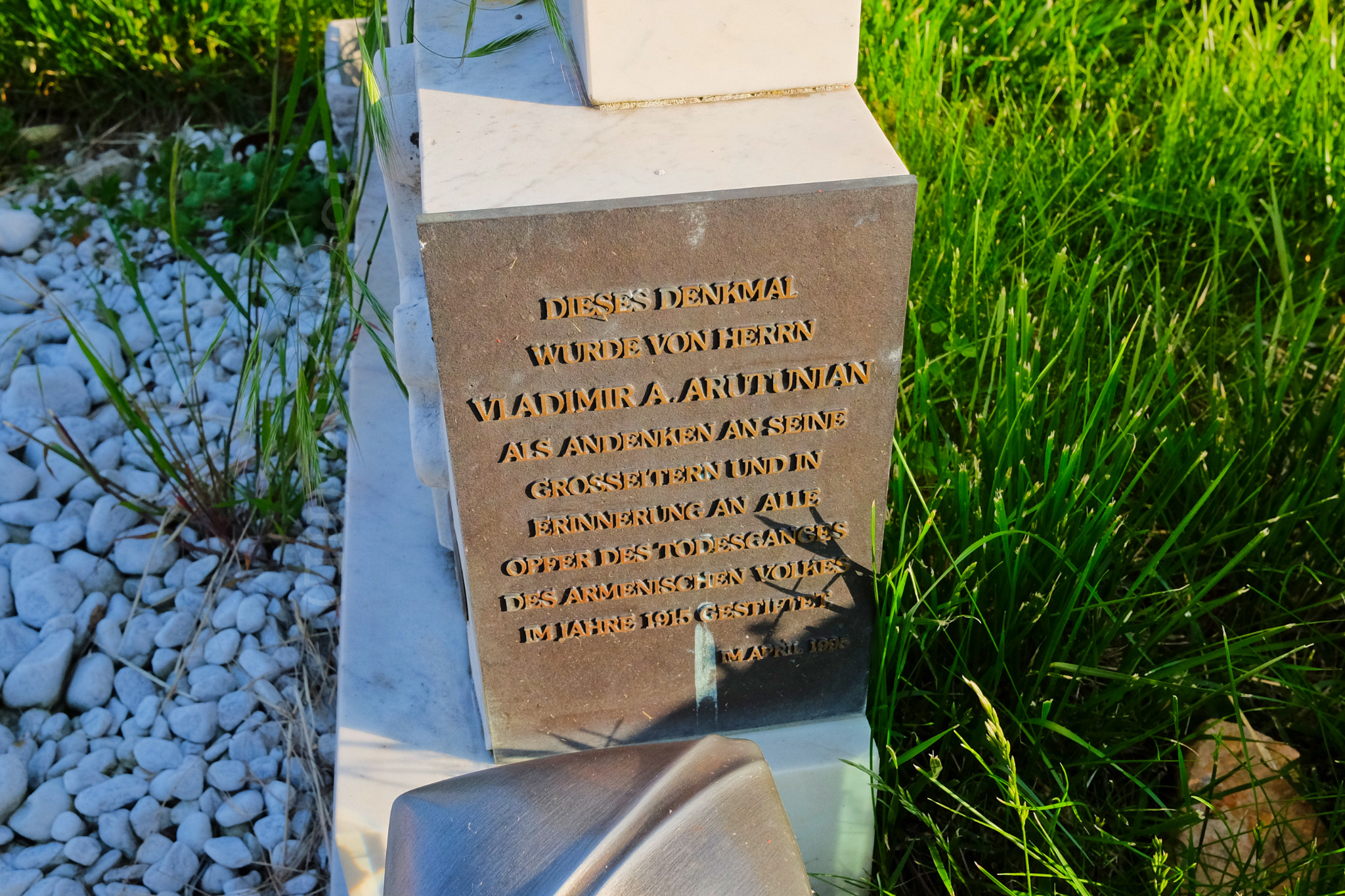
“Dieses Denkmal wurde von Herrn Vladimir A. Arutunian als Andenken an seine Großeltern und in Erinnerung an alle Opfer des Todesganges des armenischen Volkes im Jahre 1915 gestiftet. Im April 1995.” // April 1995: Mr. Vladimir A. Arutunian established this memorial in memory of his grandparents and in remembrance of all Armenians who perished in the 1915 death marches. Photo, 25 May 2023.
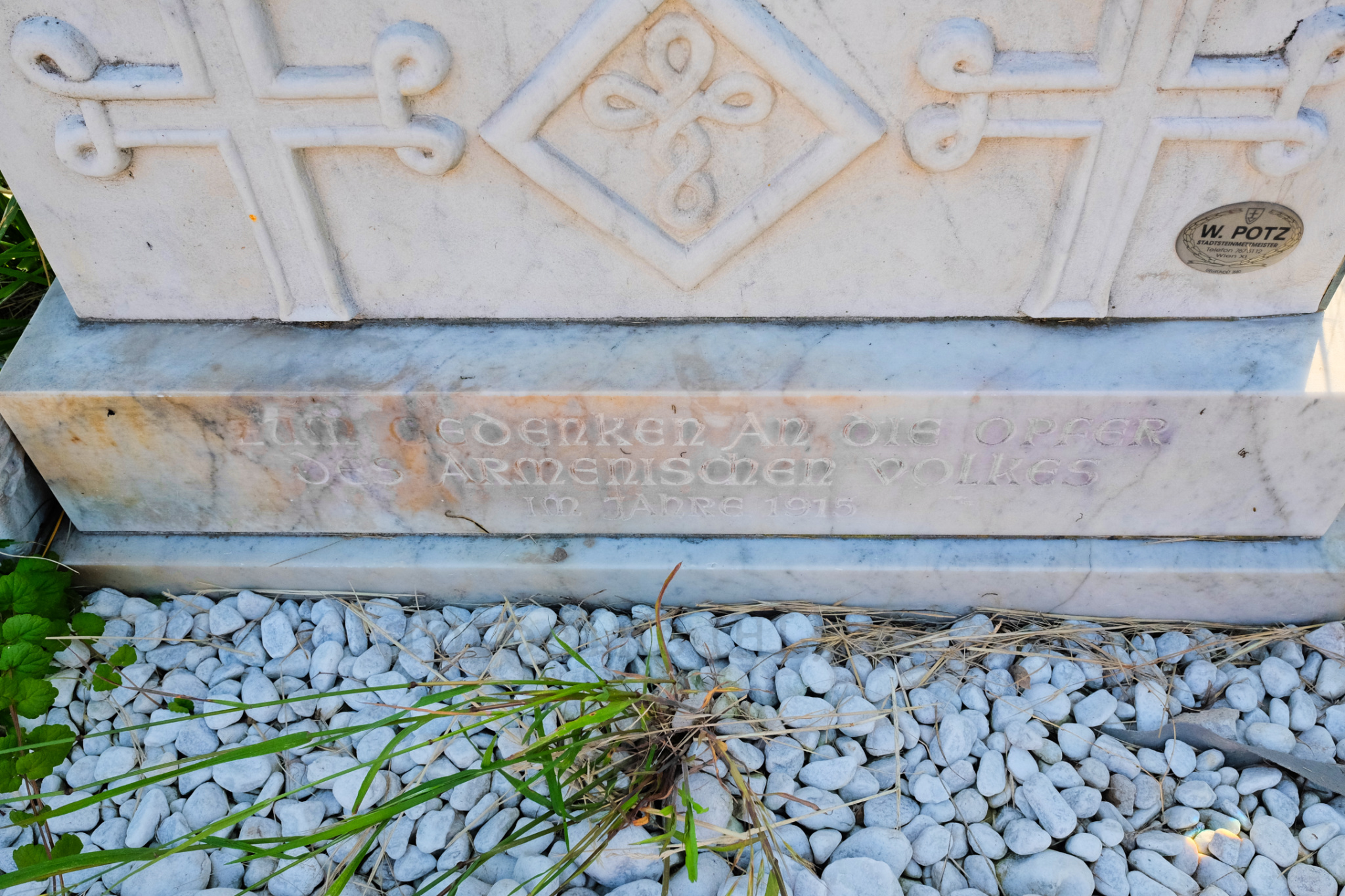
“Zum Andenken an die Opfer des Armenischen Volkes im Jahre 1915.” Photo, 25 May 2023.
Memorial to victims for a free Austria 1934–1945
• Den Opfern für ein freies Österreich 1934–1935.
• Memorial structure dedicated to the victims of the struggle for a free Austria, 1934–1945.
• Designed by sculptor Fritz Cremer, and architects Wilhelm Schütte and Margarete Schütte-Lihotzky.
• Inaugurated 1 Nov 1948; location at group 41H.
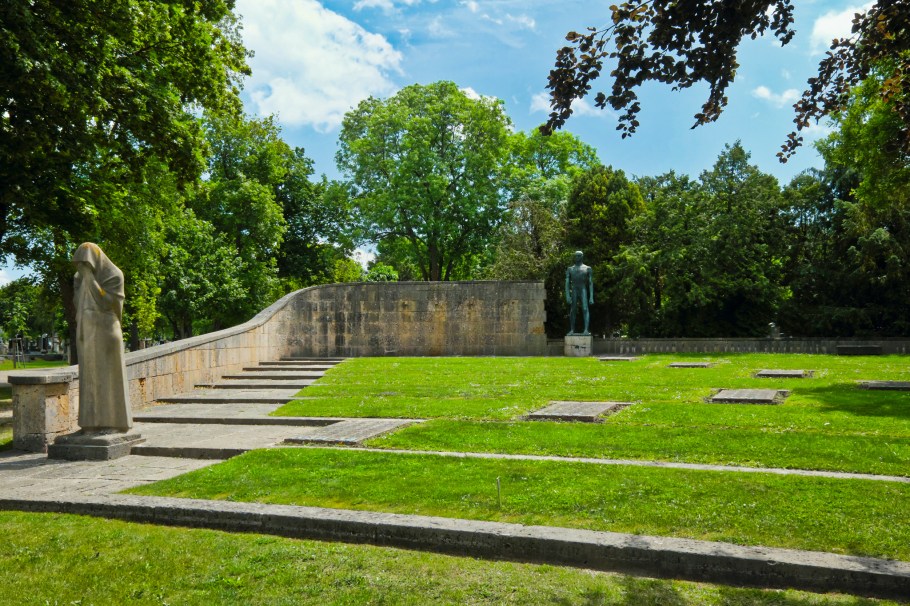
The “front” of the memorial. Photo, 28 May 2022.
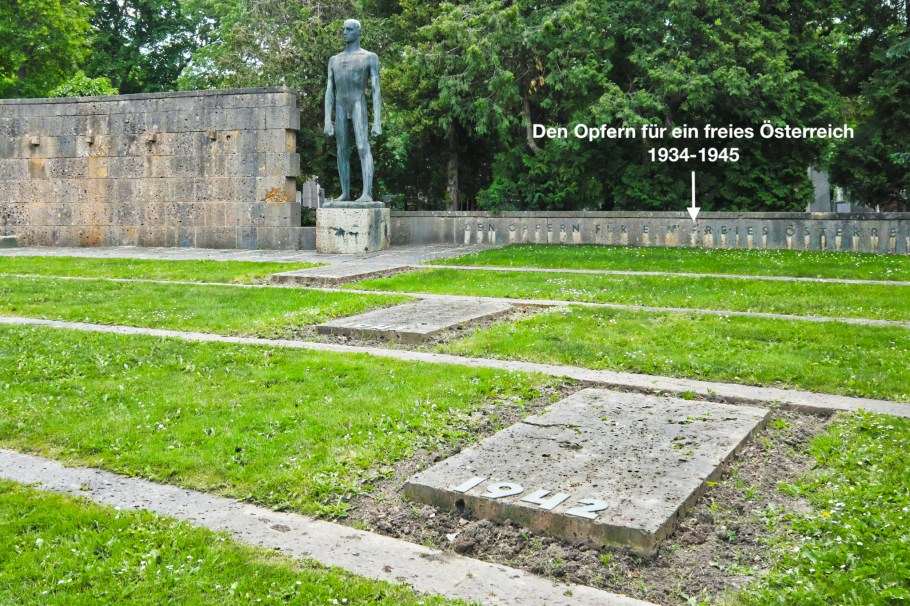
One block for each year. Photo, 28 May 2022.
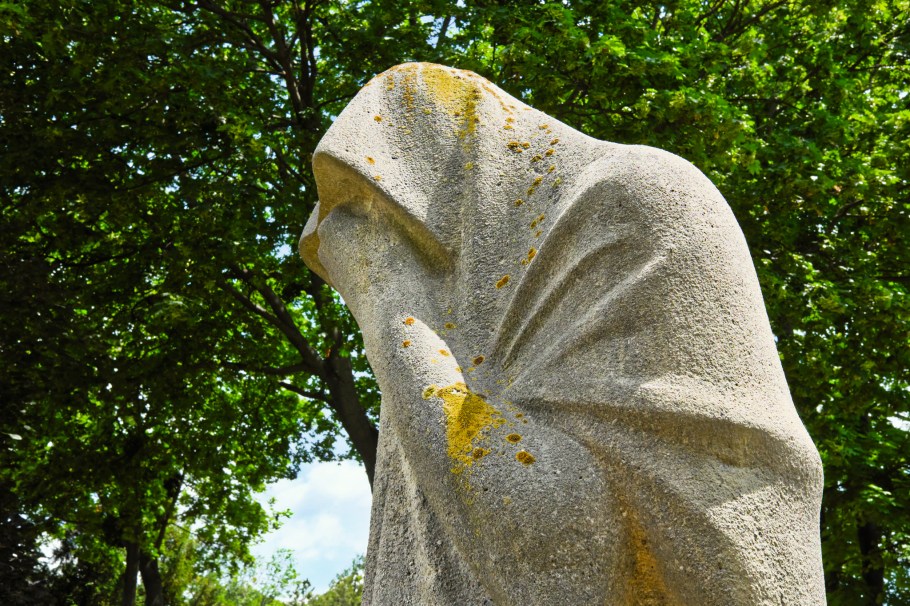
“Keine Worte mehr.” Foto, 28. May 2022.
Soviet Red Army WW2 soldiers
• Sowjetische Kriegstote, 2. Weltkrieg.
• Over 2400 Soviet Red Army soldiers are laid to rest in an area behind the Borromäus church.
• Inaugurated in 1946, location group 44A.
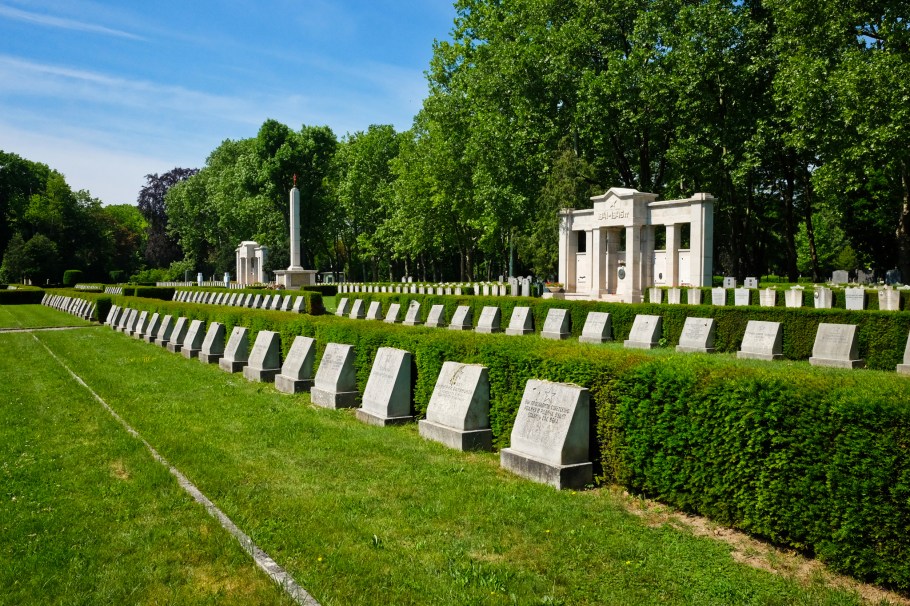
Multiple rows – 20 May 2018.
Fauna
European hamster
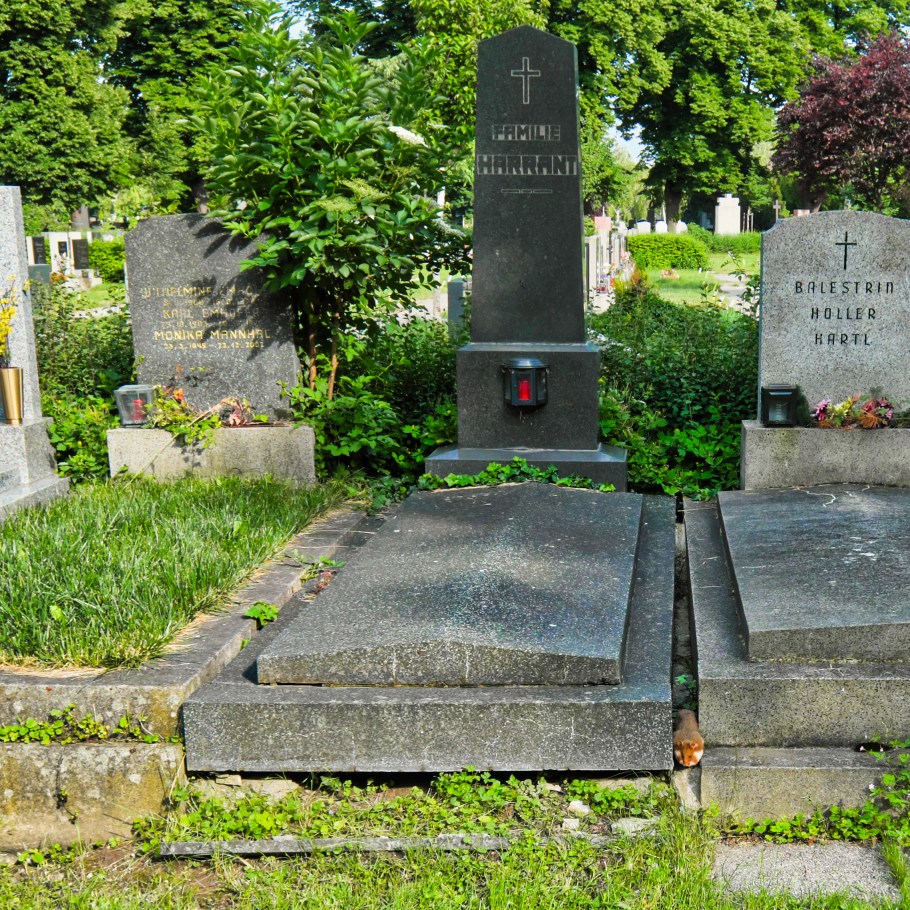
European hamster, Alter Jüdischer Friedhof. Photo, 9 Jun 2023.
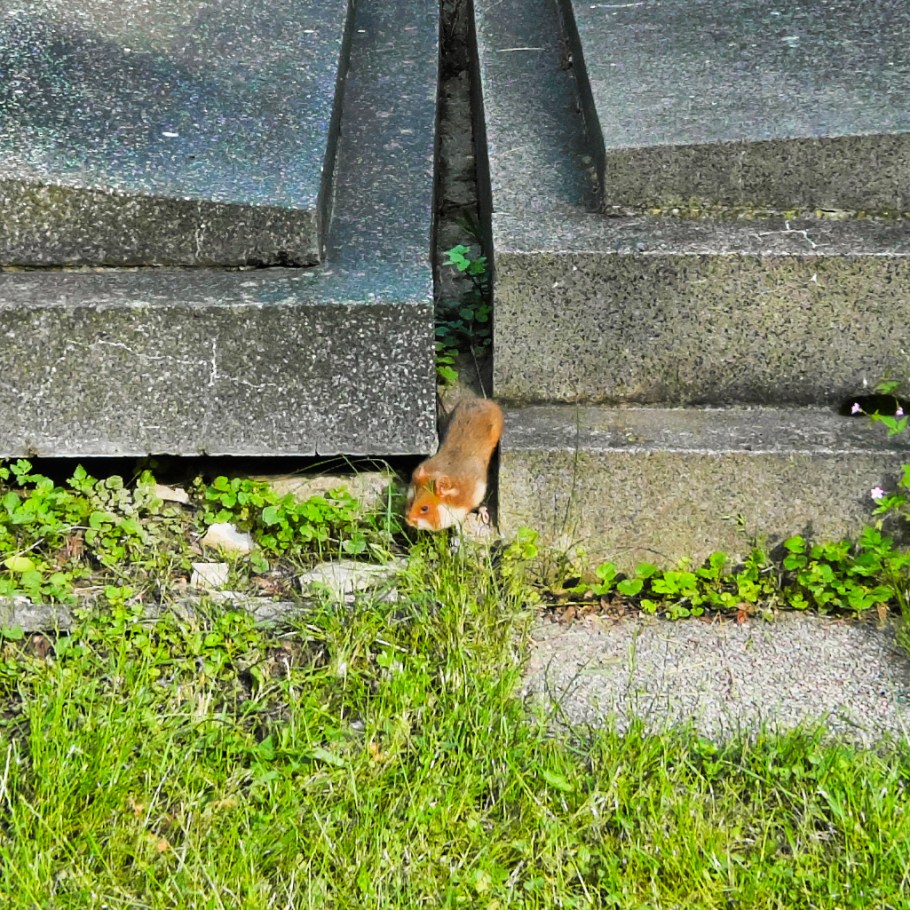
Big crop, tiny feet. Photo, 9 Jun 2023.
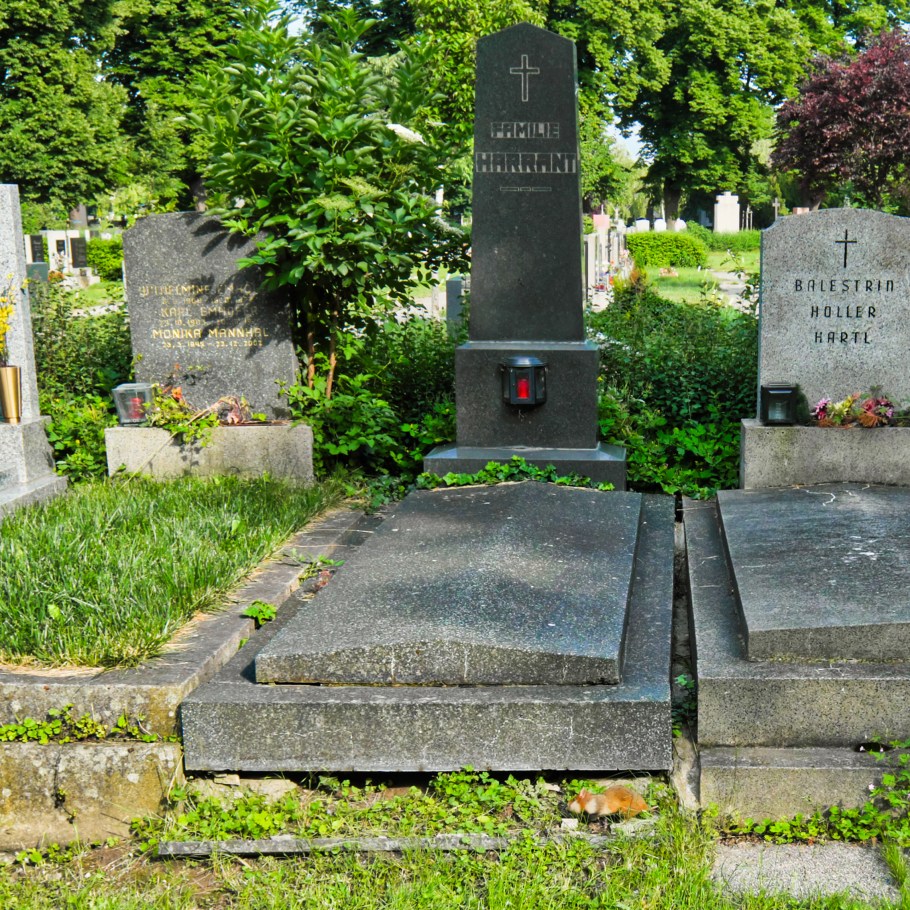
European hamster shuttling between food-gathering and their home under the gravestone. Photo, 9 Jun 2023.
• “Hamster Hunting in Vienna“, by Vol Explosion.
• Video snippet from BBC Earth.
Red squirrel
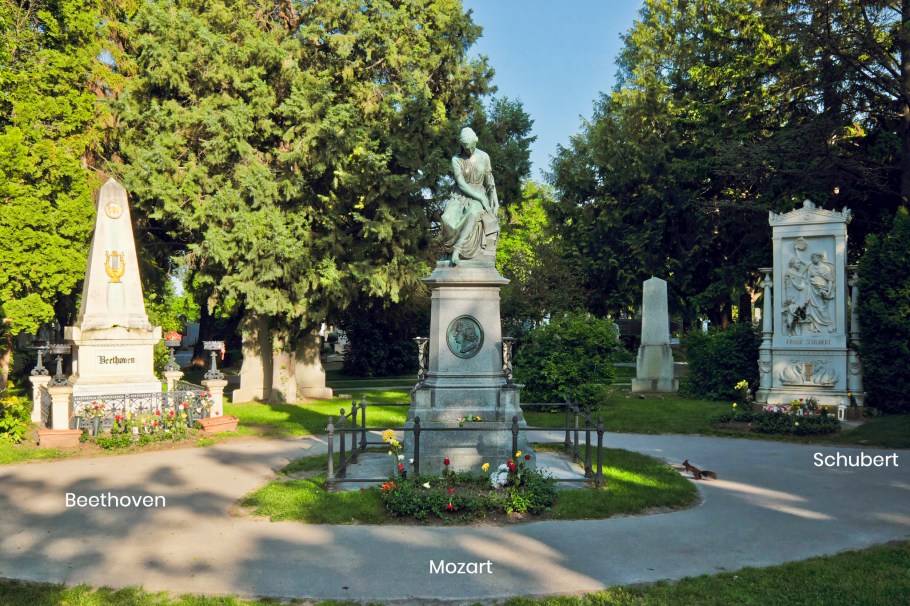
Group 32A: Beethoven grave, Mozart memorial, a fuzzy red squirrel, and Schubert grave. Photo, 25 May 2023.
Roe deer
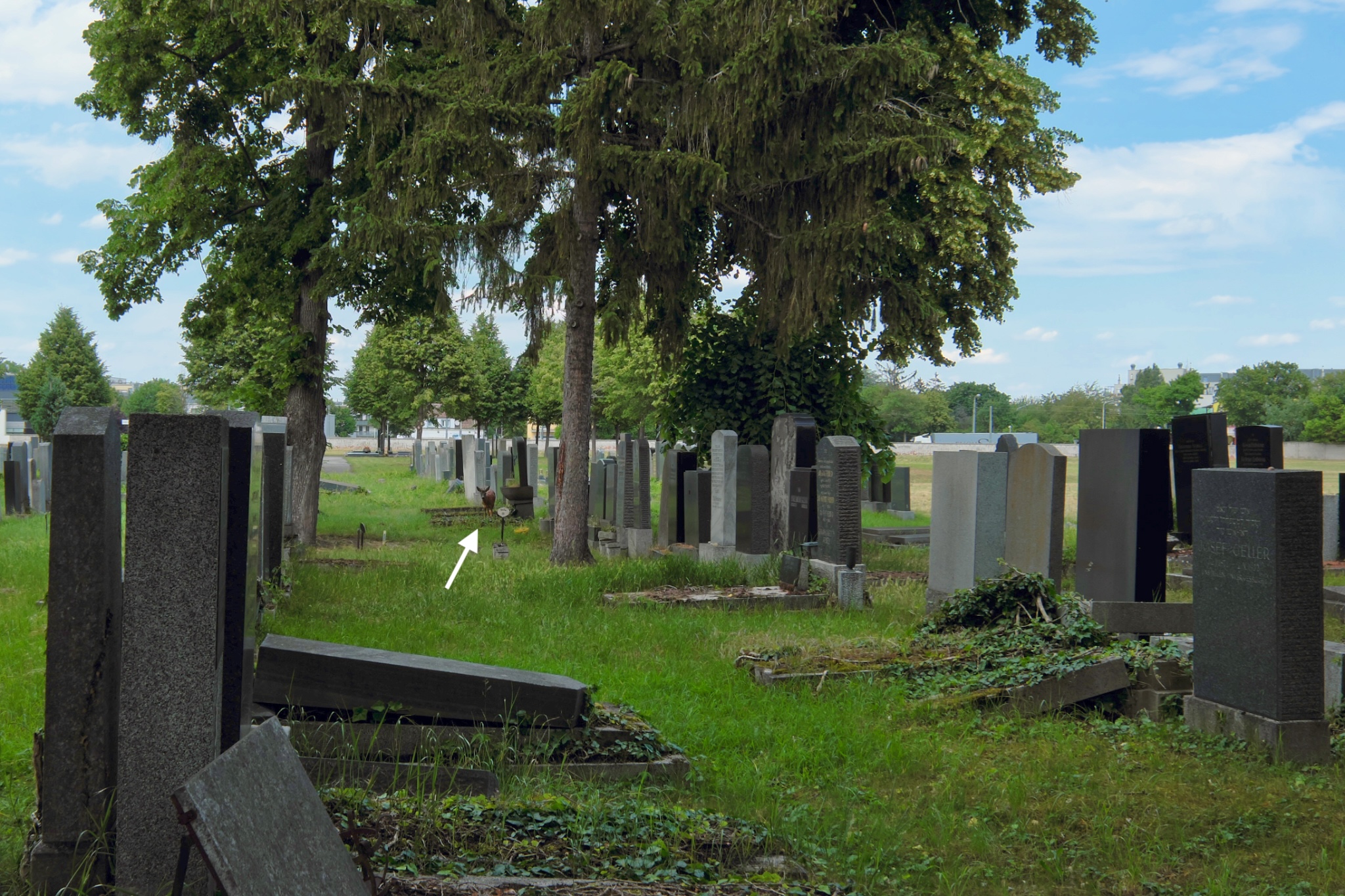
Roe deer, naturally skittish and skeptisch. Photo, 2 Jun 2022.
Transport
Public transport with Wiener Linien: U-Bahn U3 train to end station at Simmering, then tram 11 or 71 to:
• stop “Zentralfriedhof, 1. Tor” for the old Jewish cemetery;
• stop “Zentralfriedhof, 2. Tor” for the central cemetery’s main entrance;
• stop “Zentralfriedhof, 3. Tor” for the Protestant (evangelical) cemetery; or
• stop “Zentralfriedhof, 4. Tor” for the new Jewish cemetery.
Alternatively, there’s also public transport with S-Bahn Wien: S7 train to station “Wien Zentralfriedhof”, followed by entry into the cemetery through gate 11 (11. Tor).
( View cemetery location on OpenStreetMap )
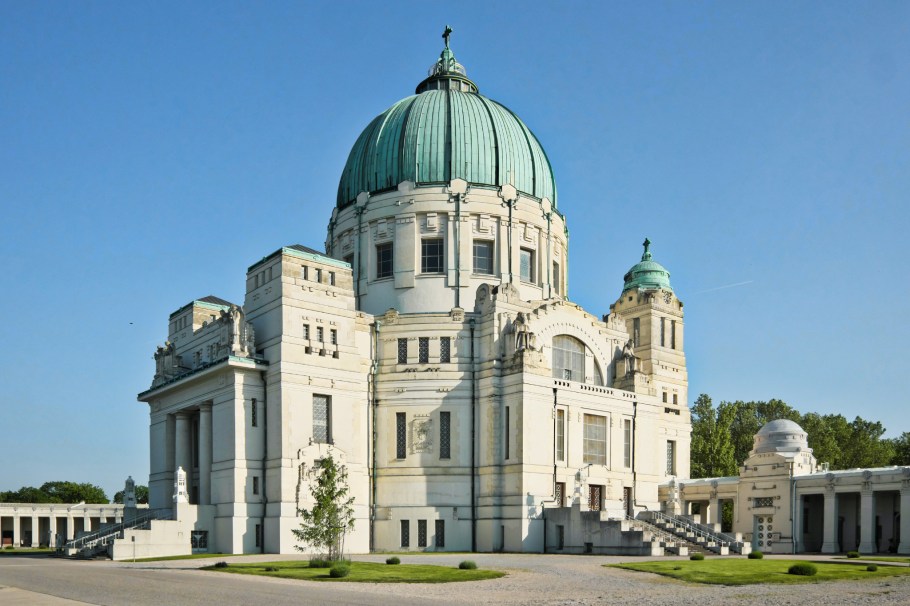
Borromäuskirche (Friedhofskirche), by architect Max Hegele. Photo, 25 May 2023.
• An important online resource is Hedwig Abraham’s website “Kunst und Kultur in Wien” with description of the city’s cemeteries.
• “Erbe Österreich: Der Wiener Zentralfriedhof” – Austria ORF documentary, 21 Nov 2017 (YouTube).
• Dark Tourism, by Peter Hohenhaus.
I made all pictures above with a Fujifilm X70 fixed-lens prime im the summers of 2018, 2022, 2023, 2024, and 2025. Alle Fotoaufnahmen sind von Wasserzeichen versehen worden. This post appears on Fotoeins Fotografie at fotoeins DOT com as https://wp.me/p1BIdT-bWJ. Last edit: 5 Feb 2026.
 Fotoeins Fotografie
23 Responses to “Vienna Central Cemetery: living city of the dead”
So many well known souls are resting in this cemetery, people of a master mind, I would call it. I do hope they will never been forgotten, especially from the younger generations, because they set milestones of amazing work. Thank you for posting this. By the way I love to go cemeteries , I spent an entire week in Paris on cemeteries to photography grave stones, many years ago.
LikeLiked by 1 person
After doing a little bit of research, what I found interesting was the variety of people: artists, scientists, engineers, etc. This should not be a surprise, because Zentralfriedhof is the big cemetery in the city which receives burials of people from all walks of life. I definitely see Parisian cemeteries as an interesting photography project. Thanks for your comment, Cornelia!
LikeLike
Indeed, in this cemetery so many people of the World War got to rest in there.
LikeLiked by 1 person
Whoa that’s a lot notable names in there. I didn’t know that Beethoven died in Vienna. Interesting post 🙂
LikeLiked by 1 person
Vienna has seen a lot of history, and thankfully, the two world wars didn’t completely destroy the various cemeteries around the city. Though born in Germany’s Bonn, Beethoven lived most of his life in Vienna; that means there are a lot of places around town where he lived and spent time. Thanks, Amor, for stopping by and for your comment!
LikeLiked by 1 person
[…] In Vienna’s Mariahilf neighbourhood resides Austria’s “most beautiful steps“, the Fillgraderstiege. The steps were designed in the Art Nouveau style by Maximilian Hegele and were built with stone and cast-iron over a two-year span by 1907 to connect two streets Fillgradergasse and Theobaldgasse. A student of Otto Wagner, Hegele also redesigned the city’s central cemetery as well as the cemetery’s main entrance at gate 2. […]
LikeLike
[…] AT Zentralfriedhof G 14C / R – / N […]
LikeLike
[…] Stefan and Boltzmann are buried in Vienna’s Central Cemetery. Boltzmann’s gravestone includes his entropy equation. Stefan does not have his own grave; instead, his descendants in the […]
LikeLike
[…] Once a student with Otto Wagner, Hegele went on to remodel gates 2 and 3 at the city’s Zentralfriedhof (central cemetery) in 1910 and designed the cemetery’s main church in […]
LikeLike
[…] Minona von Stackelberg memorial, at former Bánffy grave (48A/G1/2) in Vienna central cemetery. […]
LikeLike
[…] the centre of the Vienna’s central cemetery is the 1911 church designed by architect Max Hegele in the Jugendstil architectural style and named […]
LikeLike
[…] Schütte-Lihotzky died on 18 January 2000, just five days before her 103rd birthday. She is buried at Vienna’s main cemetery Zentralfriedhof; her grave location is group 33G number 28. […]
LikeLike
[…] Marx taking place in 1874. Subsequent funerary functions were transferred to the newly constructed Zentralfriedhof located farther out from the city centre. The very leafy avenues and “leafy gate” are what’s […]
LikeLiked by 1 person
[…] Loschmidt, 1821–1895, Größe der Moleküle Josef Stefan, 1835–1893, Strahlungsgesetz Ludwig Boltzmann, 1844–1906, Entropie und […]
LikeLike
[…] mezzo-soprano in imperial court, 1st wife of Johann II. • Buried at Zentralfriedhof: Johann Strauss II (Sohn), mother Anna, father Johann I […]
LikeLike
[…] Stadttempel in the city centre. He is buried in the Old Jewish Cemetery section of Vienna’s central cemetery. • Lichtzeichen no. 1: Tempelgasse 3. • Public transport: U-Bahn U1, to […]
LikeLike
[…] Frank, Eduard van der Nüll, Friedrich Ohmann, August Sicard von Sicardsburg, Camillo Sitte, Josef Strauss, Richard […]
LikeLike
[…] Loschmidt, 1821–1895, Größe der Moleküle Josef Stefan, 1835–1893, Strahlungsgesetz Ludwig Boltzmann, 1844–1906, Entropie und […]
LikeLike
[…] at least six times, including today. That explains how I’ve sought, found, and photographed 60-plus graves of some (very) notable people. Does a new visit add a few more to the list, or discovering new names to find in the cemetery come […]
LikeLike
[…] in the city’s central cemetery are various members of the Strauss family […]
LikeLike
[…] one corner of group 32A in the city’s central cemetery is this “portrait” view of 5 members of the Strauss family. The two daughters Anna and Theresia […]
LikeLike
[…] one corner of group 32A in the city’s central cemetery is this “portrait” view of 5 members of the Strauss family. The two daughters Anna and Theresia […]
LikeLike
[…] 22 Apr 1935. • Composer & author; born Alma Schindler, daughter of painter Emil Schindler. • Alma’s 1st husband Gustav Mahler; see above. • Manon’s birth […]
LikeLike