Fotoeins Fotografie

location bifurcation, place vs. home

Posts tagged ‘World Heritage’

25T75 Vienna’s Blutgassenviertel (Blood Alley Quarter)

E74, V22.

It sounds macabre at the outset, and admittedly, the legend of the 1862 naming for the alley points to the mass elimination of medieval Templar Knights in 1312.

But those apparently nondescript entryways, if open, reveal much more: to residential blocks, several Pawlatschen (“stacked open balconies”), and a big quiet inner courtyard with a tree that’s apparently more than 250 years old. While the foundations of this complex go back to the 12th- to 13th-century, post-war restorations and preservation efforts retained the historical character of the buildings in Vienna’s oldest residential area.

Perhaps, the only thing “bleeding” is the source of funds required to maintain the appearance and everyday working nature of the apartments within.


Entry into Singerstrasse 11, 11a, 11b, 11c.
The “seam” and open courtyard separating the blocks at left (Blutgasse 5, 7, 9) and the blocks at right (Singerstrasse 11a,b,c). The big plane tree at centre is apparently at least 250 years old.
From the tree, up into the sky.
Facing Blutgasse 9 at centre, the general description seems apt: stacked *and* squeezed.
Blutgasse 9.
The apartments in Blutgasse 9.
Blutgasse 3: typical of Viennese “Pawlatschen” style of stacked open balconies. This individual structure is a Pawlatschenhof, a courtyard with stacked balconies.

I made all images above with an iPhone15 on 21 July 2025. This post composed within Jetpack for iOS appears on Fotoeins Fotografie at fotoeins DOT com.

25T55 My slice through Vienna’s inner city

E54, V02.

There’s no finer way to mark today’s Canada Day than to find the Canadian Embassy 🇨🇦 in the Austrian capital city. It’s all part of my walk through the Inner City, starting at U1/U4 Schwedenplatz and ending near U2/U3 Volkstheater.

Vienna’s historic city centre was inscribed onto the list of UNESCO World Heritage Sites in 2001, but its status was put onto the Danger list in 2017 with plans (threats?) for development.


It’s 501am and 801am in Vancouver and Toronto, respectively. But here in Vienna, I completed food shopping for the next few days. I’m about to have lunch, after which is some time in the inner city. “3” (Drei) is Austria’s third largest mobile carrier after A1 and Magenta Telekom. Naturally, all temperatures are in degrees Celsius.
While the building has multiple tenants, the uppermost floor is occupied by the Government of Canada with its embassy (Botschaft).
The flag pole is attached to the wall with a metal plate in the shape of a maple leaf.
Summertime shop for Eis Greissler (Greissler’s Ice Cream).
Their flavours for the day 🍨 😋
At Stephansplatz, the northwest corner of St. Stephen’s Cathedral (near the cathedral model) has on its wall a small rectangular plaque whose text inscription is almost entirely faded.
This plaque dates to 1945 when Soviet troops had moved into the city and checked building by building. The two words in Cyrillic are: квартал проверен (kvartal proveren), “Häuserblock geprüft”, building checked. There are at least 2 more Soviet inscription-plates like this appearing elsewhere in Vienna.
Steiff: it’s not only about teddy bears 🧸 so how about Riddler bear, Bat-bear, and Elton John bear. At lower-left is a more modest-sized bear holding a little red heart 🫶🏽
מוּזֵיאוֹן
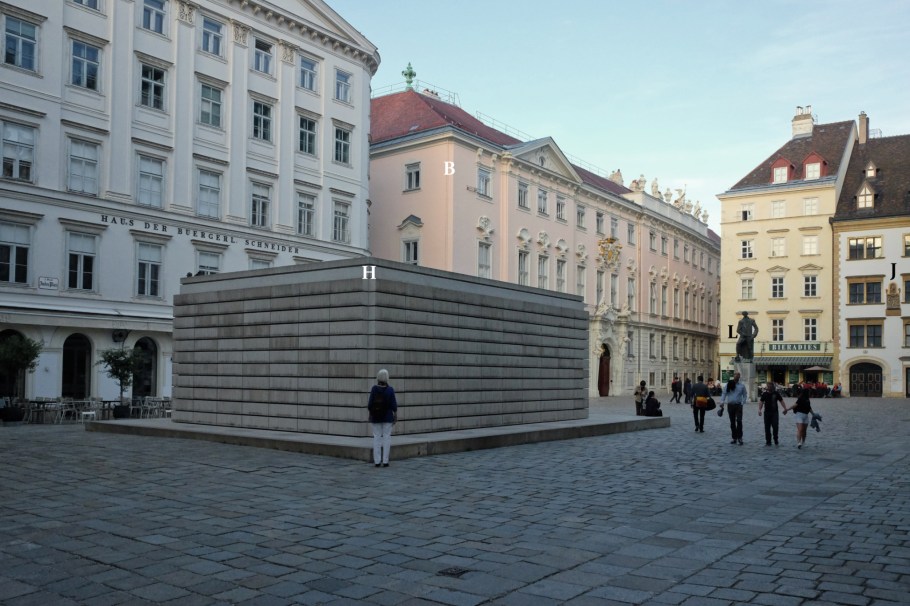
“Museum“, 2011 light installation by artist Brigitte Kowanz for the Jewish Museum Vienna.
Bräunerstrasse, west towards Josefsplatz.
“Henry: the art of living”, at Billa Corso Michaelerplatz.
Hofburg Palace, from Michaelerplatz.
“Volkspartei, Volksgarten”
“Island” platform for U-Bahn U3 (orange) station Volkstheater. This is also a junction station with the U2 line (purple).

I made all images above with an iPhone15 on 1 July 2025. This post composed within Jetpack for iOS appears on Fotoeins Fotografie at fotoeins DOT com.

25T51 Potsdam: Sanssouci World Heritage Site

E50, B45.

Potsdam’s Sanssouci (“care free”) palace and park are very popular places for visitors in summer. However, a couple of days with severe thunderstorms and high winds in the past week forced the closure of the entire grounds, as announced earlier today on their website and as seen with signs on their locked gates. Downed branches and tree segments needed clearing. By mid-afternoon, some of the grounds opened to foot traffic, bicycles, and motor vehicles. It’s no surprise there were far fewer number of visitors observed on the grounds today.

In 1990, selected gardens and palaces in Potsdam including Sanssouci were inscribed by UNESCO as a single item onto their list of World Heritage Sites.


Locked gate on the grounds’ southern perimeter in morning hours.
Orangerieschloss: 1851 to 1860/1864, by Stüler and Persius.
Neue Kammern: 1748 by Knobelsdorff; first an
orangery, then guest palace.
Hauptallee, facing west to Neues Palais.
From Hauptallee up to Sanssouci palace.
Weinbergterrasse (vineyard terrace), facing north to Sanssouci palace.
Weinbergterrasse (vineyard terrace), facing south to the Great Fountain.
On the terrace steps, up to the palace.
The final spots for Friedrich the Great (below) and his beloved dogs (above center).
Grave for Friedrich the Great (1712-1786) who ruled as Prussia’s monarch from 1740 until his death. Yes, those are spuds on the plaque; legend has him responsible as the first to getting potatoes into German hands and bellies.
The visual jewel that is the centre portion of Sanssouci Palace.

I made all images above with an iPhone15 on 27 June 2025. This post composed within Jetpack for iOS appears on Fotoeins Fotografie at fotoeins DOT com.

25T25 Museum Island: 200 years on World Heritage Day

E24, B19.

The international UNESCO body recognized the importance of Berlin’s Museumsinsel or Museum Island by inscribing the site onto the list of World Heritage (WH) Sites in 1999.

I wrote here:

The Berlin Museumsinsel is an island consisting of five museums built between 1824 and 1930: Alte Nationalgalerie, Altes Museum, Bode-Museum, Neues Museum, and Pergamonmuseum. These museums represent individual artistic and historical significance, the continuing development of what museums should mean to society, and the achievement of a grand central civic project.

To coincide with Germany’s annual World Heritage Day on the 1st Sunday in June, the entire Museum Island celebrates its 200th anniversary with a weekend festival. I’ve chosen to visit the Altes Museum (Old Museum) and the Alte Nationalgalerie (Old National Gallery).


Altes Museum

Altes Museum: construction 1823-1830, to designs by Karl Friedrich Schinkel. Berlin’s oldest museum now specializes in Greek and Roman antiquities.
Natural light through the cupola in the rotunda illuminates Roman statue-copies of deities from Greek mythology.
Hera (Juno), queen goddess.
Hygeia (Salus), goddess of health.
Nike (Victoria), goddess of victory.
Tyche (Fortuna), goddess of chance.
Aphrodite (Venus), goddess of love.
Demeter (Ceres), goddess of agriculture.
Artemis (Diana). goddess of wild animals and the hunt; however, she’s missing a bow and arrows.

Alte Nationalgalerie

Alte Nationalgalerie, constructed 1866-1876 from designs by F. Stüler & J. Strack; now houses paintings and sculptures mostly from the 19th-century, including important works by C.D. Friedrich and K.F. Schinkel.
“Gothic Cathedral on the water”, by Karl Friedrich Schinkel, 1813.
“Castle by the water,” by Karl Friedrich Schinkel, 1820.
“Rock arch”, by Karl Friedrich Schinkel (1818).
“Deep in the forest by moonlight”, Caspar David Friedrich, c. 1830.
“Greifswald Harbour”, Caspar David Friedrich, 1818-1820.
“Moonrise over the sea”, by Caspar David Friedrich, 1822.
“Woman at a Window”, by Caspar David Friedrich, 1822.

I made all images above with an iPhone15 on 1 June 2025. I did not receive any request or compensation for the content here. This post composed within Jetpack for iOS appears on Fotoeins Fotografie at fotoeins DOT com.

Vienna Ringstrasse & Architectural Historicism

Above/featured: Examples of the “Ringstraßenstil” historicism style at Maria Theresa Square, with Maria Theresa Monument at left and the Museum of Natural History at right. Photo, 15 May 2022 (X70).

•   Can a street alone define its surrounding architecture?
•   Do the buildings themselves establish the street’s visual impression?
•   Is Vienna (un)fairly defined by the Ringstrasse and the inner city?

The answers, as always, are a little complicated.

Like many, I’m also fond of Vienna’s Ringstrasse (Ring Road), as a kind of “hello” and re-introduction to the city after my first visit in 2002. At 5 kilometres in length, the Ringstrasse is one of the longest streets in Europe, longer than the nearly 2-km Champs-Élysées in Paris and longer than the 4.5-km Nevsky Prospekt in St. Petersburg. The boulevard is surrounded by Prachtbauten (buildings of splendour), constructed in the architectural style of “historicism,” a big nod to classic “forms” reflecting structural “functions”. The late-19th century “Ringstrassenstil” (Ring Road architectural style) continued the practiced habit of choosing a historical style which best identified with the purpose of the building. For example, the Neo-Baroque architectural style is represented in the Civic Theater; the Neo-Classical style in the Parliament and New Palace; the Neo-Gothic style in City Hall and the Votive Church; and the Neo-Renaissance style in the museums, palatial mansions, Opera House, and the University.

On Christmas Day 1857, the Wiener Zeitung newspaper published an imperial decree written 5 days earlier (on 20 December) by Habsburg emperor Franz Joseph I. He ordered the demolition of the inner-city wall and the subsequent creation of a circular boulevard, bordered by grand buildings and filled with green spaces. The large outward extension of the inner city changed and influenced the urban development of Vienna, still seen to this very day.

It is my will that the extension of the inner city of Vienna should proceed as soon as possible, providing for appropriate connections between the city and the suburbs as well as the embellishment of my imperial residence and capital. To this end, I authorise the removal of the walls and fortifications of the inner city as well as the ditches around it …

– Emperor Franz Joseph I: 20 Dec 1857, published 25 Dec 1857.

On 1 May 1865, Emperor Franz Josef unveiled the Ringstrasse in an official ceremony, even though large areas remained under construction. Ringstrasse structures included the religious and the secular, as well as the public and the private. The Ringstrasse symbolized the power of the imperial state, and the growth of a new arts and culture scene with the increasing popularity of coffee houses.

It’s also important to note the architectural impact made by the Jewish middle- and upper-class to integrate within the Habsburg empire. For example, the families Ephrussi, Epstein, and Todesco commissioned architect Theophil Hansen to construct palatial mansions as visible manifestations and partial realization of the dream of many Viennese Jews: assimilation into and emancipation within Viennese society. (Viennese journalist and political activist Theodor Herzl might have had a different opinion about that.)

For residents and long-term visitors today, it’s entirely possible to fit into the unintended shape and mentality of the “modern” city: that the inner-city wall was simply replaced by a different wall of “economic class”, that the architectural callback to historicism “freezes” the inner-city in time, and that like many, I can live, traverse, and work in the outer districts and avoid entering the inner city.

For short-term visitors today, the Ringstrasse buildings form a golden shiny “ring” around the “fingers” of the U1 and U3 metro lines traversing through the UNESCO World Heritage inscribed inner-city. For these visitors, all that’s needed for their limited time in Vienna is the inner city.


( Click here for images and more )