Fotoeins Fotografie

location bifurcation, place vs. home

Posts tagged ‘Tyrol’

My Tirol: Scharnitz and Porta Claudia

Where: Scharnitz, at the northern edge of Austria’s Tirol, next to the Austro-German frontier.
What: Porta Claudia, mid 17th-century fortifications directed by and named after Claudia de’ Medici.
BTW: Scharnitz Pass is technically not a mountain pass.

I’m interested in geography, historical relics, and the topography of European borders.

Scharnitz Pass is one of the lowest crossing points over the Alps at an elevation of only 955 metres (3130 feet) with the Wetterstein mountains on one side to the west and the Karwendel mountains to the other side in the east. The pass might better be described as a “gorge”, given how the Isar river traverses the valley floor between the two sets of mountains. Naturally, a road at this location would’ve been ideal as a vital north-south route for trade and communication, which is why the Romans built the stone road, Via Raetia, through the river valley. A 200-metre section of this old Roman road remains in the woods outside the nearby town of Klais. The location of the pass/gorge is also why the Romans built a guard station “Mansio Scarbia” here to control traffic between the northern outer provinces and the rest of the inner empire to the south.

One of the earliest records from the 8th-century AD/CE documents the establishment of Scaraza Monastery, known also as Scarantia#. The name evolved to “Scaraz”, “Scarbia”, “Scarnize”, and eventually “Scharnitz”. Today, between 1300 and 1400 people live in the Austrian town of Scharnitz in the Tirolean region of Seefeld. The town lies on the road between Innsbruck and Munich and next to the international border between Austria and Germany; the strategic importance of this modest town has never gone away.

“Porta Claudia” is the name of former fortifications on high ground at a narrow curve over the Isar river valley. In the midst of the pan-European Thirty Years War, Claudia de’ Medici, the Regent of Austrian Tirol, ordered in 1632 the construction of a strategic defensive rampart at the Tirol-Bavaria border to protect Tirol’s northern border from invasion by Swedish forces. The Bavarians overran the rampart in 1706, but fortifications were expanded in 1766. Johann Wolfgang von Goethe wrote about passing through Scharnitz in 1786 on his journey into Italy. In 1805, Napolean’s army laid siege and destroyed the fortifications, freeing the path for joint French-Bavarian armed forces to enter Austria. Remnants of the retaining wall up to six metres in height and an archway through the wall are visible today.

I’m up and about at dawn, and within 50 minutes on an S-Bahn Tirol S5* train from Innsbruck, I’m about to satisfy my curiosity about this stretch of the Tirolean landscape in Scharnitz. With the existing Schengen treaty among participating European nations, anyone can walk, bike, or drive freely across the unguarded international border between Austria and Germany%.

# “Scar” (noun), 2nd etymological meaning.
% I entered the European Union at Frankfurt am Main international airport where I went through passport check and control.
* S5 in May 2018; renumbered as S6 as of Oct 2020.


( Click here for images and more )

Innsbruck’s Hungerburgbahn, by Zaha Hadid

As much as the Austrian federal state of Tirol is about mountains, spending time in the capital city of Innsbruck is also about reaching those very heights. To that end, Iraqi-British architect Zaha Hadid left her mark in Innsbruck with her redesigned Bergisel Ski Jump which opened in 2002, and her “Shell and Shadow” design of the Hungerbergbahn stations which opened in 2007.


( Click here for images and more )

Hafelekar, Nordkette, Nordkette cable car, Nordkettenbahn, Hungerburg funicular, Hungerburgbahn, Innsbruck, Tirol, Tyrol, Oesterreich, Austria, fotoeins.com

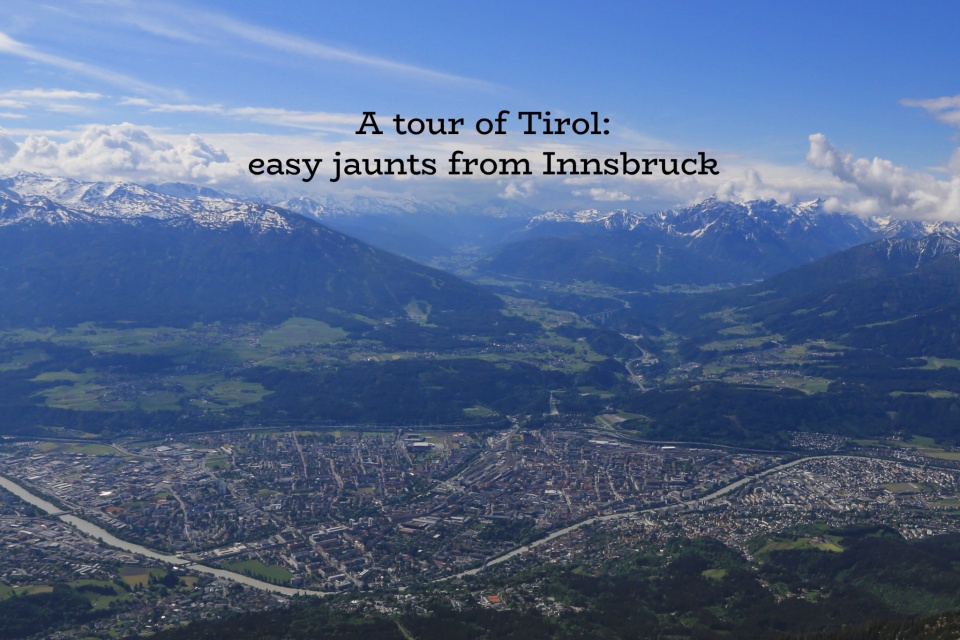
My Tirol: day trips from Innsbruck

As one of nine states within the federal republic of Austria, Tirol is well known not only for all-season access to the Alps, but also for a variety of other attractions.

With transport authorities IVB Innsbruck, VVT Tirol, and ÖBB Austria, Tirol state capital Innsbruck was the base from which I travelled to Alpbach (half-day), Brenner (half-day), Hall in Tirol (half-day), Nordkette (half-day), Scharnitz (half-day), Stubaital (half-day), and Wilder Kaiser (full day).


( Click here for more )

Erwin Schroedinger, Annemarie Schroedinger, Alpbach Cemetery, Heiliger Oswald, Pfarrkirche Alpbach, Alpbach, Tirol, Tyrol, Austria, fotoeins.com

Alpbach, Austria: finding Erwin Schrödinger

Localizing his final wavefunction in Alpbach.

It took a little effort: a train out from Innsbruck to Brixlegg, followed by a regional bus into another valley of countless valleys, accompanied by the illumination of sharp morning light, in a blanket of meadows and buttercups, under a deep ocean of impossibly blue skies. And on both sides of this river valley are an endless series of mountains, these peaks the smaller cousins to larger Austrian Alps nearby.

In Alpbach, the weekday morning is quiet, as the town begins to stir with people starting their work day. The bank has just opened, fresh baked bread and pastry and roasted coffee emanate from the cafe from around the corner, a couple of trucks rumble into town with deliveries. An older couple walks by, and there are mutual sunny greets of “Grüss Gott”. The church steeple glows yellow at this hour, and it’s easy to imagine with its bell the church is an aural and visual beacon for miles.

I’m drawn to the church because that was always the plan, to look for someone who’s buried in the church cemetery. Ordered rows of headstones lie as you would expect, but by the northwest gate, I find a single plaque on the bordering stone wall. The plaque reads: “Erwin Schrödinger, Nobelpreis für Physik, 1933”, and next to the plaque is Erwin and Annemarie Schrödinger’s final resting spot%. Another academic pilgrimage completed.

( Click here for more )