How to be ridiculous, in perfectly good Denglisch
Date: 2009 October 10.
Location: Terminal 2, Frankfurt am Main Airport.
State: “unorientation”
Something one often forgets is that they might want to pay attention to the public-address announcements : the next gate for a connecting flight, or where to pick up their luggage.
After disembarking the plane from Prague, it’s obvious from the overhead signage in the terminal about whether I should be going to baggage claim D or baggage claim E. Now if I’m actually paying attention, that’s an entirely different matter.
Nonetheless, I stride boldly and confidently into luggage claim D.
Conclusion number one? I have chosen unwisely.
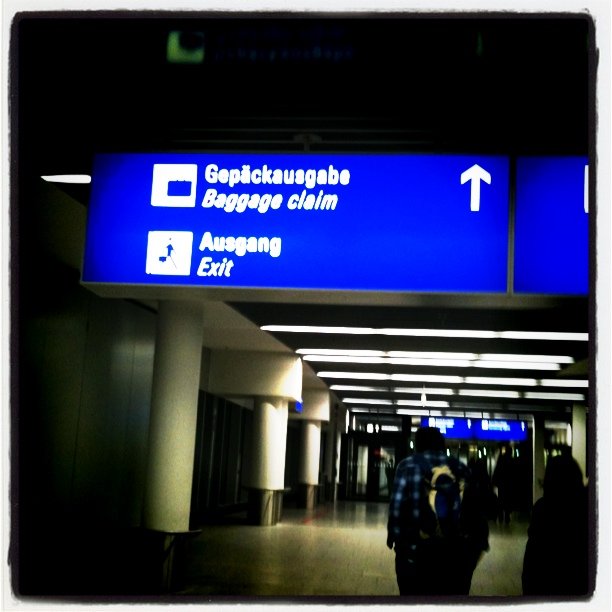
Gepäckausgabe | baggage claim. Photo by
Claus Wolf (CC2.0)
Schadenfreude
I flag down one of the luggage porters in the claim area …
ME : Entschuldigung … ich bin gerade von Prag angekommen und ich suche ja die richtige Gepäckausgabe. (Excuse me, I’ve just arrived from Prague and I’m looking for the baggage claim.)
HIM : Welcher Flug? (Which flight?)
ME : Czech Airlines, O-K Flugnummer 5-3-6.
He nods and gives me a look of sympathy … or … is that pity …
HIM : Sie sind im falschen Bereich. Sie müssen in die Halle-E hingehen, um Ihr Gepäck abzuholen. (You’re in the wrong area, you have to go to baggage claim E.)
ME : Ach, für SCHEISSE … (You really don’t need that translated, do you?)
HIM : Kein Problem, bitte gehen Sie draussen zum Information hin und da gibt es ein Angesteller, der Ihnen helfen können wird. (No problem, just head on out to the Information booth. Tell the clerk there about your situation, and they should be able to help you out.)
ME : Alles klar. Danke sehr!
HIM : … a final look of sympathy …
I leave baggage-claim D, out of the security of airside to find myself in front of the Information booth. I’m telling my sob story to the lady at the booth, complete with boarding card and passport as visual confirmation of my folly. I receive another look of sympathy, or maybe this time, it really is pity. A quick decision made in her mind, she commands me to follow her.
(Yes, ma’am …)
We slip past the crowd of people “landside” waiting for their loved ones to come out of the baggage claim area “airside”, and we pass through two sets of doors into the correct luggage-claim area E.
I’m gobsmacked, because we’ve just “casually” walked from an unsecured-landside area to the secured-airside baggage-claim area without going through security checks. No, it’s all about authority, her authority: a badge on her uniform, her electronic pass-card, and her faith in the truth of my story – all three elements, each equally vital. As I’m not completely out of my mind (yet), what little I’ve left is conjured to thank her for her help. She smiles, and she’s off on her way, back to her realm at the Information Booth.
I don’t bother to look back to see if she’s shaking her head at me … in sympathy … or pity.
Five minutes later, my luggage is out on the carousel. Because apparently, I’m made of magic today …
And that’s just the first part.
Someone needs MY help?!
After retrieving my baggage and leaving the security-area a second time, my plan is to take the monorail to Terminal 1 and the regional train station (Regionalbahnhof). I want to take suburban rail S-Bahn to Frankfurt central train station (Hauptbahnhof). As a trip from airport into the city is about 4 Euros with the S-Bahn or about 30 Euro with a taxi, I’m going cheap today.
As I leave the baggage area, a stranger walks up to me, asking me in German if I can help him and about how he can get to the Hauptbahnhof.
The first question in my head is: “why are you asking me this question?” There are tons of other people around, leading me to the second question: “why are you asking me? Do I have “loser”, “sucker”, or “Dummkopf” plastered on my face?
Must be, because thankfully, I’m keeping my piehole shut.
I find myself helping the poor guy, as I manage to talk to the guy out in passable German. He’s got to get to Wolfsburg, which, at 300 kilometres from Frankfurt, is not a trivial schlep. I ask him to follow me to the Regionalbahnhof, where we’ll hop on the S8 or S9 S-Bahn train for the short ride to the central station downtown.
Throughout the short ride, he keeps looking at his slip of paper with information about his train connection to Wolfsburg. He looks up and asks: “Sicher?” (Are you sure?)
In my head, I’ve got a snappy, if not snippy, reply.
“Look, you asked for my help, why would I be yanking your chain, to go this far, to take the train from the airport to the main station, where in fact there is not only graphical signage inside the train showing us where we’re going. Have you also not noticed a nice lady’s voice over the public address system: nächste Haltestelle: Frankfurt Hauptbahnhof (next station: Frankfurt main train station).
Instead, I nod dumbly, and point to one sign indicating the route of our train between the airport and downtown, and to the display indicating what the train’s next stops will be, including the central station.
It’s only natural he’s asking; I’m a stranger, he’s a stranger, and I’m helping out another stranger.
Mercifully, we arrive at Frankfurt central station. We leave the S-Bahn underground level, and we ride the escalators up to the “Fernverkehr” (long-distance trains) at ground-level. We’re standing in front of the departures board to look for his train. I lead him to the correct platform, I shake his hand and wish him well. Viel Glück!
Conclusion number two is having to learn the differences between two verbs. When you tell someone to follow, the correct verb is “mitkommen,” (to follow or to accompany; i.e., “Kommen Sie bitte mit“). The other verb is “folgen”, which is generally used to mean to follow something or something to cause some kind of following result.
Conclusion number three is this. “Frankfurt am Main” is Frankfurt on the river Main (pronounced “mine”). This prevents confusion with “Frankfurt am Oder,” located on the other side of the country next to the Polish border. So, if you see or hear “Frankfurt am Main main train station”, don’t panic. Your eyes or ears are not fooling you, and you haven’t lost your mind.
Just be sure to check the overhead signage …
Originally posted on Posterous, 2010 April 28 and adapted from “The 25” on Facebook, this post appears on Fotoeins Fotopress at fotoeins.com as http://wp.me/p1BIdT-2z.
50.110922
8.682127


 Fotoeins Fotografie