Fotoeins Fotografie

location bifurcation, place vs. home

Posts tagged ‘Saarland’

David Oppenheimer: Germany to Vancouver

Featured: Alter Markt, facing southwest to the former Schloss Blieskastel at upper-centre: Blieskastel, Saarland, Germany (X70).

David Oppenheimer: ✵ 1 January 1834 – 31 December 1897 ✟

As a child of the city, I learned the name of Vancouver’s 2nd mayor, David Oppenheimer, who served in the top post from 1887 to 1891. Escaping the violent revolutions spreading through Europe, David Oppenheimer and his brothers had long been immigrants from Germany, and after time in New Orleans and California, they arrived in what is now southwestern British Columbia and developed business success with their supply stores during the Gold Rush, and with wholesale trade and real estate in the newly incorporated city of Vancouver, where the national railway established its western terminus one year later in 1887. The Oppenheimers stamped their civic legacy not only with the location of the railway terminus, but also with an expansive infrastructure program including a new grand city park, fire department, extensive roadworks, a city-wide electricity grid, streetcar public transport network, and a city cemetery. On 11 April 2008, the Government of Canada’s Historic Sites and Monuments Board designated David Oppenheimer as a National Historic Person.

There’s little doubt the Oppenheimers spent plenty of time in what are now Vancouver’s Chinatown and Strathcona with their business interests and connections to the city’s Jewish community. These are neighbourhoods, respectively, where my parents sought closer ties with the Chinese-Canadian community, and where they bought a new house to raise their family. Decades later, I’ve flown out from Vancouver, and I’ve been on the train from Frankfurt to southwest Germany’s Saarbrücken for its proximity to the Völklingen Ironworks world heritage site. I also recently learned David Oppenheimer was from the area and born in the city of Blieskastel. I arrange to meet with a representative of Stadtarchiv Blieskastel (city archive), and I make my way to Blieskastel to see what I can learn about the Oppenheimer family.

( Click here for images and more )

24T32 All 16 German federal states visited

E31

Travel day 32 is very long, as I make my way from HGW Greifswald to BA Bamberg, via Berlin and Würzburg, with delays caused by infrastructure issues and rolling effects from recent heavy flooding in Baden-Württemberg and Bavaria. Up at 430am and out the door at 6am from the HGW “Pension”, I finally arrive and step into my BA hotel room at 6pm, for a total of 12 hours door-to-door.

This provides an opportunity to look back at the past month, and highlight other (unposted) images from time spent in two German federal states. Saarland in the southwest corner and Mecklenburg-Vorpommern in the northeast corner were my final two states on the list.

I’ve now visited all 16 of Germany’s Bundesländer or federal states.


Saarland (SL)

After the end of the war, Saarland was a French protectorate in 1947. In a 1955 referendum, almost 68% of voters decided against remaining with France, and with the signing of The Saar Treaty in 1956, the Saarland and its capital Saarbrücken officially joined (West) Germany as a federal state in 1957.

Ludwigskirche, from Saarbrücken’s Ludwigsplatz – 14 May (0.5x).
Blieskastel, near Saarbrücken – 15 May.
Watching over the former Völklingen ironworks, from Völklinger Platz – 16 May.

Mecklenburg-Vorpommern (MV)

Also known in English as Mecklenburg-West Pomerania, the state capital is Schwerin, not to be confused with Schleswig; while Rostock is the largest city in the state.
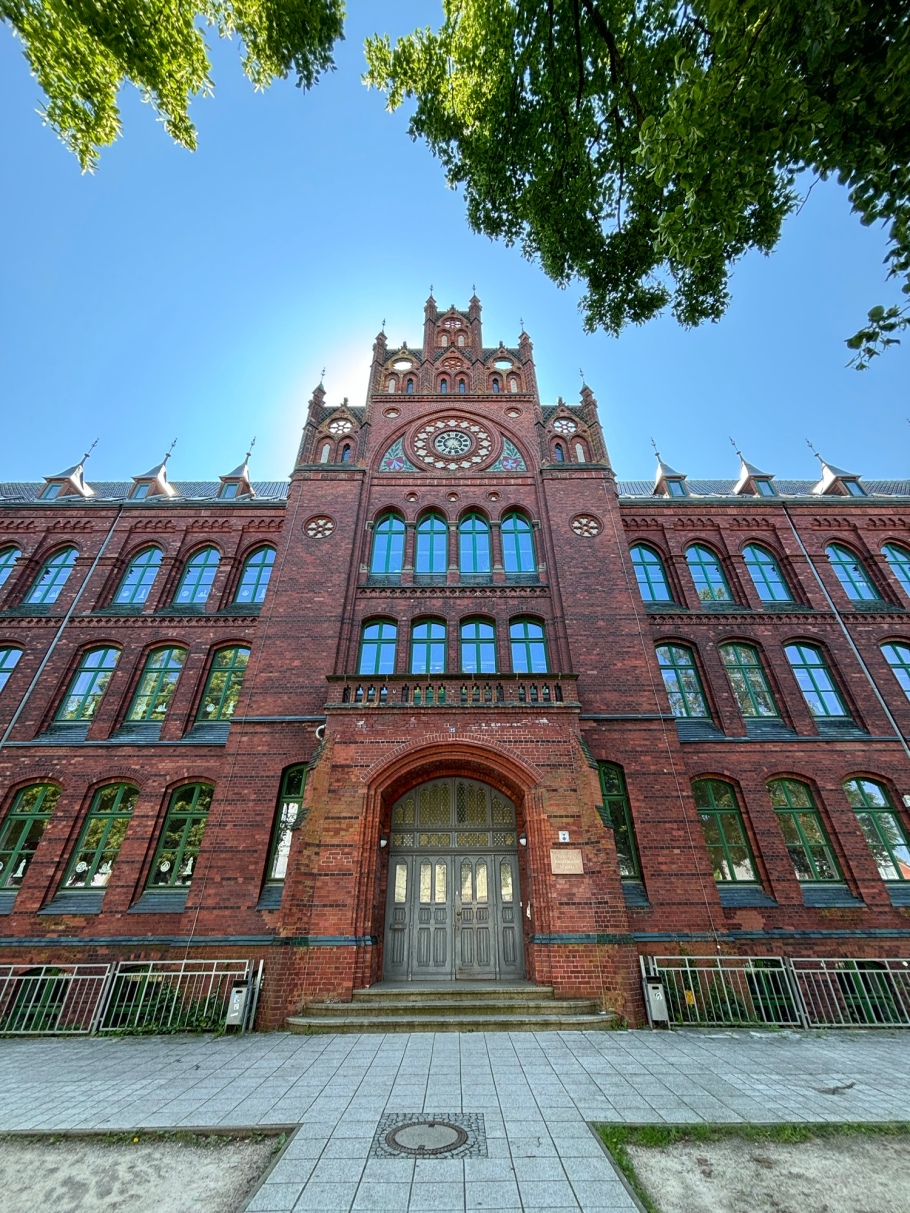
Gerhart Hauptmann elementary school, in that classic northern-European brick-Gothic style. Stralsund – 1 June (0.5x).
Stralsund market square: 30 vs. 1, in 30 simultaneous chess marches – 1 June.
Near Ernst-Moritz-Arndt viewpoint – 3 June.
Prora Südstrand (south beach), facing south – 4 June.
Prora Südstrand (south beach), facing north – 4 June.
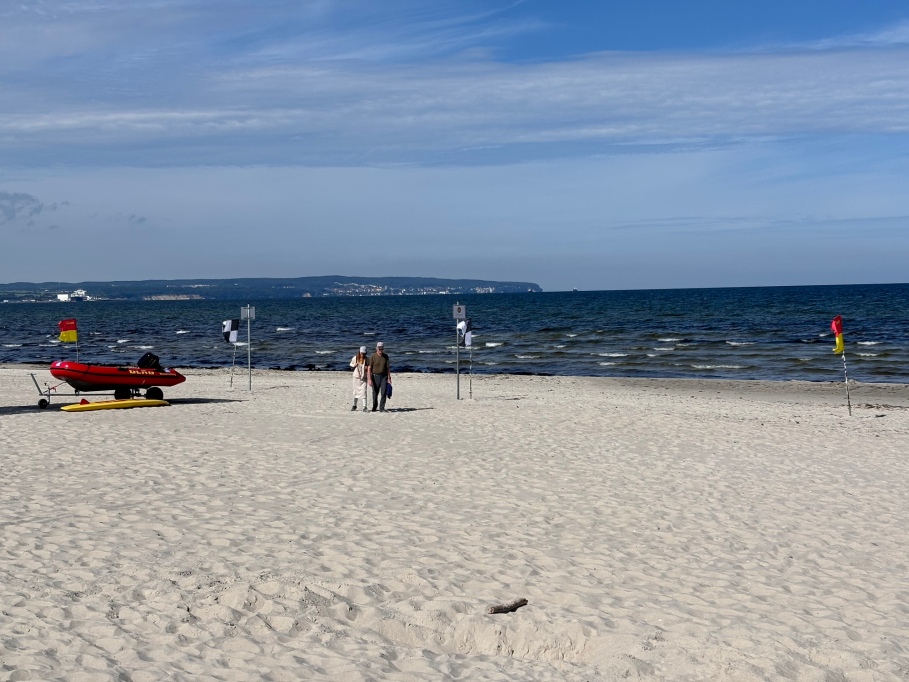
Prora Südstrand: rescue boat from DLRG (German Lifeguard Association), waters of the Prorer Wiek (Prora Bay) as part of the Ostsee (Baltic Sea), cliffs forming the Sassnitz coastline in the background – 4 June.

I made all images above with an iPhone15 in May and June of 2024. This post composed with Jetpack for iOS appears on Fotoeins Fotografie at fotoeins DOT com.

24T09b German Film, a short visual history

Der deutsche Film

Heavy rain in southwestern Germany wiped out day 10. Severe train disruptions made for an interesting and eventful journey from Saarbrücken to Trier (travel day T10, next).

Here is another and personal highlight from travel day 9 in Völklingen (Saarbrücken).

What used to be an industrial facility has acres of space, and that’s prime real estate for arts & culture displays. During my visit to Völklingen Ironworks on travel day 9, there was an additional concurrent exhibition on the history of German film, with huge film posters and banners, as well as multiple screens showing clips from selected German films. Visual gravity pulled me to some of my favourite films, including “Metropolis” and “Lola rennt” (Run Lola Run).


German Film: 1895 to the present – on exhibition from 15 Oct 2023 to 18 Aug 2024.
“Engelein” (Little Angel), 1914.
Nosferatu: Eine Symphonie des Grauens” (Nosferatu: A Symphony of Horror), 1922.
“Der Blaue Engel” (The Blue Angel), 1930.
“Metropolis”, 1927. This film by Fritz Lang was the first film inscribed on UNESCO’s Memory of the World Register.
Replica of “Maschinen-Maria” (artificial Maria), original concept by Walter Schulze-Mittendorff.
“Olympia”, 1938: propaganda film for the NS by Leni Riefenstahl.
“Die Sünderin” (The Sinner), 1951.
“Der Geteilte Himmel” (Divided Heaven), 1964, based on Christa Wolf’s 1963 novel.
“Die Blechtrommel” (The Tin Drum), 1979, based on Günter Grass’ 1959 novel.
“Wir Kinder vom Bahnhof Zoo” (Zoo Station: The Story of Christiane F.), 1981, based on Christiane F. autobiography.
“Coming Out,” 1989. Wiki: … the last East German film released to the public prior to German reunification; one of the last films made by DEFA, the East German state film studio, and the only gay-themed feature film by the studio.
“Aus dem Nichts” (In the Fade), 2017. Fatih Akin’s films are not for the faint of heart, but strike at the heart of interpersonal relationships, as well as domestic issues between the Turkish-German and German communities.
“Run Lola Run”, 1998. I saw this film on a big screen in Toronto, and those visuals of Berlin grabbed my eyeballs. 3 years later, I move to Heidelberg; 3.5 years later, I visit Berlin for the first time. Since 2002, my visit count to the German capital city is safely in double-digits.
The moment where I might have fallen in love with Franka Potente.
Run, Lola; run.
“Im Westen Nichts Neues” (All Quiet on the Western Front), 1st German-language film version in 2022, based on Erich Maria Remarques’ 1929 novel.
“Mädchen in Uniform”, 1931; remade in 1958 with Romy Schneider & Lilli Palmer. Wiki: due to the film’s overt and openly lesbian themes, the film remains an international cult classic.
Reproduction of stage set for classroom by Géza von Radvanyi, for the 1958 remake of “Mädchen in Uniform”; film poster at upper right.
Big symbol, big company, big neon: UFA, for Universum-Film Aktiengesellschaft (Universal Film public limited company) founded in 1917, and responsible for some of the biggest and well-known films from Germany. The logo above was in use from 1917 to 1991.
Massive central platform with multiple screens with clips from various German films.

I made all images above with an iPhone15 on 16 May 2024. I received neither sponsor nor support from any organization. This post composed with Jetpack for iOS appears on Fotoeins Fotografie at fotoeins DOT com.

24T09 Völklingen Ironworks, World Heritage

E08, outside Saarbrücken

The massive industrial facility providing wealth, economic growth, and stability in the bilingual Saar region went from a duration of many decades, to a new form of sustainability including art and museum space, as well as an industrial park to highlight its 1994 inscription as UNESCO World Heritage Site. The site covers an area of almost 7.5 hectares (185 acres).


The ironworks, located to the southwest of Völklingen train station.
“Kunstfabrik” (art factory), by jaume, 2022.
Tenemos miedo a las nubes”, by e1000 (2024) for Urban Art Biennale.
“Black is beautiful!”, by Jef Aérosol (2014), for Urban Art Biennale.

I made all images above with an iPhone15 on 16 May 2024. I received neither sponsor nor support from any organization. This post composed with Jetpack for iOS appears on Fotoeins Fotografie at fotoeins DOT com.

24T08 Blieskastel’s Oppenheimer families

E07, outside Saarbrücken

My visit to Blieskastel’s city archives taught me there were many who shared the surname Oppenheimer. As future immigrant to Canada and becoming Vancouver’s 2nd mayor, David Oppenheimer (1834-1897) grew up in the house at Kardinal-Wendel-Straße 58. Seeing in-person at the city archives the book containing Oppenheimer’s birth certificate was “historic.” A number of David’s relatives including his mother are buried in the city’s modest Jewish cemetery.

Not related to David’s family was Anna Oppenheimer who once lived in the house at Kardinal-Wendel-Straße 62 in the early 20th-century. The Stolperstein (stumbling stone) embedded in the cobblestone outside the latter address tells us Anna was deported by NS-forces in 1940 and died on the way to Theriesenstadt.

With a total population of about 20-thousand, Blieskastel is served by hourly-frequency regional-trains with a 30-minute trip from Saarbrücken (SB).


Kardinal-Wendel-Straße 58, where David Oppenheimer spent his childhood.
Kardinal-Wendel-Straße 60-62: another Oppenheimer family, not related to David’s.
Book containing David Oppenheimer’s birth certificate (Stadtarchiv).
David Oppenheimer, born 1. January 1834 in Blieskastel (Stadtarchiv).
Entering the city of Blieskastel in the rural district of Saar-Palatinate (Saarpfalz-Kreis).

I made the images above with an iPhone15 on 15 May 2024. I couldn’t have done this research without the help of R. Berger at the city’s archives. This post composed with Jetpack for iOS appears on Fotoeins Fotografie at fotoeins DOT com.