Fotoeins Fotografie

location bifurcation, place vs. home

Posts tagged ‘river’

ShUM, SchUM, medieval Jewish cities, Speyer, Shpira, Worms, Warmaisa, Mainz, Magenza, Germany, Ashkenaz, Rheinland-Pfalz, Rhineland-Palatinate, fotoeins.com

ShUM, Jerusalem on the Rhine: Speyer, Worms, Mainz

When threats of destruction to property and life follow and linger over a group of people through no fault of their own over centuries, there’s something to be said about an eternal need to keep a watchful eye. Words like Verfolgung, Vernichtung, and Vertreibung1 have been etched into memory. I have all this in mind as I explore Jewish history in Germany as part of my need to answer the following question:

How did a nation of people which fostered composers Bach, Beethoven, Handel, Mendelssohn-Bartholdy, Strauss; and writers Goethe, the Brothers Grimm, Heine, Hesse, Heinrich and Thomas Mann, and Schiller sink to the worst depths of human atrocity and depravity in the first half of the 20th-century?

It’s easy to forget Jewish people have lived in what is now Italy and southern Europe since the middle of the 2nd-century BCE and inhabited southern Germany from the late 10th-century AD/CE2. During the High Middle Ages, three important bishopric (and cathedral) cities of Speyer, Worms, and Mainz along the Rhine river formed an important league or federation of Jewish communities (Kehillot) from the end of the 10-century to about the mid-to-late 14th-century. The word שו”ם or ShUM (SchUM in German)4 is an acronym consisting of the first letters of the Hebrew names for the three cities:

•   Shin (ש), Sh for Shpira (שפירא) → present-day Speyer;
•   Waw or Vav (ו), U for Warmaisa (וורמש) → present-day Worms;
•   Mem (ם), M for Magenza (מגנצא) → present-day Mainz.

The ShUM cities became centres for learning, training, religion, culture, and trade within medieval Germany (Ashkenaz3) and throughout Europe. Today, the three ShUM cities establish key destinations for historical travel, provide rich examples for continuing research on medieval Jewish life, and add up to a comprehensive project in recognizing an important chapter of the history of Jews in Germany.

The ShUM/SchUM was inscribed as World Heritage Site by UNESCO at the 44th meeting of the World Heritage Committee in July 2021. ShUM is Germany’s 1st all-Jewish world heritage site, a big acknowledgement to the centuries-long presence of the Jewish community along the Rhine river.


( Click here for more )

My Cologne: there’s a lighthouse that never goes out

Above/featured: Mural of the Helios structure, Köln Ehrenfeld, 9 Jan 2013 (450D).

Why is there a lighthouse located in the middle of the city? That makes no sense!

Did the Rhine river once flow here? Is that why there’s a lighthouse?

Is the structure some kind of forgotten remnant of the past?

Maybe that’s not a lighthouse, but rather a beacon that lets people know about a fire somewhere in the neighbourhood.

These are some of the questions and statements posed by Cologne residents when asked if they know anything about the lighthouse in their midst.

Located in the Ehrenfeld1 borough of Cologne is a red brick 44-metre (144-foot) high lighthouse. But why is there a lighthouse at all in the “middle” of Cologne? The Rhine river flows through the city, but the river is hardly visible from the lighthouse at a distance of about 3 kilometres (2 miles). The structure is not an actual operating lighthouse; it’s a symbol of early 20th-century enterprise from what was once one of the most important companies in Europe and marking the location of a big factory that once manufactured electrical equipment including maritime lights.

Founded in 1882, Helios2 established their presence in the town of Ehrenfeld before the latter was incorporated into the greater city of Cologne in 1888. The company once boasted a staff complement of over 2000 people, with products sold in Germany and Europe ranging from electrical generators and transformers, light bulbs, light fixtures in public spaces, and electrical streetcars. Helios also built light towers for the North and Baltic Sea coastlines, including ones at Roter Sand (Weser river estuary), Borkum and Wangerooge (East Frisian Islands), and Sylt. The onsite lighthouse in Ehrenfeld was constructed as a testing facility and never used as a navigational aid or marker. The company overextended its financial reach until Berlin’s AEG3 purchased Helios in 1905. Manufacturing operations in Ehrenfeld ceased in 1930, bringing a final end to Helios’ business presence in Cologne.

The present-day buildings which remain are used as office- and art-space. As historical landmark, the “Helios Leuchtturm” remains as part of the urban heritage in Ehrenfeld and Cologne. If the people in both borough and city have any final say in the matter, the lighthouse will never have to go out.4

( Click here for images and more )

Wochenmarkt, Saturday farmers market, Neuenheimer Markt, Markplatz, Neuenheim, Heidelberg, Germany, fotoeins.com

My Heidelberg: Saturday farmers’ market in Neuenheim

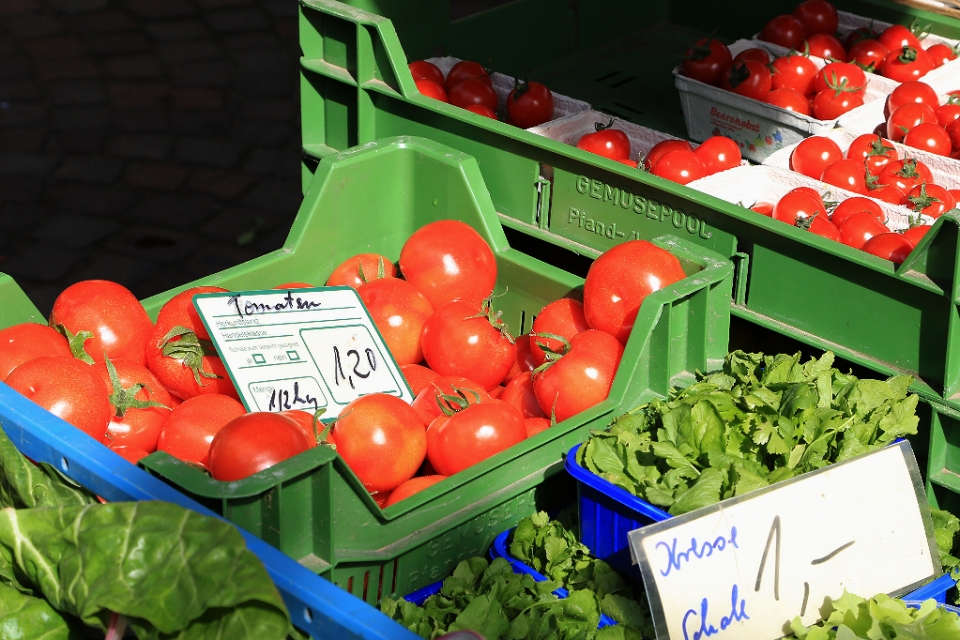
In Heidelberg, the farmers’ markets are held regularly throughout the week at a number of locations throughout the city and region. One of six Saturday markets takes place across the Neckar river in Neuenheim. Most visitors in town will visit the Saturday market in Heidelberg’s Marktplatz, which leaves the other five Saturday markets pretty much “clear and free” to residents. And as I arrive at the market square in Neuenheim, it’s clear I’m in the minority, literally and figuratively. This is not criticism and it’s not a negative, as I used to come here occasionally when I lived here. I say as much to the various vendors, when I buy a cup of coffee, some cherry tomatoes, a piece of cake, and three empanadas.

Fresh fruit and vegetables, grown locally and imported from around Europe. Fresh bread and baked goods from a regional bakery. Fresh herbs, grown locally; fresh flowers, grown locally. Honey harvested from bees at a regional apiary. “Empanadas Argentinas”, by a woman from Córdoba who’s lived in Germany for over ten years. And there are fresh cuts of meat, tubs of olives, and glorious varieties of cheese from around Europe.

It’s time to stop eating and leave, when the vendors begin to pack. Another market, another day.

When I leave Heidelberg, no small measure of wistful longing remains; these are my streets, and this is one of my markets.

( Click here for more )

Ratskeller, Speyer, Rheinland-Pfalz, Germany, fotoeins.com

Speyer: typically German in the Ratskeller

Normally, my passable handling of conversant German gets me far enough in a snack-joint (Imbiss) for a Döner or the gut-busting Dönerteller. On the infrequent occasion I’m inside a restaurant, it’ll be local German fare, much of which I’ve become accustomed while travelling within Germany since 2002.

The town or city hall in every city, town, or village is often accompanied by its own “Ratskeller” (Cellar) serving wine, beer, and food in an underground tavern. At the Speyer Ratskeller, a cold and wet Friday night is in full swing, the place packed with city residents filling all available tables and seats. My host apologizes for the wait, and I reply that it’s no problem. She suggests wine while I wait: definitely not a problem.

( Click here for more )

Altstadt, Inn river, Inn, Innstadt, Passau, Bayern, Bavaria, Germany, fotoeins.com

Passau: the town of Three Rivers (Dreiflüssestadt)

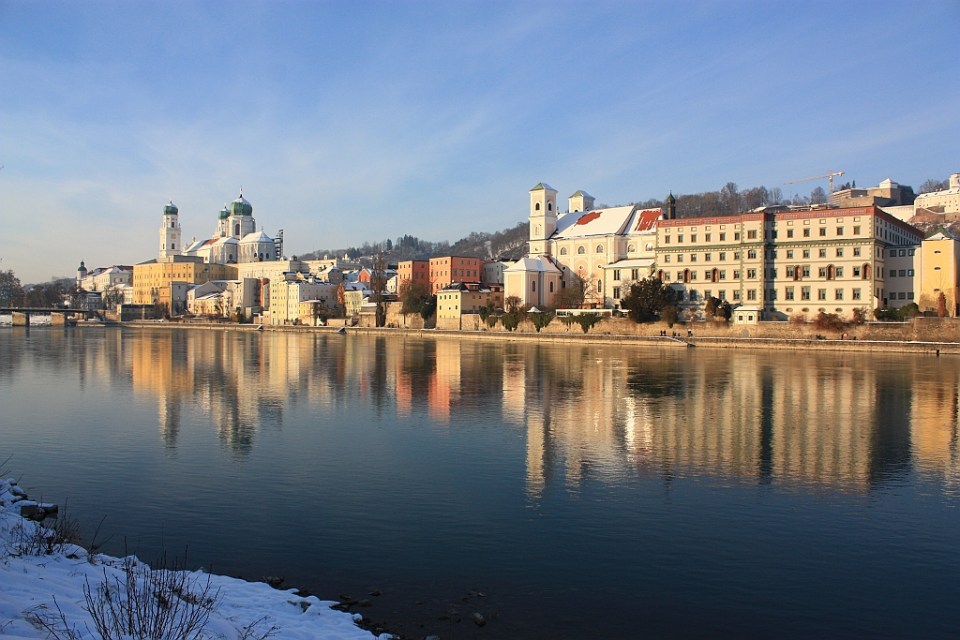
Next to the Austrian border in the southeastern corner of Germany lies the Bavarian town of Passau. At the city’s so-called ‘Ortspitze’, three rivers converge: the black Ilz from the north, the green Inn from the south, and the blue Danube from the west. The unique setting provides the city with the nickname or moniker “Bavarian Venice.” Facing east and up and over the hills in the distance is Austria.

With a few short hours of late-autumn and winter daylight, I chase the remaining light on foot through a bitter windchill. The following pictures show it’s worth the effort and the sacrifice of comfort: “always for the shot(s).”

( Click here for images and more )