Fotoeins Fotografie

location bifurcation, place vs. home

Posts tagged ‘Remembrance Day’

Chinatown Memorial Plaza, Chinatown Memorial Square, Chinatown Memorial Monument, Chinatown, Vancouver, BC, Canada, fotoeins.com

My Vancouver: Chinatown Memorial Square

Above/featured: Chinatown Memorial Square, Vancouver, Canada – 15 Mar 2019 (X70).

Living in and between two societies can often mean a fractured existence; unclear and ambiguous it might be at times between cultural identity at birth with the country of birth.

But my truth is and always has been very simple.

I am Canadian. I am Chinese. I am Chinese-Canadian. I am Canadian-Chinese.

I am all of these, and all of these make up who I am.

I believe my parents would not have emigrated to Canada, that my sister and I would not have been born and raised here in this country, had it not been for the perseverance and hard work by early-generations of Chinese Canadians.

Memorial to Chinese Canadians

The history of the city of Vancouver and of the province of British Columbia includes the history of Chinese people in Canada. These histories are inseparable.

What is significant and well-documented are: the impact by Chinese on the construction of the Canadian Pacific Railway (CPR), the completion of which delivered in 1871 the “promise” of British Columbia joining Canadian confederation; the 19th-century “gold rush”; fighting racism and state-sponsored repression; volunteering to fight for a country who didn’t want or recognize them; and their subsequent rightful claims of their right to become Canadian citizens and the right to vote.

Standing at the northeast corner of Keefer Street and Columbia Street in Vancouver’s Chinatown is a memorial to early Chinese-Canadians. The stylized “中” character is surrounded by two sculptures representing important times in Canadian history: a Chinese-Canadian working on the national railway, and a Chinese-Canadian soldier serving in World War Two. In the context of the memorial, the character “中” also represents harmony in spirit, and a declaration and recognition of the past and present, and hopes for the future.

Inscriptions at the memorial are as follows:

This Chinatown Memorial Monument is the creation of sculptor Mr. Arthur Shu-Ren Cheng. The bronze statues of the railway worker and the World War II veteran represent the sacrifices made by Chinese Canadians in building a united and prosperous Canada. The main column is a stylized form of the Chinese character “centre” (“中”) which symbolizes Chinese culture. The Chinese couplet inscribed on the front and back of the column reads:

(Front/Left) “Rich legacies of Chinese pioneers shining bright as the sun and moon.”

(Back/Right) “Great deeds of noble forbears zeal entrenched as mountains and rivers.”

In commemoration of the significant contributions of Chinese Canadians to the growth, vitality and prosperity of Vancouver, British Columbia and Canada.

The Chinatown Memorial Monument is funded by the City of Vancouver, Province of British Columbia, and Government of Canada under the Vancouver agreement.

Unveiled on the 2nd November 2003


Chinatown Memorial Square can be reached by TransLink with the SkyTrain to Stadium-Chinatown Station, or with any of bus routes 3, 4, 7, 8, 14, 16, 19, 20, 22, 50, or C23.

More

•   Chinese building the CPR: “Nitro”, video by Historica Canada.
•   Chinese Canadians in military service Chinese Canadian Military Museum.
•   Remembering Gim Wong

This post appears on Fotoeins Fotografie at fotoeins DOT com as https://wp.me/p1BIdT-3YG. Initial photos for the 2013 post have been removed, and a 2019 photo has been inserted in a 2021 edit.

Vancouver Honours: Beatty Mural, South Cenotaph

The Cenotaph (1924) at downtown Vancouver’s Victory Square is one location of many in the Vancouver area where Remembrance Day commemorations will take place.

Poppies at the Beatty Mural

Just minutes away on foot from Victory Square is the Beatty Street Mural, highlighting historical events and figures in the city’s history, beginning with the presence of First Nations, to Captain Vancouver sailing into the bay and meeting their Spanish navy counterparts, to aspirations of constructing a green “city of destiny”. A section of the mural shows painted images including poppies in remembrance of the fallen during two world wars of the 20th-century. The mural is located just steps from the north entrance of the Stadium-Chinatown SkyTrain station.

http://instagram.com/p/gZUp7ZpIjO/


South Vancouver’s Cenotaph

Many may not be aware of another cenotaph in the former city of South Vancouver.

Opened in 1926 in the original municipality of South Vancouver, Memorial South Park was known initially as Wilson Park, and was designed to commemorate deceased soldiers in World War I. South Vancouver was amalgamated into the City of Vancouver in 1929, and Vancouver’s first Cenotaph, erected in 1926 at the former South Vancouver Municipal Hall, was moved to this park and rededicated in 1939. The cenotaph is located at the end of a tree-lined avenue as gateway into the park, standing modestly with little extra decoration. The inscription on the memorial reads: “To the memory of the men and women who served in the defense of their country”.

The park is located a few streets east from the intersection of East 41st Avenue and Fraser Street. With public transit from downtown Vancouver, take the SkyTrain’s Canada Line to Oakridge-41st Avenue station, before transferring onto an eastbound 41 bus (destination Joyce-Collingwood station).

http://instagram.com/p/gZUEgaJIim/

With my 4th-generation iPodTouch (and Instagram), I made the photos above at the Beatty Street Mural on 15 October and 5 November 2013; and at Memorial South Park on 19 September 2013. This post appears on Fotoeins Fotopress at fotoeins.com.

Canberra: Poppies at the Australian War Memorial

The word “poppy” in Germany is associated with the delicious poppy seed filling (“Mohn”) commonly used in cakes and pastries. Elsewhere, poppies are unfortunately associated with the production and consumption of hard drugs.

It’s easy to forget another representation associated with the flower: a commemoration symbol for the war dead.

Wild poppies grow in Belgium, and in particular, in the Ypres salient, one of many places where bodies, blood, and mud were the norm in close-contact trench warfare in World War One. Canadian physician and Lieutenant Colonel John McCrae was serving in the 1st Field Artillery Brigade, and after burying his friend, Lieutenant Alexis Helmer who died of injuries sustained during the Second Battle of Ypres, McCrae wrote the poem “In Flanders Fields” as he took the scene before him. Moved by McCrae’s poem, American Moira Michael began in 1918 the practice of wearing poppies on Remembrance Day.

It’s why you may see people sporting poppies on their lapels in the days leading up to November 11; the tradition is encouraged and upheld mostly in Commonwealth countries. In Australia and New Zealand, the big day of commemoration is ANZAC Day on April 25.

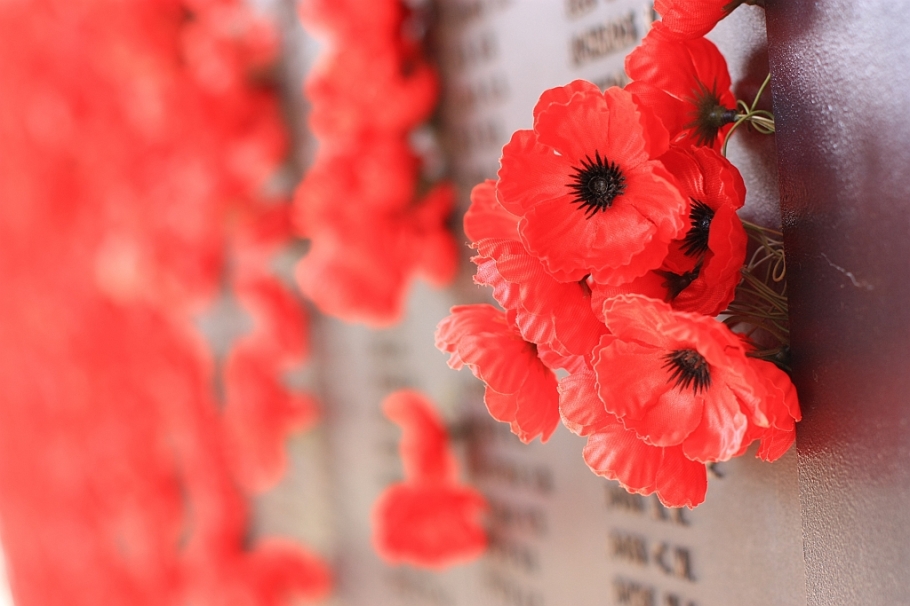
At the Australian War Memorial in Canberra, over one hundred thousand names are inscribed on the walls at the Roll of Honour; these are the names of people killed in action since 1885. A paper poppy is placed next to each name for relatives or direct descendants.
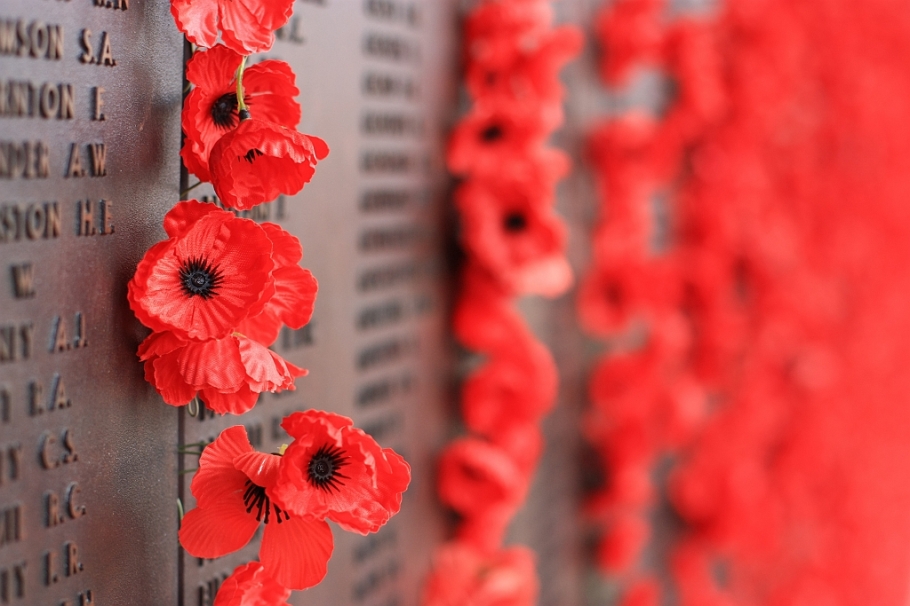
Roll of honour, west, Australian War Memorial, Canberra, ACT, Australia
Roll of honour, east, Australian War Memorial, Canberra, ACT, Australia

Roll of honour: west (top), east (bottom) : Australian War Memorial, Canberra, ACT

I made the two photos above at the War Memorial’s Roll of Honour on 6 September 2012; this post appears on Fotoeins Fotopress at fotoeins.com.