Fotoeins Fotografie

location bifurcation, place vs. home

Posts tagged ‘Pogromnacht’

Vienna: Lichtzeichen testament to Jewish presence

Above/featured: Lichtzeichen number 10 (Stumperschul) in the city’s 6th district. Photo, 28 May 2022.

From a distance, the light seems suspended in mid-air.

Closing the distance widens my realization: it’s an illuminated sculpture that has a curved warped shape on top. That’s also when understanding narrows into sharp focus when I stand directly underneath: the shape “straightens” out, revealing itself as a Star of David.

Lichtzeichen Wien (LZ) consists of 26 structures in the Vienna region, marking former locations of synagogues, schools, temples, and prayer rooms destroyed by the Nazis in the pogrom of November 1938. During the night of 9–10 November 1938, the Nazi regime organized and carried out a systematic attack against the Jewish population in Germany and Austria. The rampage in Vienna continued for several days; most of the city’s synagogues, temples, and prayer-halls were destroyed.

Launched by the Jewish Museum Vienna and Austrian artist Brigitte Kowanz, an urban memorial project by joint collaboration of the Jewish Museum Vienna and the University of Applied Arts Vienna consists of identical columns, designed by artist Lukas Kaufmann. The commemorative project is called “Ot” (אות), which means “symbol” in Hebrew. Each “light column” sculpture stands about 5-metres high with a star of David, and includes the name of the former Jewish structure and an accompanying QR-code. Official unveiling of the memorial project occurred in 2018 on the 80th anniversary of the 1938 pogrom.

I visited and photographed all 26 Lichtzeichen locations in Vienna over a period of three summers in 2022, 2023, and 2024.


( Click here for images and more )

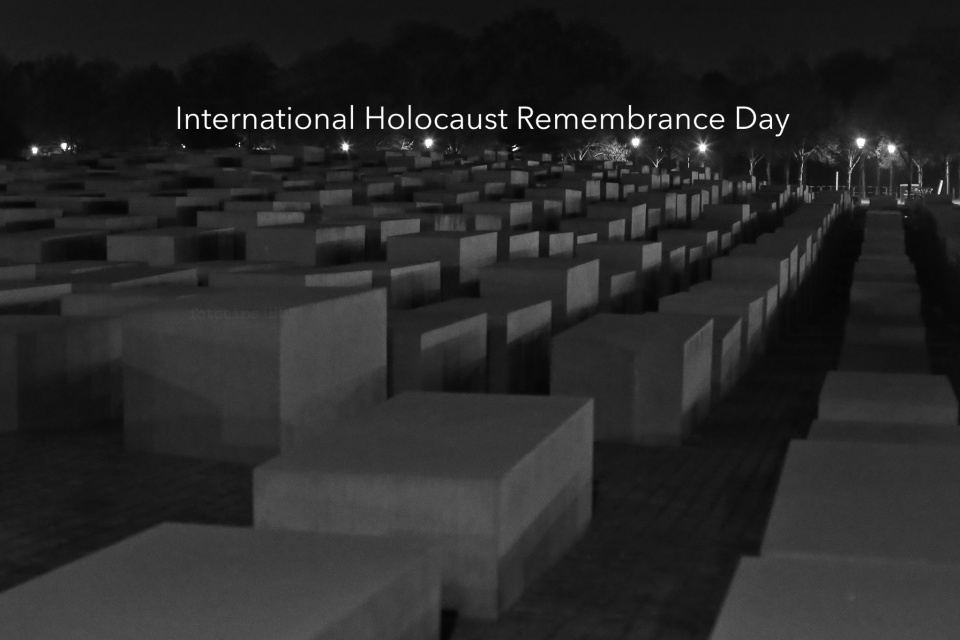
IHolocaustdenkmal, Berlin, Germany, fotoeins.com

International Holocaust Remembrance Day: observations from Germany

Primo Levi, Italian-Jewish author, chemist, and Auschwitz survivor, delivered a set of essays about life and survival in Nazi extermination camps in his 1986 book “The Drowned and the Saved”. Levi wrote:

… For us to speak with the young becomes even more difficult. We see it as a duty and, at the same time, as a risk: the risk of appearing anachronistic, of not being listened to. We must be listened to: above and beyond our personal experiences, we have collectively witnessed a fundamental, unexpected event, fundamental precisely because unexpected, not foreseen by anyone. It took place in the teeth of all forecasts; it happened in Europe; incredibly, it happened that an entire civilized people, just issued from the fervid cultural flowering of Weimar, followed a buffoon whose figure today inspires laughter, and yet Adolf Hitler was obeyed and his praises were sung right up to the catastrophe. It happened, therefore it can happen again: this is the core of what we have to say.

On 27 January 1945, Soviet Red Army troops liberated the Nazi concentration and extermination camp at Auschwitz-Birkenau in south-central Poland. Over 1 million men, women, and children were murdered.

The United Nations declared January 27 as International Holocaust Remembrance Day; the designation came during the 42nd plenary session of the United Stations when resolution 60/7 was passed on 1 November 2005.

Accepting and openly stating responsibility are critical first steps, but spending time, money, and effort to ensure the simple motto of “never again” is also an ongoing reality that isn’t solely up to the citizens of Germany. It’s a collective responsibility that we all should have to remain vigilant; that we all have to recognize and bolster actions which encourage and strengthen the universality of human rights, and reject the erosion and withdrawal of those rights.

I believe responsible tourism also includes paying appropriate respect at a memorial, especially the Holocaust Memorial in Berlin. It’s my view this important memorial is not (supposed to be) a playground.

And yet, there’s something to be said about what it means to have freedom in the early 21st-century, allowing people to laugh and frolic in the public space, an undulating sculpture of featureless massive grey cement blocks, a testimonial to the systematic murder of millions of people.

Naturally, you have the freedom to play here, take selfies, and have a grand time. But it doesn’t mean I’m gonna laugh with you; for example: Yolocaust art project (DW 2017).


( Click here for more )

Alter Synagogenplatz, Altstadt, Heidelberg, Baden-Württemberg, Germany, fotoeins.com

My Heidelberg: Synagogue Square and Pogromnacht

It happens every time without fail.

My spirit breaks a little more every time I see a memorial, another example of the depths to which our species have plumbed.

Does feeling this way make me weak? Or am I resembling a human being after all?

I often hear a common chorus:

history is hard, history is boring, why should I care?

I can’t decide what’s worse: the rise of the far-right or blatant willful ignorance.


A Mob of Broken Glass

From the evening of 9 November to the following morning of 10 November 1938, Kristallnacht (“the night of broken glass”) was a “pogrom”, a coordinated series of violent attacks by Nazis against the Jewish people and their property in Germany, Austria, and Czechoslavakia’s Sudetenland. Pogromnacht (or Reichspogromnacht) is a truer description; the “prettier sounding” Kristallnacht hides the brutality of “the night of (broken) crystal” referring to broken shattered glass from windows to synagogues, homes, and stores owned by Jews. Aside from a few who intervened, most stood aside and watched people and property burn.

The word “pogrom” is a late 19th- to early 20th-century Russian word (“погром”), derived from the verb “gromit” (громи́ть) meaning “to destroy with violence.” While “pogrom” is used generally to describe mob violence by one ethnic or religious group on another, the term is used in this post to describe attacks on the Jewish community.

The numbers across the country were appalling: at least 90 dead, hundreds injured, 30000 arrested and detained in concentration camps, up to 2000 synagogues burned, over 7000 Jewish businesses damaged or destroyed. With one more insult, the Jewish community was forced to pay for damage to their own property. The outbreak of coordinated actions against Jewish people marked the beginning of state-sanctioned violence. With the Pogromnacht, the state no longer hid their hate and escalated their savagery as a turning point directly leading to the Holocaust.

( Click here for more )