Fotoeins Fotografie

location bifurcation, place vs. home

Posts tagged ‘Oberbayern’

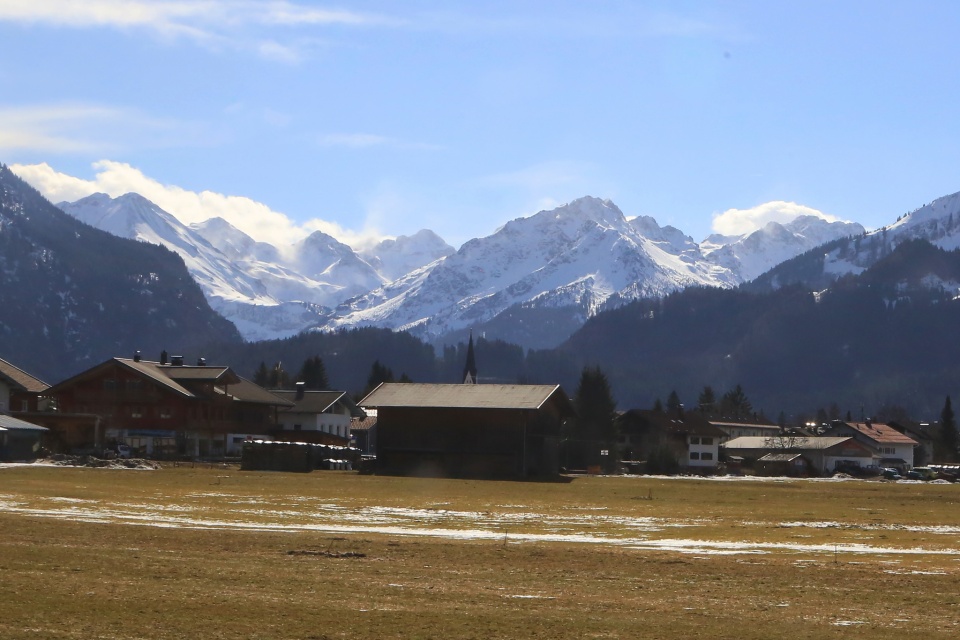
My Mittenwald: mountains, masks, music, Mahlzeit!

Above/featured: From the regional train: facing southwest over Schöttlkarstrasse and the eastern end of the Wettersteinwand at right.

In 1786, the German writer Johann Wolfgang von Goethe described the alpine town of Mittenwald as “lebendes Bilderbuch” – a living picture-book. Images and descriptions in print and provided by visitors became a real draw and lure. Funny thing is I’d stayed in nearby Garmisch-Partenkirchen several times, and I hadn’t taken the easy 20-minute train hop to Mittenwald.

I took care of that with two visits within a span of 15 months: with snow and without snow.

Wandering through Mittenwald is pure delight because of abundant fresh mountain air, picturesque surroundings, and the compact nature of the town. The description becomes a common refrain for alpine towns.

Mid-winter is special with the combination of seeing mountains freshly frosted with snow, people of all ages wearing masks and costumes during carnival season, houses painted in colourful “Lüftlmalerei”, and the town’s special place in music history. When the warm sun dominates in spring and summer, it seems like an endless vista of blue skies along with green meadows and mountains to accompany your time outside on walks and hikes in the area.


( Click here for images and more )

Bahnhof Garmisch-Partenkirchen, train station, Garmisch-Partenkirchen, Bayern, Bavaria, Oberbayern, Upper Bavaria, Germany, Duetschland, fotoeins.com

My GaPa: glorious alpine beaut

Above/featured: Garmisch-Partenkirchen train station, with the characteristic red of Deutsche Bahn’s regional trains – 27 Feb 2017 (HL, 6D1).

I’m pleased to present one of my favourite spots to visit in Germany. Located in southern Bavaria near the international border with Austria, Garmisch-Partenkirchen (GAP)* provides ample opportunities for year-round exploration with ample hiking in summer and skiing in winter. GAP also provides a convenient base to visit the Mittenwald area, Oberammergau, and Tirol across the border in Austria.

I’ve stayed in GAP four times: 2002, 2011, 2017, and 2018; I’m kinda fond of Biohotel Bavaria. Next are 10 spots in and around the GAP.


( Click here for images and more )

Fasching, Maschkera, Oimrausch: pre-Lent shenanigans in Mittenwald

This ain’t no Hallowe’en1.

In southern Germany, this is Fasching, known also as Werdenfelser Fosanacht, to go along with the masks for Maschkera. It’s also about about distinctions and differences by comparison with Karneval on the Rhein.

Festivities take place before Catholic Lent, and the key idea behind the wild colourful costumes and wooden masks is the very pagan origin and ritual of driving out or driving away evil spirits of winter lurking inside people and their homes and welcoming the friendly spirits of spring for a productive growing season.


( Click here for images and more )

Freistaat Bayern, The Free State of Bavaria

Bavaria: 100 years of statehood (2018)

Featured image: The blue and white diamonds (fusils) are a familiar Bavarian symbol, adopted in the late 13th-century by the Wittelsbach family who ruled Bavaria from 1180 to 1918.

As a product of the coastal and mountainous Canadian Southwest, I always feel the pull exerted by the Bavarian Alps regardless of where I am in Germany; it’s been this way over the past 18 years. But there’s more to Bavaria than fairytale castles, Oktoberfest, and BMW, although they’re spot on for the Wurst (sausage). And frankly, there’s a ton more to Germany than Bavaria, but that’s one of many reasons for this entire blogsite after all.

Located in southeast Germany, Bavaria includes more than a half-dozen World Heritage Sites, the pre-Easter Fasching/Fastnacht festival, the sight of Audis on the Autobahn, over one thousand years of wine-making in Franconia, and violin-making since the late 17th-century, among many things to explore, eat, and experience.

( Click here for more )

Zugspitze: spotting the Alps across 5 nations

“If I’m at the highest point in Germany, can I see Italy?”

Over the years, I’ve seen at various times the claim made about seeing Italy from the tallest mountain in Germany.

I’m startled by the winter morning sun, streaming through the window into my hotel room in Garmisch-Partenkirchen. I rise slowly from the bed, barely able to keep my eyes open. I shuffle across the room, and pull the small linen drapes aside. It’s blue everywhere, and there isn’t a cloud in the sky. My eyes are now wide open, heart pumping with excitement, because I know skies are gonna be clear up top. Later I learn forecast conditions for the Zugspitze summit are excellent: mostly sunny, visibility out to 160 kilometres (100 miles) with a high temperature of -8C/+18F. Cold, but very doable. It’s also why I have with me 70-300 glass for the long zooms.

Below I show photographs with sightlines and their corresponding average azimuths*: east-southeast (107 degrees), southeast (138 degrees), south (175 degrees), southwest (210 degrees), west-southwest (250 degrees). I label specific mountain peaks of interest in addition to the flag of the country where the mountain is located. In a few cases, mountains lie along the border between two nations in which case I provide two country flags. For the labeled peaks, I’ve also provided further information about mountain heights and sightline distances in the map below.

Spoiler alert: not only am I able to spot mountains in Italy, but also other peaks in Austria, Switzerland, and Liechtenstein.

* Azimuths are measured with north at 0 degrees, east at 90, south at 180, and west at 270 degrees.


( Click here for images and more )