Fotoeins Fotografie

location bifurcation, place vs. home

Posts tagged ‘Neue Nationalgalerie’

Schwarz Rot Gold, Gerhard Richter, Neue Nationalgalerie, Berlin, Deutschland, Germany, fotoeins.com

Fotoeins Friday: Tag der deutschen Einheit

After the fall of the Wall in November 1989, voices grew louder for quick reunification, for both capital city and country. In under one year, not only did the two Berlins become one, the former West and East Germany nations reunited to form a single Germany, made official in a grand ceremony on 3 October 1990. Annually, the federal government of Germany observes October 3 as Tag der deutschen Einheit (Day of German Unity) and as gesetzlicher Feiertag (federal statutory holiday).

Shown here is the 1999 artwork “Schwarz, Rot, Gold” (Black, Red, Gold) by German artist Gerhard Richter, on display within the exhibition “Gerhard Richter: 100 Works for Berlin” at Berlin’s Neue Nationalgalerie. Consisting of synthetic resin paint on glass, this smaller version of Richter’s original art piece refers to the much larger version he created for the entrance hall of the German Reichstag building to indicate at the time new beginnings for both Germany and its Bundestag federal parliament.

I made the image above with a Fujifilm X70 fixed-lens prime on 22 May 2025 with the following settings: 1/60-sec, f/4, ISO2000, 18.5mm focal length (28mm full-frame equivalent). This post appears on Fotoeins Fotografie at fotoeins DOT com as https://wp.me/p1BIdT-whL.

Schlachtfeld Deutschland XI/78, Katharina Sieverding, Neue Nationalgalerie, Berlin, Deutschland, Germany, fotoeins.com

Fotoeins Friday, Berlin 2025 (5): Battlefield Deutschland

In the 1970s, West Germany experienced inner unrest and great confusion: was there “law and order”, was there a “police state”. The questions and answers depended partly upon political spectrum and age. To quote the information panel provided by the Neue Nationalgalerie (New National Gallery):

… In West Gernany, the armed struggle of individual political groups like the Red Army Faction (RAF) leads to widespread public debate. After kidnappings and terrorist attacks by the RAF, the West German government establishes the GSG 9, a special police unit charged with protection and enforcing order. Artist Katharina Sieverding uses a press photo of the GSG 9 to give the image a new and critically charged meaning. In her piece “Battlefield Germany”, the police appear threatening, suggesting the process of becoming a state governed by violence.

I made the image above on 22 May 2025 with a Fujifilm X70 fixed-lens prime and these settings: 1/60-sec, f/5.6, ISO2500, and 18.5/28mm focal length. This post appears on Fotoeins Fotografie at fotoeins DOT com as https://wp.me/p1BIdT-vsX.

25T15 Art4All Thursday: “Birkenau” by G. Richter

E14, B09.

“Can something truly awful be depicted in a meaningful way?”

Art4All Thursday means the Neue Nationalgalerie (New National Gallery, NNG) is entirely free to the public from 4pm to 8pm. Residents and visitors in the masses stream into the gallery, because regular admission is between 16 and 20€.

Gerhard Richter is one of the featured artists on display at the NNG. Since the 1970s, the German artist has explored the limits of the painting process and physicality, but he like many of their generation has also challenged the ideas of producing meaning in German art in a post-Holocaust world. I saw some of his work this past winter at San Francisco’s Museum of Modern Art, but here on display in Berlin, his 2014-2019 work called “Birkenau” is abstract, challenging, poignant, and provocative.

“Abstract images are fictional models because they visualise a reality that we can neither see nor describe, but whose existence we can infer.” (Gerhard Richter)
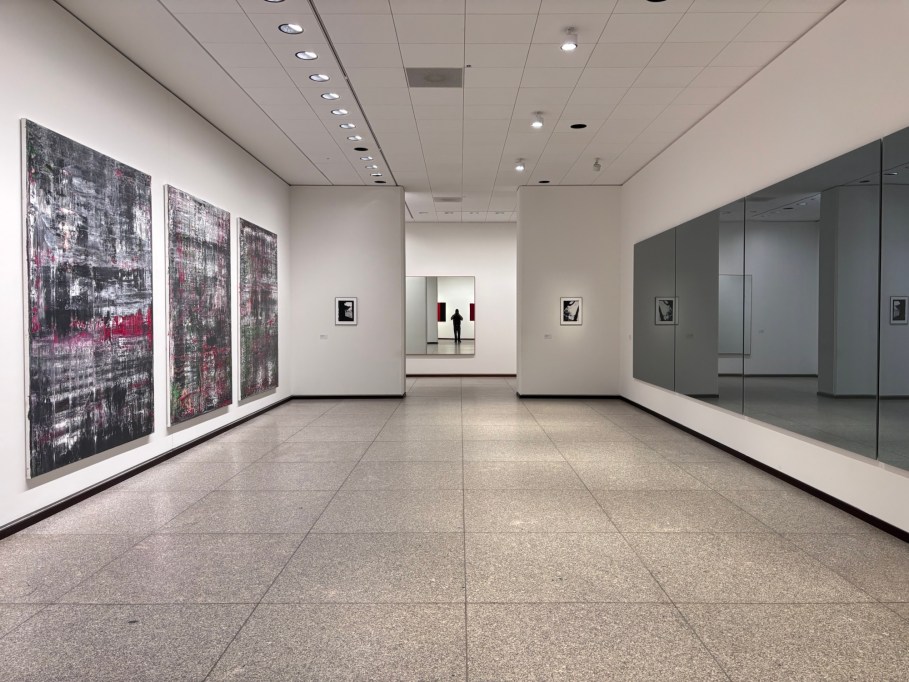

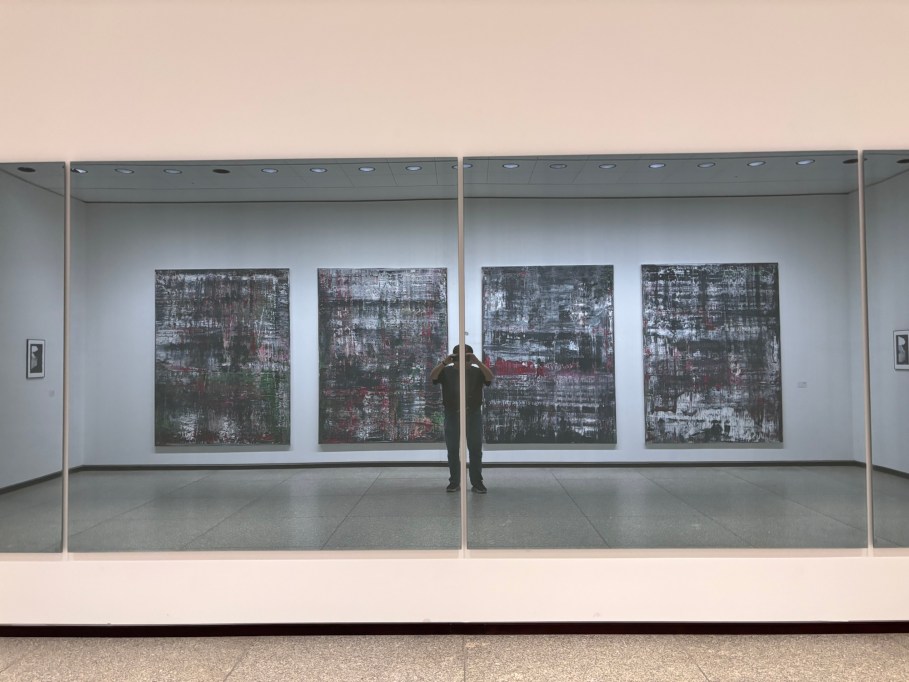
That’s another mirror at the end.
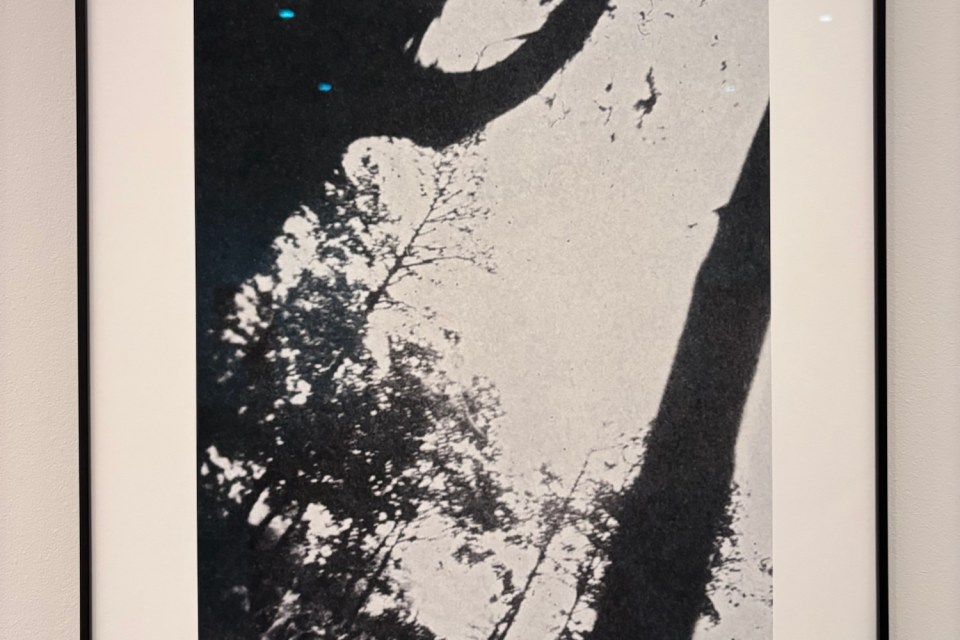
A forbidden image taken by a prisoner, attributed to Alberto Errera: Auschwitz-Birkenau, 1944.
“Grauer Spiegel” / Grey mirror, by G. Richter, 2019, 4 parts.
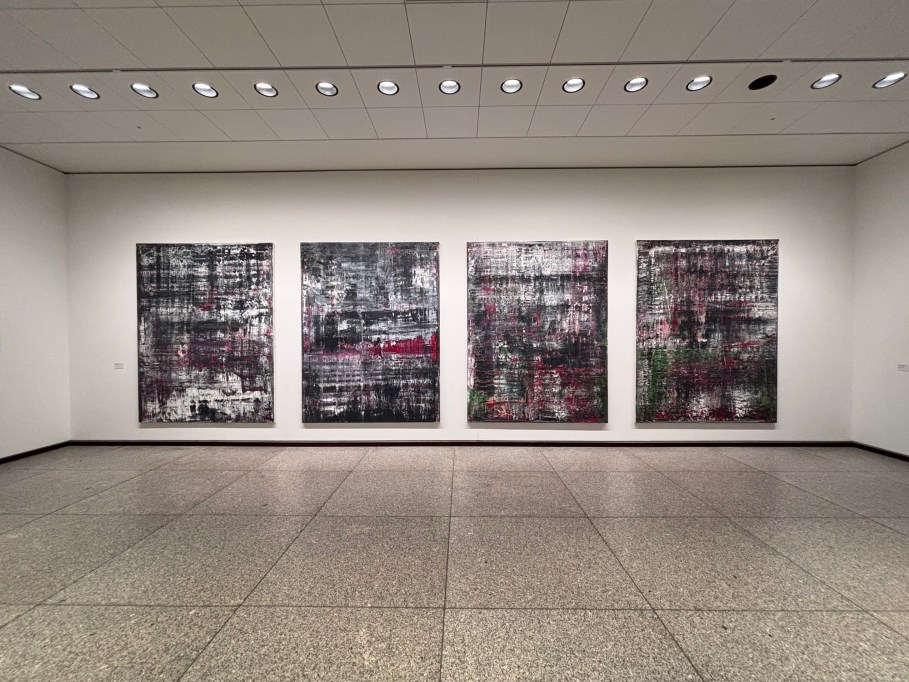
“Birkenau”, by G. Richter, 2014, 4 parts.
The physical reflection invites the impossible, a (self-) examination asked by the artist of the viewer to consider the moral depths into which we will sink; whether survival welcomes or allows creative expression, and whether we still have it in ourselves to truly engage with the history of very difficult questions.
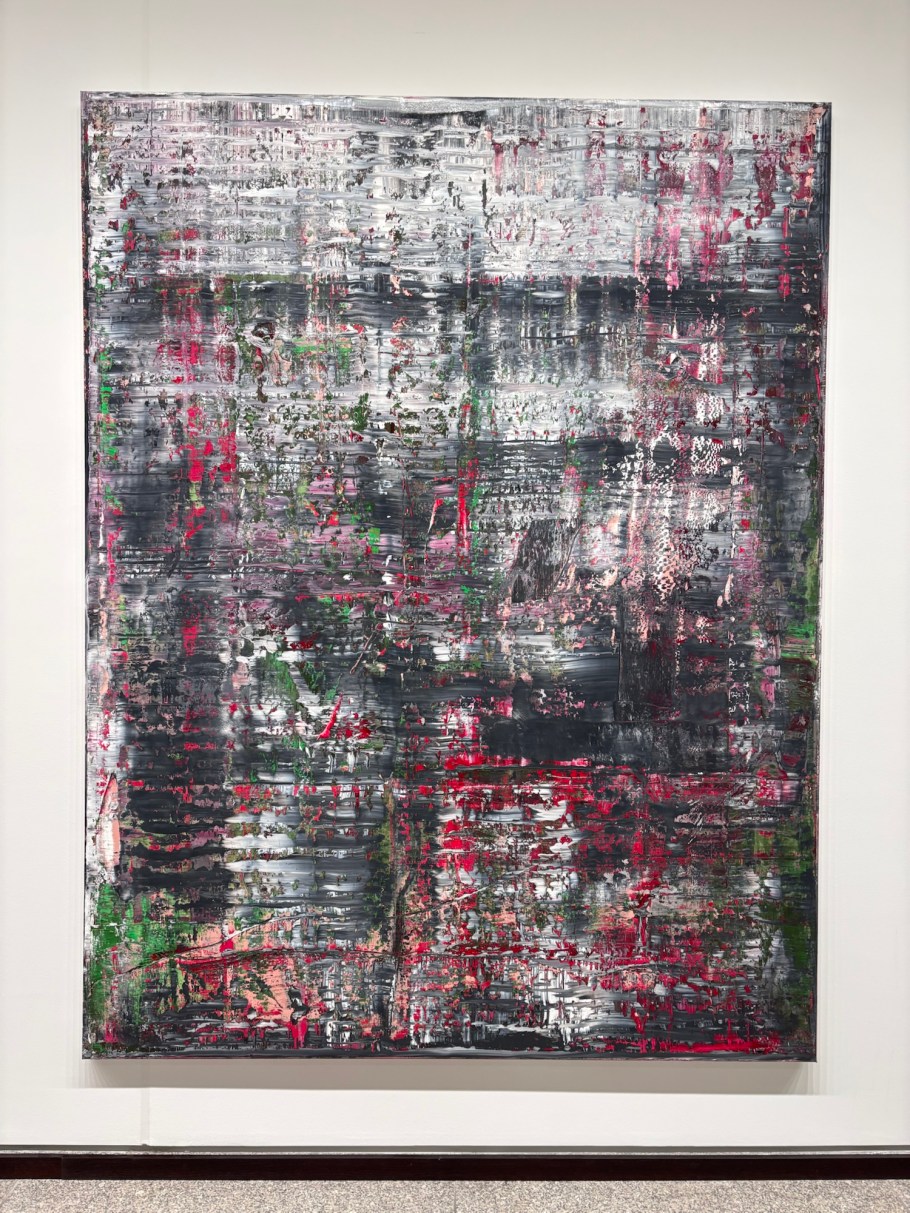
1 of the 4 parts. The abstraction is what keeps things “level”; see why below.
Neue Nationalgalerie.

I made all images above with an iPhone15 on 22 May 2025. I received neither request nor compensation for this content. This post composed within Jetpack for iOS appears on Fotoeins Fotografie at fotoeins DOT com.