Fotoeins Fotografie

location bifurcation, place vs. home

Posts tagged ‘Mauerfall’

My Berlin: The Parliament of Trees

Above: “Parlament der Bäume gegen Krieg und Gewalt.”

In Berlin’s government district is a patch of ground – a garden, really, with tall trees and a place that’s easy to overlook. The official name is “Parlament der Bäume gegen Krieg und Gewalt” (Parliament of Trees Against War and Violence), begun by artist Ben Wagin in 1990.

Wagin (1930–2021) began planting trees on land where the former Berlin Wall used to run near the historic Reichstag government building, as authorities began dismantling the physical wall. What remains of Wagin’s experiment is a piece of ground that acts as both memorial to what the Wall represented and fractured, and an aspiration for both modern Germany and Europe.

Of the many trees in this space, 16 of them represent the 16 modern federal states of Germany. There are also slabs of granite on which are engraved the names of the victims of the Wall. The “back” wall is painted with murals and messages, and in between are little paths and flower beds. I think Wagin also wants to remind us that in many parts in Berlin and throughout Germany, the former Wall dividing the city and the two former nations, respectively, have been reclaimed by nature.


( Click here for images and more )

My Berlin: Bornholmer Strasse, first through the Wall

By today’s appearance, it’s easy to overlook the bridge at Bornholmer Strasse (also known as BösebrĂĽcke) as an historic landmark. On the night of 9 November 1989, the Berlin Wall opened here first, at the Bornholmer Strasse bridge border-crossing between East Berlin and West Berlin.


( Click here for images and more )

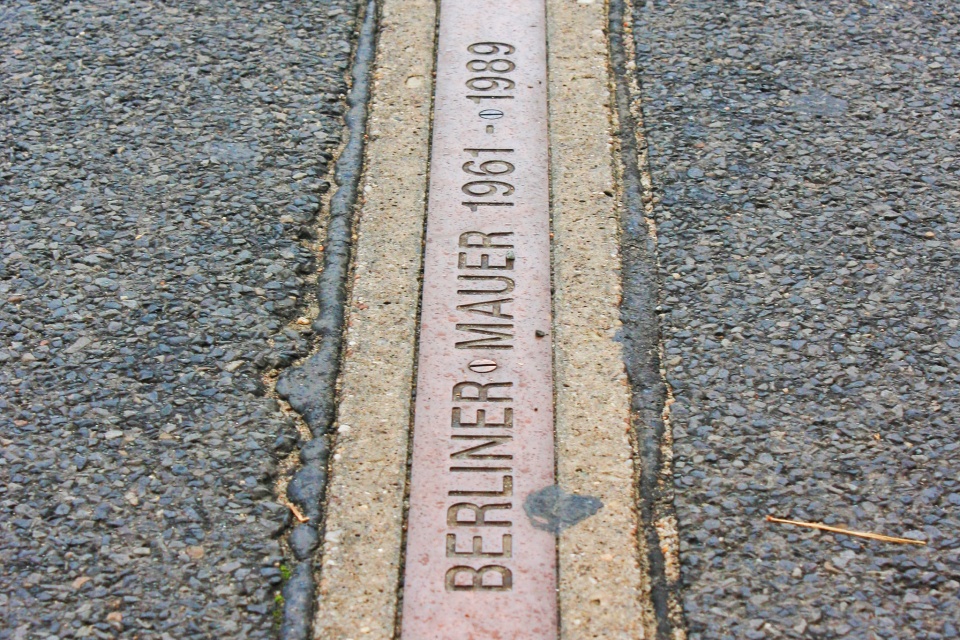
Pavement marker Niederkirchnerstrasse, between Martin-Gropius Bau & Topographie des Terrors, Berlin, Germany - 2. Okt. 2009

The Berlin Wall, 1961-1989

Some view East Germany (GDR/DDR) with great fondness, if it’s a comparison made between today with the “good old days.” I’m not interested in the “Ostalgie” (nostalgia for the former east). I’m interested in learning how a system in place does a gradual creep, takes over a country and her people. Before they realize what’s happening, their own government has locked them inside the borders to prevent them from leaving; get caught trying to escape near the border, and you’ll be shot for your trouble.

“No intention to build a wall …”

On 15 June 1961, when asked at a press conference if a wall would be erected between west and east Berlin, Walter Ulbricht, leader of the GDR’s only recognized political party, the Socialist Unity Party of Germany (Sozialistische Einheitspartei Deutschlands), answered:

“Die Bauarbeiter unserer Hauptstadt beschäftigen sich hauptsächlich mit Wohnungsbau, und ihre Arbeitskraft wird dafĂĽr voll eingesetzt. Niemand hat die Absicht, eine Mauer zu errichten.”

“Construction workers in our capital city are fully engaged in residential construction, and the labour force is deployed for that purpose. No one has any intention of putting up a wall.”

(Chronik der Mauer | YouTube )

Privately, Ulbricht had already been pushing hard to build a wall to stop the increasing number of people leaving East Germany for the West. Building a wall would also strengthen the (buffer) position of East Germany within the developing Soviet satellite-empire.

Two months later at midnight on August 13, work began quietly on a wall, and orders were given for additional troops to guard and “protect” the border. Berliners awoke at daybreak to a divided city.


( Click here for more )