Just south of Vienna’s city limits is Mödling which is easy to reach with S-Bahn or regional trains. Ludwig van Beethoven spent parts of 3 summers here in town. In the early 20th-century, Arnold Schönberg and his family lived in a house for a number of years, before moving to California.
Beethoven lived here
Hauptstrasse 79 / Badstrasse 2-4.
This modest memorial to Beethoven is next to the building’s east wall.
On the building’s north side is a plaque: Beethoven spent 3 summers from 1818 to 1820.
Schönberg was here
Arnold Schönberg and his family lived here at Bernhardgasse 6 between 1918 and 1925.
Small exhibition- or performance space. His former study.
String-instruments.
His typewriter, with a modern 1-Euro coin for size comparison.
“Peace on Earth”, op. 13; “Six Little Piano Pieces”, op. 19.
The eyes were always prominent in portrayals of Schönberg.
Death mask, made by Anna Mahler, after his passing in Los Angeles on 14 July 1951.
“Quality city; all me.”
I made the photos above with an iPhone15 on 27 Jun 2024. This post composed with Jetpack for iOS appears on Fotoeins Fotografie at fotoeins DOT com.
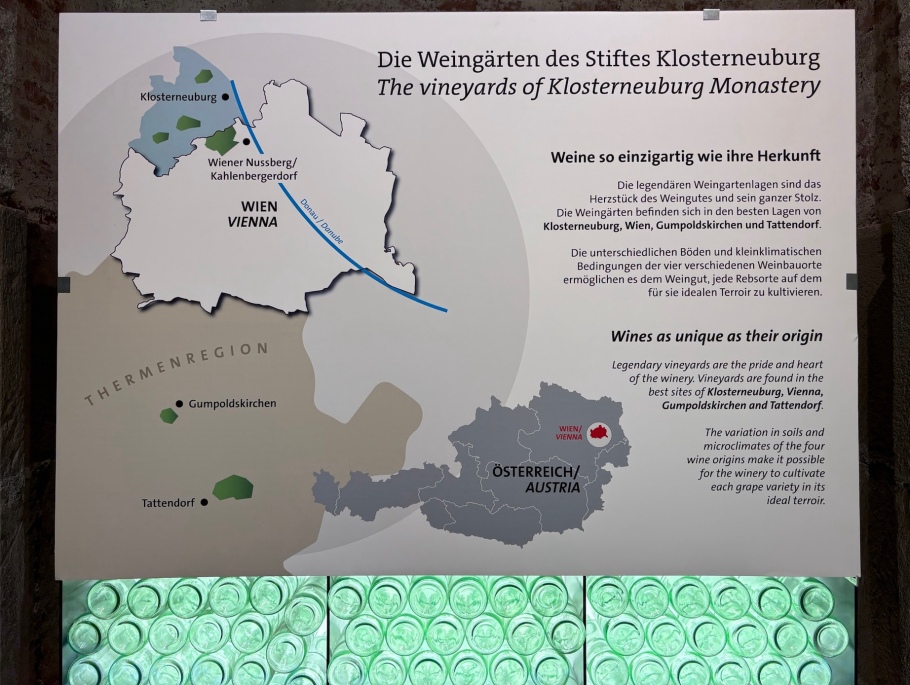
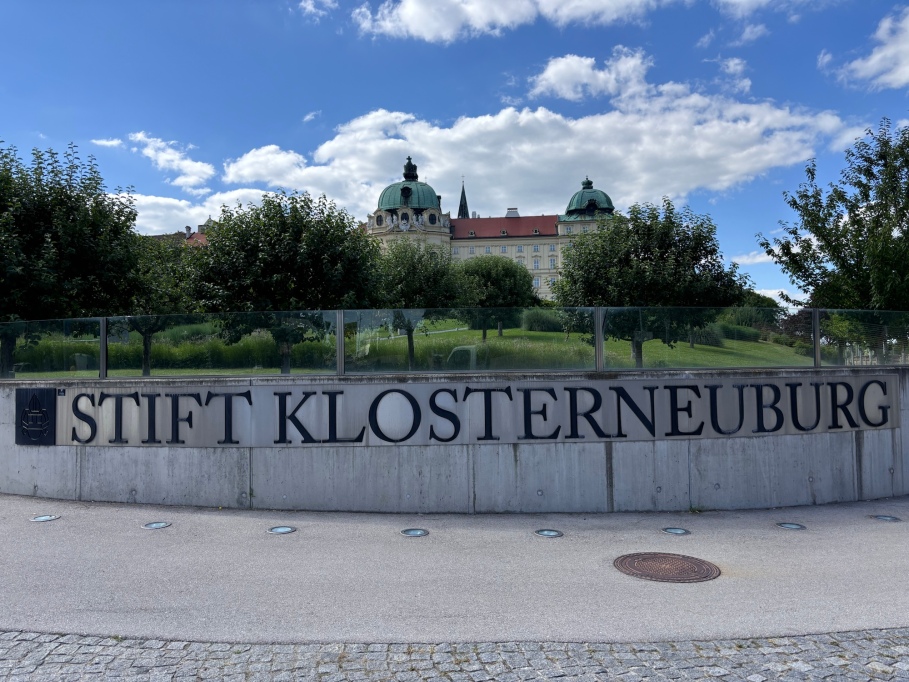
Located only 20 km north from Vienna, Klosterneuburg established as a small town in the early 12th-century, before a monastery and imperial residence were built on high ground overlooking the Danube river. The nobles and the abbey owned a lot of land in Vienna, and a lot of that land took very well to grapes. Their long history of wine-making continues today with vineyards in the vicinity, within Vienna, and in other parts of Lower Austria.
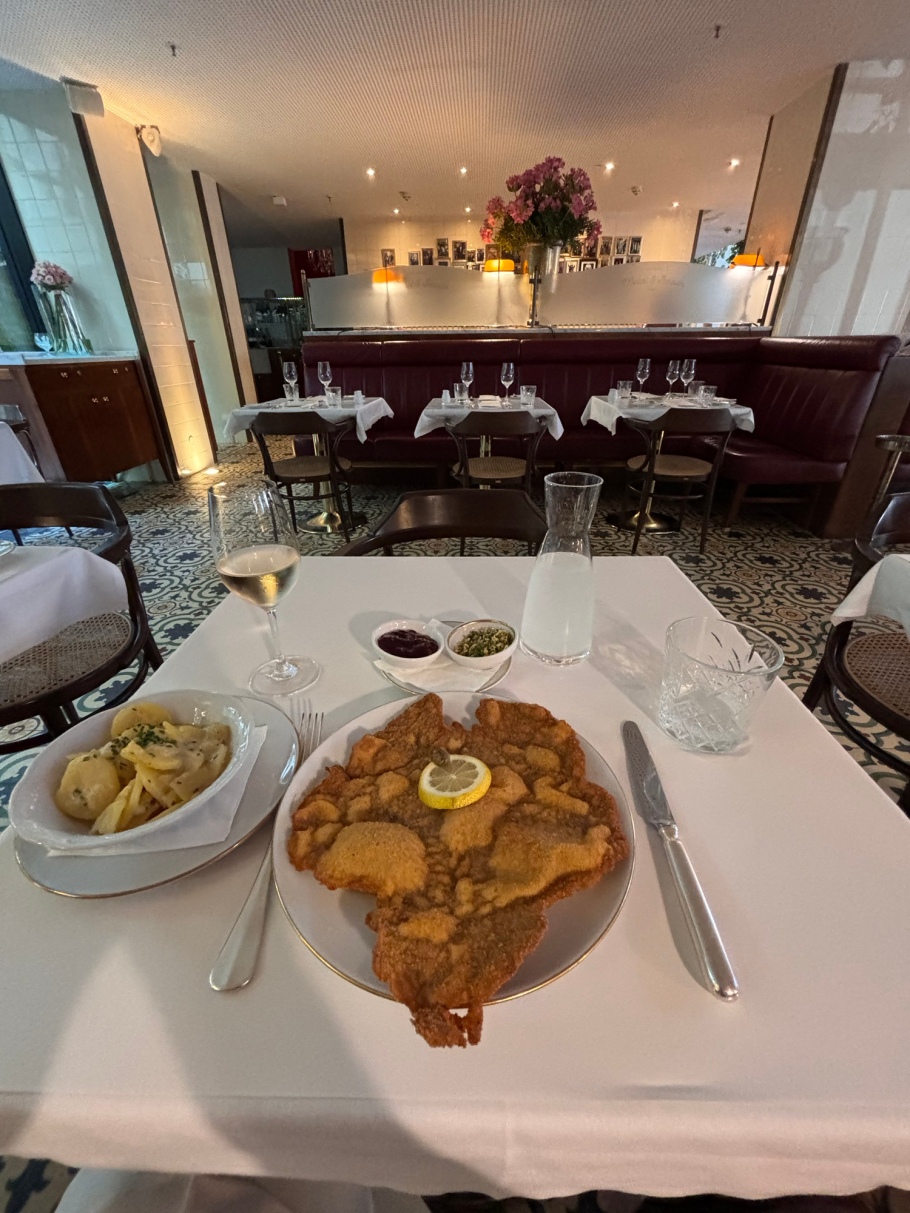
Reading about wine got me hungry, and it was finally time to break the “schnitzel duck(-egg)” this visit. In Vienna’s inner city, I meandered back to Meissl & Schadn for a second-time visit. I ordered the same as in 2022, with a small glass of “Wiener Gemischter Satz” white wine.
Stiftskirche (Abbey church).
Symbols of power: a “marriage” of divine authority and noble privilege.
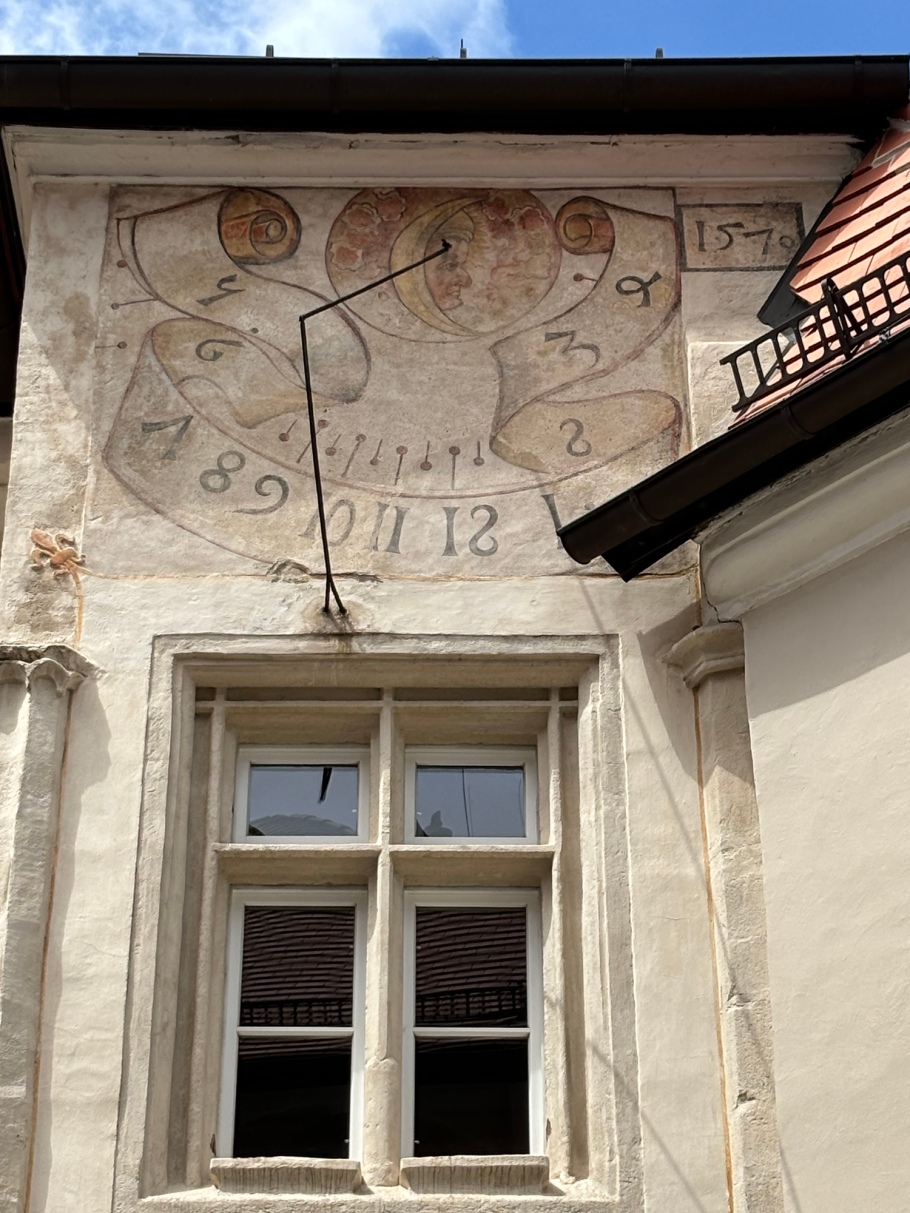
Above the Stiftarchiv (abbey archives) is a sundial from 1570 CE; I am a fan of sundials! Note how numbers are written from the time, especially 2 to 6. The shadow line intersects with 1 in the afternoon, consistent with the photo time of 2pm CEDT.
Inside the Pfarrkanzlei (right) is a visitor reception area for guided tours.
Visitor reception, where some tours begin (pic 0.5x).
The monastery continues its winemaking with its own vineyards in the region.
Examples of their own Grüner Veltliner, Riesling, Sauvignon Blanc. (Not for tasting, unfortunately.)
Over the Donaugärten (Danube gardens), facing south; background: urban towers in Vienna’s 22nd district at left-centre, Leopoldsberg at centre-right.
Back to Vienna, and a return to Meissl & Schadn for their veal schnitzel fried in lard. Plus smooth refreshing “wash”, with “achtel” (0.125-L) Wiener Gemischter Satz DAC 2023 (left) and 0.5-L Soda Zitrone. (right). The wine paired very well with the meal.
I made all images above with an iPhone15 on 24 Jun 2024. This post composed with Jetpack for iOS appears on Fotoeins Fotografie at fotoeins DOT com.
A separate city about 50 km south from Vienna proper, Wiener Neustadt is easily reached inside an hour’s ride with a regional-express train. For the most part, I was here to photograph one location to complete a project begun in 2022. But, as always, there are interesting things to see in a new place.
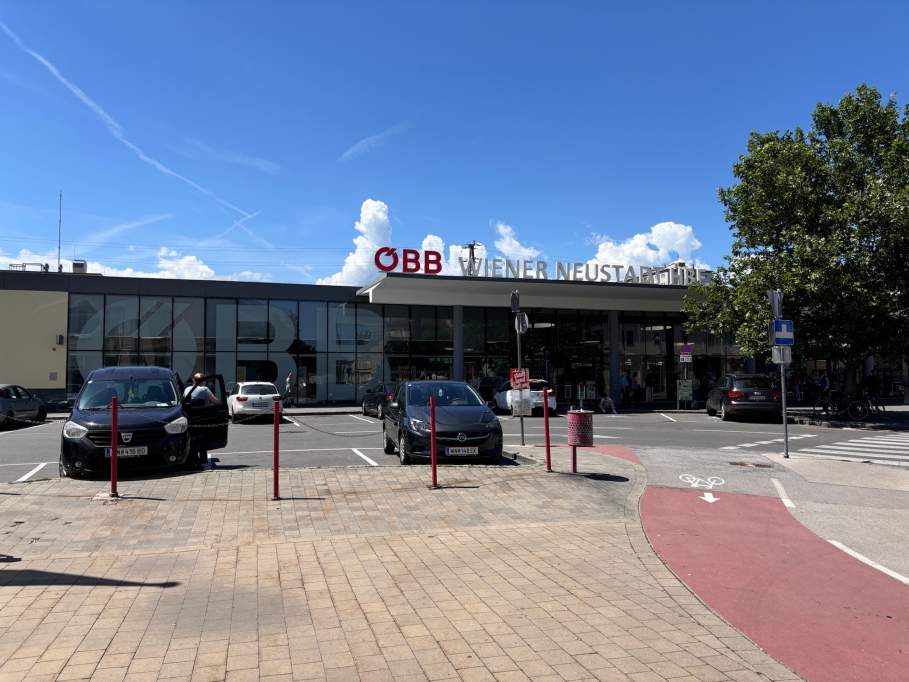
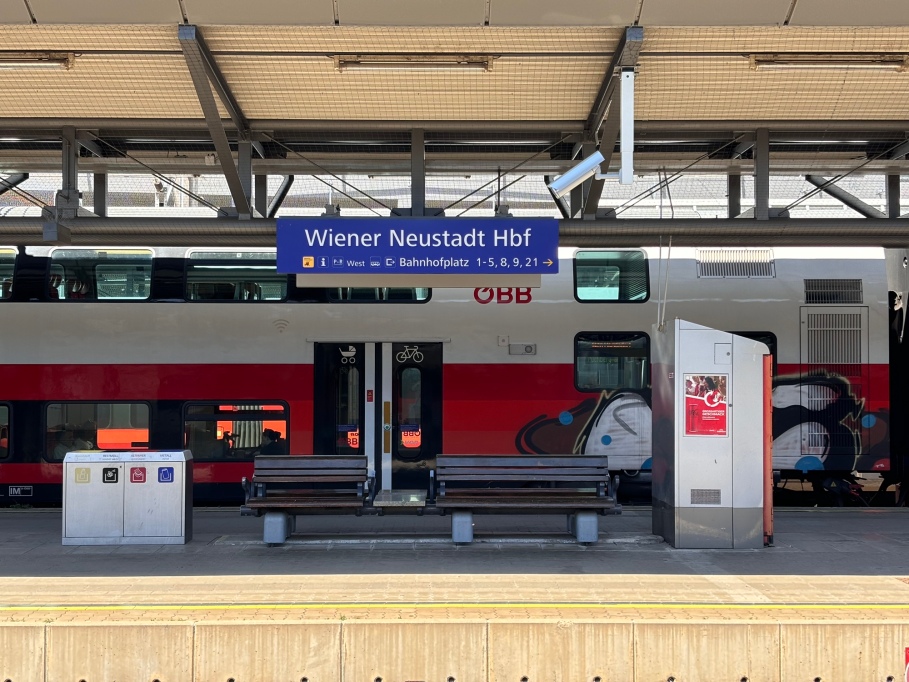
Austria National Rail (ÖBB) station, at Wiener Neustadt.
Friedrichsgasse 3.
Cathedral, began as parish church in 1279.
Lichtzeichen Wien no. 26, at Baumkirchnerring 4: location of 1902 synagogue heavily damaged in the 1938 November Pogrom; building remnant used as warehouse until complete demolition in 1952. This image completes my photography of all 26 Lichtzeichen memorial locations, a project I started in 2022.
From underneath, looking up.
Hauptplatz (main plaza), with Dom (Cathedral) & Mariensäule (Mary column) at centre background and right foreground, respectively.
Rathaus (City Hall) with flags of Austria, Lower Austria, Wiener Neustadt, and the European Union (left to right, respectively).
Once Imperial Residence from 13th to 15th century, Empress Maria Theresa converted the “Burg” into a military academy in 1752. St. George’s Church appears at top-centre.
Inside St. George’s lies the tomb of Habsburg Emperor Maximilian I (1459-1519). I first saw his grand cenotaph inside Innsbruck’s Hofkirche in 2018, not realizing it wasn’t his grave.
Facing west, Bahngasse at Neunkirchner Strasse.
Time to head back and north, to Wien.
I made all images above with an iPhone15 on 17 Jun 2024. This post composed with Jetpack for iOS appears on Fotoeins Fotografie at fotoeins DOT com.








 Fotoeins Fotografie