Fotoeins Fotografie

location bifurcation, place vs. home

Posts tagged ‘Innere Stadt’

25T56 Francesca Woodman at Vienna Albertina

E55, V03.

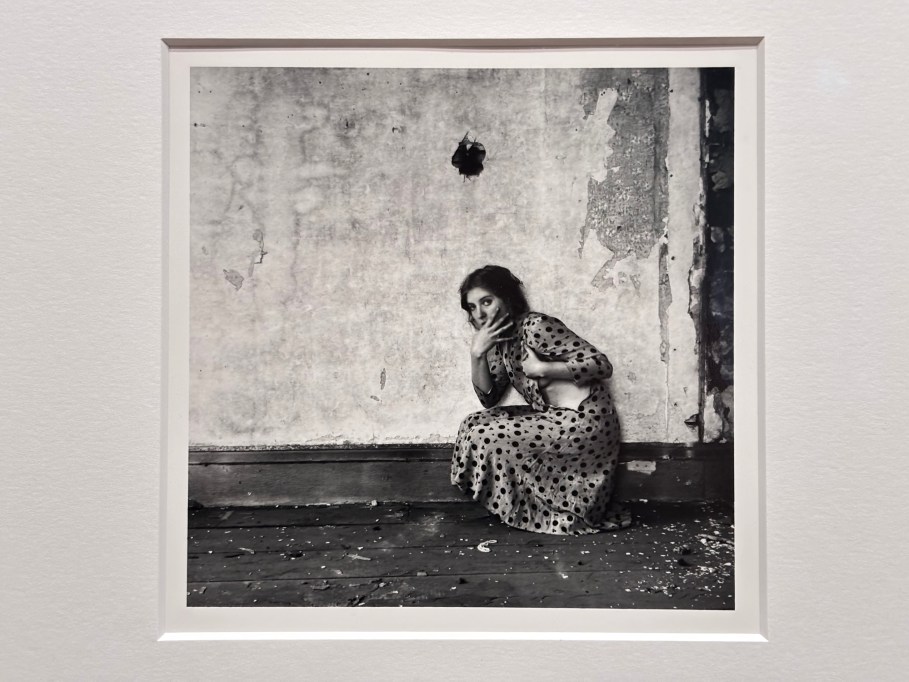
I arrived at the city in time, as a featured art exhibition was scheduled to end in less than a week. The first time I’d seen their work was in a gallery on Geary St. in San Francisco in 2011. The impact of having seen their images has long stayed with me. Almost 14 years later, I’m in Vienna’s Albertina for their 1st ever presentation of Francesca Woodman with over 100 of her photographs from the Verbund Collection.

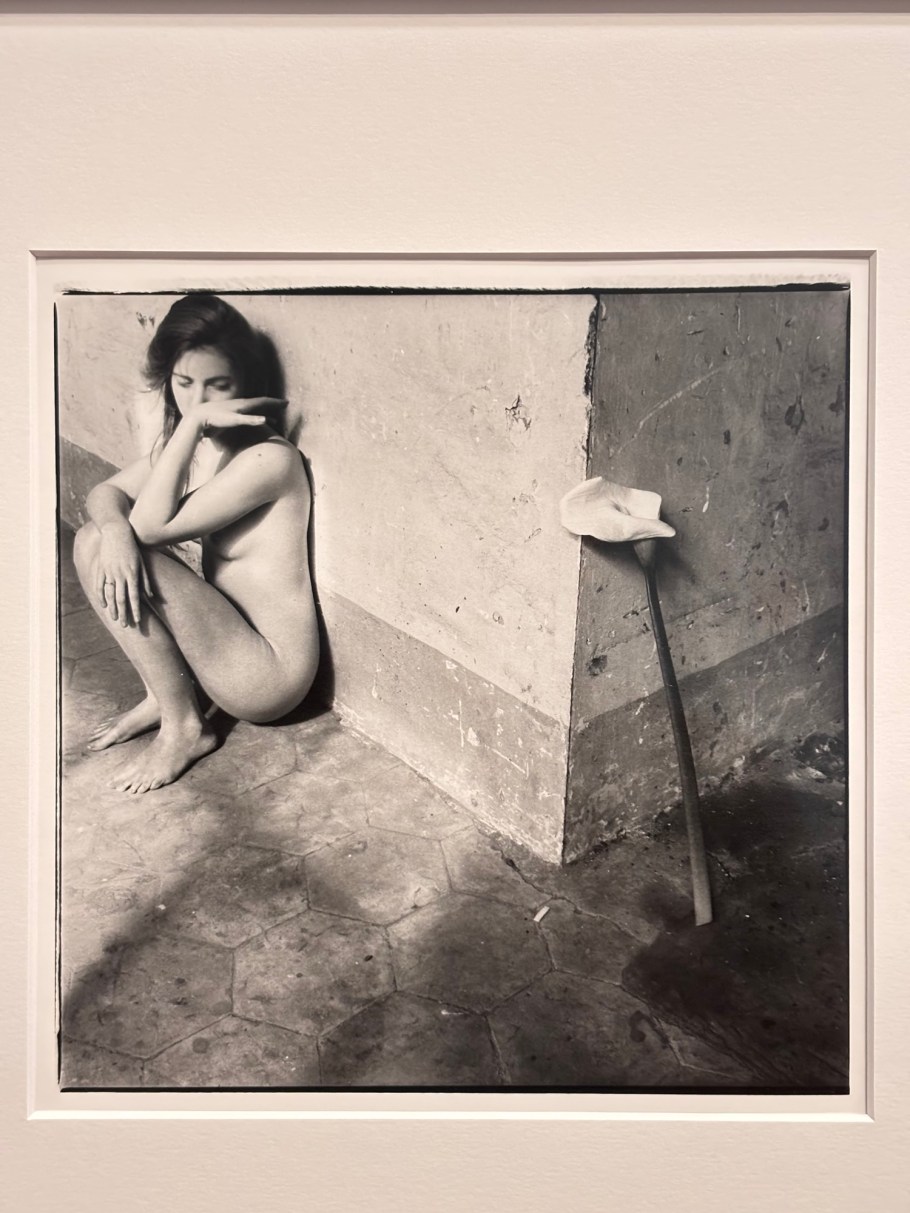
Francesca Woodman (1958-1981) was an American-Italian artist who created an essential body of photographic work: expanding poetic ideas into the visual with the play of natural light and the use of external props (as if a stage-play); examining human beings’ relationships to the spaces we occupy; and asking questions about we view each other, particularly women. Her images provide a kind of electric charge, a sense of momentum and drive, and an overall energy that transitions frequently between the static and dynamic.

I’m a little sad she didn’t have a long life: what ideas, work, wisdom, and message could have come over the intervening years. I’m happy I found her work all those years ago, more so now that I’ve had some time to learn what she was trying to communicate and portray during those 9 special years of her life.


Albertina: on display on the 2nd floor. The Francesca Woodman exhibition ends Sunday, July 6.
“From Polka Dots or Polka Dots”, from the Polka Dots series, 1976.
“House #3”, from the Abandoned House series, ca. 1975-1976.
Untitled, 1975-1976.
Untitled, 1976.
“Almost A Square”, ca. 1977.
“Corner with Lily”, 1978.
Untitled, 1978.
Untitled, 1979.
Untitled, 1979. What’s special about this pair of images: “The artist holds the skeleton of a large leaf in front of her naked back. The stalk and veins of the leaf allude to her spine and ribs, respectively, with a formal correspondence to the structure in the wall, which has been exposed by the peeling plaster layer. There’s a reference to the shape of the leaf as well as her dress’ fern-print pattern. The props are unrelated, but the artist has created a chain of references among leaf, wall, dress pattern, and her body.”

I received neither support nor compensation for this content. I made all images above with an iPhone15 on 2 July 2025. This post composed within Jetpack for iOS appears on Fotoeins Fotografie at fotoeins DOT com.

25T55 My slice through Vienna’s inner city

E54, V02.

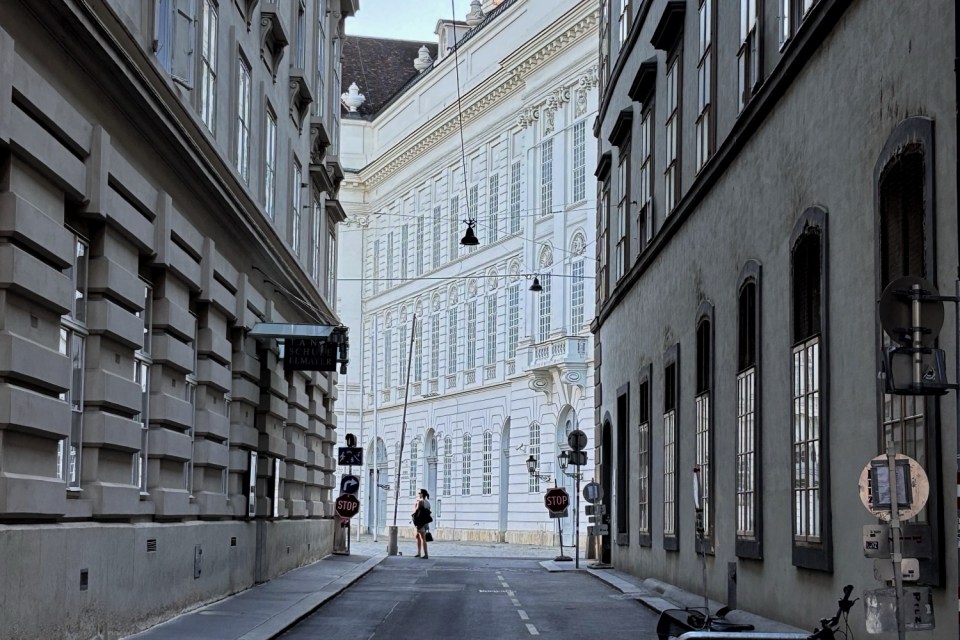
There’s no finer way to mark today’s Canada Day than to find the Canadian Embassy 🇨🇦 in the Austrian capital city. It’s all part of my walk through the Inner City, starting at U1/U4 Schwedenplatz and ending near U2/U3 Volkstheater.

Vienna’s historic city centre was inscribed onto the list of UNESCO World Heritage Sites in 2001, but its status was put onto the Danger list in 2017 with plans (threats?) for development.


It’s 501am and 801am in Vancouver and Toronto, respectively. But here in Vienna, I completed food shopping for the next few days. I’m about to have lunch, after which is some time in the inner city. “3” (Drei) is Austria’s third largest mobile carrier after A1 and Magenta Telekom. Naturally, all temperatures are in degrees Celsius.
While the building has multiple tenants, the uppermost floor is occupied by the Government of Canada with its embassy (Botschaft).
The flag pole is attached to the wall with a metal plate in the shape of a maple leaf.
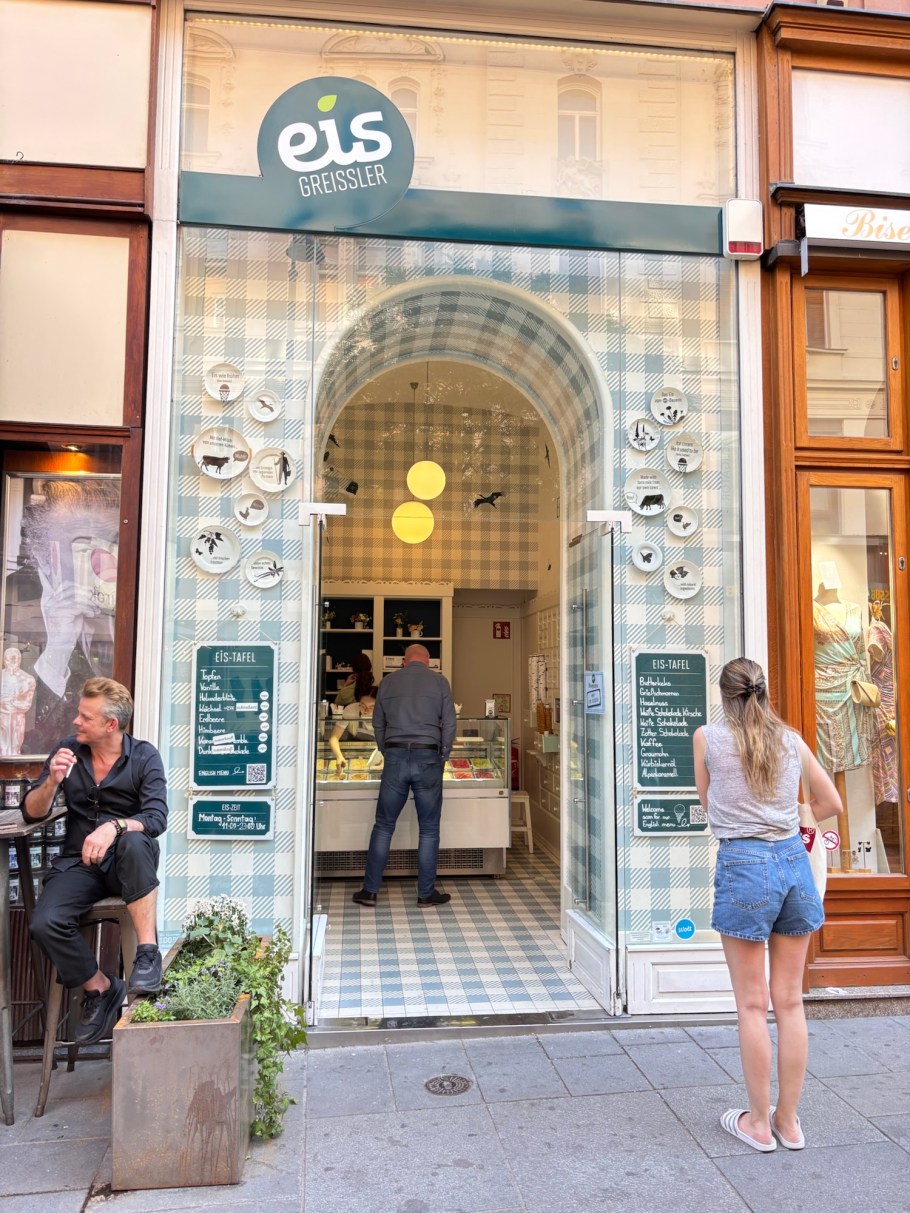
Summertime shop for Eis Greissler (Greissler’s Ice Cream).
Their flavours for the day 🍨 😋
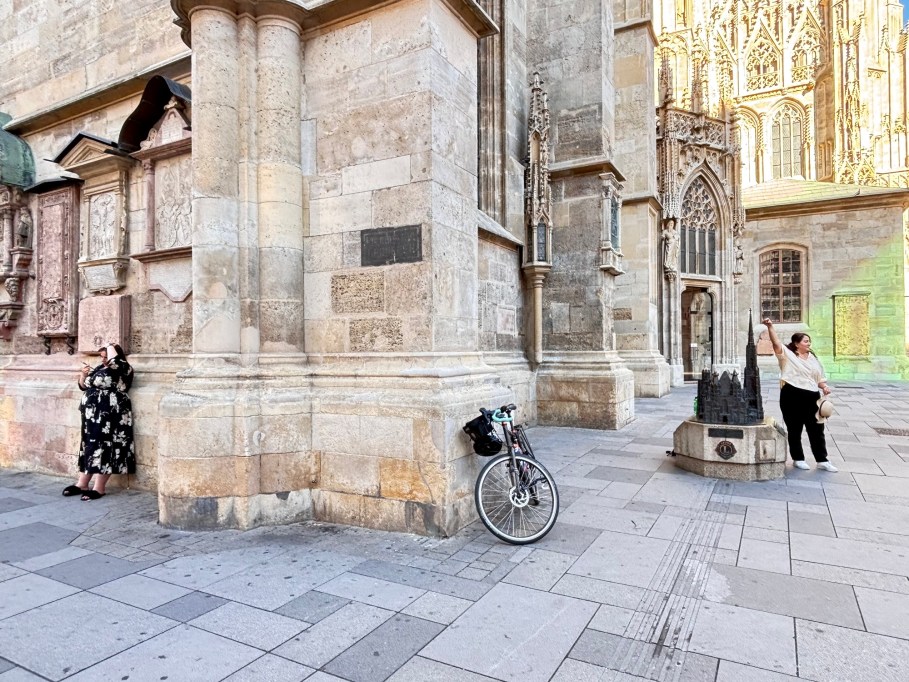
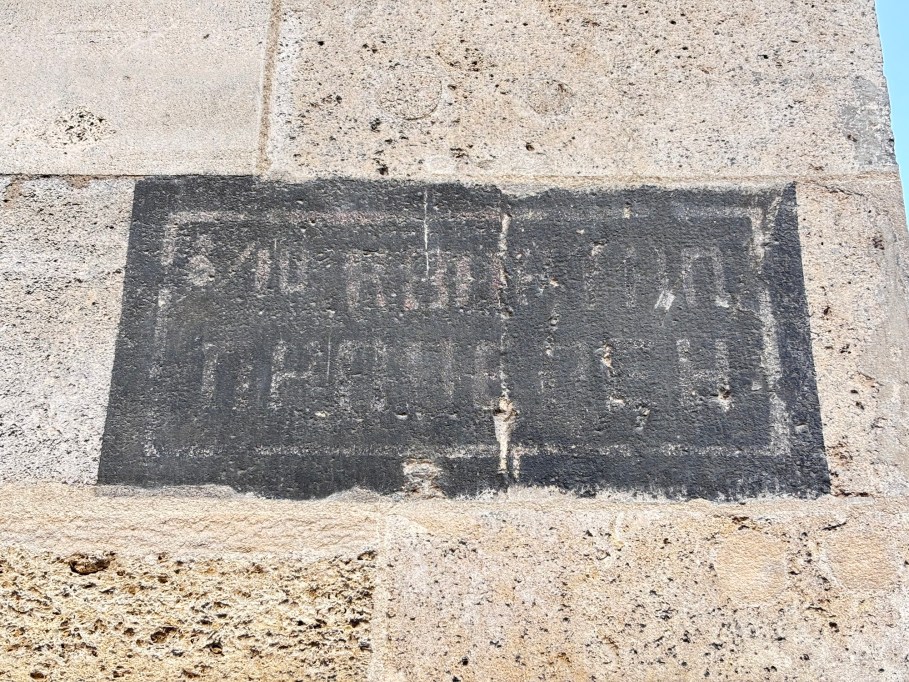
At Stephansplatz, the northwest corner of St. Stephen’s Cathedral (near the cathedral model) has on its wall a small rectangular plaque whose text inscription is almost entirely faded.
This plaque dates to 1945 when Soviet troops had moved into the city and checked building by building. The two words in Cyrillic are: квартал проверен (kvartal proveren), “Häuserblock geprüft”, building checked. There are at least 2 more Soviet inscription-plates like this appearing elsewhere in Vienna.
Steiff: it’s not only about teddy bears 🧸 so how about Riddler bear, Bat-bear, and Elton John bear. At lower-left is a more modest-sized bear holding a little red heart 🫶🏽
מוּזֵיאוֹן
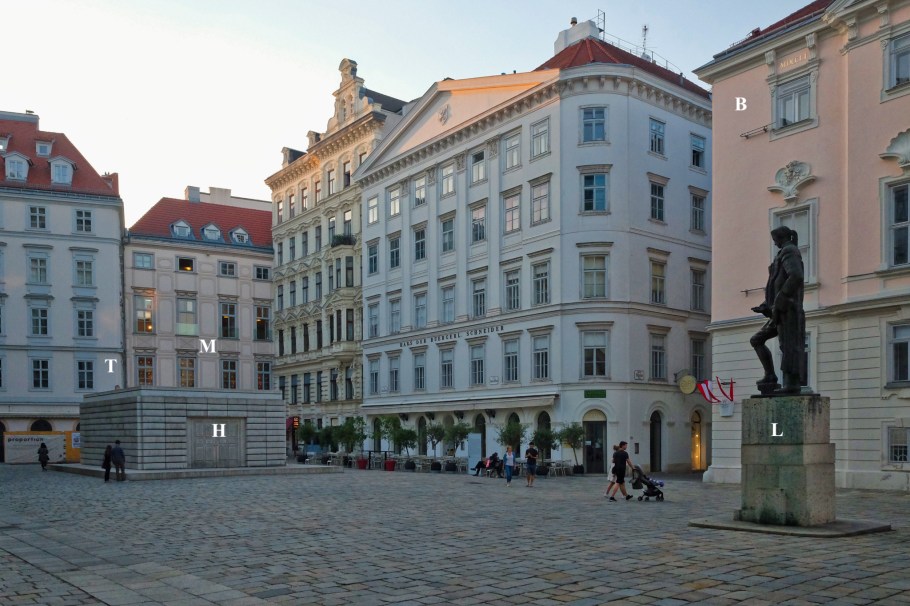
“Museum“, 2011 light installation by artist Brigitte Kowanz for the Jewish Museum Vienna.
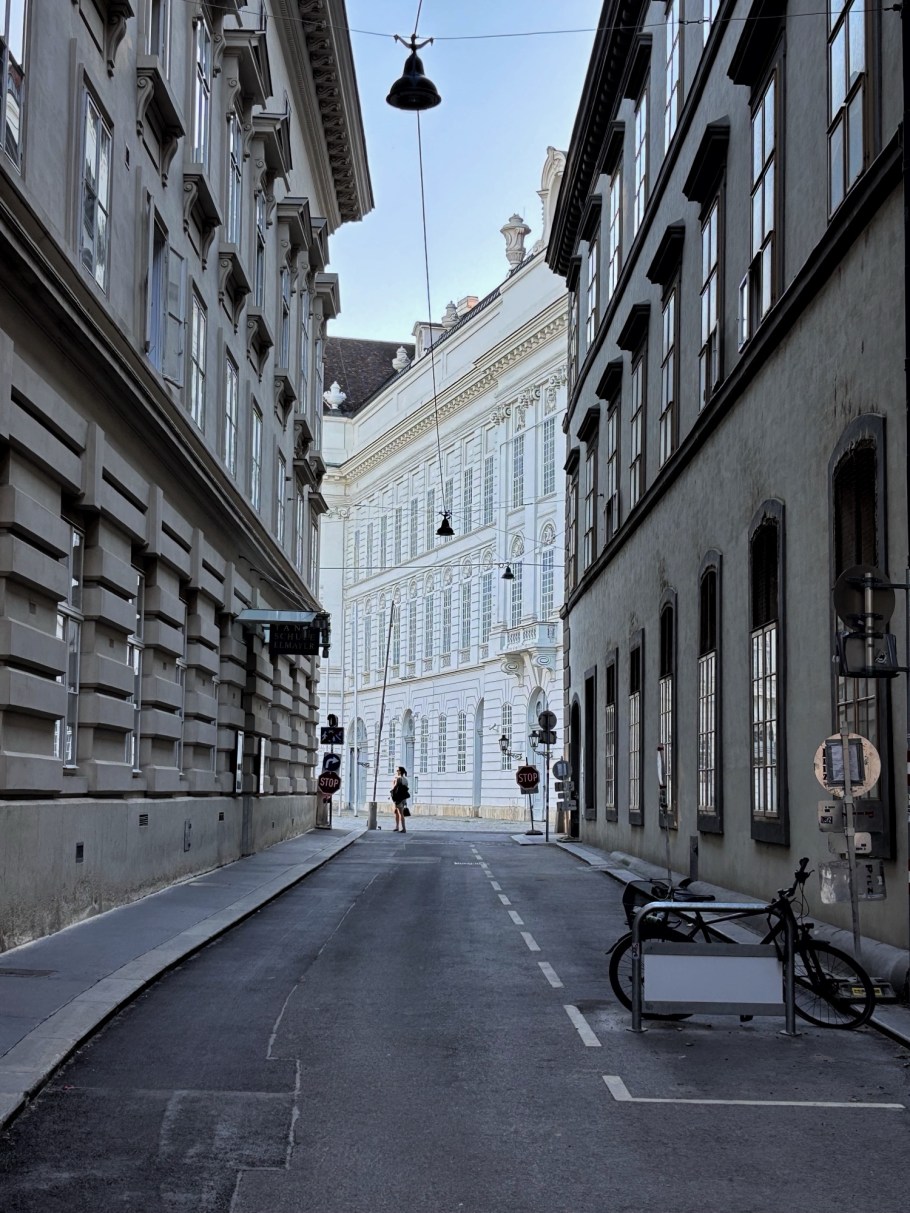
Bräunerstrasse, west towards Josefsplatz.
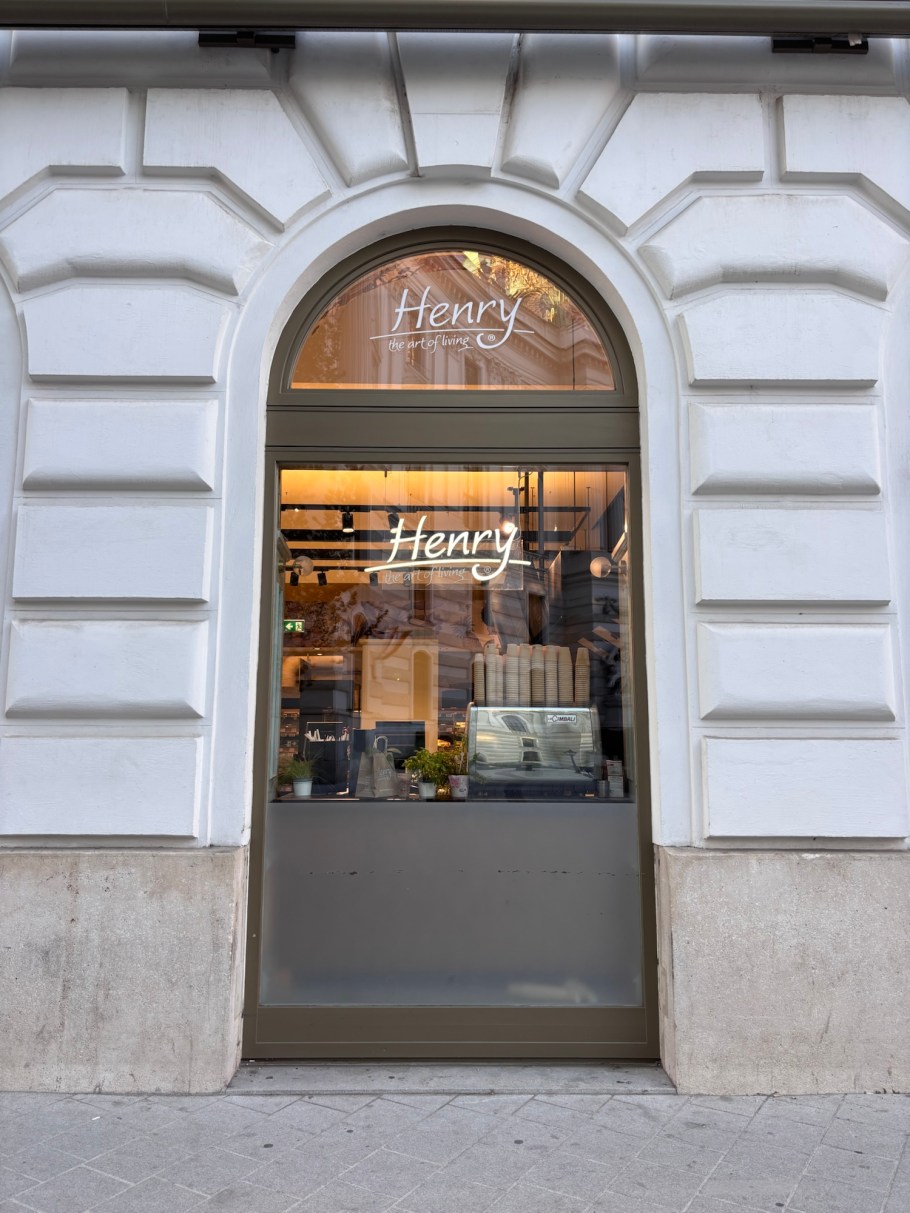
“Henry: the art of living”, at Billa Corso Michaelerplatz.
Hofburg Palace, from Michaelerplatz.
“Volkspartei, Volksgarten”
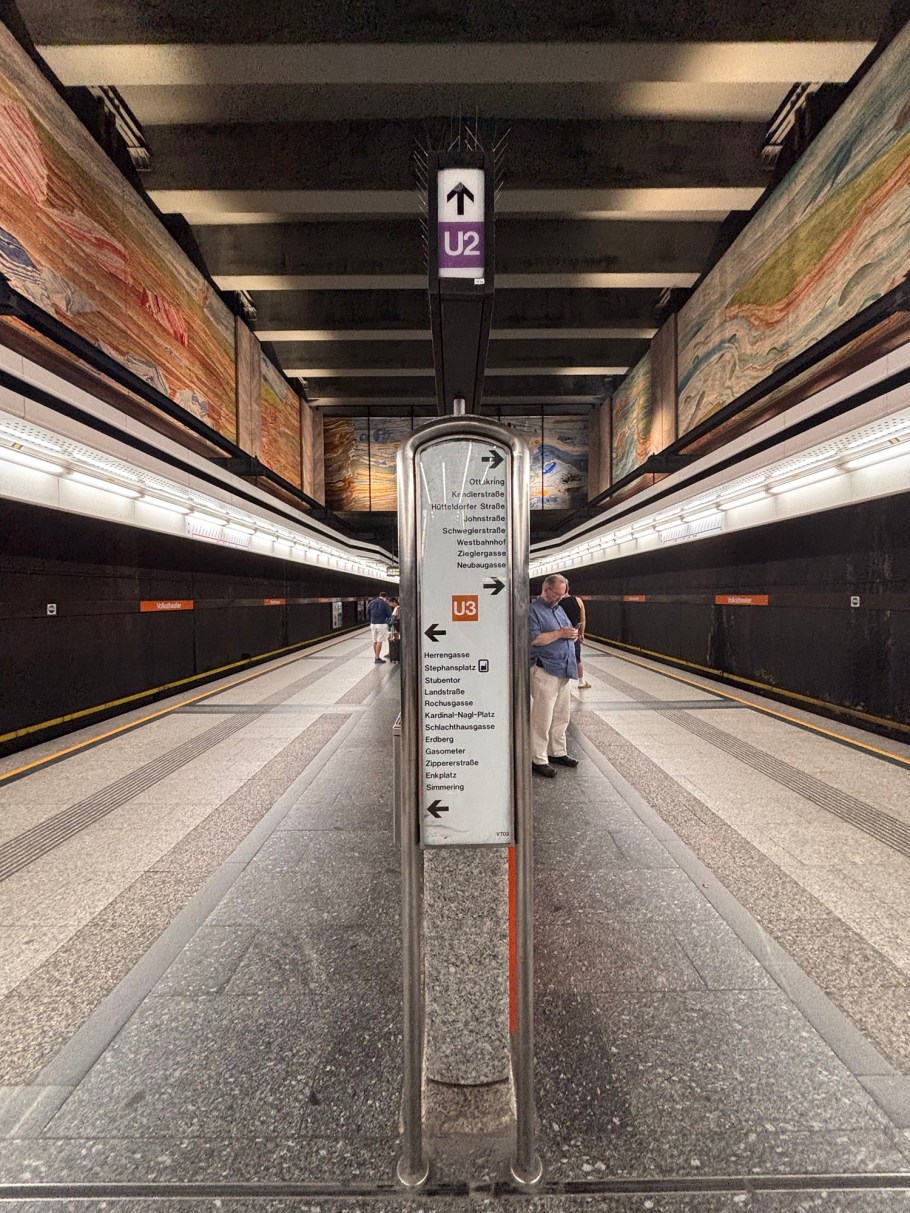
“Island” platform for U-Bahn U3 (orange) station Volkstheater. This is also a junction station with the U2 line (purple).

I made all images above with an iPhone15 on 1 July 2025. This post composed within Jetpack for iOS appears on Fotoeins Fotografie at fotoeins DOT com.

24T55 Caryatids and columns

E54 V21

The word “caryatid” is described in the Oxford Reference as “carved female figure, usually clad in long robes, as an architectural support column; first used in Greece.” For architectural elements commonly found on buildings from the late 19th-century and early 20th-century, I’ve come across some caryatids, columns, and statues over the last couple of days in the Austrian capital city.


“Do not enter, or ELSE !” (Hofburg)
What’s the story? (Hofburg)
Josefsplatz 5: caryatids at Palais Pallavicini, formerly Palais Fries.
Graben 20: boy wearing a fez holding onto a coffee bowl, and the year, 1862, Julius Meinl was established.
Renngasse 7: caryatids.
Tuchlauben 1 / Bognergasse 1. The Chanel is a “somewhat recent arrival,” inserted between two caryatids.
Caryatid, left/west.
Caryatid, right/east.
A long look from above.

I made all photos inside Vienna’s 1st district with an iPhone15 on 30 Jun and 1 Jul 2024. This post composed with Jetpack for iOS appears on Fotoeins Fotografie at fotoeins DOT com.

24T53 Vienna Albertina: potent photography

Greg Crewdson Retrospective

I’m fascinated by these images, their concepts, and their elaborate construction. I remember being stopped in my tracks the first time I laid eyes on a couple of images from the “Twilight” series a number of years ago. It might be easy to compare these images with Jeff Wall’s thoughtful constructions which satisfy the description of “a moving series in a single frame.” Greg Crewdson’s images are also cinematic and dramatic, in both scope and scale, capturing elements of film-noir and the blockbuster. But there’s also provocation in theme, as he inserts seemingly unimportant details and asks the viewer some uncomfortable questions.

The following are a sampling of photographs from three of the four series currently on display at the Albertina in Vienna.

Read more

Vienna Ringstrasse & Architectural Historicism

Above/featured: Examples of the “Ringstraßenstil” historicism style at Maria Theresa Square, with Maria Theresa Monument at left and the Museum of Natural History at right. Photo, 15 May 2022 (X70).

•   Can a street alone define its surrounding architecture?
•   Do the buildings themselves establish the street’s visual impression?
•   Is Vienna (un)fairly defined by the Ringstrasse and the inner city?

The answers, as always, are a little complicated.

Like many, I’m also fond of Vienna’s Ringstrasse (Ring Road), as a kind of “hello” and re-introduction to the city after my first visit in 2002. At 5 kilometres in length, the Ringstrasse is one of the longest streets in Europe, longer than the nearly 2-km Champs-Élysées in Paris and longer than the 4.5-km Nevsky Prospekt in St. Petersburg. The boulevard is surrounded by Prachtbauten (buildings of splendour), constructed in the architectural style of “historicism,” a big nod to classic “forms” reflecting structural “functions”. The late-19th century “Ringstrassenstil” (Ring Road architectural style) continued the practiced habit of choosing a historical style which best identified with the purpose of the building. For example, the Neo-Baroque architectural style is represented in the Civic Theater; the Neo-Classical style in the Parliament and New Palace; the Neo-Gothic style in City Hall and the Votive Church; and the Neo-Renaissance style in the museums, palatial mansions, Opera House, and the University.

On Christmas Day 1857, the Wiener Zeitung newspaper published an imperial decree written 5 days earlier (on 20 December) by Habsburg emperor Franz Joseph I. He ordered the demolition of the inner-city wall and the subsequent creation of a circular boulevard, bordered by grand buildings and filled with green spaces. The large outward extension of the inner city changed and influenced the urban development of Vienna, still seen to this very day.

It is my will that the extension of the inner city of Vienna should proceed as soon as possible, providing for appropriate connections between the city and the suburbs as well as the embellishment of my imperial residence and capital. To this end, I authorise the removal of the walls and fortifications of the inner city as well as the ditches around it …

– Emperor Franz Joseph I: 20 Dec 1857, published 25 Dec 1857.

On 1 May 1865, Emperor Franz Josef unveiled the Ringstrasse in an official ceremony, even though large areas remained under construction. Ringstrasse structures included the religious and the secular, as well as the public and the private. The Ringstrasse symbolized the power of the imperial state, and the growth of a new arts and culture scene with the increasing popularity of coffee houses.

It’s also important to note the architectural impact made by the Jewish middle- and upper-class to integrate within the Habsburg empire. For example, the families Ephrussi, Epstein, and Todesco commissioned architect Theophil Hansen to construct palatial mansions as visible manifestations and partial realization of the dream of many Viennese Jews: assimilation into and emancipation within Viennese society. (Viennese journalist and political activist Theodor Herzl might have had a different opinion about that.)

For residents and long-term visitors today, it’s entirely possible to fit into the unintended shape and mentality of the “modern” city: that the inner-city wall was simply replaced by a different wall of “economic class”, that the architectural callback to historicism “freezes” the inner-city in time, and that like many, I can live, traverse, and work in the outer districts and avoid entering the inner city.

For short-term visitors today, the Ringstrasse buildings form a golden shiny “ring” around the “fingers” of the U1 and U3 metro lines traversing through the UNESCO World Heritage inscribed inner-city. For these visitors, all that’s needed for their limited time in Vienna is the inner city.


( Click here for images and more )