Fotoeins Fotografie

location bifurcation, place vs. home

Posts tagged ‘German Rail’

Deutschland Ticket, for Canadian visitors (2024)

How-to buy guide, effective May to August 2024.

( 2025 note: On 18 September 2025, Bavarian state broadcaster BR24 reported the monthly price for the Deutschland-Ticket will go up by 5€ to 63€ , starting 1 January 2026. The price had already gone from 49€ to 58€ for the 2025 calendar year. My summer 2025 purchase went the same way as in 2024, whose details are described below. )

89 days within Europe includes by necessity substantial travel by train within Germany. I’ve already booked in advance a number of intercity express segments, but what about local transport and regional trains?

The “Deutschland Ticket” (D-Ticket) is a rail ticket for one person and costs 49€ per month on a rolling subscription. The ticket is generally valid for local transport (bus, tram, U-Bahn, S-Bahn, intracity ferry) and regional rail (RB, most RE, IRE), but not for long-distance IC and ICE routes. Intended primarily for commuters, visitors to Germany can also purchase these tickets.

It’s early-April 2024, and I’m about to buy the D-Ticket for 49€ for the entire month of May. The ticket’s “rolling subscription” means if I do nothing else before 10 May, I’ll also automatically purchase a D-Ticket for the month of June for 49€. I’ll need the D-Ticket for May, June, July, and August; but I can only buy one month at a time.

I choose Munich’s MVV-App, based on successes reported by other travellers. I’m only using the Munich app for ticket purchase, and I’m not planning to use public transport within Munich. To buy a D-Ticket, customers are neither limited by their choice of app/method, nor by the base/location where the app is based. My question is whether a Canadian-based credit card is an acceptable form of payment by the processing company in Germany for a German-based app.

Read more
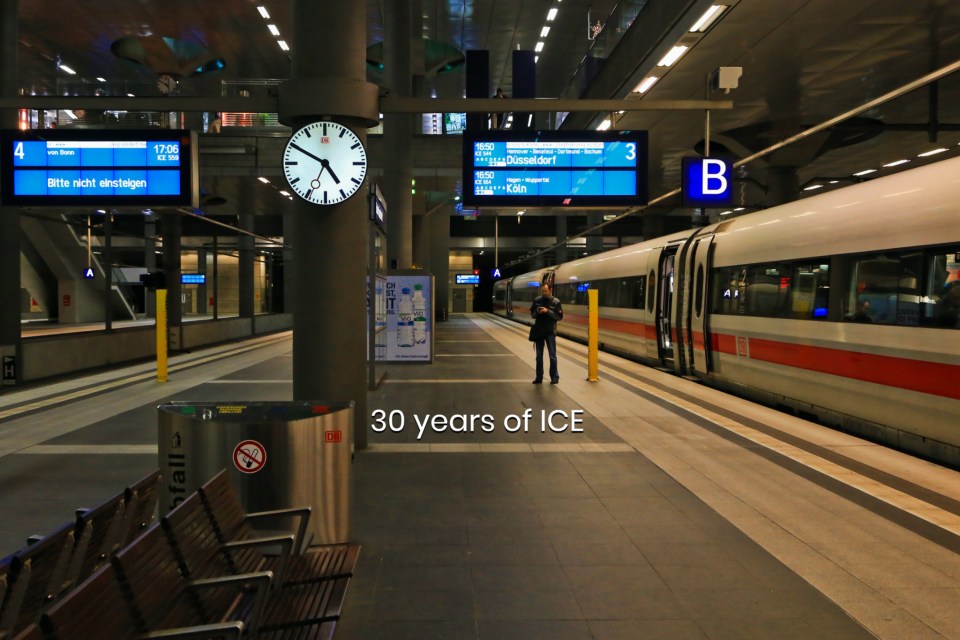
Berlin Hauptbahnhof, B Hbf, Berlin, Germany, Deutschland, fotoeins.com

Germany: 30 years of ICE on the rails (2021)

Above/featured: Berlin Hauptbahnhof – 9 Dec 2015 (6D1). Departing from track 3 is ICE 554 to Köln (front-half) and ICE 544 to Düsseldorf (back-half); trains split in the town of Hamm.

June 2021 marks the 30th anniversary of high-speed Intercity Express (ICE) service on German rail.

In the 1991 vs. 2021 comparison graphic provided by Deutsche Bahn, I’ve marked in green the ICE routes upon which I’ve made dozens of trips since late-2001 (when I moved to Heidelberg). Even after leaving in 2003, frequent annual trips back to Germany meant spending a lot of time planted on express trains across the country. Arriving in Europe mostly meant flying into Frankfurt am Main airport, from which I’d travel:

  • Frankfurt to Berlin, via Kassel
  • Frankfurt to Heidelberg, via Mannheim
  • Frankfurt to Köln
  • Frankfurt to Munich, via Stuttgart
  • Berlin to Frankfurt, via Kassel
  • Berlin to Köln, via Hannover
  • Köln to Berlin, via Hannover
  • Köln to Frankfurt
  • Munich to Frankfurt, via Stuttgart

Over the last few years, the express stretch between Erfurt and Halle/Leipzig has vastly improved the Berlin-Frankfurt and Berlin-Munich routes, cutting the one-way travel time for each route by about one hour. Except for the Erfurt-Halle/Leipzig stretch, I’ve travelled on every “Stundentakt” ICE route (thick red/green in the graphic below).

Intercity Express, Deutsche Bahn, German Rail, Germany, Deutschland

ICE coverage, including recent work on the Erfurt-Halle/Leipzig stretch; graphic courtesy of Deutsche Bahn. My “dozens on ICE” are marked in green; red filled circles indicate cities I frequented the most (B, F, HD, K, M).

Intercity Express, train fleet, Deutsche Bahn, German Rail, Germany, Deutschland

The ICE fleet of trains include vehicles with maximum speeds of over 300 km/h; graphic courtesy of Deutsche Bahn.

Frankfurt am Main Hauptbahnhof, F Hbf, Frankfurt am Main, Hesse, Hessen, Germany, Deutschland, fotoeins.com

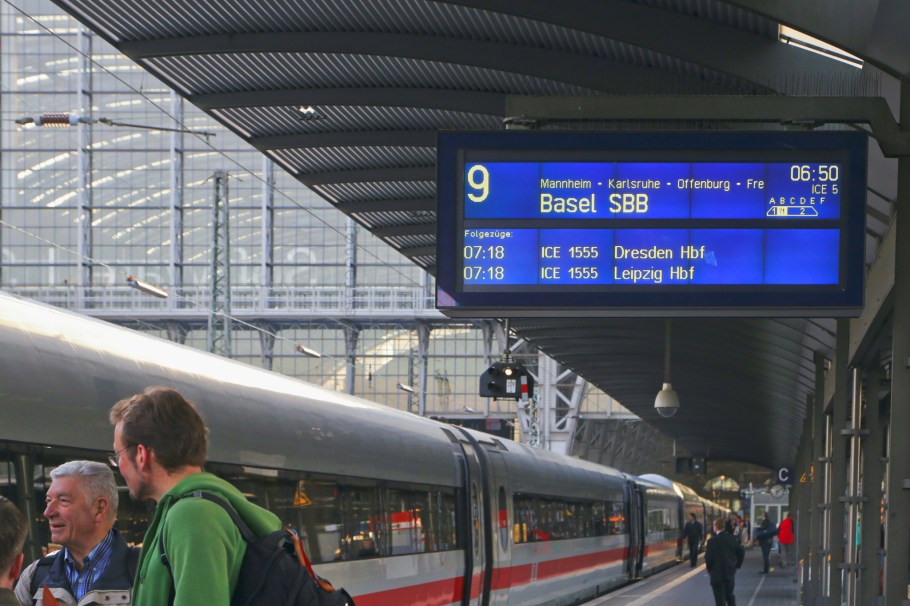
Morning ICE 5 service from Frankfurt am Main to Basel; how to read this train station signage – 20 May 2016 (6D1).

Hackerbrücke, München, Munich, Bavaria, Bayern, Germany, Deutschland.

Morning light at Munich’s Hackerbrücke station. Foreground: westbound metallic-white ICE train just departing the city’s central station, traveling right to left. Background: red DB regional train approaching central station, from left to right. Photo on 23 Feb 2017 (6D1).

I made three images above with a Canon EOS6D mark1 (6D1). This post appears on Fotoeins Fotografie at fotoeins DOT com as https://wp.me/p1BIdT-l60.

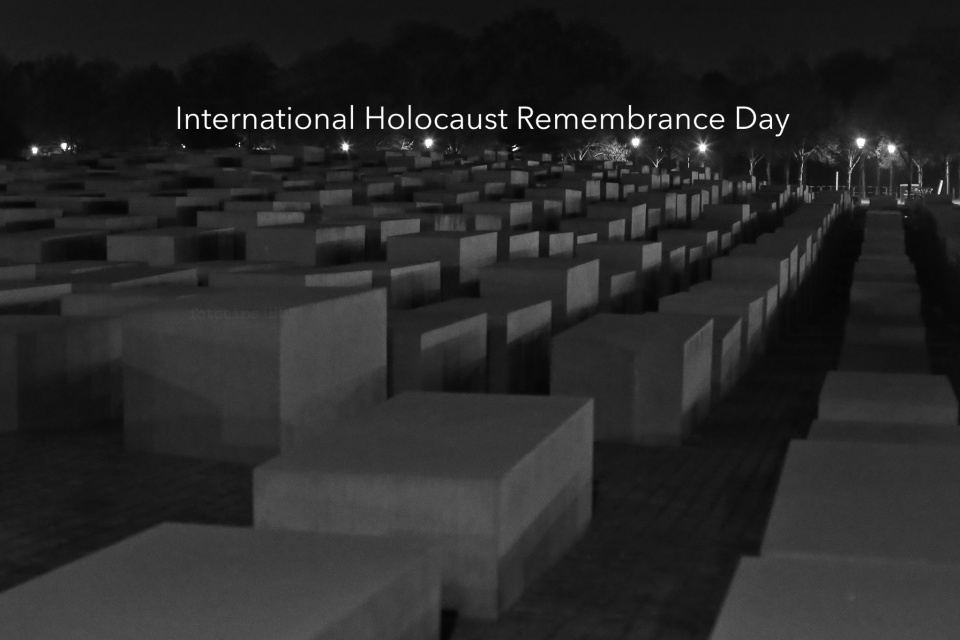
IHolocaustdenkmal, Berlin, Germany, fotoeins.com

International Holocaust Remembrance Day: observations from Germany

Primo Levi, Italian-Jewish author, chemist, and Auschwitz survivor, delivered a set of essays about life and survival in Nazi extermination camps in his 1986 book “The Drowned and the Saved”. Levi wrote:

… For us to speak with the young becomes even more difficult. We see it as a duty and, at the same time, as a risk: the risk of appearing anachronistic, of not being listened to. We must be listened to: above and beyond our personal experiences, we have collectively witnessed a fundamental, unexpected event, fundamental precisely because unexpected, not foreseen by anyone. It took place in the teeth of all forecasts; it happened in Europe; incredibly, it happened that an entire civilized people, just issued from the fervid cultural flowering of Weimar, followed a buffoon whose figure today inspires laughter, and yet Adolf Hitler was obeyed and his praises were sung right up to the catastrophe. It happened, therefore it can happen again: this is the core of what we have to say.

On 27 January 1945, Soviet Red Army troops liberated the Nazi concentration and extermination camp at Auschwitz-Birkenau in south-central Poland. Over 1 million men, women, and children were murdered.

The United Nations declared January 27 as International Holocaust Remembrance Day; the designation came during the 42nd plenary session of the United Stations when resolution 60/7 was passed on 1 November 2005.

Accepting and openly stating responsibility are critical first steps, but spending time, money, and effort to ensure the simple motto of “never again” is also an ongoing reality that isn’t solely up to the citizens of Germany. It’s a collective responsibility that we all should have to remain vigilant; that we all have to recognize and bolster actions which encourage and strengthen the universality of human rights, and reject the erosion and withdrawal of those rights.

I believe responsible tourism also includes paying appropriate respect at a memorial, especially the Holocaust Memorial in Berlin. It’s my view this important memorial is not (supposed to be) a playground.

And yet, there’s something to be said about what it means to have freedom in the early 21st-century, allowing people to laugh and frolic in the public space, an undulating sculpture of featureless massive grey cement blocks, a testimonial to the systematic murder of millions of people.

Naturally, you have the freedom to play here, take selfies, and have a grand time. But it doesn’t mean I’m gonna laugh with you; for example: Yolocaust art project (DW 2017).


( Click here for more )

Berlin Grunewald: no train will ever leave track 17 again

Present in the vicinity of a train station are very distinct and familiar sounds: the racket of heavy locomotives chugging down the rail and the screech of high-friction braking. A breeze sweeps through two columns of trees, creating a low keening sound which escapes into the open space beyond. To stop and listen, the sounds could easily be human: faint shouts and cries. Are they tricks of the mind, or are the dead speaking? The spectre of cruelty, despair, and suffering clings to the abandoned track; seven decades in the past don’t seem very far.

On a cool grey late-autumn afternoon, I’m on an S-Bahn train heading towards Potsdam. Beyond the limits of the “Stadtbahn” and one stop beyond the “Ring” at Westkreuz, the train pulls into the former goods and freight station at Grunewald. Dropping into the underground passage, signage points to the memorial at track 17. I leave the station by the southeast exit, and turn left to ascend the ramp along the side street.

In the Berlin borough of Charlottenburg-Wilmersdorf, Grunewald station lies on the S7 S-Bahn line serving central Berlin city, the city of Potsdam to the southwest, and Ahrensfelde to the northeast in the Berlin borough of Marzahn-Hellersdorf. Grunewald station began operation in 1879 under its original name Hundekehle named after a nature reserve nearby. The station changed its name to “Grunewald” in 1884 when the old Grunewald station began its new life as “Halensee” station. Grunewald station and its tracks were incorporated into Berlin’s S-Bahn train network in 1928.

Many companies including the Deutsche Reichsbahn (German Imperial Rail) were actively complicit in the machinery of mass murder during Nazi rule. After reunification of East and West Germany in 1990, the two separate railways also merged to form Deutsche Bahn in 1994, and calls arose for the new company to acknowledge its dark past. To mark the Reichbahn’s collaboration in deporting people to camps and their deaths, present-day Deutsche Bahn AG established a memorial at track 17. Inaugurated in 1998 the memorial was designed and built by architects Hirsch, Lorch, and Wandel who were very mindful of the 1991 Karol Broniatowski memorial near the station’s entrance.

Along track 17, metal plates have been inserted, one for every transport train which took Berlin’s Jews to their deaths. Each plate includes the transport date, the number of people deported, and the transport’s destination. The first train of record departed Grunewald on 1941 October 18 when 1251 Jews were deported to Łódź. Another plate marks the last train of record (so far) leaving Grunewald on 1945 March 27 when 18 Jews were deported to Theresienstadt; blank plates leave room for additional commemorations with new uncovered information. More than 50-thousand Jews from Berlin were deported from this station alone. The first set of trains went to concentration-camps in eastern Europe, but by the end of 1942, trains were directed to Auschwitz and Theriesenstadt.

The vegetation that’s been left to grow around the track over the years is a visible symbol and an unspoken promise to all: that no train will leave track 17 ever again.

( Click here for images and more )

Abfahrtstafel (Departures board), Frankfurt am Main Hauptbahnhof, fotoeins.com

How to read signage at German train stations

You’re excited – you’ve finally arrived in Germany. You’ve decided to travel the country by train, but you’re not familiar with the German language, and you may find the signs puzzling and difficult to read.

The following is a short guide to signage at German train stations to help get you on your way. Examples below are taken from Frankfurt am Main Hauptbahnhof (central or main train station), although descriptions should apply similarly at other stations.

Below are descriptions for:

  • Departures board (Abfahrtstafel)
  • Destination signage (Zugzielanzeiger)
  • Car sequence signage (Wagenreihungsplan)
  • Arrivals-, departures schedules (Ankunfts-, Abfahrtspläne)

( Click here for more )