Fotoeins Fotografie

location bifurcation, place vs. home

Posts tagged ‘fotoeins’

Fotoeins’ 13 Instants from 2013

It’s been an interesting year, as “interesting” came complete with their own highs and lows, across a variety of nations on three continents. Friends would say that’s simply par for the course to describe any length of time on travel. I ended my year-long around-the-world (RTW) trip in January, sought a new path in Sydney, Australia between March and June, and returned to Vancouver, Canada with a short stop in Europe for a writing course at the end of July. The following 13 moments in 2013 arrive courtesy from Berlin, Germany; Sydney, Australia; Vancouver, Canada; and Wellington, New Zealand.

( Click here for more )

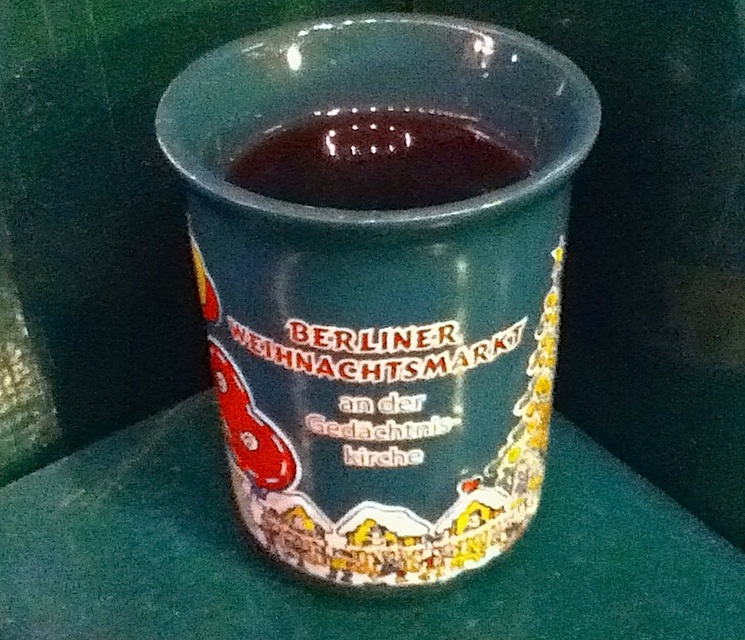
Berliner Weihnachtsmarkt an der Gedächtniskirche, Berlin, Germany

Christmas markets: Glühwein smarts

Above/featured: Christmas market at Berlin’s memorial church – 6 Dec 2012 (450D).

It’s easy to underestimate how much “punch” is delivered in a single Glühwein drink at a Christmas market. If I’m not careful and drink Glühwein too quickly and without food to soften the blow, I’ll encounter the very repeatable experience of “mind-body separation”.

What is this magically mysterious Christmas concoction called “Glühwein”?


( Click here for more )

Alter Synagogenplatz, Altstadt, Heidelberg, Baden-Württemberg, Germany, fotoeins.com

My Heidelberg: Synagogue Square and Pogromnacht

It happens every time without fail.

My spirit breaks a little more every time I see a memorial, another example of the depths to which our species have plumbed.

Does feeling this way make me weak? Or am I resembling a human being after all?

I often hear a common chorus:

history is hard, history is boring, why should I care?

I can’t decide what’s worse: the rise of the far-right or blatant willful ignorance.


A Mob of Broken Glass

From the evening of 9 November to the following morning of 10 November 1938, Kristallnacht (“the night of broken glass”) was a “pogrom”, a coordinated series of violent attacks by Nazis against the Jewish people and their property in Germany, Austria, and Czechoslavakia’s Sudetenland. Pogromnacht (or Reichspogromnacht) is a truer description; the “prettier sounding” Kristallnacht hides the brutality of “the night of (broken) crystal” referring to broken shattered glass from windows to synagogues, homes, and stores owned by Jews. Aside from a few who intervened, most stood aside and watched people and property burn.

The word “pogrom” is a late 19th- to early 20th-century Russian word (“погром”), derived from the verb “gromit” (громи́ть) meaning “to destroy with violence.” While “pogrom” is used generally to describe mob violence by one ethnic or religious group on another, the term is used in this post to describe attacks on the Jewish community.

The numbers across the country were appalling: at least 90 dead, hundreds injured, 30000 arrested and detained in concentration camps, up to 2000 synagogues burned, over 7000 Jewish businesses damaged or destroyed. With one more insult, the Jewish community was forced to pay for damage to their own property. The outbreak of coordinated actions against Jewish people marked the beginning of state-sanctioned violence. With the Pogromnacht, the state no longer hid their hate and escalated their savagery as a turning point directly leading to the Holocaust.

( Click here for more )

Melbourne, Australia, myRTW, fotoeins.com

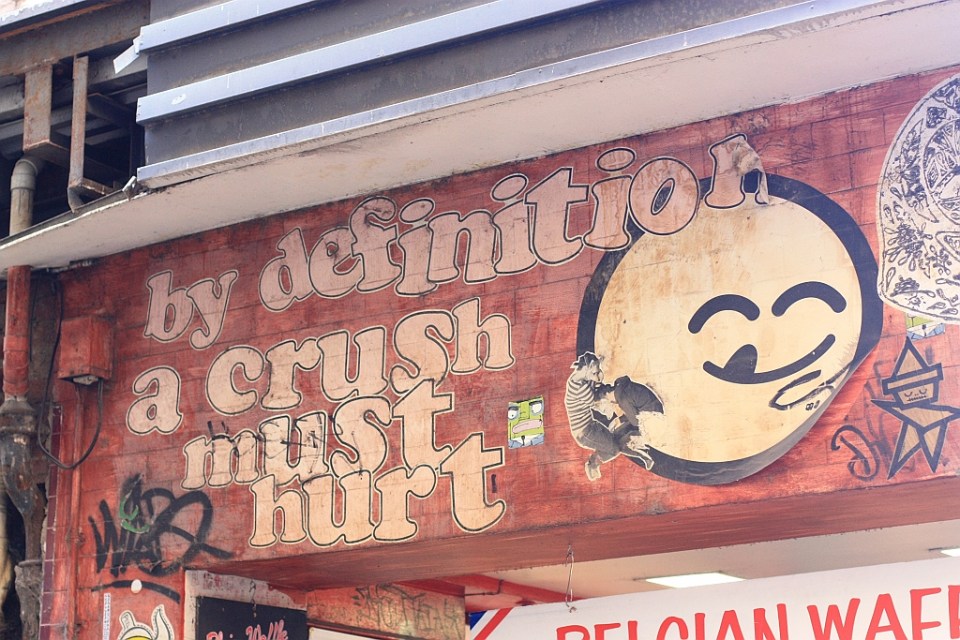
Navigating Melbourne’s lanes for street art

In an earlier post, I’ve shown some work on display as street art in Adelaide in South Australia.

Over a period of four days in Melbourne, I wandered through lanes and streets to look for some representative street art in the Victorian state capital, some works which spoke of the people who live there. Would it be the same kind of art and/or messages I’d seen earlier in Adelaide? As always, the set of artists and their respective work hold unique value in each of the cities.


( Click here for images and more )

Sydney: happy 52 to the Opera House (2025)

Above/featured: South view from Sydney Harbour towards the CBD – 12 Apr 2013 (450D).

Standing prominently above Sydney’s Bennelong Point, the white shelled structure serves as an icon for city and country.

The Sydney Opera House is made up of three groups of interlocking “vaulted shells” housing two primary concert auditorium spaces. The shell-like structures sit upon a large platform, encompassed on the outside by stepped terraces as staging or assembly areas for visitors.

On 20 October 1973, Queen Elizabeth II formally opened The Opera House. In the decades since, the building has become an icon for city and country. The building endures as a “landmark” and “ambassador” for both city and country. Immediately telling are the roof’s white shells, looking like wind-blown sails at a distance in the harbour.

( Click here for images and more )