Fotoeins Fotografie

location bifurcation, place vs. home

Posts tagged ‘fotoeins’

Photo by geralt, on pixabay CC0

Photographers for International Women’s Day

On this International Women’s Day (8 March), I remind myself how photography is made and viewed differently from either the male or female perspective.

Please check out these photographers whose work I greatly admire. Much of the following is personal, brave, unflinching, and provocative.

I prefer (and highly recommend) looking at photography as prints, in galleries, or in photo-books. Having photos take on physical form provides a kind of tactile permanence which seems “more real” to me than a mouse-click or a screen swipe that are far too ephemeral for my liking. Have a look online; then, seek work by one or all of these women at an art gallery and/or a bookstore.

Im Camera Head Man - Ares Nguyen, Flickr CC2

The featured photo is by geralt (Pixabay) with the CC0 license. The last photo is by Ares Nguyen (Flickr) with the CC2 license. This post appears on Fotoeins Fotografie at fotoeins.com as http://wp.me/p1BIdT-6AG (edited 2016,2017,2018.)

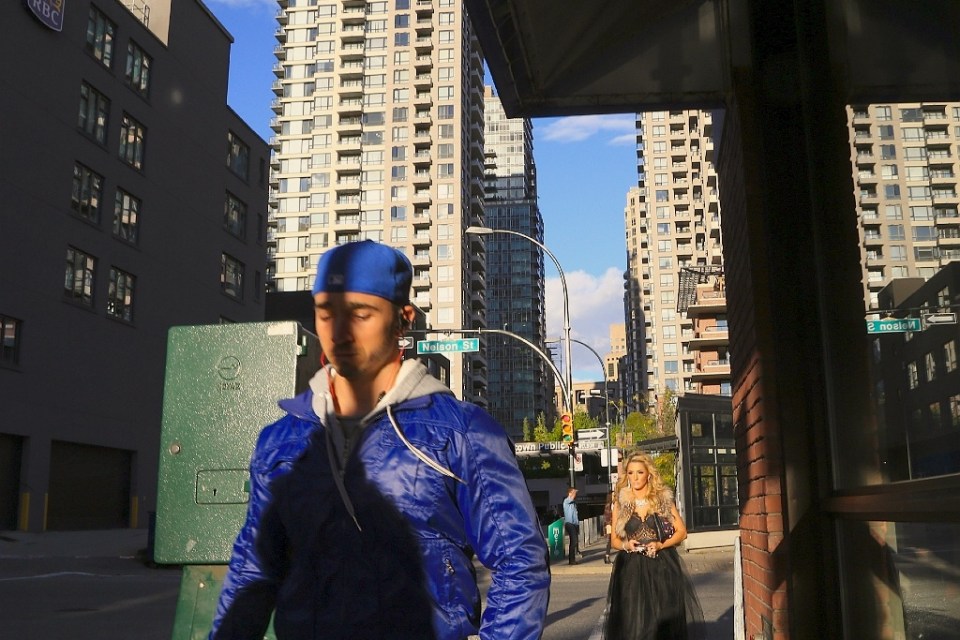
Yaletown, Vancouver, BC, Canada, 26 Oct 2014, fotoeins.com

What about now? How about now?

I think I’ve struck a nugget of gold.

I also believe the chances of finding it again might well be slim to none …

Jean François Paul de Gondi, Cardinal de Retz, wrote in the 17th-century:

Il n’y a rien dans ce monde qui n’ait un moment decisif. (There is nothing in this world that does not have a decisive moment.)

Photographer Henri Cartier-Bresson used this quote for the preface of his 1952 book “Images à la sauvette” (The Decisive Moment). That phrase has been described in great detail and (mis)interpreted over the years, undoubtedly adding only to the legend and his place in the history of photography. With his landmark photograph “Derrière la gare Saint-Lazare” (Paris 1932), Cartier-Bresson described moments like these as:

To me, photography is the simultaneous recognition, in a fraction of a second, of the significance of an event as well as of a precise organization of forms which give that event its proper expression. (Photographier: c’est dans un même instant et en une fraction de seconde reconnaître un fait et l’organisation rigoureuse de formes perçues visuellement qui expriment et signifient ce fait.)

What does any of this have to do with the photo above? Everything.

( Click here for more )

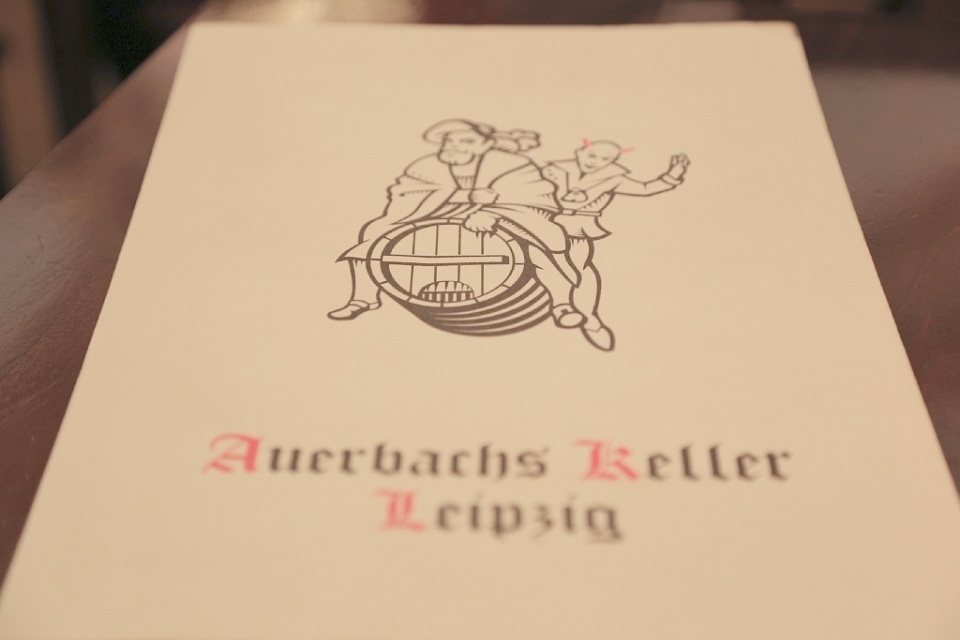
Auerbachs Keller, Leipzig, Germany, fotoeins.com

Leipzig’s Auerbachs Keller: devilishly comfortable

Goethe’s Faust meets Saxon comfort

If I didn’t know any better, I’d think I was giving away my soul for a good warm Saxon meal.

In the city of Leipzig, Germany, the name and influence of Johann Wolfgang von Goethe doesn’t stray far from conversation. Three more words are at the tip of the tongue: Faust. Pact. Devil.

Near the city’s central square at Markt, the Mädler-Passage beckons with bright lights and the promises of goods and riches within the shopping arcade. At the arcade’s north entrance, all are greeted by statues representing figures from “Faust”, the most famous published work by Goethe.

Signs to Auerbach’s Cellar lead downstairs on either side of the main passage. One thought remains as I walk into the basement. Am I sealing my own deal with the devil, setting foot in the Cellar’s chambers to sign away my freedom for some food, drink, and hospitality?

I’m sure the evening won’t be that dramatic. But the moment I walk in the door, I’m in the midst of culinary and literary tradition spanning many centuries.


( Click here for more )

Abfahrtstafel (Departures board), Frankfurt am Main Hauptbahnhof, fotoeins.com

How to read signage at German train stations

You’re excited – you’ve finally arrived in Germany. You’ve decided to travel the country by train, but you’re not familiar with the German language, and you may find the signs puzzling and difficult to read.

The following is a short guide to signage at German train stations to help get you on your way. Examples below are taken from Frankfurt am Main Hauptbahnhof (central or main train station), although descriptions should apply similarly at other stations.

Below are descriptions for:

  • Departures board (Abfahrtstafel)
  • Destination signage (Zugzielanzeiger)
  • Car sequence signage (Wagenreihungsplan)
  • Arrivals-, departures schedules (Ankunfts-, Abfahrtspläne)

( Click here for more )

Friedriche Revolution, Peaceful Revolution, Leipzig, Saxony, Sachsen, Germany, Deutschland, fotoeins.com

Leipzig’s Stasi Corner: Die Runde Ecke

Above/featured: Leipzig’s 1989 Peaceful Revolution. Photo on 4 Dec 2014.

Before arriving at the Runde Ecke, I didn’t know I’d be visiting on the very day, 25 years to the day the building was occupied by peaceful protestors. Then again, the atrium seemed to contain lingering echoes and shouts from those very same protestors: “Wir sind das Volk! Krumme Ecke, Schreckenshaus, wann wird ein Museum daraus?” (We are the people! Crooked corner, horror house, when will this become a museum?)

Walking through the ground floor museum, there’s a stale dank smell, known as the “East German” smell. The secret cameras, the recording devices. This is where Stasi employees worked, where people were kept in Stasi prisons below. No expense was spared to monitor and collect the sights, sounds, and scents of the East German people: what they said; what, how, and where they went about their daily lives.

Blood, sweat and tears, for very different reasons.

In Leipzig, Germany, the building that’s known as the Round Corner sounds innocuous. For many, the “Runde Ecke” is synonymous with the secret police or Stasi, short for “Staatssicherheit,” representing East Germany’s Ministry of State Security.

In the early 20th-century, the building housed the headquarters to the Alten Leipziger Feuerversicherung fire-insurance company. The building was rumoured to have housed Nazi Gestapo during the Second World War, before American occupation forces moved in for a short time in 1945. The Soviet military moved in shortly thereafter, followed by the Soviet NKVD secret service and K5, predecessor to the Stasi. With the establishment of the East German State Security in 1950, the building housed the local district Stasi headquarters until 1989.

1989 is significant for the building’s historical importance to both Leipzig and Germany, and key to the story of that year’s “peaceful revolution”. The “day of decision” and non-violent demonstrations on 9 October 1989 led to the downfall of the local government. Weeks of Monday demonstrations made the building a focal point for anger and outrage. Much still needed addressing after the fall of the Wall on 9 November 1989. On 4 December 1989, protestors outside the Stasi headquarters demanded access to their files, eventually storming and taking over the building, and saving countless files from destruction.

The Runde Ecke is now home to a museum to preserve knowledge about the activities of the Stasi, and is also home to a branch office of the Federal Commissioner for Stasi Files (BStU) to ensure files are properly archived and available for research, and to ensure files remain accessible for inspection to anyone who inquires.

Runde Ecke, Friedriche Revolution, Peaceful Revolution, Leipzig, Saxony, Sachsen, Germany, Deutschland, fotoeins.com

This building housed the district administration offices of the Ministry for State Security between 1950 and 1989. During the Monday Demonstrations, protestors arrived and subsequently occupied the building on 4 December 1989. Photo on 4 Dec 2014.
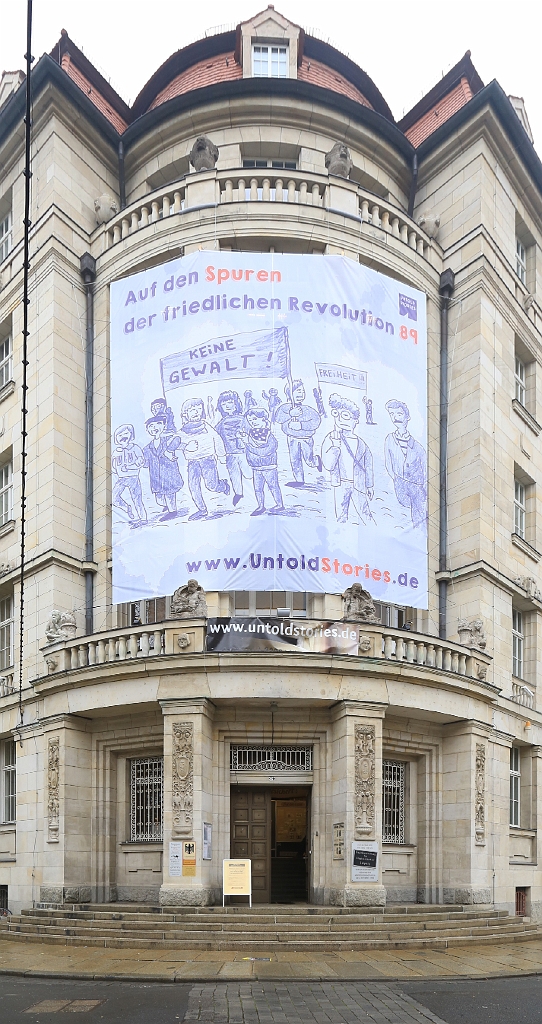
Runde Ecke, Leipzig, fotoeins.com

The building’s rounded corner: “on the path of the Peaceful Revolution”
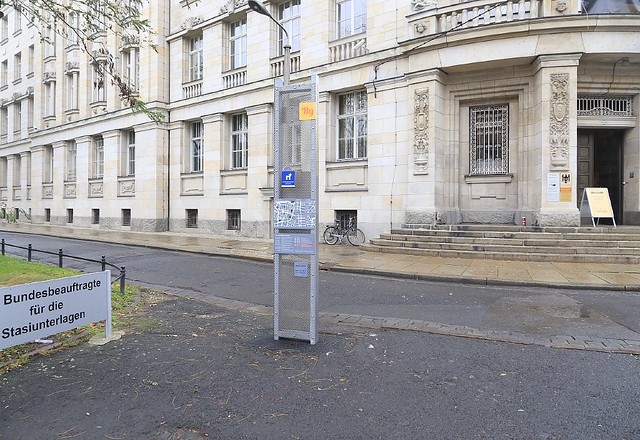
Runde Ecke, Leipzig, fotoeins.com

Bundesbeauftragte für die Stasiunterlagen | Federal Commissioner for the Stasi Files
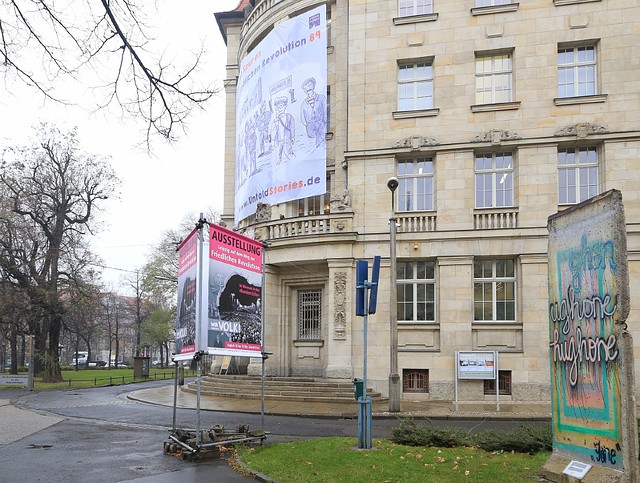
Runde Ecke, Leipzig, fotoeins.com

“Wir sind das Volk!” (We are the people!) | Berlin Wall fragment

Runde Ecke, Leipzig, fotoeins.com

Museum in the Round Corner, with permanent exhibition “Stasi: Power and Banality”
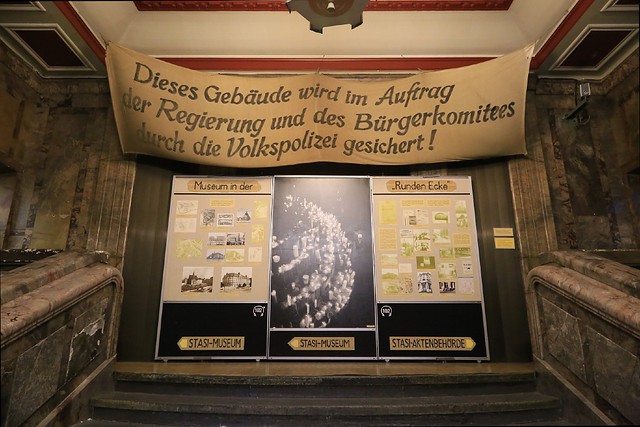
Runde Ecke, Leipzig, fotoeins.com

Building atirum: “This building is secured by the People’s Police on behalf of the government and citizen committees!” To the left is the Stasi Museum; to the right is the Stasi-Aktienbehörde, the public authority responsible for Stasi files.
Runde Ecke, Leipzig, fotoeins.com

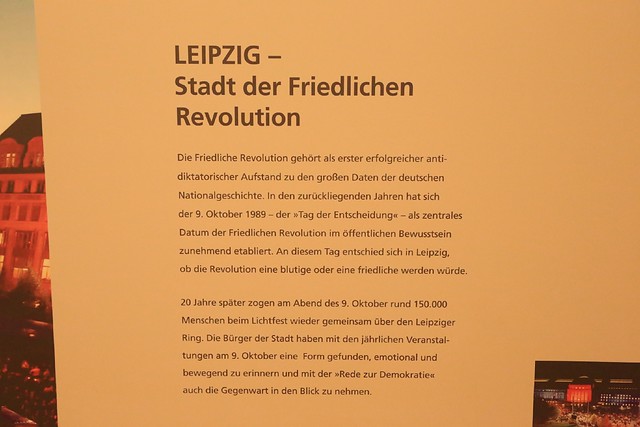
Leipzig – city of the peaceful revolution

“As a successful public uprising, The Peaceful Revolution is notable as an important event in Germany’s history. Over time, 9 October 1989 has established itself as a key date in the public eye as “a day of decision” when events of that very day could have turned bloody or remained peaceful. Twenty years later on the evening of 9 October 2009, about 150 thousand people gathered to mark the occasion on the Leipziger Ring for the Lights Festival. Yearly events on and around 9 October have taken shape as reminders about the steps and sacrifices people undertook for a more open present-day government.”


Open daily between 10am and 6pm, there is no charge to enter the Stasi museum in the Runde Ecke; most of the exhibition descriptions are in German. Photography is not allowed within the museum.

I made the photos above on 4 December 2014, the 25th anniversary of the peaceful takeover of Runde Ecke. Thanks to Leipzig Tourismus und Marketing GmbH (LTM) and InterCityHotel Leipzig for their support and hospitality. Access to public transport was kindly provided by LTM and the MDV Mitteldeutscher Verkehrsverbund regional transport authority. This post appears on Fotoeins Fotografies at fotoeins DOT com at http://wp.me/p1BIdT-6p4.