Fotoeins Fotografie

location bifurcation, place vs. home

Posts tagged ‘Doebling’

25T73 Stefaniewarte lookout tower on Vienna Kahlenberg

E72, V20.

I’ve been up to Kahlenberg hill a couple of times in past years, but coming up during weekdays meant I lost out on the lookout tower. A warm sunny Saturday is an opportunity to fix my error.

In 1887, the Kahlenberg railway company completed an extension of its cogwheel railway to the top of Kahlenberg (484 m/1588 ft). At the same time, the company constructed next to the railway terminus station a 22-metre high brick lookout-tower, named after the Crown Princess Stephanie of Belgium. The cogwheel railway is long gone, and there had been years when the tower was neglected or forgotten. Reopened to the public in 1992, the lookout tower is now managed and operated by Naturfreunde Döbling. The top of the Stefaniewarte lookout tower is effectively about 500 metres above sea level, providing 360° views of the city and surrounding area.

Open only on summer weekends in good weather, the tower is open until 6pm with 2€ admission. Public transport: S45- or U4-train to Heiligenstadt station, then bus 38A to Kahlenberg.

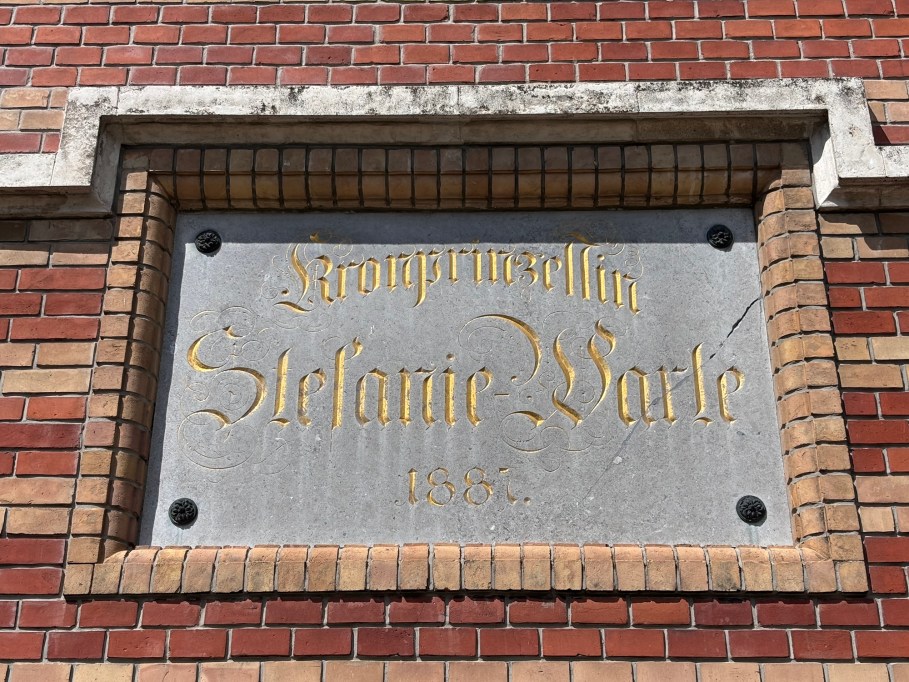
“Kronprinzessin Stefanie-Warte 1887”
The climb up the 120 or so steps was comfortable: wide deep steps, reasonable stairwell-clearing or -height.
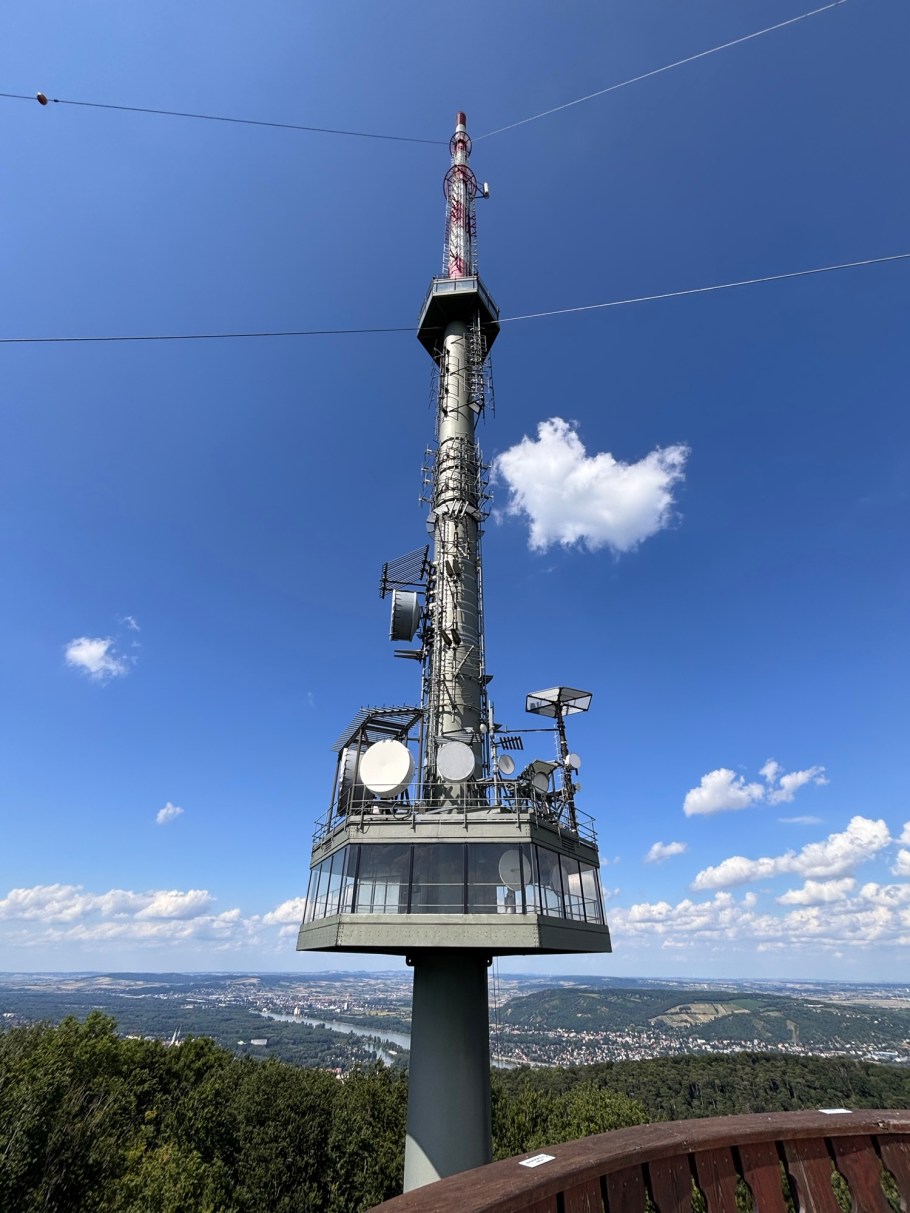
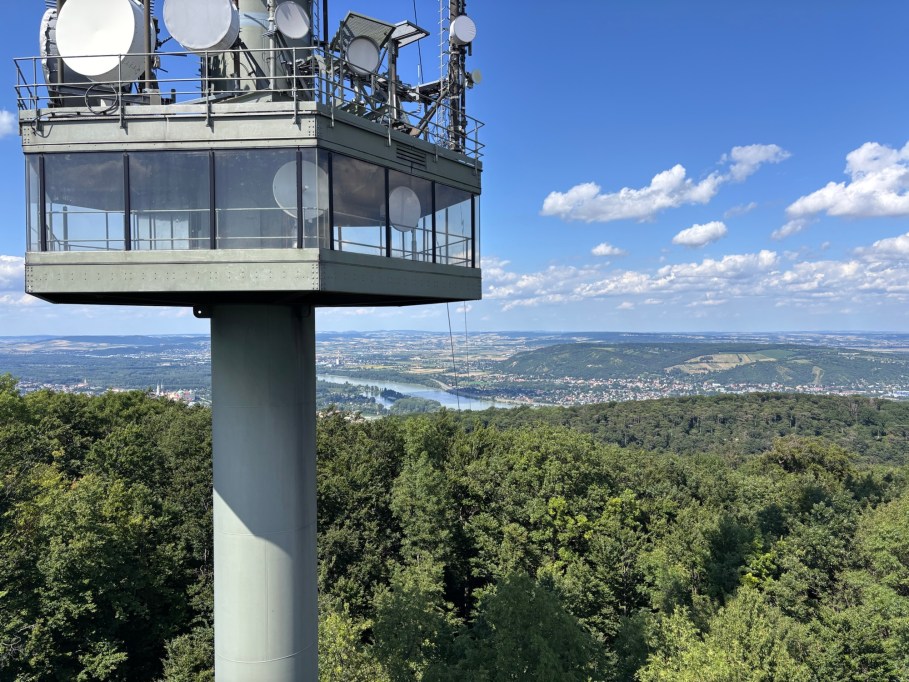
To the northwest is the 165-metre tall Kahlenberg Transmitter tower which is not open to the public. The transmission tower is anchored by 3 pairs of cables onto 3 piers.
North. This is where the crescent of the Alps’ mountain range tapers to an end.
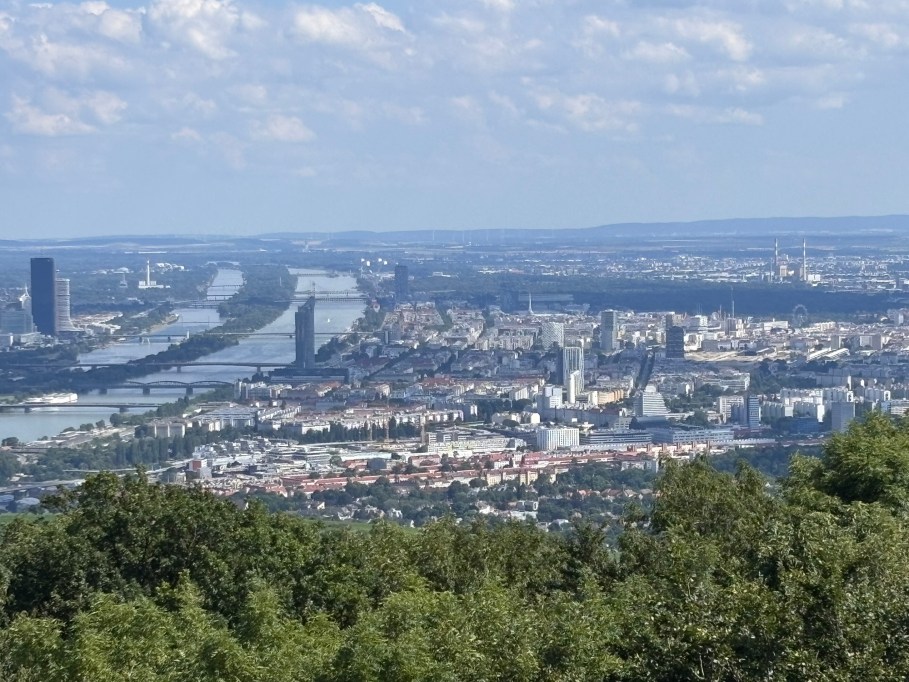
Southeast.
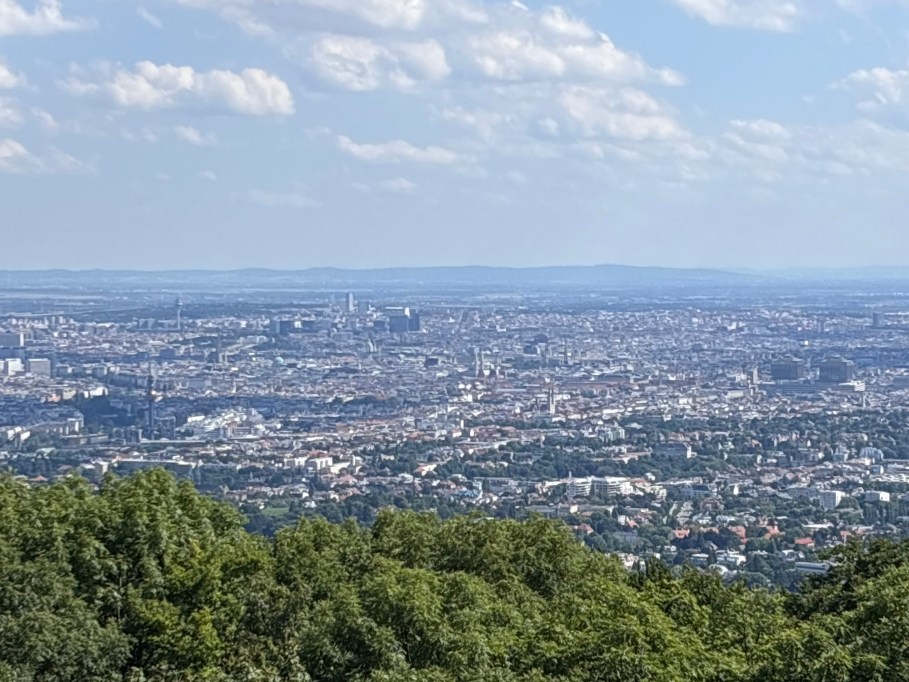
South. In the background almost 70 km in distance is the 2078-metre high Schneeberg.
Visible in this 4x digital zoom view to the southeast: DonauCity (DC) Tower 1, Danube river, Millennium Tower, Red Vienna’s Karl-Marx-Hof, the Prater and its Ferris wheel.
Visible in this 4x digital zoom view to the south: Müllverbrennungsanlage Spittelau, Ringturm, Votivkirche, Stephansdom, Peterskirche, Karlskirche, Oberes Belvedere, Hauptbahnhof complex, Arsenal communication tower, AKH general hospital.

I made all images above with an iPhone15 on 19 July 2025. This post composed within Jetpack for iOS appears on Fotoeins Fotografie at fotoeins DOT com.

25T63 Salmannsdorf in the northwest hills of Vienna

E62, V10.

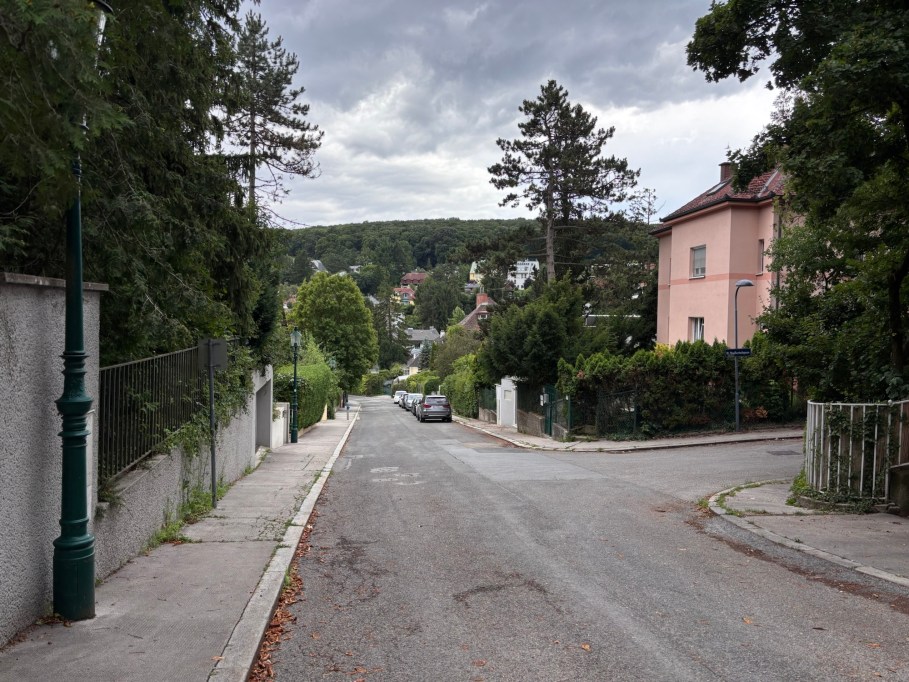
Salmannsdorf is tucked away in the northwest corner of the Austrian capital city. It only seems “far” when a bus route reaches its final stop; fact is the terminus for bus 35A is only 8 km northwest from the city centre.

First mentioned in an official document in 1279, the small village of wine growers began next to the Krottenbach creek and surrounded by hills. The name “Salmannsdorf” is likely derived from the personal name Salman or Salmann, or from the professional name of the “Salmann” who was a trustee or scribe of the land register called the “Salbuch”; literally, he of the Sal, or the Sal-man(n). By 1938, the village had been fully absorbed into the city of Vienna’s 19th district.

In a compact area, I’ve gathered:

  • a cross dedicated to victims of the French Napoleonic occupation 1809
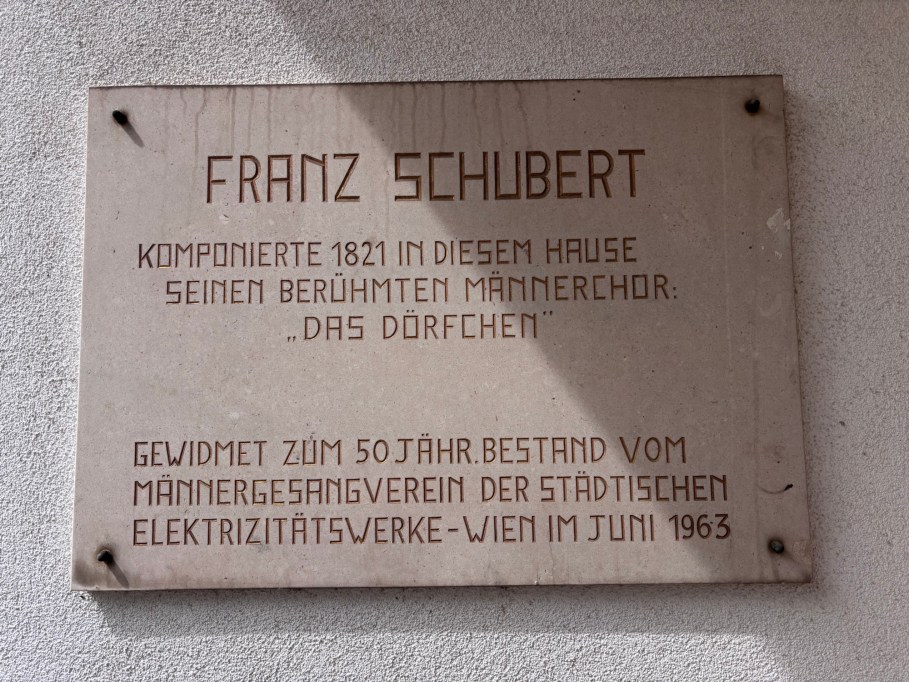
  • where Franz Schubert composed “Das Dörfchen” (The Little Village) in 1821
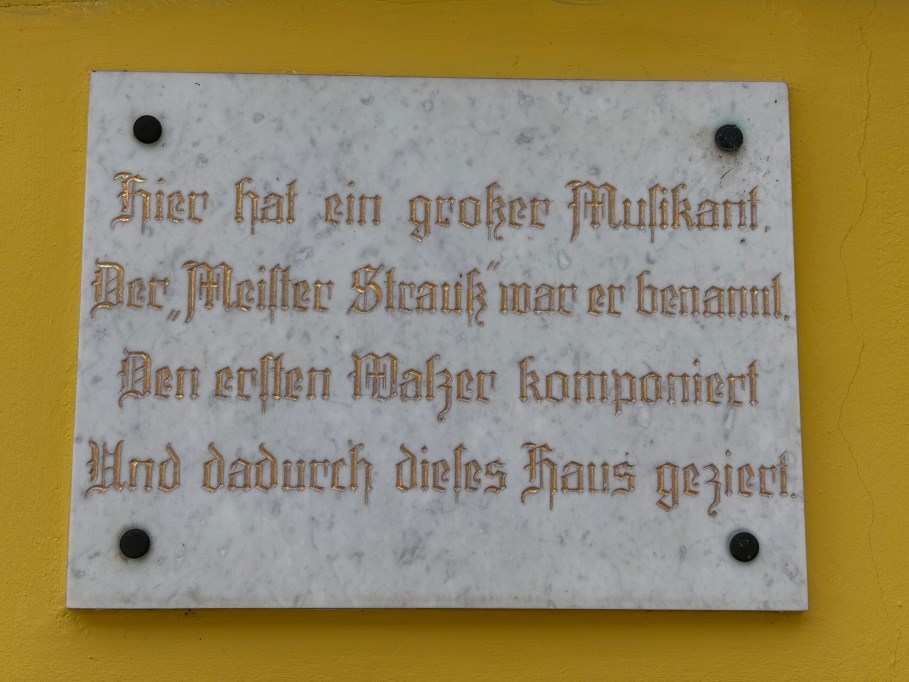
  • Johann Strauss II (JS2) spent boyhood summers at his maternal grandfather’s house, where JS2 wrote at age 6 his 1st attempt at waltz “Erster Gedanke”
  • Salmannsdorf Church, a.k.a. Dreimarkstein Chapel, a.k.a. Sebastian’s Chapel.

Sulzweg
Franzosenkreuz (French cross), in front of Salmannsdorfer Straße 32.
French cross: memorial to the victims of the 1809 Napoleonic campaign and French occupation.
The slope up Dreimarksteingasse with a plaque at building address 6 (right).
Memorial plaque: Franz Schubert composed “Das Dörfchen” at this location in 1821.
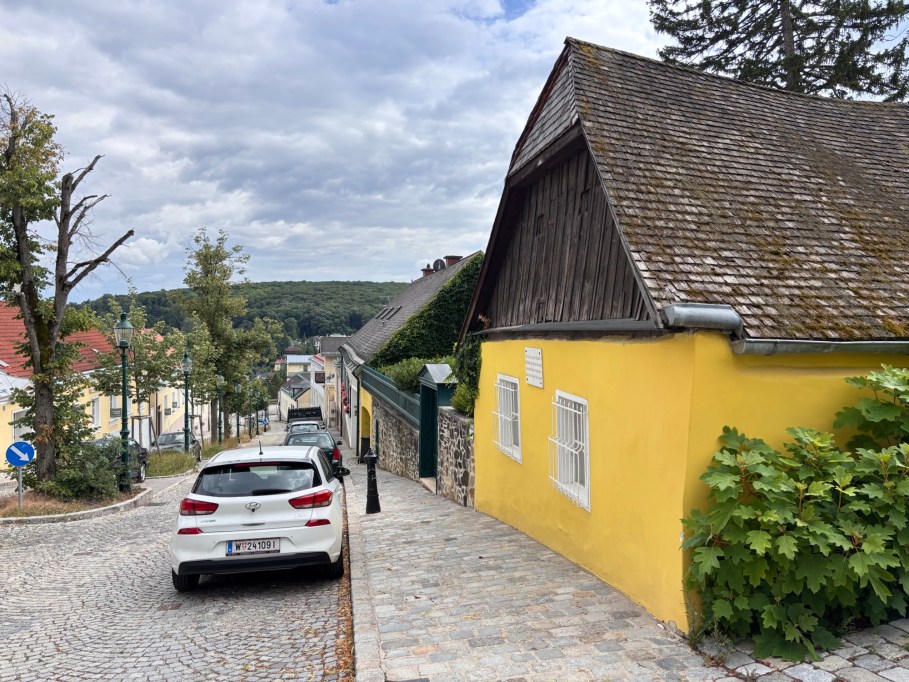
Dreimarksteingasse 13, facing northwest. There’s a plaque on the outer wall of the bright yellow barn-like structure (upper right). Johann Strauss Sr. And his family spent summers here from 1829 to 1832.
Johann Strauss Jr. at age 6 composed his 1st waltz at this location; this is memorialized by the plaque on the wall. “Hier hat ein großer Musikant / Der ‘Meister Strauß’ war er benannt / Den ersten Walzer komponiert / Und dadurch dieses Haus geziert.”
Dreimarksteingasse 13, facing south.
Across from the Strauss’ summer residence is the village church whose names include Dreimarkstein Chapel and Saint Sebastian’s Chapel. The small church dates back to the late 18th-century.
Near the top of Dreimarksteingasse with the village chapel at left and the yellow building (once occupied by the Strauss family) at right.

I made all images above with an iPhone15 on 9 July 2025. This post composed within Jetpack for iOS appears on Fotoeins Fotografie at fotoeins DOT com.

24T67 Von Trauben zu Türmen (from grapes to towers)

E66 V33

It’s early Saturday morning, and I head north to the Nussdorf ridge-line for a little hike and a long look. There’s the occasional jogger and bicyclist willing to climb the grade. But Nussdorf is home to many vineyards. As Europe’s largest urban vineyard, Vienna has within city limits about 700 hectares (1700 acres) of vineyards, producing over 2.5 million litres of wine every year.


61-seconds: “from grapes to towers.”
Wine grapes, but there’s still time to mature and ripen; it’s only mid-summer.
I’m a fan of the Grüner Veltliner and the “mix” in Gemischter Satz.
Facing southeast over vines and Danube river, and towards various towers; including the Donauturm (left-centre), DC Tower 1 (centre), and the Millennium Tower (right).
Nussberger Weinberge (Nussberg vineyards), as the slope falls off and “disappears.”

I made the photos and video above with an iPhone15 on 13 Jul 2024. This post composed with Jetpack for iOS appears on Fotoeins Fotografie at fotoeins DOT com.
24T46 Saturday summer stroll in Sievering

E45 V12

The 2nd-half of my big travel journey was begins: on travel day 46, Euro day 45, Vienna day 12.

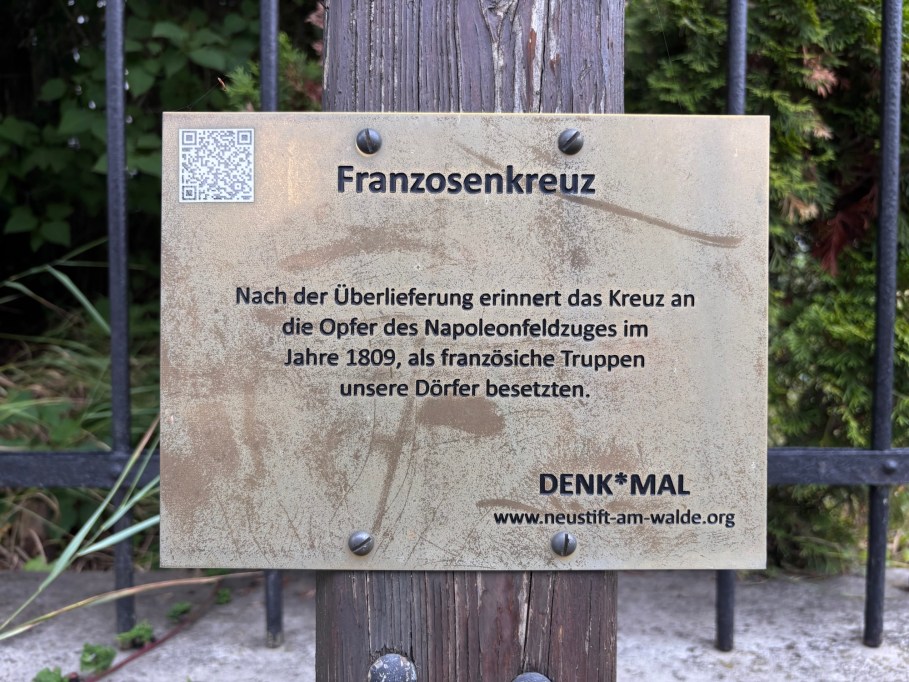
Sievering is a neighbourhood in northwest Vienna against the city’s foothills. A warm summer Saturday is ideal to move among the quiet residential streets, far from the marauding masses within the city centre. I found remnants of a 17th-century siege, evidence of Hedy Lamarr as a young woman growing up in Vienna, a sculpture dedicated to a goose, and a gravesite for a man who wrote one of the most unique themes for a landmark film.


3 cannon balls at Sieveringer Straße 99, which gave the building here its name “Dreikugelhaus” (house with 3 cannon balls).
The inscription at the bottom of the centre ball states that a witness sighted cannon balls in the house in 1683 during the 2nd Ottoman Siege of Vienna.
Private residences at Sievering Straße 135. But the gate tells another story.
The space used to be film studios for Sascha Film, and later, Wien Film. A teenaged Hedwig Kiesler dropped out of high school, joined the studio as a “script girl,” and soon joined on-set ensembles for minor film roles. She would become Hedy Lamarr after moving to L.A.
Memorial to Lilli the goose. Until 1970, streetcar route 39 went up Sievering Straße. Near this location a goose would park itself comfortably on the rail. The tram driver would stop, and attempt to nudge the goose away for the tram to go through. The memorial is symbolic representation of small-town idyll.
Friedhof Sievering cemetery.
Decent view across town to towers in the 22nd district, including the Donauturm and Donau-City Tower 1.
Karolina (“Lina”) Loos: 1882-1950, actress and journalist.
Karas family, including Anton Karas who not only owned and operated a Vienna heuriger (wine tavern), but also was famous for composing the zither-instrument theme for the 1949 Carol Reed film “The Third Man.”
The south perimeter of the cemetery nestles against the verdant vineyards on Hackenberg.

I made all images above with an iPhone15 on 22 Jun 2024. This post composed with Jetpack for iOS appears on Fotoeins Fotografie at fotoeins DOT com.

24T44 Vienna’s Cottage Quarter

E43 V10

I spend a few afternoon hours walking the streets of this neighbourhood, admiring the villas and mansions, and marveling over how architect and neighbourhood co-founder Heinrich Ferstel had intended the target audience to be mid- to upper-class families in the late 19th-century. It might be worthwhile to examine the “economic differences” between then and now. Alternatively, we can imagine how the lure of these quiet English-style spaces would surely have been tempting, as a means of escaping the hustle and bustle of the “inner city.”


Haizinger Gasse 26.
Physicist Ludwig Boltzmann and his family lived here from 1902 to 1906.
Cottagegasse 31.
Cottagegasse 37, where …
… where Felix Salten wrote “Bambi” in 1923.
Cottagegasse 44.
Weimarer Straße 92.
Weimarer Straße 83.
Peter-Jordan-Straße 28-30.
Peter-Jordan-Straße 49.
Sternwarte Straße 53, where Vienna’s Cottage Association was formed.

I made all images above with an iPhone15 on 20 Jun 2024. This post composed with Jetpack for iOS appears on Fotoeins Fotografie at fotoeins DOT com.