Fotoeins Fotografie

location bifurcation, place vs. home

Posts tagged ‘Deutsche Bahn’

25T86 Nuremberg’s DB Museum 🚂 : my picks

E85, N03.

There was a time I didn’t think I’d be a fan of trains. I’m glad I was wrong, helped in large part to living and visiting Germany over much of the last 25 years.

Nuremberg’s Transport Museum includes the Deutsche Bahn (DB) Museum and the Museum of Communication. I spent the better part of Friday afternoon, learning and gathering bits and pieces on German rail.


Nuremberg’s Verkehrsmuseum, including Bahn (rail) and Post (mail).
With North at the bottom of the map, Johann Georg Kuppler drew this map of the Ludwigseisenbahn (Ludwig Railway) between Nuremberg (left) and Fürth (right) in 1835.
Replica of the “Adler” steam locomotive engine, next to an ICE-3 model.
Established between Nuremberg and the nearby city of Fürth, the Ludwigseisenbahn began operation as Germany’s 1st railroad on 7 December 1835. A replica of the engine car, the Adler from the very first journey is in the museum proper (above).
Built in 1835, this lemon-yellow “car number 8” is the only remaining surviving passenger car from the Ludwigseisenbahn, and is Germany’s oldest railway vehicle.
In 1896, the Skladanowsky brothers produced short-films of Berlin city-life for the first time. This image is a snippet of one of their films showing the comings and goings, including city rail above street-level, at Berlin’s Alexanderplatz.
Train ticket in 2nd class, from Berlin to Wiesbaden, on 15 May 1901.
Train ticket in 3rd class, from Munich-Obermenzing to Regensburg, on 22 June 1946.
Left to right, respectively: West Germany’s Deutsche Bundesbahn logo in 1955; East Germany boundary stele at the inner German boundary, c. 1967; East Germany’s Deutsche Reichsbahn logo, c. 1960.
1974 map showing routes for the Trans-Europe-Express. By present-day standards, Berlin, Prague, and Warsaw are conspicuous by their absence.
1984 1:10 model of VT11.5 (601) locomotive for the Trans Europe Express. Cue up the Kraftwerk song …
1976 advertisement for Deutsche Bundesbahn’s Intercity trains running every 2-hours inside West Germany; note Berlin’s exclusion.
The modern DB logo.

I received neither support nor compensation for the present piece. I made all images above with an iPhone15 on 1 August 2025. This post composed within Jetpack for iOS appears on Fotoeins Fotografie at fotoeins DOT com.

25T07 DB: Deutsche Bahn, Delayed Bahn

E06, C03-B01.

Sometimes it’s best not to tempt fate.

For my trip from Cologne to Berlin, I booked many weeks in advance a seat on a morning IntercCity Express ICE train. I’ve travelled on this route enough to know it’s generally full, which is why I absorbed the cost of a 1st-class fare. For the scheduled 4.7-hour trip, the extra space and quiet (fewer total people in an individual car) is worth the reduced stress. (IC and ICE trains are not included in the Deutschland-Ticket.)

I tempted fate when I reckoned I could reach Berlin by 3pm: sounds simple. But as I write, the express has become a slow march.

With a failure in the overhead power about a third of the way along the route, the train is diverted onto regional tracks rated for a lower travel speed, and the expected duration has ballooned to 6.3 hours. Welp, people here talk poorly about the once-timely Deutsche Bahn, but many years of funding cuts to infrastructure and development have naturally led to something like this, and at an alarming frequency.

After many hours in a train seat, I feel as tired as having been on a plane. Barely awake in Berlin, I head straight to my accommodations, followed by a quick jaunt to the mall nearby to stock the small shelves and refrigerator in the apartment.

The Berlin experiment of 2025 can begin tomorrow. That is, after I go pick up an extra roll of paper towels and a small bottle of dishwashing soap.


The planned stop in Bielefeld is cancelled because of the failure in the overhead power lines in that area. To reach Hannover, our express train ICE 557 has diverted to the east onto regional tracks rated for lower travel speeds.
Arrival: Hannover central station, 95 minutes late.
Expected arrival time at Berlin Hbf (central station).
Screenshot DB mobile iOS App. Total train time 6 hr and total travel time 7 hr: ach sowas! But to reach my final accommodations, I have a couple of short train-segments and a final bus-segment.

I made all images above with an iPhone15 on 14 May 2025. I received neither request nor compensation for this content. This post composed within Jetpack for iOS appears on Fotoeins Fotografie at fotoeins DOT com.

Deutschland Ticket, for Canadian visitors (2024)

How-to buy guide, effective May to August 2024.

( 2025 note: On 18 September 2025, Bavarian state broadcaster BR24 reported the monthly price for the Deutschland-Ticket will go up by 5€ to 63€ , starting 1 January 2026. The price had already gone from 49€ to 58€ for the 2025 calendar year. My summer 2025 purchase went the same way as in 2024, whose details are described below. )

89 days within Europe includes by necessity substantial travel by train within Germany. I’ve already booked in advance a number of intercity express segments, but what about local transport and regional trains?

The “Deutschland Ticket” (D-Ticket) is a rail ticket for one person and costs 49€ per month on a rolling subscription. The ticket is generally valid for local transport (bus, tram, U-Bahn, S-Bahn, intracity ferry) and regional rail (RB, most RE, IRE), but not for long-distance IC and ICE routes. Intended primarily for commuters, visitors to Germany can also purchase these tickets.

It’s early-April 2024, and I’m about to buy the D-Ticket for 49€ for the entire month of May. The ticket’s “rolling subscription” means if I do nothing else before 10 May, I’ll also automatically purchase a D-Ticket for the month of June for 49€. I’ll need the D-Ticket for May, June, July, and August; but I can only buy one month at a time.

I choose Munich’s MVV-App, based on successes reported by other travellers. I’m only using the Munich app for ticket purchase, and I’m not planning to use public transport within Munich. To buy a D-Ticket, customers are neither limited by their choice of app/method, nor by the base/location where the app is based. My question is whether a Canadian-based credit card is an acceptable form of payment by the processing company in Germany for a German-based app.

Read more
Berlin Hauptbahnhof, B Hbf, Berlin, Germany, Deutschland, fotoeins.com

Germany: 30 years of ICE on the rails (2021)

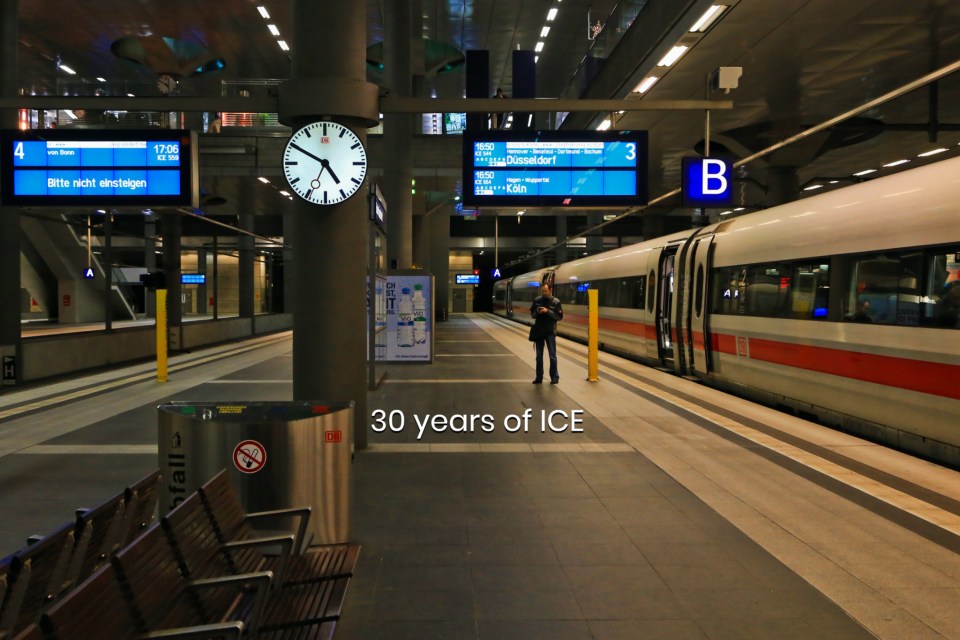
Above/featured: Berlin Hauptbahnhof – 9 Dec 2015 (6D1). Departing from track 3 is ICE 554 to Köln (front-half) and ICE 544 to Düsseldorf (back-half); trains split in the town of Hamm.

June 2021 marks the 30th anniversary of high-speed Intercity Express (ICE) service on German rail.

In the 1991 vs. 2021 comparison graphic provided by Deutsche Bahn, I’ve marked in green the ICE routes upon which I’ve made dozens of trips since late-2001 (when I moved to Heidelberg). Even after leaving in 2003, frequent annual trips back to Germany meant spending a lot of time planted on express trains across the country. Arriving in Europe mostly meant flying into Frankfurt am Main airport, from which I’d travel:

  • Frankfurt to Berlin, via Kassel
  • Frankfurt to Heidelberg, via Mannheim
  • Frankfurt to Köln
  • Frankfurt to Munich, via Stuttgart
  • Berlin to Frankfurt, via Kassel
  • Berlin to Köln, via Hannover
  • Köln to Berlin, via Hannover
  • Köln to Frankfurt
  • Munich to Frankfurt, via Stuttgart

Over the last few years, the express stretch between Erfurt and Halle/Leipzig has vastly improved the Berlin-Frankfurt and Berlin-Munich routes, cutting the one-way travel time for each route by about one hour. Except for the Erfurt-Halle/Leipzig stretch, I’ve travelled on every “Stundentakt” ICE route (thick red/green in the graphic below).

Intercity Express, Deutsche Bahn, German Rail, Germany, Deutschland

ICE coverage, including recent work on the Erfurt-Halle/Leipzig stretch; graphic courtesy of Deutsche Bahn. My “dozens on ICE” are marked in green; red filled circles indicate cities I frequented the most (B, F, HD, K, M).

Intercity Express, train fleet, Deutsche Bahn, German Rail, Germany, Deutschland

The ICE fleet of trains include vehicles with maximum speeds of over 300 km/h; graphic courtesy of Deutsche Bahn.

Frankfurt am Main Hauptbahnhof, F Hbf, Frankfurt am Main, Hesse, Hessen, Germany, Deutschland, fotoeins.com

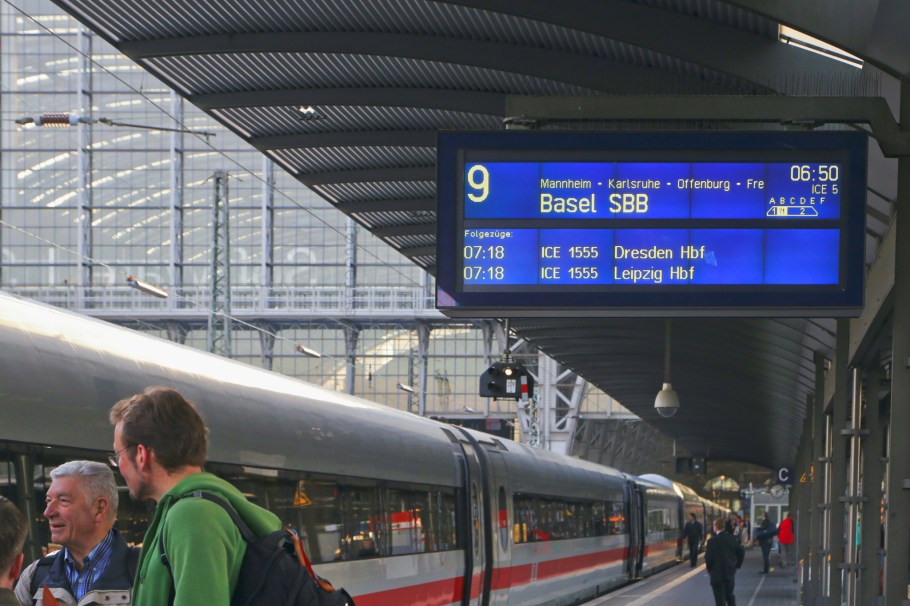
Morning ICE 5 service from Frankfurt am Main to Basel; how to read this train station signage – 20 May 2016 (6D1).

Hackerbrücke, München, Munich, Bavaria, Bayern, Germany, Deutschland.

Morning light at Munich’s Hackerbrücke station. Foreground: westbound metallic-white ICE train just departing the city’s central station, traveling right to left. Background: red DB regional train approaching central station, from left to right. Photo on 23 Feb 2017 (6D1).

I made three images above with a Canon EOS6D mark1 (6D1). This post appears on Fotoeins Fotografie at fotoeins DOT com as https://wp.me/p1BIdT-l60.

Deutsche Bahn, IC 2218, Oberes Mittelrheintal, Upper Middle Rhine Valley, Germany, fotoeins.com

The nebulous transition

I’m racing past kilometer 554.

The simple black and white sign on the east flank of the river counts down to the end, to the river’s mouth where the mineral-rich mud and silt enter the North Sea. Another sign tells me what this famous rock-face landmark is.

There’s barely enough time at Loreley to detect the hint of a siren’s call, as the train marches to the next bucolic town. Though small in size, the town and its buildings seem to stand fast in a “group hug” of the river bank in a futile attempt to hold back the rush of the Rhine.

This feels like routine, a journey in western Germany which I’ve repeated many times over the last 15 years. With heavy heart, I’ve departed my adopted hometown of Heidelberg for the umpteenth time. I’m traveling north to meet with friends I haven’t seen in a couple of years.

( Click here for more )