Fotoeins Fotografie

location bifurcation, place vs. home

Posts tagged ‘Cultural Heart of Germany’

GTM15, Weimarer Markt, Markt, Weimar, Thüringen, Germany, fotoeins.com

Weimar: an instant walk through the UNESCO town (IG)

Like Erfurt, Weimar is located near the geographic centre of Germany. It’s a small town with over 60000 people, but what it lacks in size is surely made up in history and the number of UNESCO World Heritage Sites. The city hosts multiple sites in two separate categories:

•   “Classical Weimar”, including the Anna Amalia Library and the Rococo Hall, and
•   “Bauhaus Sites”, including the Bauhaus University.

Erfurt, Weimar, and the state of Thuringia were hosts for Germany Travel Mart 2015 (GTM15), the annual meeting and workshop by the Germany National Tourism Board. Visiting the “heart of Germany” fulfilled my desire to spend time in the former East Germany. Many overlook Thuringia and the middle of Germany on their way elsewhere, but the following shots provide reasons why you should consider stop and embrace one of the “centres of classic and modern Germany.”


I’m very grateful to Weimar Tourism, Thüringen Tourismus, Germany National Tourism Board for access to places and activities in the city; and to Dorint Hotel am Goethepark for a comfortable and welcoming stay. I made the photos between 27 April and 1 May 2015. This post appears on Fotoeins Fotopress at fotoeins.com as http://wp.me/p1BIdT-6PS.

Weimar: Duchess Anna Amalia Library, UNESCO WHS

As one of over ten buildings, residences, and properties making up what is called “Classic Weimar”, the Duchess Anna Amalia Library (Herzogin Anna Amalia Bibliothek) has been a UNESCO World Heritage Site since 1998.

To consolidate her love of books into a larger holding space, Duchess Anna Amalia commissioned in 1761 the State Architect to rebuild and convert the Renaissance-style French (Green) Castle into a library, which opened in 1766. Becoming one of the most important libraries in the country, the collections included some of the finest written and produced in German literature, art and culture, history, and architecture. Johann Wolfgang von Goethe himself was Library Director between 1797 and 1832.

The library has had its fair share of names: initially called the Ducal Library (Herzogliche Bibliothek); in 1815 renamed as the Grand Ducal Library (Großherzoglichen Bibliothek); in 1918 renamed as the Thuringia State Library (Thüringische Landesbibliothek); in 1969 renamed as the Central Library of German Classics (Zentralbibliothek der deutschen Klassik); and in 1991, renamed as Duchess Anna Amalia Library (Herzogin Anna Amalia Bibliothek) in honour of the library’s founder.

An electrical short from aging damaged wiring sparked a fire on 2 September 2004; the fire held on for over two days before the final hotspot was put out. Over 100 thousand books were damaged or destroyed by fire, water, and smoke. The fire was the largest to strike a German library in post-war history. Subsequent donations and volunteers poured into Weimar from throughout Germany and Europe to help with rescue and preservation efforts. After conclusion of extensive restoration work to the building, the interior Rococo Hall, and to thousands of rescued books, the library was reopened on 24 October 2007, the birthday of the library’s namesake (Anna Amalia born 24 October 1739).

( Click here for more )

Rathaus at night, Fischmarkt, Erfurt, Germany, fotoeins.com

Erfurt: an instant walk back in time (IG)

Erfurt is located near the geographic centre of Germany, and is called the “Rome of Thuringia” for the number of church steeples in the city. Even if being in the middle depends on how borders, especially post-reunification borders, are defined, there are five towns vying for the title “Mittelpunkt Deutschlands” (Germany’s centre), depending upon the technique used to determine where the centre might be.

But Erfurt’s been at the “centre of action” for centuries, in the midst of the “Via Regia” (royal road) dating centuries back to the heyday of the Holy Roman Empire, traditional woad (blue-dye) production, the movement of trade and people along the east-west transeuropean highway, religious pilgrims back and forth and beyond to Santiago de Compostela, Martin Luther stopping by to give an update on the Reformation, and even, Bach’s parents getting married here in town.

It’s easy to overlook Erfurt, but giving this city a chance allows it to sneak up on you. The following Instagram shots provide reasons why you should embrace the sneaky bits.


Thanks to Germany Tourism, Thüringen Tourismus, and the Erfurt Tourism and Marketing Board for support and access to places and activities; and to Mercure Hotel Erfurt Altstadt for their generous hospitality. I made the photos above 26 and 29 April 2015. This post appears on Fotoeins Fotopress at fotoeins.com as http://wp.me/p1BIdT-6LM.

An der Frauenkirche, Dresden, Germany, fotoeins.com

The bright side of Dresden (IG)

It’s 6am in southeast Germany, and I’d like to know how this city will look on a spring morning. Unfortunately, there’s mid-level cloud and there won’t be any direct sun this morning. I’m no longer in a rush, and by 7am, I’m on the Carolabrücke over the Elbe river for the following view of the Dresden skyline.


Later that evening I’m in Pulverturm Restaurant near the Frauenkirche, and I’m among about two dozen other travel-trade and -press representatives from around the world. I have a Saxon version of the Sauerbraten, accompanied by red sauerkraut and a big potato dumpling: the right combination of sweet, savory, and sour, representing Saxony.

Pulverturm, Frauenkirche, Dresden, Saxony, Sachsen, Germany, Deutschland, fotoeins.com

At Pulverturm: Saxon Sauerbraten with apple red-cabbage slaw with raisins and a King-size potato dumpling. Photo on 22 Apr 2015.


The evening ends with a guided-tour of the interior to the city’s famous Semperoper opera house. Other groups outside are waiting to enter the opera house to have a look inside; we’re fortunate to leap ahead and have a look inside.

Semper Oper, Theaterplatz, Dresden, Sachsen, Germany, fotoeins.com

Classic night shot of the Semperoper – 22 Apr 2015.


I made all of the photos above on 22 April 2015 with a Canon EOS6D mark1. I’m grateful to Germany Tourism and Dresden Marketing for supporting and providing the activities. This post appears on Fotoeins Fotografie at fotoeins DOT com as http://wp.me/p1BIdT-6L3.

ICE 791 south to Leipzig, Deutsche Bahn, InterCity Express, fotoeins.com

Leipzig: impressions of the Heldenstadt, Messestadt, & Musikstadt

I’m on express train ICE 791 southbound from the German capital. When my nose isn’t stuck against the window, I’m stationed at the exit doors, swinging back and forth with the train, gazing out to familiar scenes in the German countryside: hills, farmlands, little towns, and rows of towering wind turbines.

I’m on my way to Leipzig.

From the moment I was introduced to the music of Johann Sebastian Bach, Leipzig has never strayed far from the imagination. As my train races to Leipzig, I’m looking for help with the following questions. Why is Leipzig being compared to Berlin? How do Leipzig’s historical experiences shape the city today? There are no promises for any answers, but there are plenty of places to begin.

As Leipzig celebrates a milestone millennium, the city has quietly left its mark on Germany and Europe with religion, trade, books, music, and the 1989 “peaceful revolution”. Recent attention on the art scene in Leipzig has drawn comparisons with Berlin. Some disagree and bristle with labels such as “Hypezig” or “the new Berlin.” But the people of Leipzig carry on, unfazed and perhaps bemused by the attention. Fact is Leipzig can be described in at least three ways: a city of heroes, a city of trade fairs, and a city of music.

Stepping off the train upon arrival, I stroll into a mammoth concourse in one of the largest train stations on the European continent. I’m completely in my element here in the station’s spacious hall, setting me in a proper frame of mind to kick off my time here in Leipzig.


City of Heroes (Heldenstadt)

Leipzig: St. Nicholas Church, by Schmidt, Leipziger Tourismus und Marketing GmbH

St. Nicholas Church: photo by Schmidt for Leipziger Tourismus und Marketing GmbH

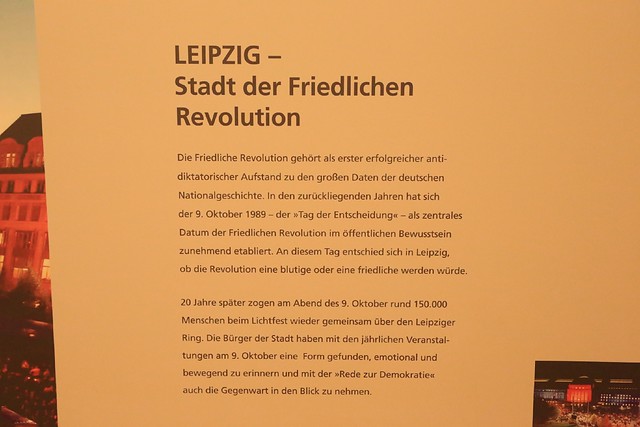
With origins dating to the 12th-century, St. Nicholas Church is better known today for its connection and origins to demonstrations against communist rule in 1989. Because unapproved public assembly was against the law, churches were safe places to gather, although all who entered were photographed and monitored. Weekly Monday prayers began in the early-1980s, which began developing into public assemblies. They grew and spilled out onto streets as peaceful marches and the Monday demonstrations. October 9 became a “Day of Decision” as East German authorities countered with massive police and security presence. An estimated 70 thousand people appeared and the demonstration proceeded peacefully with security forces staying back. The size, scale, and importance of these protests became apparent to everyone after video footage took a circuitous route out to the West. 120 thousand people appeared in a demonstration the following Monday, and 300 thousand were in attendance on 23 October.

Demonstrations began in other cities in East Germany, and by 4 November, an estimated half million attended demonstrations in East Berlin. The Wall dividing East and West fell on 9 November. What’s remarkable is that the internal revolution remained largely peaceful, especially with people and authorities very aware of the massacre months earlier in Beijing’s Tiananmen Square.

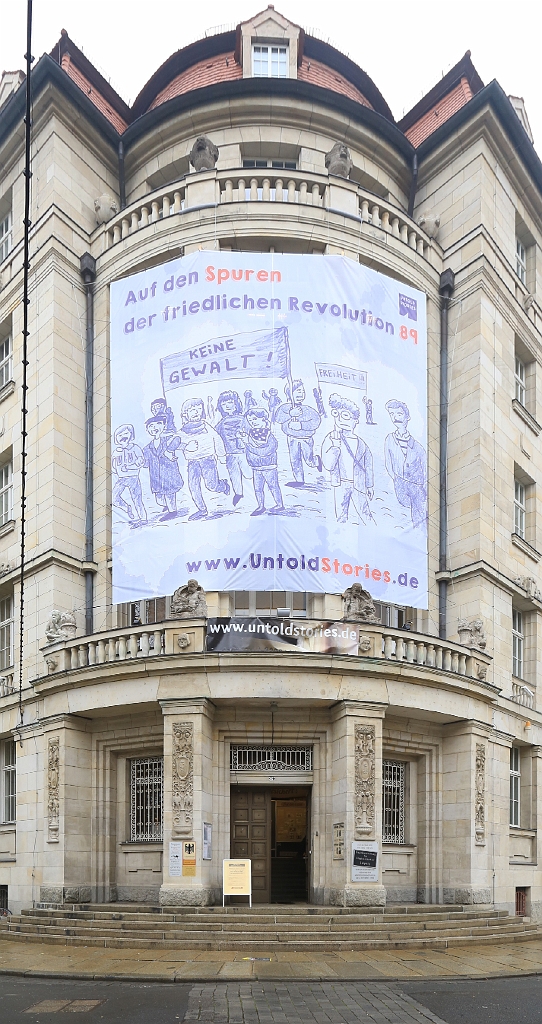
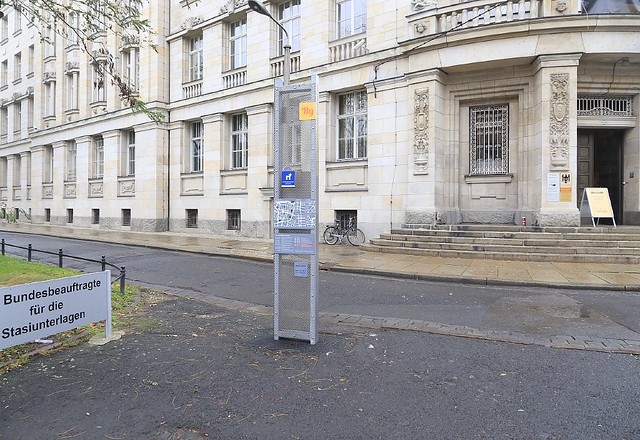
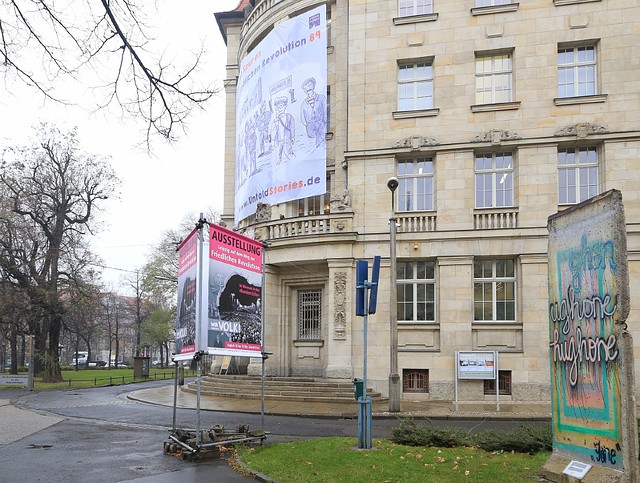
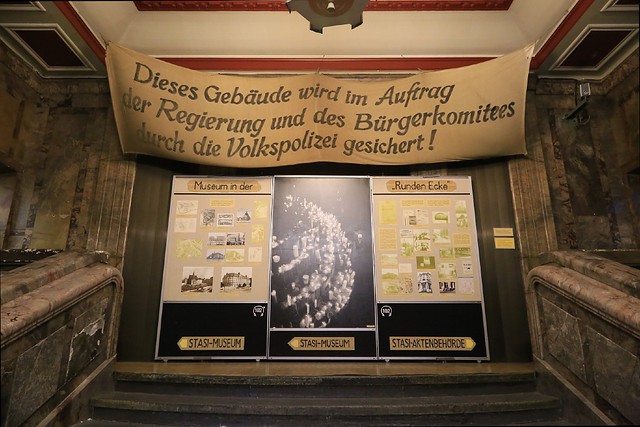
Runde Ecke, Friedriche Revolution, Peaceful Revolution, Leipzig, Saxony, Sachsen, Germany, Deutschland, fotoeins.com

Runde Ecke (Round Corner) – 4 Dec 2014.

The photo above is at the Museum Runde Ecke, which housed the Leipzig District Administration of the Ministry for State Security (Bezirkverwaltung für Staatssicherheit, Stasi) from 1950 to 1989. Even with the fall of the Wall and the collapse of one-party rule, weekly Monday street demonstrations continued with people demanding open access to their security files. About 150 thousand marched on 4 December 1989 towards the local Stasi administrative offices. People crashed through the doors, pushed their way inside, and occupied the building, protecting countless Stasi files from destruction.

While most think of Berlin as primary staging for the fall of the Wall, Leipzig is where peaceful demonstrations driving the push to end communist rule began.


City of Trade Fairs (Messestadt)

In the Middle Ages, Leipzig was at the crossroads of two major trade routes in the Holy Roman Empire: the east-west “Via Regia” (Royal Way) and the north-south “Via Imperii” (Imperial Way). Throughout the centuries, Leipzig welcomed goods, people, and traditions from throughout Europe. Leipzig was granted market rights by Otto the Rich (Magrave of Meissen) in the middle of the 12th-century, and the city was granted imperial fair privileges by Emperor Maximilian I in 1497.

Kaffeehaus Riquet, Leipzig, Saxony, Sachsen, Germany, Deutschland, fotoeins.com

Kaffeehaus Riquet – 2 Dec 2014.

The Riquet family emigrated as Huguenots from France to Germany and in 1745 they established in Leipzig a company trading in tea, coffee, and spices in the Far East. Built at the present location in 1909, the Riquet coffee house is a unique example of Jugendstil or Art Nouveau architecture in the city.

Specks Hof, Leipzig, Saxony, Sachsen, Germany, Deutschland, fotoeins.com

Specks Hof – 2 Dec 2014.

Specks Hof is an example of one of the oldest shopping complexes dating back to the middle of the 15th-century where a building with living space and brewery once stood.
The merchant and art collector Maximilian Speck purchased the corner building in 1815, naming the building Specks Hof (Speck’s Courtyard). In the early 20th-century, the architect Hansel redesigned the building as an exhibition house for the Leipziger Messe trade-fair. Post-war reconstruction took place in 1947 with additional renovation in the 1980s and 1990s. Today, Specks Hof is a prize-winning example of the city’s architecture.


City of Music (Musikstadt)

Like many fond of classical music, one dreams of walking in the footsteps of famous composers, musicians, and artists. I’ve followed them along the Leipzig Music Trail (Leipziger Notenspur). To stand in the same places where Bach and Mendelssohn once played and led their respective choirs in song is a big thrill.

Johann Sebastian Bach, Thomaskirche, St. Thomas Church, Leipzig, Sachsen, Saxony, Germany, Deutschland, fotoeins.com

Grave for Johann Sebastian Bach, St. Thomas Church – 3 Dec 2014.

From 1723 until his death in 1750, Johann Sebastian Bach was choir director of St. Thomas Church (Thomaskantor, Thomaskirche). His responsibilities included arranging music for a number of churches in the city and teaching Latin. Bach led the church’s choir, the Thomanerchor, in existence since the early 13th-century. Bach’s remains were moved in 1950 to the present resting place in the nave of St. Thomas church.

Leipzig: Gewandhaus concert hall, evening, by Schmidt, Leipziger Tourismus und Marketing GmbH

Gewandhaus concert hall, from Leipziger Tourismus und Marketing GmbH.

Gewandhaus, Leipzig, Saxony, Sachsen, Germany, Deutschland, fotoeins.com

Gewandhaus at night – 2 Dec 2014.

The building on the south side of Augustusplatz is the city’s Gewandhaus, home to the Gewandhausorchester. They’re the world’s oldest civic symphony orchestra, having been founded as a society in 1743, and playing in the Gewandhaus for the first time in 1781. The original Gewandhaus was a “garment house” or a trading house for textile merchants. Between 1835 and 1847 (except for one year), Felix Mendelssohn Bartholdy was Music Director (Gewandhauskapellmeister). Other notables including Mozart, Beethoven, Wieck, Liszt, Schubert, Schumann, Brahms, Wagner, Tchaikovsky, Strauss performed at the Gewandhaus. The present-day Gewandhaus was completed and inaugurated in 1981, the only dedicated concert hall ever built in former East Germany. Visibly illuminated through the glass facade and hanging above the front entrance is the giant mural “Gesang vom Leben” (Song of Life) by Sighard Gille. Appearing at the Gewandhaus since 1781, a quote attributed to the Roman philosopher Seneca summarizes the city’s music history:

“Res severa verum gaudium.”
(“True pleasure is serious business”.)

… and a city of arts (Kunststadt)

Spinnerei, Leipzig, Sachsen, Saxony, Germany, fotoeins.com

Spinnerei arts & cultural centre – 3 Dec 2014.

Since 2005, the Leipzig Spinnerei arts and cultural space is hosted inside a former cotton mill in the western industrial suburb of Plagwitz.


Leipzig millennium, 1015 to 2015 AD/CE

Leipzig is first mentioned in 1015 as a trading settlement, “urbs Libzi”, in the chronicles of Bishop Thietmar of Merseburg. Along with year-long celebrations in 2015 marking Leipzig’s millennium, the city will also celebrate the 850th anniversary of the Leipzig Trade Fair and the 850th anniversary of St. Nicholas Church.

Lipz Schorle, Lipz, Leipzig, Saxony, Sachsen, Germany, Deutschland, fotoeins.com

“Lipz Schorle” locally produced rhubarb-flavoured soda – 4 Dec 2014.

“Lipz” or “Lipsk” are early names for the city of Leipzig from the Sorbian (Slavic) word “Lipsk”, meaning “place of linden (lime) trees.” The Czech name for Leipzig is “Lipsko”. This bottle of Lipz Schorle is a non-alcoholic fizzy drink made and bottled in Leipzig.


It’s easy to be carried away by the stories. The sense of knowing civic pride mixed with quiet humility. That there’s much less historical baggage and less attention than the sharp focus on the capital city.

I’ve barely scratched the surface over the short time here. I must come back to meander along the “Karli” (Karl-Liebknecht-Strasse), to explore the Musikviertel and Mediaviertel, the former Industriegebiet, and the green belt; to sit among the linden trees next to the pit-lakes; to absorb the day-to-day in the “Lipsk”.

I leave Leipzig recognizing her people aren’t very concerned by the “Hypezig” label or declarations as “the new Berlin”. Leipzig is a place whose people have always recognized change, always been a city about publishing, of coal, of food and drink, where trade and commerce intermingle freely with open culture.

To paraphrase my new friends about the ongoing history of Leipzig:

“Wie Phönix aus der Asche, ist die Stadt immer über den neuen Leipzig gewesen. Man tu’, was man will; man mach, was man kann.”

(Like a phoenix rising from the ashes, the city has always been about the new Leipzig. Anybody can do whatever they what; they’ll create whatever they can.)


Hourly trains with Deutsche Bahn’s InterCity Express service go between Berlin and Leipzig in 70 to 80 minutes. Frequent rail service from Dresden to Leipzig take anywhere from 70 minutes (IC, ICE trains) to 100 minutes (RE trains).

I made seven images above during my 2-4 December 2014 visit, graciously hosted by Leipzig Tourismus und Marketing GmbH (LTM). Thanks to Christine Horchheimer, Michael Luderwig, and Simone Feldmeier for their tours, and to Jane Langforth and Steffi Gretschel at LTM for their help. This post appears on Fotoeins Fotografie at fotoeins DOT com as http://wp.me/p1BIdT-6fC.