Fotoeins Fotografie

location bifurcation, place vs. home

Posts tagged ‘contemporary art’

Vienna Votive: “Infinity of Light” by Billi Thanner

By definition, a “votive” is an object offered in fulfillment of a solemn promise.

Having survived an assassination attempt in 1853, Austria’s Emperor Franz Joseph promised to construct a church in gratitude. That’s how Vienna’s Votive Church came to be in 1879 with the design by first-time architect Heinrich Ferstel.


Suspended Infinity

In mid-December 2025, Austrian artist Billi Thanner unveiled her light sculpture, “Unendlichkeit des Lichtes” (Infinity of Light), placed between the two towers of the Votive Church. The art work is a 28- by 6-metre aluminum loop weighing 800 kilograms, and includes almost 5000 lights. The sculpture wraps around both towers in a figure-eight; but sitting on its side, the visual is also the mathematical symbol for infinity (∞).

The significance for the number 8 is its representation of the time taken by light to travel from the Sun to the Earth. As for “infinity”, Thanner explains:

Licht ist für mich das Leben. Und irgendwann kam der Impuls: die Unendlichkeit im Licht sichtbar machen. Nicht abstrakt, sondern real im Stadtraum — zwischen den beiden Türmen dieser Kirche

Light is life itself. The impulse came to me at some point: to make infinity visible in the light. Not in its abstract nature, but something real in the urban space — between the two towers of this church.)

What’s a little unusual is that this sculpture and its installation have been financed entirely through private sources: no public money and no church donations. Thanner also waived her commission fee, essentially making this years-long project one out of total independence and personal dedication.

While the sculpture’s attachment to a church building makes a direct association with religion or spirituality, I feel there’s something simpler and more fundamental. Billi Thanner’s sculpture reminds us to do better for and to be better with each other as people. That’s in part a promise I made after accompanying my parents to the end. I’m inspired by Thanner’s light to try a little more with every passing day, despite spectacular failure and disappointment.

The light sculpture will remain in place until May 2027.
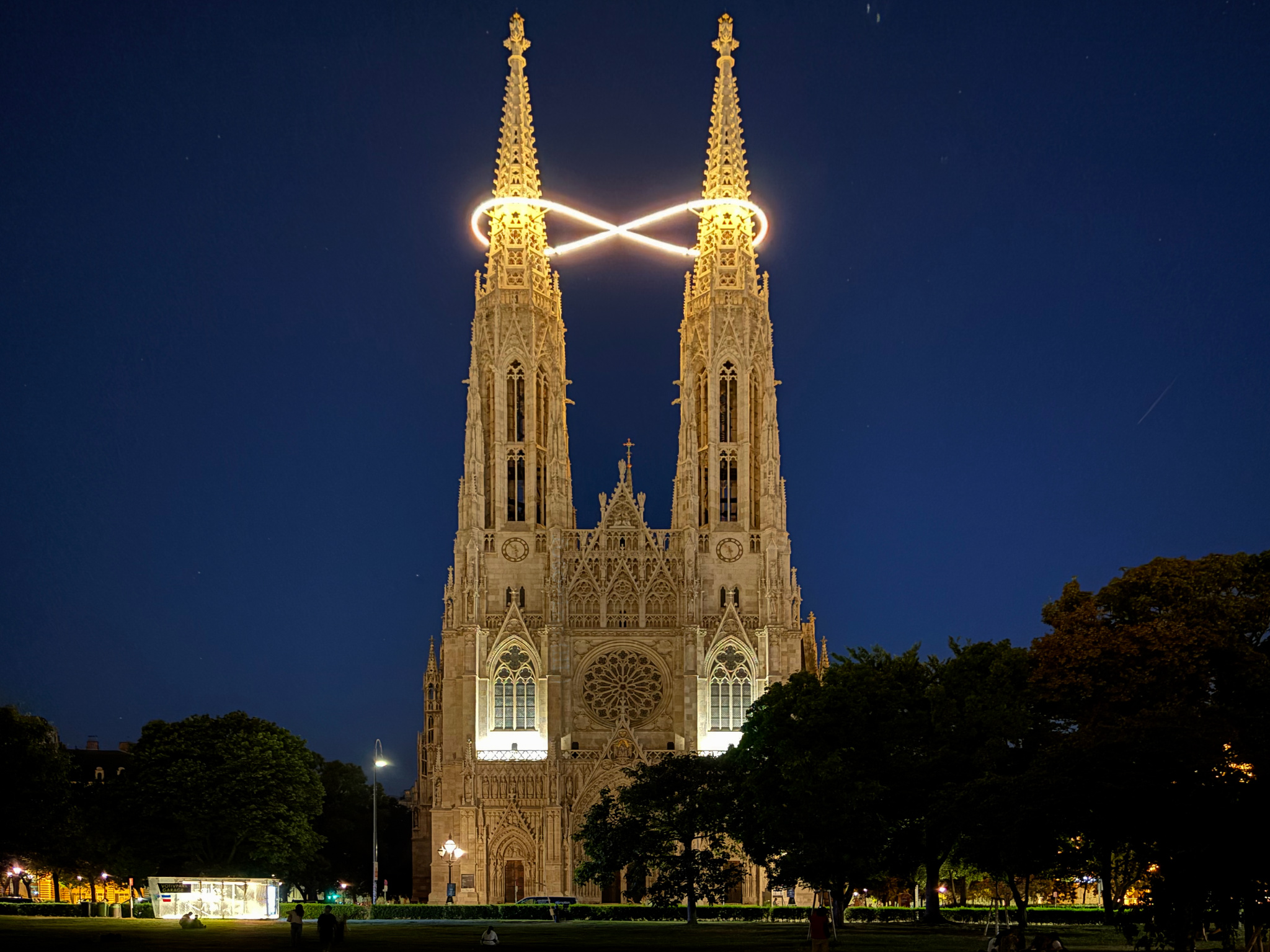
Infinity of Light, Billi Thanner, Votivkirche, 9. Bezirk, Alsergrund, Wien, Vienna, Austria, Österreich, fotoeins.com

Votive Church from Sigmund-Freud-Park, 28 Jun 2026; image corrected for geometric distortion.
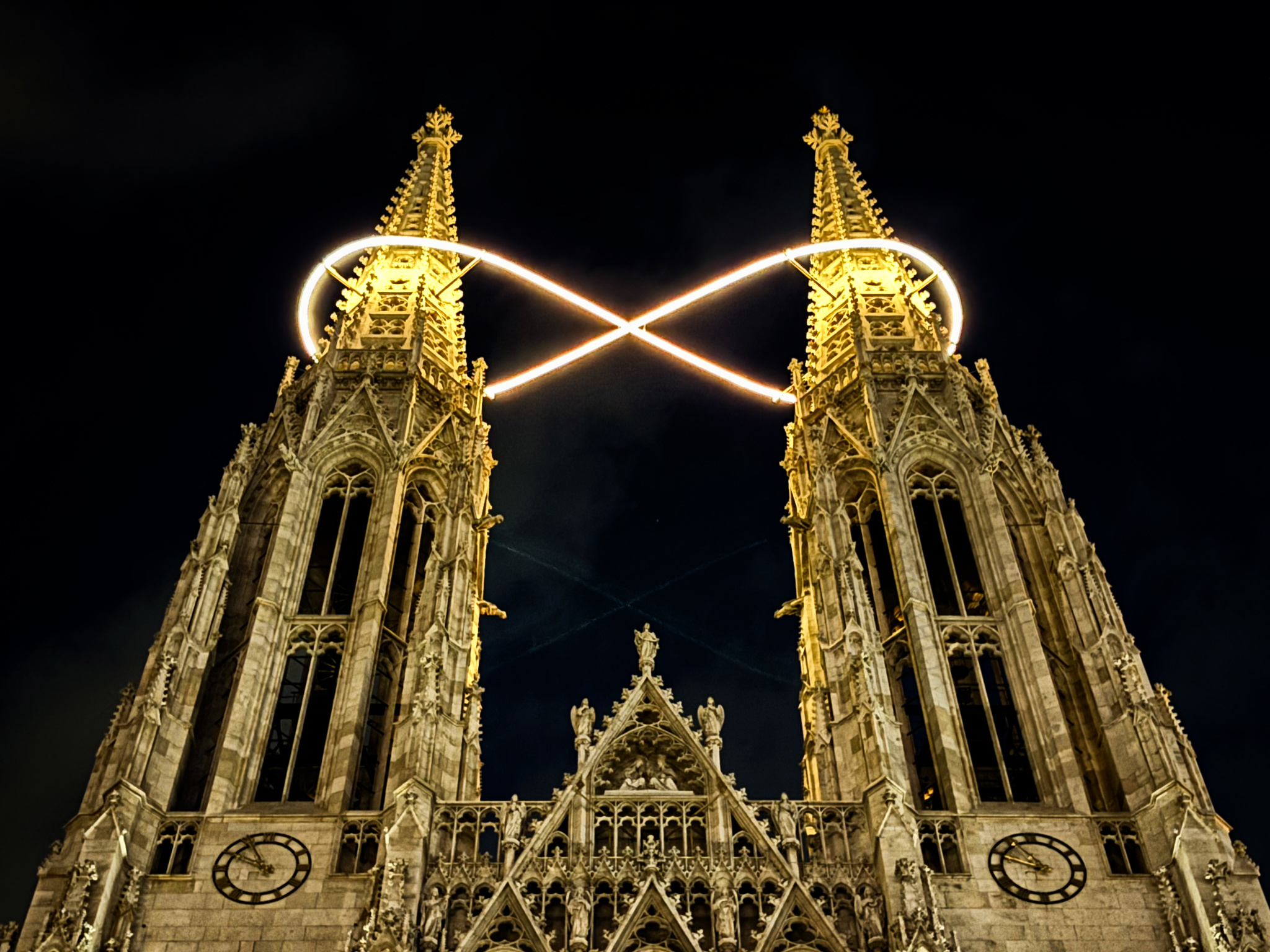
Infinity of Light, Billi Thanner, Votivkirche, 9. Bezirk, Alsergrund, Wien, Vienna, Austria, Österreich, fotoeins.com

Votive Church from Sigmund-Freud-Park, 18 Jul 2026.

7.5 minutes: light-display recorded 18 Jul 2026. The dynamic display appears to occur at the top of every hour at night, but I didn’t go out to check past midnight (heh).

Für mich war diese Skulptur nie nur eine Lichtinstallation. Sie ist eine Möglichkeit, Menschen für einen Moment an Hoffnung, Freude und ihre Verbundenheit zu erinnern. Gerade in einer Zeit, in der vieles trennt, kann Kunst Räume öffnen, die Menschen wieder miteinander in Verbindung bringen.

For me, this sculpture was never just a light installation. It’s a way to remind people, if only for a moment, of hope, joy, and their close connections. In these divisive times, art can open spaces that bring people together again.

– Billi Thanner.


I received neither pre-visit support nor post-visit compensation fot this entry. I made all media above on 28 June and 18 July 2026 with an iPhone15. This post appears on Fotoeins Fotografie at fotoeins DOT com as https://wp.me/p1BIdT-z2V.

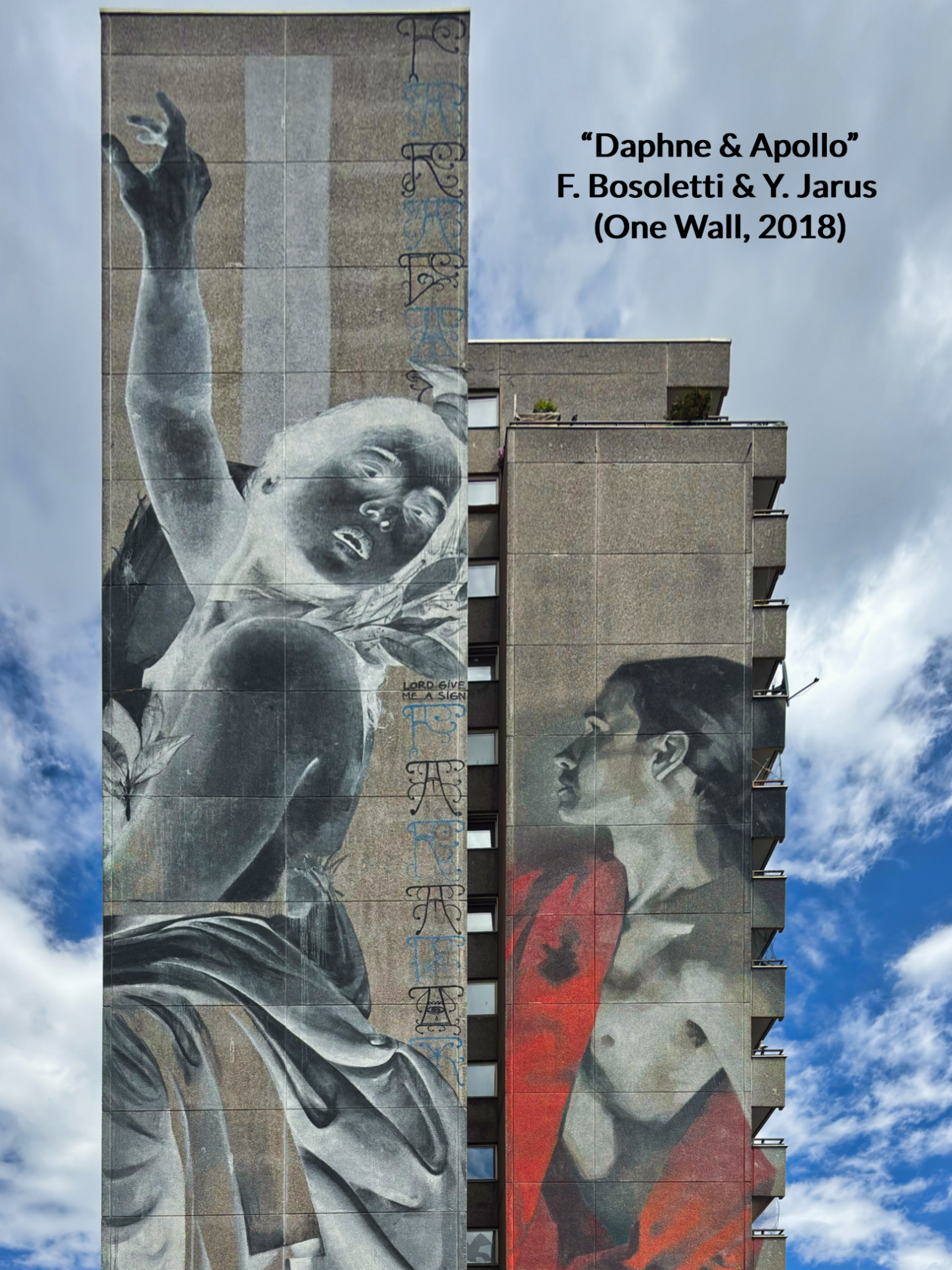
Daphne and Apollo, One Wall 2018, Kreuzberg, Berlin, Germany, Deutschland, fotoeins.com

Berlin: “Daphne & Apollo” mural in Kreuzberg

•   “Daphne and Apollo”, by Francisco Bosoletti 🇦🇷 & Young Jarus 🇨🇦.
•   Commissioned by Urban Berlin for the “One Wall” project in 2018.
•   The mural appears on the south wall of an apartment building in Kreuzberg (Bezirk Friedrichshain-Kreuzberg), facing Gitschiner Strasse and the Berliner U-Bahn Stammstrecke.
•   Characters from “Metamorphoses” by Roman poet and writer Ovid (Publius Ovidius Naso), written in Latin and published about 8 CE.


Daphne and Apollo, One Wall 2018, Kreuzberg, Berlin, Germany, Deutschland, fotoeins.com

Part 1: original photo, corrected for geometric distortion.

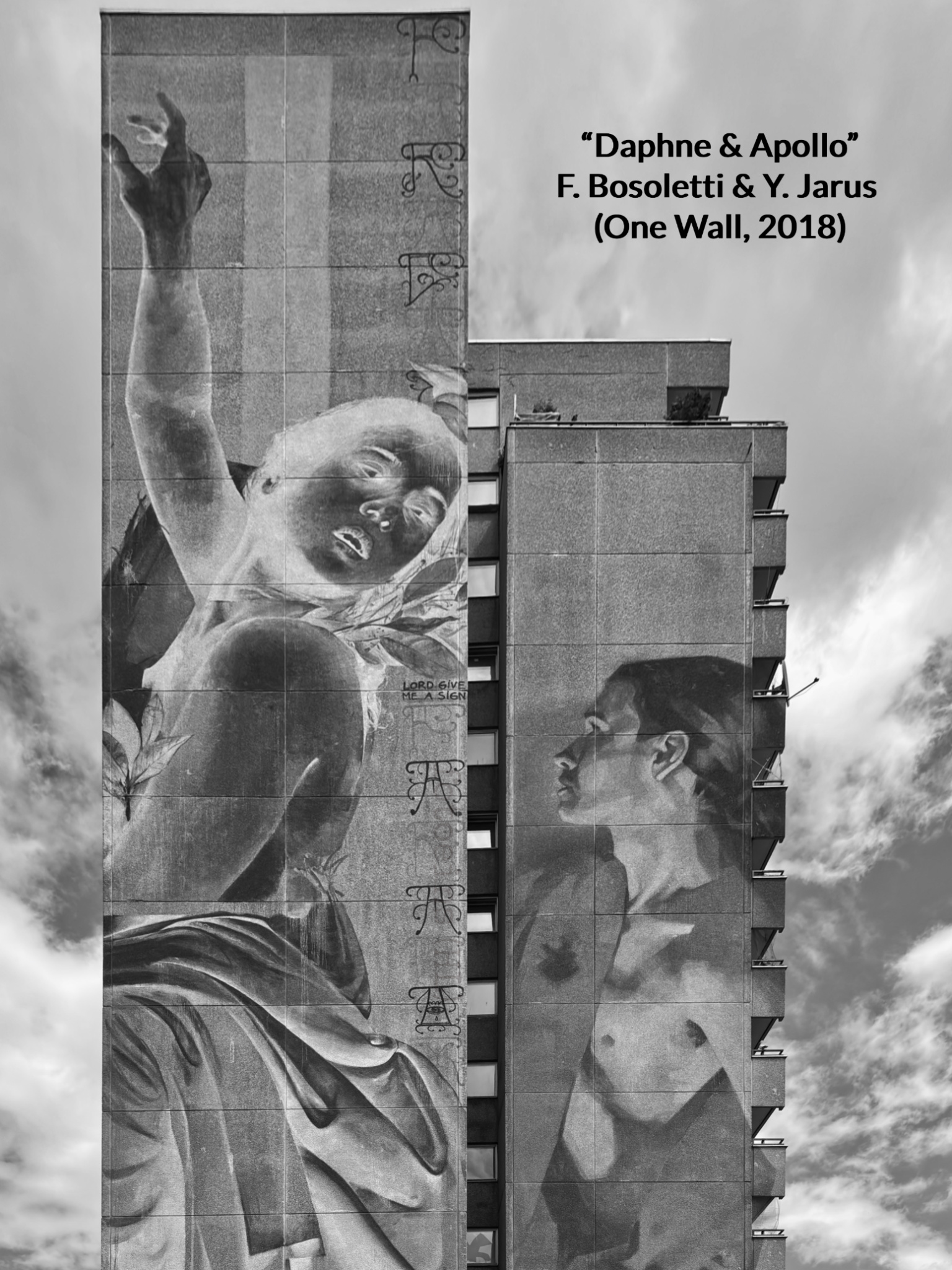
Daphne and Apollo, One Wall 2018, Kreuzberg, Berlin, Germany, Deutschland, fotoeins.com

Part 2: corrected photo converted to monochrome.

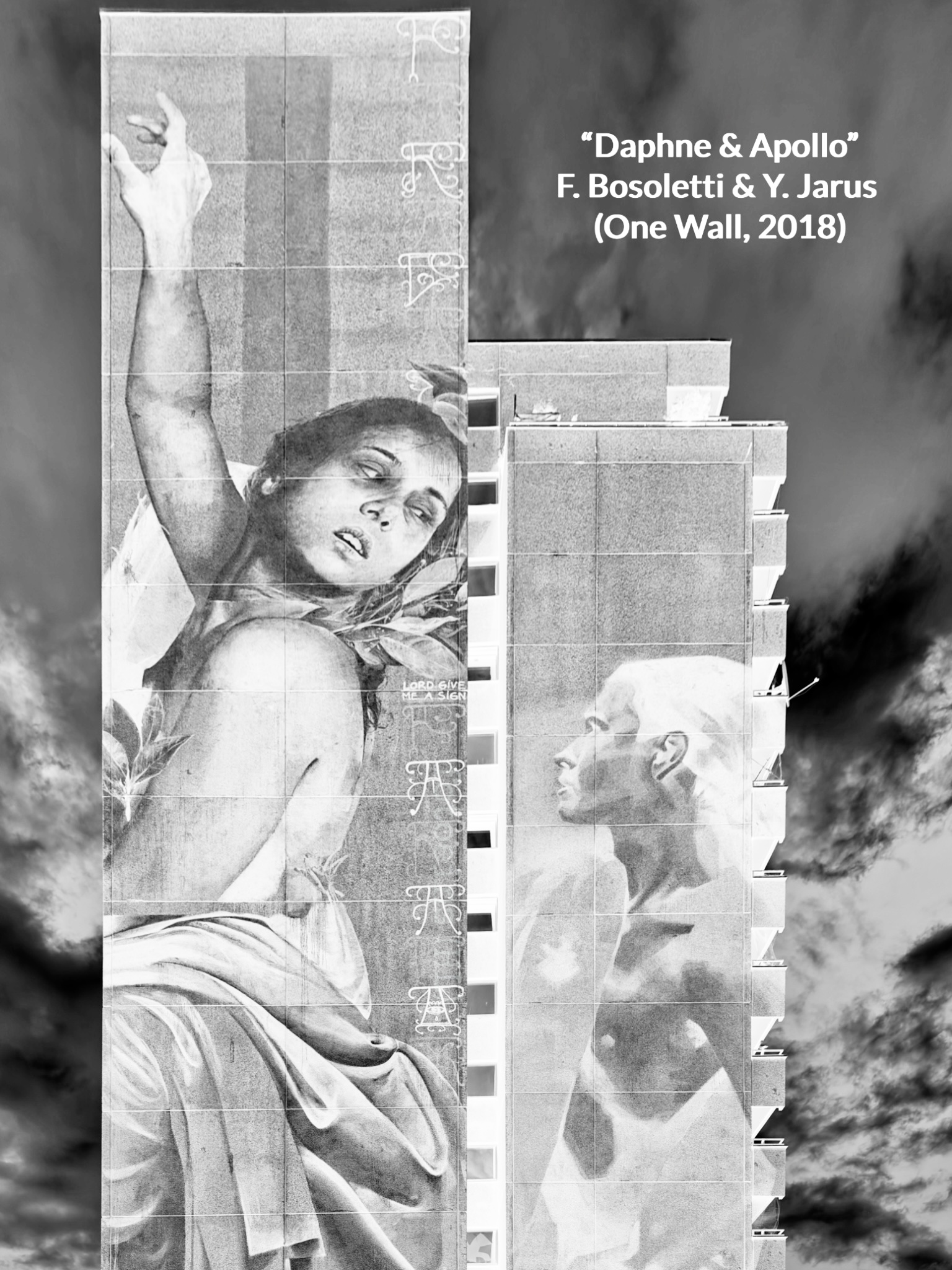
Daphne and Apollo, One Wall 2018, Kreuzberg, Berlin, Germany, Deutschland, fotoeins.com

Part 3: black- and white-points reversed in monochrome image.


The mural is located between U-Bahn stations Prinzenstrasse and Kottbusser Tor. If you’d like to see the mural illuminated in natural light, it’s best to visit between 11am and 2pm (when the sun is at or near zenith). In addition to the Google Map below, here is the corresponding view on Open Street Map.

I made original images above on 7 Jun 2026 with an iPhone15; I edited images with Polarr Pro and Preview. This post appears on Fotoeins Fotografie at fotoeins DOT com as https://wp.me/p1BIdT-z1A.

Berlin’s Hamburger Bhf: no trains, only transition

Above: Appearing in Raleway font is my added line: This is not a train station.”

There is no meat or bread here.

There are also no trains here. No longer.

There is only art, and in this instance, there is a contemporary art piece that’s a historical nod.

The artwork “Transition” (2009–present) by Polish artist Robert Kuśmirowski is housed in the Hamburger Bahnhof – Nationalgalerie der Gegenwart, a museum of late-20th and 21st-century art in the German capital city of Berlin. Kuśmirowski’s piece refers to the building’s past and its present. “Transition” is a part of the ensemble “Unendliche Ausstellung” (Eternal Exhibition”) on permanent display throughout the Hamburger Bahnhof gallery-museum.

( Click here for images and more )

My Berlin: Alicja Kwade, bridging art & science

Above/featured: Alicja Kwade exhibition, at the Berlinische Galerie. HL:X70.

In mid-2021, the world slowly climbs out of the worst of the pandemic. Later that autumn, I watch DW Culture’s Arts.21 feature on Polish-German artist Alicja Kwade whose work strikes a personal resonance. I have to go see her work and exhibition in person, but would it even be possible? My answer arrives six weeks later with a quick jump home to Berlin.

All of Kwade’s sculptural pieces in her exhibition, “In Abwesenheit” (In Absence)”, are “self-portraits.” But none of them show her face; the pieces aren’t necessarily simple, nor are they “selfies” characterized by the present vernacular. She is not physically present, and yet, every piece provides the visitor a glimpse into her mindset including questions she raises about the volatility of the human condition and about where we fit within a very large universe.

As former scientist, I love and recognize the influences on her art. She is clearly very interested in mathematics, physics, astrophysics, biology, genetics; but she’d be the first to admit she’d need multiple lives to completely fulfill all of her interests. The deconstruction of “self” into precise scientific elements is another way of expressing those (dreaded) “selfies” or self-portraits. I admire the clever play: it’s the breakdown into those elements that tell us what she is, and it’s the measured synthesis of those elements into the broad strokes of her sculptures that tell us who she is.

We’re all playing this game. Everyday things seem so important. But then you zoom out and realize that you’re standing with another billion [people] on a spinning sphere. With that perspective, you’re reminded to just be glad you’re here at all.

– Alicia Kwade about her rooftop commission at New York City’s Metropolitan Museum of Art: Artnet News, 16 April 2019.


( Click here for images and more )

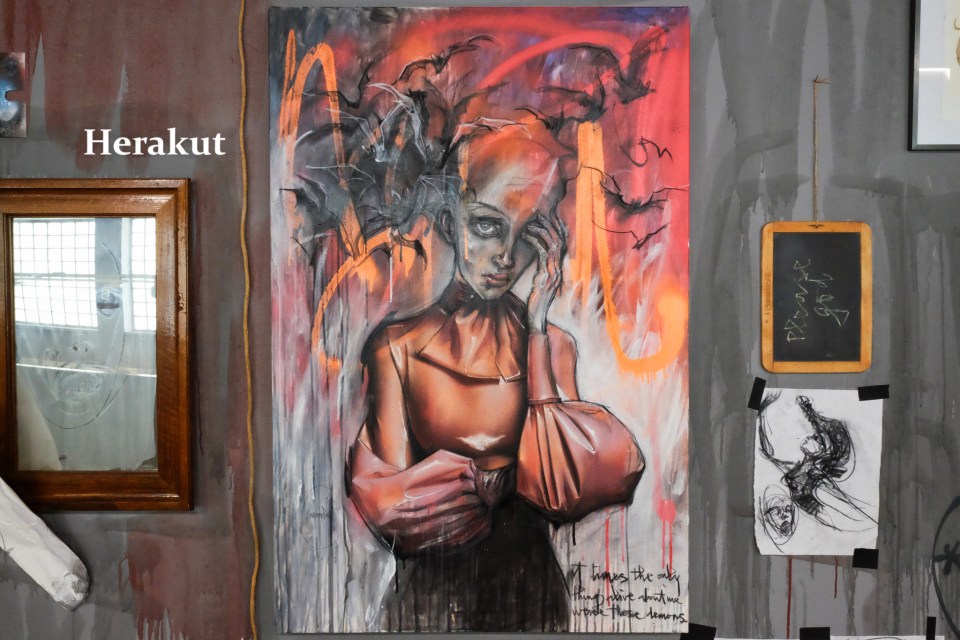
herakut, Museum of Urban and Contemporary Art, MUCA, Munich, Muenchen, Bayern, Bavaria, Germany, Deutschland, fotoeins.com

Herakut: big wall art around Germany

Above/featured: “At times the only thing alive about me were those demons.” MUCA Munich – 31 May 2018 (X70).

One of my favourite artists is Herakut, a German duo whose street murals have appeared in Europe and around the world since 2004. Hera (Jasmin Siddiqui) and Akut (Falk Lehmann) use walls and big spaces for their big art with a signature look that includes expressive faces and big eyes, lots of photo-like details, and sharp typography. Their work explores issues such as physical and emotional isolation, maternal relationships, gender and racial equality, and all the things we think and feel lurking inside. But I think their compositions also include long notes and pauses which allow and incorporate vivid fantasy and playful whimsy.

Examples shown below include Wittenberg 2016, Heidelberg 2017, Berlin 2017, Munich 2018, Berlin 2021, Frankfurt am Main 2024.

( Click here for more )